gentle music
Welcome back to Quick Fit. I'm Cassy. Part of living better, longer is remaining independent your entire life. But the loss of balance is one of those things that unfortunately leads down the path to long-term care.
Yet there are simple and effective things you can do right now to prevent that. Let me show you with today's class, Balance 101. Now a little spoiler alert, for those of you being treated for vertigo or tinnitus, definitely follow along, but keep your eyes open. Balance is like any other activity.
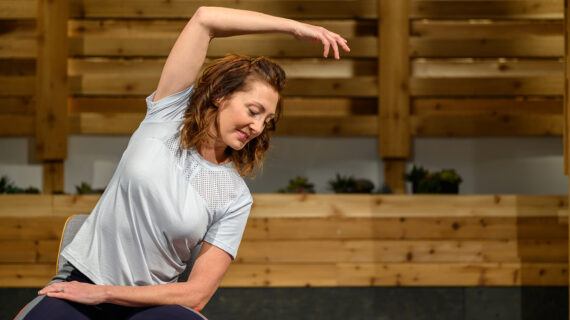
It requires continued, patient practice. So have a stable chair and work with your shoes off. We're going to create an unstable yet controllable environment. We'll be standing behind a chair, standing with your feet fairly wide, hands on the back of the chair.
So take a nice, deep breath.
inhales
This next part is part of that controllable yet unstable environment. But trust me. Keep your hands on the chair and close your eyes. Now just enjoy this for a bit, let your brain and your muscles stabilize and settle down.
Breathe deeply and try to relax. Feel the chair in your hands. Your skin, your largest organ, contains sensory receptors. Right now, they're busy detecting temperature, the texture of your chair, and more.
Feel the ground. The skin on your feet should be sensing your socks, the texture of your carpeting or your floor, whether it's hard or fuzzy. Maybe it's uneven. And it's relaying these messages to your brain and back again.
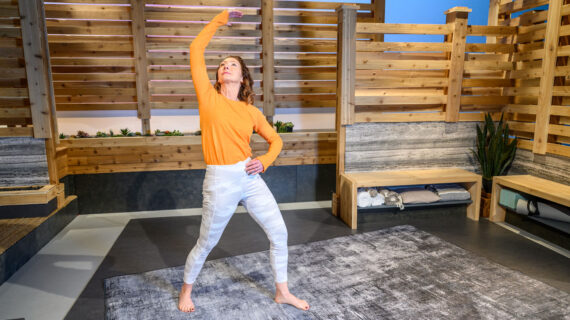
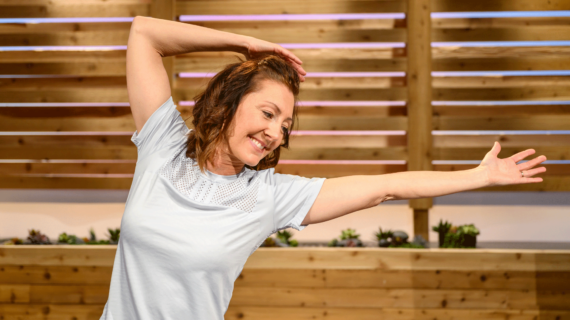
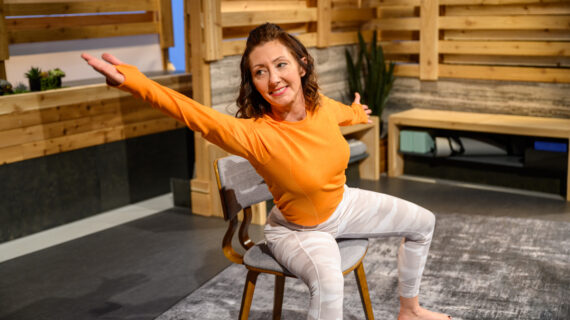
Now let's take your right arm out to the side and just ease it on up towards the ceiling. Keep your breathing going, keeping one hand on the back of the chair. We're doing this three times, nice and slowly, and I'd like you to envision where your arm is moving in relation to the rest of your body. Imagine the hand, shoulder, wrist, and elbow.
We're waking up your body's internal stabilization mechanisms. Now let's go ahead and do all this, the same thing with the arm, on the other side. Three times. What's happening is called proprioception.
Your sense receptors in your joints and skin are communicating with your central nervous system about the body and joint position.
inhales
Big breath in and out, still your eyes are closed. We're going to be moving two arms out to the sides, right at shoulder height. Envision that. With your right arm and your right middle finger, let's touch your nose.
Do this a few times while I talk. At this moment, your brain is growing. This movement of your body is feeding the brain with new sensory information. Let's do it with your other arm.
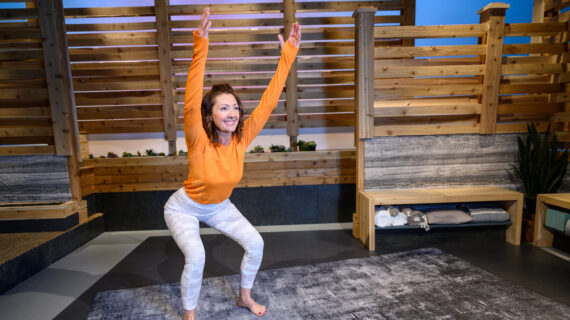
Take your middle finger and try to touch it to the tip of your nose and out. Did you know that your brain retains its ability to mold and grow until the day we die? This is called neuroplasticity. Now let's touch two arms overhead, your eyes are still closed.
This is simple practice to wake up and use all your senses to improve your balance. Try touching your two middle fingers to one another. All right, let's bring your arms slowly back down to the sides, opening up your eyes. Let's go and hold on to the chair and put your weight on to one leg.
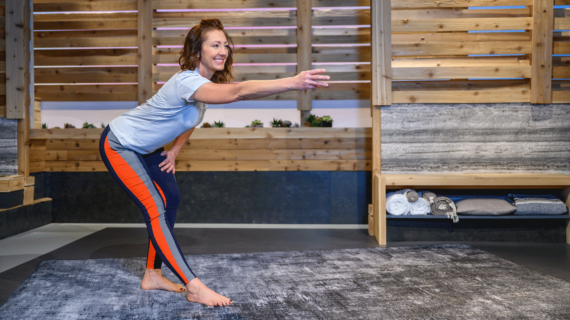
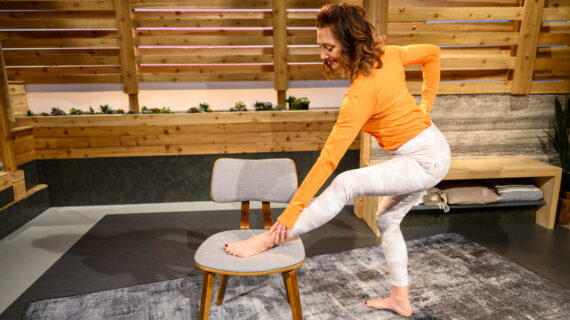
So extend your, let's extend your left leg so you're mirroring me. We're going to be conditioning this right leg, your single leg strength, keeping your toes in contact with the floor. You won't have to tell your toes to come off the floor. When that happens automatically, you are ready to go on to a more difficult challenge.
There are several stages. This first one with the eyes open, hands on the chair, one leg out and toes down. That's the first one. The next one, we still have our eyes open.
Hands on the chair. But let's lift those toes. Good. Your next stage, and it's only if you don't fall back over, release the chair.
If you immediately just start falling over, you need to go back to the stage before. Now let's stretch a little bit. The standing leg gets a little tired. But let's do it again with the same side, holding the chair, foot up, now let's close your eyes.
We're still holding the chair, eyes are closed.
exhales
This is a totally new sensation for your body. Let's just enjoy it for a bit. All right, now we're going to do everything on the other side. So we're hanging on to the chair with your eyes open, extend that right leg out to the side, toes are down.
Just barely skimming the surface of the floor. That's probably all you need. And you don't need to have a death grip on the chair. Eyes are open, hands on the chair, let's lift that foot up.
As long as that all feels good,
exhales
you can try with the next stage. Eyes open, foot up, let's try to release the chair. Maybe just a fraction of an inch above the chair.
exhales
And breathe. So good. So this was just a small sampling of great moves that we can do together to improve your balance and self-awareness. Come back to this one often, and don't forget to check out our other videos online, at pbswisconsin.org/quickfit, so you can continue to move about with confidence and strength.
See you next time.


 Passport














Follow Us