(starter pistol fires)
WILLIAM C. RHODEN
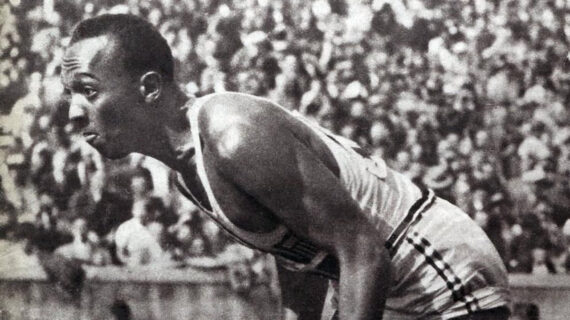
Jesse Owens was a model of technical perfection, the way he ran. Jesse Owens was a machine. That was in such opposition of what African Americans were supposed to be-- technically proficient. (Hitler speaking German)
MARGARET MacMILLAN
Well, of course, Jesse Owens was not meant to win anything. The Olympics were to be a sort of symbol of German racial superiority, which to Hitler was so important, and also a symbol of how successful the Nazis were.
HARRY EDWARDS
There were voluminous warnings concerning Nazi philosophy, intentions, the character of Adolf Hitler, and the people that he was surrounding himself with. Jesse Owens stated that if there are minorities in Germany who are being discriminated against, the United States should withdraw from the 1936 Olympics.
JEREMY SCHAAP
It's the height of the Depression. And he's a Black man in a country in which he is afforded very few opportunities. For Jesse Owens, the 1936 Olympics are everything. Without those Olympics, who knows what's in store for Jesse Owens? This is his opportunity to become a hero, an enduring hero.
RHODEN
Track and field, on our landscape of sports, was probably the most heroic, it was the purest, it was basically the American ideal. And there was still something to be said then about who's the fastest person. There was something about going to the Olympics and being the fastest person in the world.
SCHAAP
In the 1930s, the country was much closer to its frontier roots. There were so many millions of people who had grown up going to county fairs and state fairs where there were races. And the simple foot race was something that people could appreciate in a way that later generations don't appreciate.
NARRATOR
As a child, Jesse Owens raced other kids from his Cleveland neighborhood on city sidewalks. He was the youngest of ten children born to sharecroppers who had migrated north from Alabama. The world that Jesse grew up in was an accommodationist world. These are people who have to cooperate with the white power structure to survive. And it began in Alabama. They had to be obedient, and they had to be deferential. And Jesse early on learned to smile to get his way. And that carried right into his adulthood. For young Jesse, running was freedom. "You could go in any direction, fast or slow as you wanted," he once said, "fighting the wind if you felt like it, "just on the strength of your feet and the courage of your lungs." In junior high school, a gym teacher, Charles Riley, noticed his natural talents.
BAKER
Charles Riley became a kind of father figure for Jesse. So much so that for years, on Sunday afternoons, Charles Riley would go and fetch Jesse in the old Model-T Ford and bring him to his home for dinner. Jesse, in his adulthood, becomes a very well-mannered, smooth... he's a smooth operator. And much of that came from the dinner table of Charles Riley. (bells ringing) One of the things Charles Riley told Jesse Owens was, "Never look to your left or right, never look behind you, "that's wasted effort, it's only going to slow you down. "Look at the horses. "You don't see them looking left or right or behind them. They just keep running."
NARRATOR
By the time he was in high school, Jesse had begun to make a name for himself. He quickly became a star in the 100 and 200 meters, the broad jump, and the hurdles.
GUY WALTERS
Unsurprisingly, Owens was wooed by an enormous number of colleges. I mean, it was almost like a beauty parade. But Ohio State were the lucky ones to get him, and that's where he ended up.
RHODEN
Jesse Owens would be the greatest athlete at a great track school, but there's still race. Outside of track, there's still certain things that you cannot do because you are a Black person.
MARLENE OWENS RANKIN
They would cover many miles going from one track meet to another, mainly in the Midwest, and there were times when they would have to stop for food, and the Black athletes could not be served in the restaurants.
NARRATOR
As a Black student, Owens wasn't allowed to live on the Ohio State campus. As he would throughout his life, Owens chose to ignore the racist policy. For him, the track was a great equalizer. And there, Owens excelled.
ZAMPERINI
He was just a... really, a graceful piece of a guy. He was just... nothing bothered him. Somebody made a racial slur against him, he'd say, "That's his problem, not mine." So Jesse was great for returning, you might say, good for evil.
NARRATOR
At Ohio State, he was taken under the wing of an innovative coach, Larry Snyder.
SCHAAP
His methods were unorthodox. One of the things that he was best known for was having his athletes train to the strains of music on the phonograph. (jazz music playing) He thought it helped them develop rhythm in their strides. (jazz music continues) Here's a dance you ought to do Let me introduce to you Posing, everybody pose Get a partner, then begin Hold whatever pose you're in Posing, everybody pose. It's a dance...
NARRATOR
Snyder made sure Owens was elected captain of the track team-- the first Black to lead a sports team in school history-- and pushed him relentlessly to perfect his technique.
REPORTER 1
Jesse Owens, Ohio State marvel, ties the meet records with...
REPORTER 2
Jesse Owens of Ohio State set up a new world record for the 220-yard.
REPORTER 3
100-meter dash, Owens again covers himself with glory as he equals the championship mark of ten and four-tenths...
NARRATOR
On the eve of Owens's most important competition so far, the 1935 Big Ten Championship, Owens was horsing around with teammates when he fell down a flight of stairs, injuring his back. Larry Snyder told him to withdraw. But Jesse refused.
JESSE OWENS
As I tried to get down on my mark, I felt this pain, still in my back, and then when he said "set," I came up. (starter pistol fires) The gun went off.
SCHAAP
One of the remarkable things about Jesse Owens is how injury, pressure, circumstances which might make another man wilt, really steeled his nerves and concentrated all of his talents. What Jesse Owens achieves at Ferry Field in Ann Arbor is arguably the most spectacular achievement ever in sports. He set three brand-new world records in the 220-yard dash, the 220-yard hurdles, and the broad jump. And, by the way, he's equaled the world record in the 100-yard dash. All in less than an hour, at a time when most people thought he should be back in bed nursing a sore back. He becomes the great hope as the Games of the 11th Olympiad approach.


 Passport

















Follow Us