Barney Frank - "The Politician"
One of the first events that I remember getting deeply angry about was the murder of Emmett Till in 1954. He and I were the same age. He was 14 as I was in '54 when he was murdered for looking disrespectfully at a white woman. And so I just, from that time on really was very interested in politics. I was aware intellectually, not emotionally, about just how outrageously mistreated black people were in Mississippi. It was almost as bad as apartheid in South Africa. They had no legal rights, they couldn't vote. When I finally got there I felt the full emotional impact. I first realized I had a terrible voice when I was in the second grade. The class was singing "My Old Kentucky Home" on stage at school. And I was asked not to sing, just to move my lips because I was throwing everybody else off. But that stuck with me because I remembered
as I thought back the line from that song
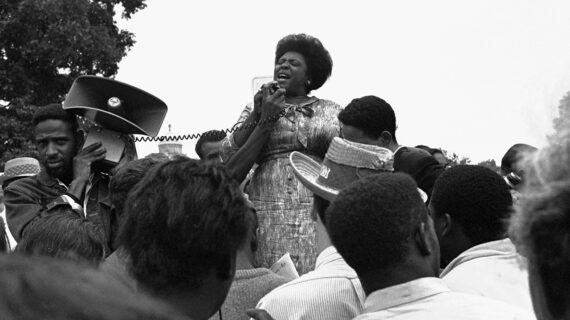
"The sun shines bright in my old Kentucky home, it's summer and the darkies are gay." That was being sung in New Jersey, in Bayonne, New Jersey, in the late '40s and no one thought about it. And it somehow came back to me as I began to deal with the civil rights issue to realize how deeply rooted racism was in America. I decided to go to Mississippi because I couldn't justify not going. So that was in December of 1963 and I was a graduate student at Harvard. So I was in Jackson working with the headquarters people. I was a liaison with our Washington office. I did some work with Mississippi officials. We were coordinating the evidence that we were going to present to the Democratic National Convention in 1964 that showed the exclusion of black people. These were the white-only meetings. So we were showing... we wanted their numbers so we could show that we had more black people showing up at our meetings than they had at theirs as to who was more representative. As people might be able to tell listening to me, I'm not easily understood, I mean physically. This is Barney Frank. I speak too fast, I have a... at that point I had a New Jersey accent. It's now kind of evolved into a New Jersey-Massachusetts, God knows what. And Southerners have a hard time understanding me, particularly black Mississippians. Literally the few times that I was out in the field there were some problems. I long... I hadn't been there very long when I stopped trying to tell people that my name was not Benjamin Franklin. That just seemed much more logical to many of the people in Mississippi. Mississippi wasn't America if you were a black person. It's interesting, the denial of fundamental rights was so severe, and this is something which I've tried to argue to some of my gay and lesbian colleagues in terms of how you fight for things and how you have to set priorities and you cannot expect to get everything all at once even though you should be entitled to it morally. In 1964, while we were in Mississippi, Lyndon Johnson signed the Civil Rights Act of 1964 so that segregation at the lunch counters was now illegal. That had been a central part of the argument. And the decision of the leadership of the Mississippi Summer Project was not to take advantage of the new civil rights law and not to integrate the movie theaters and not to integrate the lunch counters because they did not want to detract attention from the more fundamental denials of the right to vote and the right to fair policing. And that, I think, is an important lesson that people should remember. I knew things were bad, but living them made it even more graphically real. You were unprotected, you were kind of like a turtle on your back because we had accepted nonviolence. We were in the midst of a culture, which included a lot of very violent people and we had a law enforcement... this is extraordinary for me. I grew up with law enforcement as the good guys and here law enforcement was the enemy. I mean it was members of law enforcement who murdered those three guys, Goodman, Schwerner and Chaney, and you knew that there were people there who wanted to do violence to you and you would have no protection if that happened. It was an emotional high. I felt very good about what we were doing. I felt morally empowered, but it was very scary. I hadn't realized quite how scary until I left and I guess I flew out and got to the airport in Atlanta and got off the plane and I suddenly realized, "I'm not terrified anymore. "I'm not living in fear that I'm unprotected against vicious violence."


 Passport















Follow Us