In this episode of Wisconsin Foodie, we explore the resurgence of local -- and micro meat processors. First, we meet with Steven and Darlene Pinnow of Pinn-Oak Ridge Farms. We'll get a tour of their facility as well as meet their lambs on the pasture. Then we meet up with Bartlett Durand of Black Earth Meats to get his philosophy on getting back to a once proud tradition.
Then, finally, we visit Burgers and Brew, an event put on by root food groups at Capital Brewery. All of that and more on this episode of Wisconsin Foodie. Wisconsin Foodie would like to thank the following major underwriters for their support. Wisconsin Milk Marketing Board, representing the dairy farm families of Wisconsin, who fostered a proud history, with generations of family-owned dairy farms, working to sustain the state's economy through job growth and providing acclaimed cheeses and other dairy products.
For more information on Wisconsin dairy,
visit
eatwisconsincheese.com Pinn-Oak Farms in Delavan, Wisconsin, raise some exceptional tasting lamb. And some of the most acclaimed chefs throughout the Midwest, and most discerning home cooks, have noticed as much. On this exquisite piece of land with some really lovely animals, Steve and Darlene Pinnow are doing something distinctive. But it shouldn't be.
I'm here, though, to find out why it tastes so good and what their story is. Steve and Darlene! Well, hello, sir! As I live and breathe, how are you?
Hello, sir. It's a good looking farm you've got out there. Thank you. This is the country store.
Most plants, old plants, are trying to look modern. Well, we're a new plant. We've only been here a little over three years, and we're trying to look old. So there's the tour.
I know you've got more than one acre here. Yes. You going to take me out? Absolutely.
Good. Do you want to go through the processing plant first? We'll put our white coats on. Yeah, show me how the beauty happens.
Okay. So you guys are unique, because you pasture them out there. They birth. You guys live across that little stretch of gravel.
Yeah. And then you break them down right here. Yes. That's serious quality control.
Absolutely. We try to think that we're from pasture to plate, with the quality control that we do here. They trim some fat on it, of course. If you notice, there's not much fat on there to begin with.
We do like a little fat on it. Flavor. That's where the flavor comes from. Oh, hey!
This is cool! Well, this is the main chill down area. After we harvest the lambs, they come in on the rail here, and then we'll put them on a certain rail. So, you've got pasture right out there through that door.
Well, a little bit further down. Okay. But we can have Dave cut one down, if you want, and then we'll go and cut it up on the saw. I feel real privileged, Dave.
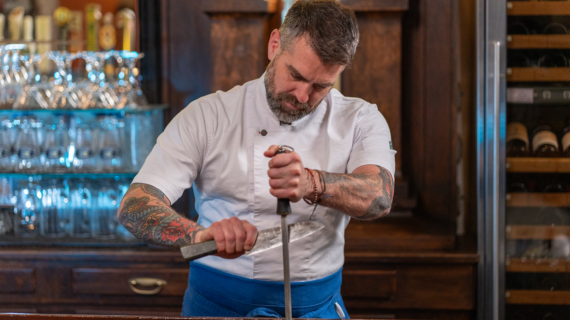
The old band saw, here we go. He's going to cut off the pieces he doesn't need right away. He's basically cutting it into the primals right now. Those just went from ribs to short ribs, by the way.
That quick. That's your belly. I don't know if you noticed that or not. There's a belly there.
You bet. Some of the restaurants down in Chicago are making bacon out of that now. Just a minute ago, there was a whole lamb here. Yep.
Those are going to be the lollipops. We'll take those out later. We'll cook them up. We're coming into the other part of the plant.
We'll take our coats off now and then we'll go show you the live animals. Yeah, the first thing I like about this room is the plastic bags that you've got hanging over those implements of whatever they are, so you think you have a nice day. It's kind of a gentle lamb slaughter in here. Well, come on, we'll go into the barn now, and I'll show you the animals.
All right, have you told them I'm coming, because sometimes I scare the animals. We're coming into the barn now, and this is kind of a set up. This is gorgeous. These are some of the lambs that are going to be harvested here this coming Friday.
So, Steve, for everyone who's watching, tell me, when does a lamb go to a sheep? Our protocol calls for under ten months of age, so that we don't ever have that problem of it turning into a sheep or mutton. We're going for that young phase. What's next?
We've got one more barn. These will be a little bit smaller. They're already coming, you can see that. Yeah, they might be enthusiastic, a little bit.
Wow! You go right over the ribs, and you can tell the finish right there, he's got about 2/10 of an inch of finish on him. He's a little stressed. Here, let me give him a massage.
Actually, they seem like really, really happy animals. Yes, absolutely. Well, wouldn't you be? I mean, bedded down with a little sun shining in?
One of the prettiest barns I've ever been in. Then you and Darlene come in and sing to them every night. Well, I don't know about that. We can go and move the theater.
They're already wanting to get out. Hoping. So we can go and open that and let them out on pasture. Let's do it.
Boy, it's like on cue. They just knew this is what's next. This is like Pamploma!
laughs
visit
This is akin to releasing the kraken!
laughter
visit
There they go. This acreage right here is five acres. Our main farm is over on the other road. That's a couple hundred.
Now, they'll be out here, and sheep will mainly pasture or eat grass in the morning and late evening, just like deer. In the heat of the day, they'll come to the building and get in the shade. It's very calming and relaxing to watch them out here. Yeah, no question.
I love that pile of rocks over there. Basically, that's 60, 70, maybe 100 years of farm, just trying to till, finding a rock, and putting it all in one pile. It's part of the Midwest's history. Absolutely, part of Wisconsin.
That looks like a table laid out. Oh, yeah, we're all ready for you. We've just got to put the chops on, and we'll see what kind of trouble we get into. It's kind of what happened with a bunch of other animals, they get processed and the flavors were really kind of anemic.
Then when you taste what actual lamb is supposed to taste like, you realize why it's been a favorite for thousands and thousands of years. Yeah. And you guys are growing it and raising it so it's slowly coming back to people's palates. It's "oh!" Right.
Yeah. I mean, we're not reinventing the wheel here, we're just reinventing on how it gets distributed to the people. Amazing. Yep.
I'm just going to pull this off and show the camera. Look at that beautiful finish. Tell me about the name of the farm, because I know there's nice little double entendre with your last name. Right.
Our last name is Pinnow. And we live on a ridge, and also the trees are Pin Oaks, so we just kind of-- Those guys, right there. Right there. We kind of stretched it out and said, Pinn-Oak Ridge Farm.
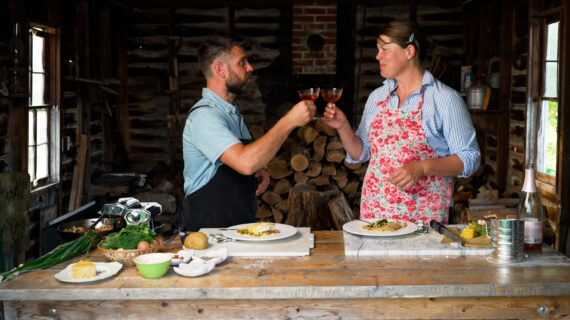
That took all of nine minutes. Who said that fast food can't be delicious? It's a true honor to be invited to this table. Well, thank you very much.
I'm really flattered. So this is essentially the essence of good eating. We've got this incredible lamb that was raised over there, seasoned in that kitchen with three or four things that stay out of the way of the flavor. Great Wisconsin wine that was made two miles down the road.
It's a perfect fall day. Yeah. Really great company. The thing about lamb raised the way you guys do, and what Tony who cooks for Spiaggia, and things like that, that it isn't, is that it isn't gamy.
Right. I think a lot people have that perception, because they've basically had bad lamb. And that's what we're trying strive for here. That's why we have the protocol, so that we get the same taste all the time, and never get into that gamy-ness at all.
Well, Pinnows of Pinn-Oak, I know you don't need the press, because you're already sending your great lamb off to basically some of the best rockstar chefs in the Midwest, but it's a privilege to be here. Well, it's a privilege to have you here and you're very welcome to come back any time you want. I told you, don't say that, because you're going to get a knock at one in the morning, saying "I'm hungry." Okay. Black Earth Meats is a micro meat processor.
We work with farmers who do small lot agriculture, who do a very good job with their animals, primarily no antibiotics, no hormones. So this is one of the few left where you have the slaughter in the back, the aging, the portion cutting, and then the distribution, all at the same shop. We have a retail counter in the front, and here we are in the middle of the metropolis of Black Earth. This was an old country meat cutter.
There used to be a lot of these in Wisconsin. All these used to survive on the local farmers just bringing in what's called custom beef. This meat cutter here in Black Earth was going to close down. He didn't have enough business to keep going.
To have a processing plant in a village, doing things properly, this close to Madison, being able to reach Chicago and Milwaukee, it was just too precious. If a place like this closed, it would never re-open. I didn't want to give that opportunity up. So you see one of our farmers.
This is Rich Lang backed up. He brought us some steers and some hogs. He's a really nice organic farmer out of Platteville. So we do some custom work for him that he turns around and sells on his own.
Then he'll sell us some of his own, some animals for us. When we took it over, the whole idea was to focus on organic, grass fed, and the local food concept, and to do direct distribution. We service a lot of restaurants and a lot of grocery stores directly. This little shop out here in Black Earth has really become a centerpiece for the local foodies.
Every weekend, people from Milwaukee and Chicago drive up. They'll come with coolers and stock up. It's a lot of fun. Retail for us is really an extension of our mission.
It's an avenue for local foods to be sold. We support a lot of our fellow artisans as much as we can. Here's the cheese that comes off our farm, Otter Creek Organic Farm. Pastured eggs coming out of Mt.
Horeb. We have bratwurst. We have RP's pastas. So we provide the basic steaks out here, sirloin, strip, tenderloin.
We'll do our bone-in steaks. All of this, we dry age, five to ten days, minimum, before they start getting put out. We have an organic Berkshire that we do. The Berkshire is my favorite pork.
It's just phenomenal, really tasty, really rich, a lot of nice juices, and a healthy hog. We're in the area I call the vestibule. We're not yet in the USDA inspected area. This is a spot just off of retail that we invite customers to come back and watch the entire operation.
Obviously, you can't see the slaughter floor from here, but you can see the packaging. You can see the grinding. You can see the cutting. This is part of the transparency.
I want people to be able see where it comes from, the people working on it, that it's fundamentally a human operation. I have a number of chefs the come through and they're like, give me a knife, I want to go. They get it. They can immediately jump in and be part of the whole operation, whereas in some big industrial plants, they can't.
That's not what we are. We're training butchers from scratch. And it's all reaching back to something our grandfathers and great-grandfathers would recognize in daily life. We're just reclaiming that.
Here's some of the brats we made yesterday. We make our brats in the afternoon. We flash freeze them. Then we'll take them and package them in the morning.
We'll finish up our grind order for today, and then this will all get packaged up. You can see here, he's stacking up cow tongues. Beef tongue and cow tongues are a very popular item in some of our restaurants and retailers. It's very, very rare to find these in town anymore.
That's something I actually take a great amount of pride in. that this can exist in a town, I think shows-- We've deliberately as a system tried to remove food from where we live, and that can come back together. That's what I'm trying to do, is recapture all of that. This is a dry aging room.
This is where the animals can hang anywhere from three days if it's a hog or a cow, up to some steers that will hang for like I said, up to 28 days. This is something, again of the past. This is really a small-scale kind of operation. I certainly appreciate it a great deal.
I don't know anyone who does everything we do, having put the whole puzzle together. This is the kill floor. And what we try to do is just maintain a sense of respect, just a seriousness of purpose with what the guys do here. We have a sign up that we emphasize, just to really respect and honor what's happening.
This is life. And for me, this is critically important to bring back into our culture and our world. The human connection is the all important one for me. It's the stories and understanding the links in the chain.
Without that story, without that honor in the process, food does become fungible. It becomes a cheap thing. I don't care if you're the best chef in the world, if you're using cheap product, it's a cheap thing at the end of the day. This is the fundamental place that's been ignored for the last two generations.
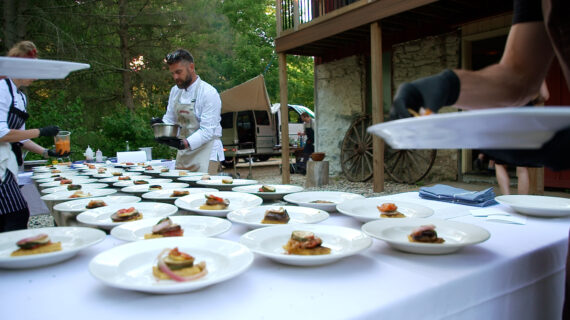
So, getting these small, regional processors going again is my crusade. It's a gorgeous Wisconsin day at Capital Brewery's Beer Garden. I'm right here on the edge for something called Burgers and Brew. It's basically when they invite their friends who also brew great beer, to pair with a bunch of creative burgers created by some of Wisconsin's best chefs.
How can you go wrong? The Reap Food Group has been around for about 15 years. We're a grassroots organization that started out just trying to help people figure out where their food comes from and why that's important, shortening that road from farm to table. This is our fifth year doing Burgers and Brew, right here.
We've always done it partnering with Capital Brewery, here in Middleton. Each station pairs a local chef with a local farmer with a local microbrew. So these people who work together all the time in their restaurants get a chance to come out, do something creative with the kind of hamburger format. And it's just been phenomenal.
Excuse me... So this is summer in Wisconsin. Where else can you get this many people on a gorgeous day under a tent? All for two things.
Burgers and beer. Michael, what are you frying there, buddy? We've got a little quail egg action going on here for the Pinn-Oak Ridge Farm lamb burger. Oh, that is some of the best lamb this state has ever produced, is it not?
So, you're one of the co-owners of Lombardino's. Yes, sir. A classic Wisconsin and Madison restaurant, if there ever was one. How did you guys come up with this burger recipe?
We used Pinn-Oak, and then we paired it with Roth Kse gruyere. You're like singing love songs to me right now. Of course. These are foodie sweet nothings you're whispering.
You've got to use really good cheese with the really good lamb, because otherwise, you know, they just don't match up. Why would you disparage one? Then we're big fans of eggs on burgers. Since we had to go small, we went quail egg.
Right, because they're tiny burgers. Obviously, tiny burgers, tiny eggs. So we've got truffle fries. We've got bacon aioli.
We've got quail egg. We've got the best lamb burger in the state. And then, an amazing bun. An amazing bun.
You're trying to seduce me, right now. I do what I can. Can I have a beer? Can I have a beer, miss?!
What are you pairing it with, as far as the beer? Because I know you guys stayed up really late drinking a lot to figure this out. We went with Rush River. We went with their amber and their IPA.
What's amazing to me is that you're doing this, you're having this incredible conversation with me, all while you're picking up these delicate little quail eggs and putting them on top of burgers. Multi-tasking is the key to this business. I've eaten several burgers today, and this is one of the best burgers. This is a prime burger.
That's what we're trying to do. It's about local food. It's about community. It's about people coming out to support it.
I own RP's Pasta Company here in Madison. I've always been a large supporter of local food. REAP Food Group kind of got me onto the board. Now I'm president of the board.
So everything that we do is about food, clean food, sustainable food. The monies raised from this event help to support our Buy Fresh Buy Local program, which is the farm to restaurant program, primarily, and then the farm to school programs. All of the chefs that are here today are part of the Buy Fresh Buy Local program. That means they've signed on as a partner with us to increase the amount of fresh local foods they're serving at their restaurants.
They are telling their customers that they choose to buy local, because they care about the same things we all care about. Stone of Scone Scotch Ale from the Great Dane. Caramely toffee body with a kiss of chocolate right on the end, well balanced, medium body, very tasty. It goes well with that kimchi burger.
You've got sweetness and spiciness. You've got a little bit of that funk from the kimchi. It goes well together. These two together, it's like waffles and syrup.
Absolutely. It's like jazz and dark clubs. It's like peanut butter and jelly. That's saying a lot.
Local food not only improves local health, it improves local economics. It makes a more sustainable food system, which in turn really just makes a stronger food system. Because without the farmers, we don't have food. This is by far our favorite event of the year.
You just can't go wrong with beer and hamburgers. You just can't. And people come away from this, even though they stood in line for ten minutes, and there was plenty of crowding issues, there's never a whimper. I mean, this is Wisconsin.
If we can't deal with a little bit of stuff together, I don't think we've done our job. People really love this event. So Jack with Willy Street Co-op, tell me about your meatless burger. Yeah, we're offering a meat burger, but also an alternative today, and that's the portobello mushroom burger.
It's on a homemade onion potato roll with Edelweiss Creamery's gouda, and fire-roasted tomato garlic ketchup. What's the beer, since this is beers and burgers. We have a Pearl Street beer, Pearl Street Brewery from La Crosse. They paired it up with their organic stout.
I think we're also pairing with pale ale. A portobello anything, especially a burger, is a fine art. This little slider and this beer together, man, this nails it. I mean, this is so flavorful.
You could eat these all day and be happy. I'm sure they drink this all afternoon and be happy. There's an old adage that if you want to catch bears, tease them with honey. Well, if you want to turn people onto the local food movement, a good idea would be a beer garden, a gorgeous summer night, 14 breweries, 14 great chefs making burgers.
That's exactly what REAP has done for the fifth year. And this time, for 1200 people. It's what's great about Wisconsin. It's what we love to taste, and it's turning people back onto the food that we've always been creating.
Does anyone need some potato chips?! We can turn this sack of potatoes into chips! It would go well with the burgers. Wisconsin Foodie is made possible by underwriting support from the following companies.
The Wisconsin Milk Marketing Board; Travel Wisconsin; Outpost Natural Foods Co-op; Wollersheim Winery; Alterra Coffee Roasters; and Something Special from Wisconsin; This episode of Wisconsin Foodie is now available on DVD through WisconsinFoodie.com There, you'll also find articles, recipes, events, and past episodes. You can also like us on Facebook, follow us on Twitter, and watch other content through YouTube and Vimeo. Wisconsin Foodie would like to thank the following major underwriters for their support. Wisconsin Milk Marketing Board, representing the dairy farm families of Wisconsin, who fostered a proud history, with generations of family-owned dairy farms, working to sustain the state's economy through job growth and providing acclaimed cheeses and other dairy products.
For more information on Wisconsin dairy, eatwisconsincheese.com


 Passport













Follow Us