

 Passport






Kickapoo Country Fair | Organic Valley Family
03/16/16 | 26m 47s | Rating: TV-G
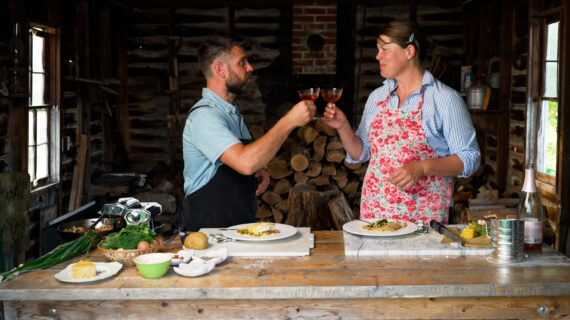
Kyle travels to a small dairy farm in Chaseburg to meet the Gretebeck family, whose farm produces milk that goes to Organic Valley for grass-fed milk and butter. Kyle follows the family’s milk from their farm to a nearby butter plant and watches their grass-fed milk become butter. He then returns to the farm with some new butter to enjoy.


Copy and Paste the Following Code to Embed this Video:
Kickapoo Country Fair | Organic Valley Family
Wisconsin Foodie would like to thank
the following underwriters for their support
Wisconsin Milk Marketing Board and the dairy farm families of Wisconsin, Illing Company, Outpost Natural Foods Co-Op, Potawatomi Hotel and Casino, Society Insurance. Wisconsin Milk Marketing Board, representing the dairy farm families of Wisconsin, who fostered a proud history with generations of family-owned dairy farms working to sustain the state's economy through job growth and providing acclaimed cheeses and other dairy products. Every product tells a story, and every story starts with a seed. Your story, your product, your company all started with an idea. Illing Company ensures you have the right packaging to help you proudly take your harvest to market. Illing Company is dedicated to packaging your vision.
This week on Wisconsin Foodie
I love a good country fair, and I especially love the Kickapoo Country Fair. When you guys started this, organic wasn't even a word that was part of most people's vocabulary. No, in fact, we had local people saying, "How's that generic farming going?" (laughing) Our philosophy is sustainability. And everything starts with the soil. You feed the soil, you feed the crops, you feed the cattle that feed us. Oh, look at this! Do we get to feed some calves? We can feed some calves. - Right on. Becky and Tucker Gretebeck, who have a farm in Cashton, Wisconsin, produce this exquisite milk, and I'm here to see how that story flows through what is Organic Valley. Ron's opening the door now, and we'll be putting the butter boat inside of there. The butter boat, that's really what it's called? Yep, that's called a butter boat. (laughing) (jazz percussion music) (car driving by) (chickens clucking) (filling glass with fizzy liquid) (chopping) (popping) (meat frying, pan sizzling) (lively bass and guitar jazz music) (luxurious music) (lively country music) I love a good country fair, and I especially love the Kickapoo Country Fair, set here at the headquarters of Organic Valley in the driftless region of Wisconsin. We're going to meet with a couple of the stalwarts of what this organic movement, this tipping point, has meant. Two of the original seven farmers that founded Organic Valley, Jim and George. We'll also meet with Will Allen, the founder of Growing Power, and, lastly, Andrew Zimmern, an internationally-known culinarian who sees things from 30,000 feet and a microcosm. It's organic cotton candy and cow's milk. ("The Lonely Goatherd" by Julie Andrews) So tell me, this Kickapoo County Fair, this Organic Valley thing, what's it like to just talk in front of all those people to address all that enthusiasm? Well, it's great. I speak all over the world, whenever I have an opportunity, especially with a good partner, like Organic Valley, we've been partnering for a lot of years now. Anytime I get an opportunity to grow what I call "the good food revolution," I'll go and do it. It's really important. This state has historically always been a great ag state with small farmers and small farms, and we want to continue to support those farms and those farmers and this is a great way to do it. The excitement, it gives me goosebumps. And I have to tell you something, personally I've been dying to tell you for a couple of years. I will never not believe again that one small idea cannot explode and literally change a culture in a short period of time. I've watched it and lived it through you. I'll always believe that from here on out. Thank you, and, you know, it's a lot of people working together in partnership. That's what it's all about. - Yeah. I'm the Captain Red Snapper And I sailed the Seven Seas And though I've never seen a mermaid In her we still believe Oh-wee-oh, a pirate's life for me (rock and roll music) Walking over to meet a couple of the original farmers of Organic Valley, three of the original seven. One of them is the C.E. E-I-E-I-O. I'm not making that up, by the way. I'm here with George Siemon and Jim Wedeberg, two of the original seven founders of Organic Valley. This is a big deal. You guys are my double heroes because you're double stewards. You've been stewards of the land, and you've been stewards of Organic Valley for basically more than a generation. Yep, that's true. So, in '88, when you guys started this, "organic" wasn't even a word that was part of most people's vocabulary. No, in fact, we had local people saying, "How's that 'generic' farming going?" (laughing) So, it definitely wasn't a word that anybody could produce, and it wasn't like people were necessarily against it. Just that it was such a big leap to think that you could start a business like this and succeed. Everybody wished us well from the very beginning. We had tons of people supporting us and saying, "Great idea, go ahead, do it." But it doesn't mean they believed we would. When we started, farmers were frustrated with farming. They weren't making a living. They just felt like on a treadmill. So, actually, there was a lot of excitement in organics. Going to organics was, "Hey, I'm going to do something different. "I'm tired of the same old, same old, "and I'm going to try to see if we can change the world." So there was a real sense of defiance that it was a challenge, but they were also very interested in it. Well, flattered you'd give us some time, and please, please keep doing what you're doing. Thank you, we will. - You bet. (steel drum hand drumming) Called "slow food" that is dedicated to both the ethics of food and the pleasure of the table, as well as honoring those who grow the food and prepare it.
Child labor
so effective. (steel drum hand drumming) Hey, buddy! - Hello. Welcome to the Kickapoo Country Fair Organic Valley Fest. I love this. This is a really great event. It's super cool. So, Will Allen, before, was talking about how the pendulum has swung as far as what used to be grown here in Midwestern states, like Wisconsin...85% local, now hardly anything consumed nearby. Yep, Will was talking about evolution, revolution, where we are as a food movement, and I think we're at that, if we're not quite there already, we're at the tipping point where I think there's enough mass of people engaged that, like bacteria, we're going to help to fix this thing. Distribution is the key to all of this. So many people want to participate in it, and if you're not big enough, the price is going to be high. I want people in our world to be able to not live in a society where food is a class issue. And, to that end, larger cooperatives like this with stunning product that's the food the way you want it, that supports local. And it doesn't matter whether it's a CSA, or the co-op grocery I shop at, or Organic Valley. The whole point of it is that it supports the lifestyle I want to lead, and it gives me the food I want my family to eat. Thanks for the perspective. See you somewhere else in a couple months? - Absolutely. All right. Take it easy. (lively polka music) So, what's the sum of all these parts? These seven farmers way out on the western edge of Wisconsin that, in 1988, decided to say, "No, "we're not going to do what's called 'conventional farming.' "We're going to do something called organic," which was really not understood, even novel, at the time. Something like the Kickapoo Country Fair actually brings the world together for these people. It's these men and women with their family farms saying, "I'm going to grow/raise/milk something that's good enough for my family and it's going to be even better for you." (polka music) (calm acoustic guitar music) There are so many ways to talk about Organic Valley. You can talk about the original seven farmers who, in the 1980s, decided to pursue a new paradigm and raise their cows more in tune with nature. Or you can talk about how that little clump of farmers grew into the largest organic cooperative in North America. Or you can talk about the people. Becky and Tucker Gretebeck have a farm in Cashton, Wisconsin and a modest herd, just 50 cows or so, but they produce this exquisite milk. And from that milk Organic Valley makes their butter and their cream, and their yogurt, and their great glasses of milk. And I'm here to see how that story flows through what is Organic Valley. We have a dairy farm, and we ship our milk to Organic Valley's farmer-owned cooperative. I also work for Organic Valley. I work in product development for them. So, I have both a professional tie, and then we have a farm tie. Our philosophy is sustainability. What we're doing with the cows with the grass-fed, we're cutting back on plowing. Not feeding grain so we're not raising corn. And we're adding tweaks here and there to try to make everything work as one. Our main philosophy is that everything starts with the soil. You feed the soil, you feed the crops, you feed the cattle that feed us. Bye, guys, have a good day. The products that our milk typically goes into would be new Grassmilk yogurt, it would be our Grassmilk, potentially pasture butter or other butters. (calm country music) Good morning. - Morning, how are you doing? How are you? - I'm Becky. Nice to see you. - Nice to see you. (laughing) I just want to hug you to be warm. Morning. - How you doing? I get a hug, too? Aw! Look at that! What kind of beautiful ladies do you have here? We've got all kinds of different breeds. Our primary breed we started with is Holsteins and Red Holsteins, a personal favorite of mine, dairy goats, llamas, that hang out with the goats, potbellied pig, the cats and the dogs and the bunnies. (laughing) A little bit of everything. The health of the cows is really good being organic. When we switched to the grass-fed, we saw another level of health with the cows. Every once in a while, you'd get a twisted stomach or maybe some milk fever, and those are things we just don't see. Some of those sicknesses, or diseases, whatever you want to call them, they don't exist for us right now, which is not a bad thing. The quality of the milk and the final product always come back to right here in the barn. Not to put too fine a point on it but they're cows, they eat grass. And then we, as humans, get the benefit of that great milk. So they're fed the way that they fed themselves for millennia. This just seems to make perfect sense. Yes, we like it, and we've seen some serious health benefits in the cattle, as well. That's a crazy thing is that cows that are raised the way that you and Tucker are raising and milking these cows-- A normal dairy cow lives maybe two, three years 'cause they're essentially eating junk food and getting a lot of, you know, chemicals pushed through their body. Right. - Yours, 10-12 years? Yep, we've got a girl in here that's 16 years old. 16? - Yep, Robin is 16 years old. She can drive! She can drive-- She 'thinks' she can drive. (laughing) Right there, I'm sold on organic; That's all you need. So I've grown up milking, and I feel pretty capable at that. But everybody's barn is different. Would you let me do that? Absolutely. Yeah? All right, cool. Yeah, let's go find Tucker. He'll show you. Save him a little bit of work. So grab a towel, and then put it in the wash water. Then you're going to need one to dry her with. I've got your milker. So what we do, is we hang it up. This is your pulsator. It slides in. (vacuum pump pulsing) Hook the milk line in. There's a button on the bottom. So, put these back. When you push the button in-- That's when the suction starts? Yep, so, push that in. Then, when you flip that up, you can feel the suction. All right, so, I'll get out of the way, and we'll switch hands. Put this one underneath, like that. Trade 'ya. - There you go. Let her know you're there. You got it. We have ignition. You're hired. Oh, look at this. (laughing) Do we get to feed some calves? We can feed some calves. - Right on. We'll go right in here. Here's the door. Hello, sweetie pies. - Morning, girls. Which one do you want? I think this is the one I just bonded with. I think so. - Hey, hey, hey, hey. Hold it up. Oh, yeah. There we go. - Perfect. How old are these girls? - About a month old. Wow, when we think about what organic means and the laws that came in as a "marketing label," as the old Secretary of Ag said, you know, Organic Valley helped write those. Not because they were trying to change the paradigm, but because it was, "This is what we've been doing and it works. "Maybe you want to set your standards as high as ours "because ours are really high." And that's still the case today. You have your organic standards. Your national organic USDA standards, but Organic Valley does have its own set of standards. For how much pasture the cattle need to have for humane standards, for how the cattle should be treated. Everyone in the co-op buys in. They walk the walk. Yeah, you couldn't fake it with 1,800 farmers because if there's one fact that's true across every American farmer-- heck, in the world-- they are discerning folks that don't really have a lot of room for BS. No, they don't. The only BS that they will allow is their own animals' actual BS. So you met in college, fell in love. You both came from farming. - Yes, correct. If Organic Valley didn't exist, do you think you'd still be in farming? Yeah, but we'd be doing it different. I don't know that it would be our primary living. Even when I was teaching, and I was always looking out the window and jealous of the guy driving the lawnmower. I need to be outside and need to be moving. We would have been working full-time to support being able to do something outside. But our jobs would have been paying for it. So without that, I'm not sure. You would have had an expensive hobby that worked with the earth instead of earning a living and cultivating the earth. We're in it for the long haul, and not every day out here is perfect, but we do the best we can. It's kind of neat what's happened here is my neighbor on this side went organic, and more people are kind of coming on board. But there's no other way I could have started, if we didn't start organic. We treat them right, and they're going to treat us right. And knowing the other side of it from Organic Valley and the research, we got full circle here. We got from eating the grass to milking them in the barn to her developing the products. What always impressed me about how Organic Valley does what it does is the support is there, but you're pretty autonomous, too. Every farm is built a little different, so you've got to take the advantages you have. On this farm, we have that 100-acre valley that a lot of farms don't. I like it, it's enjoyable, and there's no better place for the kids to grow up. Well, they've got plenty of room to roam around. And then you've got that herding dog, if they get too far. Blue will bring them back to the house for dinner. Brings them back or let's us know. (laughing) Let's us know. So we're going down to the bottom end of the farm. We used to raise tobacco down here, and when we stopped raising, we put a quarter-acre of pumpkins in and invited a few families, and the people liked it so much that they invited other families and it grew very organically. And it's all been pretty much word of mouth. We don't do a lot of advertising, but we're getting quite a few people each year. So we milk in the morning, and then we meet a school group down here, and take them for a ride in the valley. They get to pick pie pumpkins and gourds. So this is what I do for two weeks during October. All right, guys, you guys excited? Yeah! You are? What are we going to hunt for? Pumpkins! All right, everybody ready? - Don't get stuck in a puddle. Puddle? Do you think there's puddles out there. It did rain quite a bit. (bright banjo music) Vanessa. There are a lot of rocks in the field, so careful where you step. I can really grow them, too. Guys, I found one! I found one. I'm on my way from Tucker and Becky Gretebeck's farm, and we brought the cows in this morning and milked them, and we're heading to Chaseburg where Organic Valley has got their butter plant, and I'm going to see the whole process, and if I'm lucky, I'll get to take home a couple sticks of that fantastic grass-fed butter that Organic Valley does, I think, better than anybody. Hi, Steve. How are you? - Good, how are you? Good, welcome to the Chaseburg Creamery. Thank you. Instead of following breadcrumbs, I followed milk. Okay. (laughing) You do beautiful butter for Organic Valley and I want to see that whole process. All right, we'd be glad to show you. All right, so if we go this way, we'll catch up to that truck that you saw the milk going on to, and we'll bring it into the plant. Watch your step. Hey, that's a big shiny milk truck, if I ever saw one. You can see John up on top of the truck, and he's all harnessed up. He's going to get a milk sample for us and get it to the lab, see how it tests out. How long before it's butter? We're going to get this milk all sampled and tested, make sure everything's good for us. We'll bring it into a raw silo, separate it into cream and skim, and that cream will be made into butter, probably on Sunday. About a day and a half. We're going to be pumping this milk into one of our storage vessels, and from there to the pasteurizer room, and we can walk through there. And finally, into the butter operation. All right, lead the way, my friend. So here's where we're storing all that raw milk that comes off the truck. Let's walk through here, and we'll show you where we're making it into butter. Okay, so in here is where we're churning butter. That is a 21st century stainless steel butter churn. You could park a car in that. Yeah, I suppose you could. It'll hold it. That's about the weight of what goes in there. So we have pasteurized cream here in these tanks behind us. We bring that pasteurized cream over here into our barrel churn. So what's striking me right now is that this technology is the same that's been going on for thousands of years, where people put cream into a barrel and churned it until it turned into butter. Yeah, the basic practice is the same. The way we do it is the artisan way of doing butter. So it all happens in this room. Everything happens in this room. By the time it's through with this machine, it's in a carton, ready to be put into a cardboard box and sent to the customer. Butter is so integral to great cuisine. And it's happening in this room. This is like, I don't know... It's like going to Yankee Stadium for some people. I have goosebumps. As a moderate home cook who has stood next to great chefs that have used exquisite butter, I have goosebumps. This is huge. Ron's opening the door now. He'll be putting the butter boat inside there. The butter boat, that's really what it's called? Yep, that's called a butter boat. He opened that and this entire room smells like a movie theater where everybody is eating buttered popcorn. That's right. He'll put approximately half of the butter that's in the churn into the boat. We'll take that boat over and dump it into the trolley. And then the trolley, I saw some augers or something in there, right? Yep, those augers basically extrude that butter out to a pump, and then from the pump it comes through the pipeline over to the machine to be packaged. And how many sticks or pounds of butter do you think come out of this great little plant of yours? We do approximately nine million pounds of butter a year. (Kyle whistles) That's right. That's a lot of really good toast. All right. Well, before you go, I got one more thing for you. Ha-ha, right on! There's some of our butter that's already been through our Q.A. test and is ready to be released. Better than going to the baseball park and catching the ball. There you go. It's a home run. Thanks, buddy. (truck engine roars) (car door closes) (doorbell ringing) Hello. Hi, kids, how are you? - Good. Kyle good to see you, again. I brought a handshake and some butter. All right. How are you? How was your day? Good. - This is a nice little spread. This is the after-school snack? - Mm-hmm. So, you got pastured, I've got cultured. Got some yogurt. We got yogurt, we got fresh bread. This is going to be good. I have to say, what I like best about this is that you two left for school this morning when I got here, and then we milked some of the cows, and that milk made this butter, not this exact butter, but that is cool. Now I'm here at your farm. It doesn't get any better than this. It's pretty neat. I know that this is a Wisconsin show, but I like your Texas toast cuts. (laughing) Seriously thick bread. I'm going to try some yogurt, it's my favorite part. You ruin it by stirring it. So tell me, as eloquently as you can without getting all science-y, why this is special and you don't want to stir your yogurt? Well, it's non-homogenized. So there's a fat layer on top of the yogurt. So you see this nice, beautiful, yellow fat layer, and it's a cup-set, so the body sets in the cup, and it is not stirred before it's packaged. Do you think, in all the years you've been doing this, you could ever take it for granted because this is such a better product than what most of America gets? We're pretty proud of it. I don't know that we would ever take it for granted. You know, we work awful hard for what you see here. It does mean a lot to us. Good bread and real, exquisite butter. It's a great simple snack. Thank you, people. Oh, yeah. It was great. Thanks a ton. Thank you so much. You're welcome. I'll come to your table and your farm anytime you want. Yeah, anytime... Sounds good. We always need help. You get up a little earlier than I prefer, but, you know, that's all right. That's what friends are for. (upbeat jazz music) If I were a farmer, my goal would be to be on a milk carton. (laughing) I'm serious, I know it sounds funny. Forget the Wheaties box. I want to be on an Organic Valley grass-fed milk carton. Not one of those lost kids, though. No. (laughing) This is just a break for the two of you. Yes. And you two have homework. Well, yes, except it's Friday. (laughing) I'm heading back to All Seasons Farm. I think I'm going to actually eat some of this butter on some yummy somethings. They're probably going to make you do chores. I've been walking around in a hairnet and footies all day. It can't get that much more difficult. It's the good news and everything tastes pretty good, too, which for me, kind of turns me on. Wisconsin Foodie would like to thank
the following underwriters for their support
Wisconsin Milk Marketing Board and the dairy farm families of Wisconsin, Illing Company, Outpost Natural Foods Co-Op, Potawatomi Hotel and Casino, Society Insurance, the Wisconsin Department of Natural Resources, WMSE 91.7 FM, Frontier Radio (soft ukulele music) Wisconsin Milk Marketing Board, representing the dairy farm families of Wisconsin, who fostered a proud history with generations of family-owned dairy farms working to sustain the state's economy through job growth and providing acclaimed cheeses and other dairy products. Every product tells a story, and every story starts with a seed. Your story, your product, your company all started with an idea. Illing Company ensures you have the right packaging to help you proudly take your harvest to market. Illing Company is dedicated to packaging your vision. (jazz music)
Search Episodes
Related Stories from PBS Wisconsin's Blog




Donate to sign up. Activate and sign in to Passport. It's that easy to help PBS Wisconsin serve your community through media that educates, inspires, and entertains.
Make your membership gift today
Only for new users: Activate Passport using your code or email address
Already a member?
Look up my account
Need some help? Go to FAQ or visit PBS Passport Help
Need help accessing PBS Wisconsin anywhere?

Online Access | Platform & Device Access | Cable or Satellite Access | Over-The-Air Access
Visit Access Guide
Need help accessing PBS Wisconsin anywhere?
Visit Our
Live TV Access Guide
Online AccessPlatform & Device Access
Cable or Satellite Access
Over-The-Air Access
Visit Access Guide




Follow Us