>> In this episode of Wisconsin Foodie, we visit Milwaukee's first inner-city cheese factory, Clock Shadow Creamery. The creamery sits in the shadow of the Allen Bradley clock in Milwaukee's historic and up and coming culinary neighborhood, Walker's Point. Award-winning cheesemaker and owner Bob Wills travels from his cheese factory in Plain, Wisconsin, Cedar Grove, to meet us at his newest venture, Clock Shadow Creamery. Bob tours us through the creamery and introduces us to some of the personalities and entrepreneurs responsible for the amazing artisinal products being produced at Clock Shadow Creamery. All of that and more on this episode of Wisconsin Foodie. Wisconsin Foodie would like to thank the following major underwriters for their support. Wisconsin Milk Marketing Board, representing the dairy farm families of Wisconsin, who fostered a proud history, with generations of family-owned dairy farms, working to sustain the state's economy through job growth and providing acclaimed cheeses and other dairy products. For more information on Wisconsin dairy,
visit
eatwisconsincheese.com >> When you say the word "creamery," the image that most people would conjure up would be out in the heartland, or really in fact, in the midst of America's dairyland, Wisconsin. And it would be a red barn, and there'd be cows, but you'd only glimpse it from the freeway. This is the new era of the urban creamery. It's here, Clock Shadow, in the midst of one of Milwaukee's three original neighborhoods. It is community. It's cheese made right in front of people. It's our living tradition. It's a way to connect everybody, and it flourishes. >> I'm Bob Wills. I'm the owner of Clock Shadow Creamery and Cedar Grove Cheese in Plain, Wisconsin. Clock Shadow Creamery is the first, and so far, only cheese factory ever in the city of Milwaukee. It's a relatively small factory focused on making fresh cheeses for the local community. Right now, we're in the retail store. We have a space that we share with Purple Door, and then we have a wide variety of cheeses both that are made on the premises, and that are made either in our other factory or by friends of ours. On the counter here, we have, first of all, a variety of cheeses that were made at Cedar Grove Cheese. Some of them are made with sheep milk, goat milk, water buffalo, and then some regular cow milk cheeses. Then we have some cheeses here that we make in the Clock Shadow Creamery cheese factory, including our Quark, which is sort of one of the signature products of this cheese factory. It's a traditional German-Polish-Dutch style cheese. Basically, we've been trying to find cheeses to make here that are specific to the cultural and ethnic heritage of this community. So the German and Polish cheeses made a lot of sense. Quark, while it's a staple in German diets, has not really been available in the United States at all. Like all of our cheeses, we make it with very simple ingredients. There's no additives or preservatives in any of our cheeses. We have cheeses made by friends of ours, like Cesar at Cesar's Cheese, a string cheese, which he makes better than I could make. We make a lot of cheese curds at Clock Shadow Creamery. Then we have cheddar that we make with the leftover curds, since cheese curds are the building blocks of cheddar. So we have small pieces of yellow cheddar, garlic and dill cheddar. Then also, on the other counter, we have large 12-pound wheels that people come in and buy for parties. The cheese curds were made fresh this morning. They have a squeak to them. So right now, we have two licensed cheesemakers working at Clock Shadow Creamery. They're both quite young. Ron Henningfeld is the plant manager here. Then Billy Knox, William Knox, comes from a cheese family that owns Maple Leaf Cheese and Edelweiss Creamery. >> Our set up kind of goes from one end to the other. We're walking down to where we receive the milk, then we'll go through where we store milk, then where we make the cheese, and then where we sell the cheese.
laughs
visit
We have a car in here. This is our intake garage, where the milk truck comes directly from the farm. We connect this hose here right up to the truck and pump it through these pipelines down to our storage tank, which is in the next room. This is our tank and pasteurizer room. Our milk tank will hold 3,000 gallons of milk when we fill it full. We don't often have it full, because we're making smaller batches of cheese. The quality of milk is really important. It's our main ingredient. The quality of milk determines how good a cheese we can make. This is our milk tank with the raw milk in it. It's about a quarter of the way full of milk this morning. We used part of it today, and we will use the remainder of it this week. This is the cheese vat that we have going today. We're making cheddar cheese curds this morning. We're at the process right now that we call cheddaring, which is very specific to cheddar cheesemaking. The reason we cheddar, or we have these slabs that we turn and we stack, it does three main things. It gives time for the bacteria used in cheesemaking to keep living and producing acid in the cheese. It allows more time for the moisture, which is the whey, to be pushed out of the cheese, while we have these slabs stacked on top of each other. Also, stacking these slabs causes, the weight causes them to squish and stretch the curd some, which is part of the texture that is part of cheddar cheese. Right now, it would not taste like a whole lot, like maybe a little bit milky. But really, there's not a whole lot of flavor in the cheese here until we add a little bit of salt at the end of it. Here is cheesemaker Billy Knox. Billy does a lot of the cheesemaking here at Clock Shadow Creamery. He comes early in the morning.
He came about 1
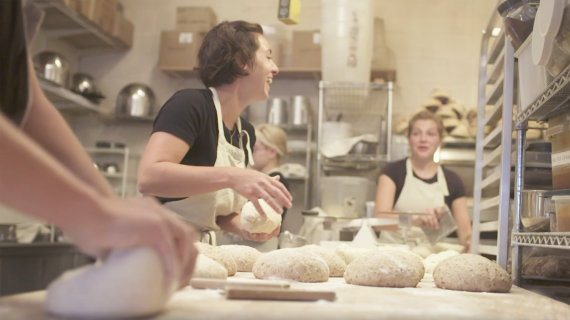
00am this morning. He starts the cheesemaking for us. He starts by pasteurizing our milk, and filling the vat with milk, and then takes it from there until I come to work a little later. The other cheese we're making here is called quark cheese. Quark is a fresh cheese. It stays soft and spreadable. This afternoon, we will drain this curd in cheesecloth bags, so that they can then drain, the whey can drain out of them overnight. So far, it's been really exciting. We've open just seven months, and here in Milwaukee, we've had a lot of enthusiasm from our neighbors, the neighborhood, and all around Milwaukee. People are coming to the creamery, looking to find fresh cheese curds, looking to find cheeses that we make, as well as cheeses that we sell from other cheesemakers from around Wisconsin. So it's been going good. What is set up right here is the curd mill. Shortly, we'll be taking these slabs of curd and we'll be putting them over this grid of knives. We have a plate that presses them through the knives to cut them into our long cube shaped curds. We're taking these slabs of cheddar curd and milling them into cheddar cheese curds. They'll be sold today. The wonderful thing about the cheese curd is it's one step in making cheddar cheese. The curds are, they're almost cheddar cheese. When they're curds, they get the last ingredient on them, which is the salt. Then the very next thing we do with these curds is either we bag 'em up to eat 'em as fresh cheese curds, or we can take the same exact curd and we put 'em in a wheel form or a block form and you press them into cheddar cheese. This is the freshest version of the cheese. If you get technical, it's a step just before it becomes cheese. It's the pressing that makes it a cheese. It's the cheese curd that you have just before you press it into a cheese. We have newer equipment, but it models more of the old-type cheesemaking equipment. Very modern equipment is enclosed, and you don't have hands-on cheesemaking, and you don't see the milk during the process. Our set up here is smaller, it's more artisan, and it models that older type, where our cheesemaking in turn then is hands on with the milk, and then hands on with the cheese. We use our senses to decide what to do next. It's more traditional, more typical of the past, than some of the larger, modern setups that are making most of the cheese today. Here we have Billy adding the salt over the top of the cheese curds. He'll add them in a couple different additions, stirring it in each time to get the salt evenly spread and dispersed over the curds. This is essentially the finished look of the cheese curd. You know, and I think people love cheese curds, because it is a unique food. I can't think of any other, you know, food that's, you know, you look for it to squeak against your teeth in your mouth, and that's a nice salty fresh taste. You know, it's cheese, and people love cheese. I mean, cheese curds are a Wisconsin phenomenon, that people love them, and the states around Wisconsin, too. >> We really believe that fresh curds should be a maximum of four days old, but in most cases, should be less than four hours old or straight out of the vat. It's really hard to transport that fresh product and distribute it over a wide area. So, Wisconsin has it because we have cheese factories that still make cheese the old fashioned way, like this one. Then, we have Martha's Pimento Cheese here. Martha is another friend, who has been very active in the Milwaukee community in helping to help other people. Martha is originally from the south, and missed her pimento cheese. So she decided that the entrepreneurial spirit hit her, and she needed a place to be able to make her pimento cheese spreads. So she uses cheese from Cedar Grove Cheese and uses our space here. >> Into the make room we go. Got it. Hi, I'm Martha Davis-Kipchak. I'm the owner of Mighty Fine Food. We're here today making Martha's Pimento Cheese. This is Annie Kipchak. >> Hi. >> And Adrian Lee. >> Hello. >> My trusted cohorts today. Pimento cheese is grated or shredded cheese with peppers and mayonnaise. But I'm a bit of a purist. I like mine with really good quality cheese. Cheese is 67% of our product, so it is heavy on the cheese. It's important that it be high quality cheese. I use Cedar Grove Cheese. A pimento is basically a variety of a red pepper. It's not hot. This is not where any heat comes from. We add the heat with jalapeos. I've been told that Wisconsinites used to eat pimento cheese. It never fell out of vogue in the south. It's been eaten with abandonment for about a hundred years. Ours is really savory and a complex flavor, because of the aged cheddar. My goal is to educate, evangelize pimento cheese in the Midwest. My day job is I'm a community food system organizer for the Center for Resilient Cities in Milwaukee. I've been active with slow food for many, many years. This is essentially the principles of slow food, of elevating food traditions. In this case, my southern food tradition of eating pimento cheese, and marrying that with the assets of what's in this community, which is cheese, which I think is one of Wisconsin's greatest gifts to the world. I'm putting in the black pepper. You're getting all my secrets here. Oh, that's okay. But this is part of what I think makes artisan food so special, is it's actually touched. It's that handcrafted quality that can only be done in a small batch. It replicates more of home cooking, instead of large manufactured, what we think of as processed food. I also like misshapen pieces.
indistinct
He came about 1
Thank you. Some quite small and some quite large, yes. That way, you know that it was really chopped by hand. Thank you. I had a feeling that's why you were doing that. Thank you, Annie. The opportunity to come into a facility like this, that is right in the town where I live, in a wonderful community, and be a part of the making of something new in this very green and live building. So it's important to me to be here, to be with Bob Wills at Clock Shadow Creamery, to use Cedar Grove Cheese, to be in the same space as Purple Door Ice Cream, so more artisan food makers. Not just artisan food makers, artisan food makers that carry the same ethos that I find so valuable around social and environmental responsibility, and foods that taste delicious. So, here we have the jalapeos. This is the part where I'm able to take advantage of more local produce, and to help support other initiatives in the community, both the Fondy Farm and Alice's Garden. It's not just art and science. Food is alchemy. There is some other magic ingredient in it that you can't quantify. It's about the spirit of the ingredients, about the spirit of the maker, the spirit of how you enjoy it, being at the table. It is all of that at once. That's what gets me up in the morning. This is, mayonnaise is really what holds it all together, and gives it that spread quality. Southerners love mayonnaise. I don't know why. Kind of like lemon butter. I just love mayonnaise. Pimento cheese, at least this pimento cheese, with so much good cheese in it, is like other fine cheese. It's much better eaten at room temperature, when the flavors are at their height. Because it's such a simple recipe, it's amazing how nuanced it becomes. Okay, here we go. So this is the true test. We know what it looks like. We know what it feels like. We've got to see what it tastes like. >> I like the peppers. >> You like the peppers? We have to get a hunk of the red pepper. >> I got it. >> Oh, you got a big bite. How we doing? >> Perfect. >> Perfect? You sure?
both laugh
He came about 1
Okay. Perfect is what we're going for. Perfect and delicious is even better. Okay. That's pretty much the gist of pimento cheese. There we go. Martha's Pimento Cheese. Ready to go. >> One of my goals in building this was to really make local local. You know, the local foods movement gets a lot of verbiage these days, and a lot of big companies pretend to be local companies, in some of their products and things. But if product comes from 150 miles away, you lose so much of the opportunities of being local. By being here, we can teach people where their food comes from, how it's made, talk about all the decisions that go into making the products, you know, how we want to have products that are specific to their needs, how we work with the farmers to communicate back to the farmers what the customers want, and to be able to just connect people back to their food. >> I'm Lauren Schultz, co-owner of Purple Door Ice Cream. >> I'm Steve Schultz, also co-owner of Purple Door Ice Cream. >> We use local dairies, local products, which I think gives a freshness to the ice cream. Everything is handmade, hand-packed by Steve or myself and our ice cream maker. It's being made and it's going out in a week, so it's a nice freshness to the ice cream, which I think comes through when you're tasting the flavor and the creaminess, and everything. It just all marries well together. >> Okay, so how this works, this obviously is the batch freezer ice cream maker. But for cinnamon, it's a very simple and to the point flavor, where we have our sweet cream base, and vanilla, and then our cinnamon. That's all that's in this flavor. I always put in vanilla right after the sweet cream base, because they're the two ingredients that pretty much create every flavor, so I like to match those two up. No matter what the flavor is, the vanilla is going to bring a lot of the flavors out. So there's vanilla in almost every flavor. Then we just add the cinnamon. That's from Penzy's Spices, so it's very, very good cinnamon. It's very strong and very sweet. Throw it all in, and then it freezes. Depending on the flavor, anywhere from ten to 15 minutes. We taste, sample every flavor, to make sure everything is good. So you can see it comes out a little bit soft. You check for consistency in the flavor. It's very good. The cinnamon is very popular. You don't see cinnamon in very many places around here. Actually, you don't see cinnamon ice cream anywhere in Milwaukee. We literally just pack the pints as it's coming out. We cap 'em, wipe 'em, and then we throw 'em in here. These are our blast freezers. This one right here, this is brand new. So, for the ice cream geek, which I'm sure there's you know, five or ten in the world out there, but buying this was kind of like buying a hemi for some people, who are into cars. This is our new purchase. This is something Lauren has talked about doing ever since she was in eighth grade. She loved ice cream. She wanted to own her own ice cream shop. Even at that time, she came up with the name Purple Door with her friends. >> These are our new ice cream sandwiches. This one is a lemon cookie with raspberry green tea ice cream. >> We want to definitely be part of the community. That's been part of our philosophy from the very beginning. To have more than just one bottom line, just a financial bottom line, but to look at the bottom lines for social responsibility, that's just a big part of what we want to do as well, as a business. You know, work with the community, work with the neighborhoods that we're in. To make even a small impact is important to us. Local is kind of this trend right now, I think, around the nation, which is great. But it's so much bigger than a trend. It makes sense. It makes sense for communities. It makes sense for people. It makes sense for the earth. It just makes sense. It's something that we're just going to continue doing and try to do it more and more, as we can. You know, ice cream making is a science to a point, but then it just becomes an art. It's never going be, like every batch we make, because it's all handmade by us, and handcrafted in just little batches, there's going to be little idiosyncrasies almost every batch that you make. I think that's part of the art of it. We just want to be able to make sure we're making a great product, but be open to variations, be open to what else it could be. So, when that art side comes out, that's a lot. So, it's, yeah, there's definitely a science and art to it, that's for sure. >> Between the farms that we're doing custom production for, which there's several of those now, and new companies like Martha's Mighty Fine Food, and Purple Door Ice Cream Company, we've been around for six months now, and we've already been involved in really helping a number of new businesses get going. This is a dangerous place to work, because we can have ice cream for breakfast every day. >> And cheese curds for lunch. >> Cheese curds for lunch. >> Wisconsin Foodie is made possible by underwriting support from the following companies. The Wisconsin Milk Marketing Board; Travel Wisconsin; Outpost Natural Foods Co-op; Wollersheim Winery; Alterra Coffee Roasters; Something Special from Wisconsin; and Visit Milwaukee. This episode of Wisconsin Foodie is now available on DVD through WisconsinFoodie.com. You can also like us on Facebook, follow us on Twitter, and watch other content through YouTube and Vimeo. Wisconsin Foodie would like to thank the following major underwriters for their support. Wisconsin Milk Marketing Board, representing the dairy farm families of Wisconsin, who fostered a proud history, with generations of family-owned dairy farms, working to sustain the state's economy through job growth and providing acclaimed cheeses and other dairy products. For more information on Wisconsin dairy,
visit
eatwisconsincheese.com


 Passport
















Follow Us