

 Passport





Wisconsin Lighthouses
03/31/14 | 44m 1s | Rating: TV-G
Barb and Ken Wardius, co-authors, "Wisconsin Lighthouses: A Photographic and Historical Guide," share photos and tales of historic Wisconsin lighthouses and the mariners they guided. Learn about the lighthouses on Lake Superior, Lake Michigan and Lake Winnebago. Discover what life was like for the lighthouse keepers.


Copy and Paste the Following Code to Embed this Video:
Wisconsin Lighthouses
cc Today we are pleased to introduce Ken and Barb Wardius as part of the Wisconsin Historical Museum's History Sandwiched In lecture series. The opinions expressed today are those of the presenters and not necessarily those of the Wisconsin Historical Society or the museum's employees. Lifelong residents of Milwaukee, Ken and Barb Wardius travel nationally to pursue their hobbies of photography, history, and lighthouses, which first drew their interests at Door County's picturesque Cana Island. Here today to share with photos and stories from their book Wisconsin Lighthouses, please join me in welcoming Ken and Barb Wardius.
APPLAUSE
Thank you, Katie. Good afternoon, everybody. Thank you for joining us on a rather blustery lighthousy day, but we thank everybody for coming. We thank the museum for inviting us this afternoon.
What you're going to see in the next 30-40 minutes or so is a compilation of photography and research that Barb and I have done over 20-plus years. Our book is floating around here somewhere. This is a totally, thank you, totally revised edition of a book that we published in the year 2000. So it needed some updating.
A lot of things have changed with lighthouses. We'll touch on that in the program. What you're going to see on the screen as well as in the new book is completely new color photography. We updated some history, we corrected a few errors in the original book, and most importantly we teamed up with the Wisconsin Historical Society Press.
They are our publishers, and they also, as you probably know, have these wonderful archives of old historic photos. They are sprinkled throughout the book, really changed the entire book. We're going to start the program with some music; we're going to end it with some music. In between, Barb and I will be narrating live.
There's 48 lighthouses in Wisconsin. There's no way we're going to cover all of those in 30 minutes, but we'll give you a good slice of what the state has to offer. If all the technology works, we'll be good. So let's take a journey to Wisconsin's lighthouses.
As Ken and I did our research and photography for the book, we crisscrossed the state of Wisconsin many times in order to get the perfect shot. Some places, only one time had to do, and, luckily, we were able to get some great pictures. We'll begin our tour this afternoon on Lake Superior, the largest freshwater lake in the world. There are actually 10 lighthouses found in this area of our state.
Some of the most beautiful scenery is also found here, and with the opening of the Soo Locks in 1855, this portion of Wisconsin was the very last to be settled. The first lighthouse we'll discuss today appropriately has Wisconsin in the title. This the Wisconsin Point Light. It dates back to 1913.
It's outside the city of Superior. It's on a long, rocky breakwater, as you can see. This is our daughter Sara. We did a lot of lighthouse trips as a family.
She was a teenager in this photo, and we have documented her smiling at a lighthouse.
LAUGHTER
Any parents in the audience probably realize going lighthouses with mom and dad is not near the top of their list.
LAUGHTER
But she's smiling. She survived and so did we.
LAUGHTER
Most lighthouses, not only on the Great Lakes but throughout the world, were built in response to commerce. Historically, wooden ships would have plied the Great Lakes and ports of the world. Today, modern tankers still come and go from the Duluth-Superior harbor. One thing we learned, a little bit of trivia if you will, about Wisconsin Point, Duluth-Superior is a very active port even today.
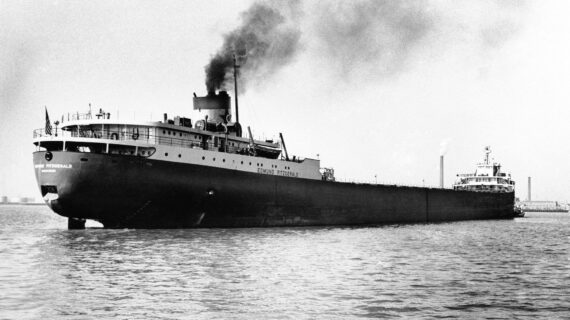
In November of 1975, the giant ore carrier Edmund Fitzgerald left Duluth-Superior bound for the eastern end of Lake Superior and the city of Detroit. Little did the 29 men aboard the big Fitz know that in less than two days they would pass by Wisconsin Point on the way out to Lake Superior, in less than two days they would all perish in the terrible November storm. And when we do our photography, we like to go at different times of the day to add interest to our work. One of our favorite times is sunrise, which means you've gotten there ahead of the sunrise.
It means you've gotten set up on the beach, in the wrong place many times. This morning was not different. We were in the wrong place. I said we were in the wrong place.
Ken said no, no, we're fine. So we picked up, ran down the beach, had about a minute to take this picture, and then the sun went behind that huge cloud bank and sunrise was over for the day. One time. Very, very lucky.
There were a number of those things that happened along the way that we were blessed with. We're going to move on now from Superior to the northeast. All the little green structures you see there are lighthouses in an area called the Apostle Islands National Lakeshore. It's a national park, and there are more lighthouses in this national park than any other.
If you've ever been to Bayfield, chances are you know that it is a very beautiful area. People come for rest, relaxation to see the sea caves and also to visit lighthouses by boat. By boat. The only way to get there is by boat.
This is the Sand Island Light built here in 1881. It's just a gingerbread house in my mind. It's just a beautiful little lighthouse. And much of the history of this light comes to us courtesy of the Luick family.
Ella and Emmanuel Luick were a very hardworking lighthouse couple, but you might think since they were on an island that they were isolated. Just the opposite on Sand Island. There was a fishing village there as well as some other people that actually lived on the island year-round with them. So they were able to socialize.
By the way, these two photos are an example of what I was saying before about the Historical Society's archives. Both of these are from there. They're priceless. And here she is again.
At any given day you might ask me what my favorite lighthouse is. As of this moment, it's this one. As the program goes along, it'll be a different one. I love them all.
Many of you know the levels on the Great Lakes over the last decade or so are below normal. We rented what was called a water taxi, and the captain usually would tie up very close to Sand Island but there's a lot of exposed rocks now. So he put us in this, we affectionately called it our little yellow banana boat. Sara's in the front with me.
She's laughing. She knows we're not the most graceful people on these kind of vessels. The boat captain said get as close to the island as you can, jump out, there'll be a path, and you'll meet a docent at the lighthouse. Take your pictures, learn some history.
You've probably heard stories about how cold Lake Superior water is. This is a relatively shallow bay. We were only a foot or two deep when we hopped out. Middle of the summertime, freezing cold.
Absolutely true. This is Mary Ann. She was the volunteer that stayed at Sand Island for about a month. We told her at the time we were researching history, we were taking photographs.
We said some day we're going to write a book on Wisconsin lighthouses. We eventually met her, just by chance, at a lighthouse presentation years ago. We showed her the book. It actually happened.
If you live around the Great Lakes, chances are you know that weather changes quickly. We're at Sand Island in the morning, the weather changed very fast. The forecast for the day was fine. We ran into a summer storm outside of Outer and Devil's Island and really should not have been on the lake that day.
Our boat captain assured us the bottom of the boat was double hulled. I didn't know what that meant, but I figured it was a good thing and he was trying to be very reassuring. So we hung on for dear life, said a few prayers, and made it to our last landing which is
this
the Michigan Island Old Tower. This is the oldest light in the Apostles. Built here in 1857. Depending upon whom you believe, it was either built here by mistake or somebody listened to the locals and said put it there.
Maybe they just misread the map. I don't think they'll ever really know. And we've been asked, did you take this from a hot air balloon or an airplane? Actually, it's taken from a widow's walk or a parapet of this next lighthouse.
Michigan Island actually has two lighthouses on it. The one Barb just described is in the lower right-hand corner, the Old Michigan Tower. Mariners were complaining they couldn't see the light well enough at Michigan Island. Eventually, the government, the federal government took a lighthouse from the east coast of the US, disassembled it, reassembled it on Michigan Island in 1929.
So it has the oldest and the newest light in the Apostles.
LAUGHTER
this
Go figure. Government does some, even back then did some different things.
INAUDIBLE
this
They did. They're both still there. We were fortunate, well I don't know if fortunate is the right word, we visited all eight Apostle Island lights in one day. If you ever go to Bayfield, don't do that.
LAUGHTER
this
It was hectic. We ran into this storm, as I mentioned. Sara sat at the base of the tower here. There's a circular stairway of 134 steps to give you that grand view that Barb just described.
Sara said, I'll stay at the bottom, thank you, you guys go. It was worth the view. Michigan Island, the new tower, is the second tallest in Wisconsin. 110 feet.
And we're going to leave Lake Superior now and go to Lake Winnebago. When we first began our research, we didn't think there were any lighthouses on Lake Winnebago, and lo and behold, there are actually four. And Lake Winnebago is very important to commerce. It's part of the Fox and Wolf River systems that were used for lumbering back in the day.
And even though the lake is very shallow, maybe 22 feet at its deepest point, recreational boaters today still use the lighthouses to guide them. This is called the Rockwell Light. It's built where Lake Winnebago and the Fox River join. This is actually someone's backyard.
This is a privately owned lighthouse. History tells us that over the years whoever owned the point, it became their point. William Bray was one of the first owners here, and he transformed the entire point into a show place. History tells us he entertained friends, colleagues, even President William Howard Taft came to lunch.
And this is another one of those great shots that we were provided with, an old archival postcard. Today the owners still light the light and pay the taxes on this light just as they did back in the day. They are required to keep it lit at their own expense. We're going to move on now from Lake Winnebago to part of Lake Michigan actually known as the Bay of Green Bay.
As you can see from the map, there's a number of lights. Some of them are on islands out in the bay. A couple of them used to reside there but now have been moved. We'll touch on that briefly now as well as later.
This is another old archival photo of the Green Island Light, which is located five miles offshore from Marinette and Menominee. It doesn't look like this anymore. Samuel Drew was the first keeper at Green Island. This is his son Frank.
The logbooks from the station tell us that Frank was born under the light. Later he became chief keeper here. We know for certain that he was a chief keeper because he sports K for keeper on his lapel, and even the brass buttons have lighthouses on them. Even after Frank Drew passed away, he could not get away from lighthouses.
This is his family's tombstone. If you look at the top, there's an engraving. This is actually very appropriate. There were many, many families, spouses, husbands, wives, daughters, brothers, uncles that were in the lighthouse business.
It was considered to be a very prestigious job. When Frank Drew died, all the pallbearers were assistant keepers and lighthouse keepers from the Great Lakes. So, very hardworking families. We ran into a lady in Milwaukee years ago, the young girl on the left.
Her father was a lighthouse keeper on Green Island and also Cana Island in Door County. She came up to us after a program and she said, my father was a lighthouse keeper, would you like to talk to me, sit down with me sometime?
LAUGHTER
this
Yes, please! This is Virginia Drezdzon on the left and her sister June. We just visited Virginia a couple of months ago. She is a spry 90 years old.
She and her family were stationed at Green Island before its demise, which we'll touch on next. This is, unfortunate, what Green Island looks like today. Ultimately, the government abandoned this lighthouse. It was boarded up.
Just the elements took charge. There was also vandalism and a fire. It actually doesn't have as much brickwork as it does in this photo. There was still the need for a light on Green Island.
They don't call this a lighthouse. It's a modern metal pole the Coast Guard erected years ago. Certainly doesn't have the human stories and the history of the traditional lighthouse. We're going to venture now to the very southern end of Green Bay.
If you look at the bottom of the slide here, this is what southern Green Bay looks like in the middle of the summertime. It's where the bay gets its name. Sorry, Packer fans, it doesn't get its name from...
LAUGHTER
this
I'm a Packer fan. It doesn't get the name from the football company. This tower is, the locals still call it the Old Stone Tower. It dates to when Wisconsin became a state, 1848.
It doesn't look like much, but it is the oldest original tower that still stands in the state of Wisconsin. It sits on the end of a sandbar. Very shallow water. This area is called Tail Point, and the island is called Long Tail Point.
The bay level about 20 years after Tail Point was erected, came up to the very base of the tower, and the government feared that it actually was going to topple into the bay. So what they did is they hired a construction company with the tools of that time, the mid- to late-1800s, and they were supposed to dismantle the Old Stone Tower. You can see from the brickwork here, the stones, that's a tougher job than they imagined. Thankfully, they were not able to take the tower down.
This is what it looks like still today from the inside. The circular stairway probably was in the area you see that very large crack. I actually learned from some descendants of lighthouse keepers at Tail Point that there were three lighthouses there. This is the second one.
This gentleman, Andy Weber, and his family spent almost 30 years in the lighthouse service. His daughter Adris is on the left. She's pictured with a teenage friend frolicking on the beach at Tail Point. Tail Point now is completely overgrown, and it's just wonderful to talk to the lady on the left of the right-hand photo.
We sat down with last year, gave us all of her family photos, all of her family writings. It's like, wow. People are so generous when it comes to history, and lighthouse history in particular. So by now you know we don't have a boat, so we have to depend upon the kindness of strangers or rent a boat.
We contacted the Green Bay Yacht Club, and they said, well call Merle. He has a boat. He likes to go out for fun. Well, here's Merle's boat.
It's a 40-foot yacht. This is the way to go. This is the way to do your tour of the Bay of Green Bay. Here I am working on the book.
LAUGHTER
this
You are not. I am too. You are not. It was a lot of work, but it was a lot more fun.
We certainly met the nicest people along the way. And now we're going to go to one of our favorite places. This is Door County, and many of you know, history shows hundreds of shipwrecks in the Door County area. Just look at that rocky shoreline.
And Door County can claim one of the highest concentrations of any county in the country. There are 11 lighthouses found here, and that Door Peninsula is just that thumb-shaped piece of land that stretches out into the lake. We're going to journey now to one of the most difficult lighthouses to get to in all of Wisconsin. I should have kept the map up for a second.
It's actually on Rock Island, the Pottawatomie Light. If you've ever been to Rock Island, chances are you've taken a car ferry over. Perhaps you had another vessel. You're going across here what's called the Death's Door Strait.
You'll pass Plum Island, Pilot Island. They both have lighthouses. Eventually you'll get to Washington Island. We hopped on what's called the -- that day.
If you've ever been to Rock Island, chances are you've pulled up to this gorgeous boathouse. We are still a mile and a quarter away from the Pottawatomie Light. Rock Island is a Wisconsin State Park. There's no motorized vehicles on the island.
There's primitive camping. The ranger told us what path to take. He said you'll go up and down some paths, in and out of some woods, eventually you'll come to a clearing. After about a half an hour I thought, I think maybe we took the wrong spot, but lo and behold we came to this clearing and found this rather disappointing image of a lighthouse.
As you can see from the photo, it's missing something really important if you're a lighthouse.
LAUGHTER
this
This is Pottawatomie and how it looked about 15 years ago. They actually took the lantern off. It's completely better now. This location, this same spot is the original oldest light in Wisconsin, 1836, which actually Wisconsin wasn't even a state there.
The first Pottawatomie light had faulty brickwork and mortar work. They tore it down and the building that you see was placed here in 1858. There is still a need for a modern beacon on Rock Island. Rock Island used to be a very important passage, historically, called the Rock Island passage, but this modern metal tower certainly is not a lighthouse.
So, our first book was supposed to go to press, and we didn't have a picture of the new lantern room that was being restored, so we made a day trip to Door County. This was back in the day when we had paying jobs, and we had to do this.
Get up at 3
00 AM on a Friday or a Saturday and go up there, but luckily for us, on that given day, the friends were on the first boat with us, and of course they have a key for the building, would we like to climb and see the new lantern? Of course we would. So it was a very, very good day. And this photo is more than 100 years old.
This is a young man delivering wood to the Pottawatomie Lighthouse. There's a friends group associated with Rock Island over the last decade, decade and a half. One of their main goals was to refurbish and renovate Pottawatomie, and they have done just that. You saw that in the previous photo.
They have volunteers that are stationed at the lighthouse from spring through fall. You conduct tours, you do cleaning, you keep the place ready. It gave us a real good sense of lighthouse keeping, say, a century ago. Sometimes we have this idea that the era of lighthouses was this grand, romantic nice time.
Don't you believe it. Tons of work. Pottawatomie today does not have running hot water. It does not have electricity.
It does have a really new composting toilet in the yard, which is a plus when you're there for a week. But here's Barb looking at probably some lighthouse book material by candlelight. So it really gave us a nice appreciation for the hard work that lighthouse families went through. We're going to journey back now to the main Door Peninsula.
This is where Barb and my interest in lighthouses started. More years than we admit, but about 40. We had never been to Cana Island. Some friends said, have you ever been to Cana Island Lighthouse?
You've got to go see it. So we did. We fell in love with the place. Cana Island is kind of the close your eyes, think of a lighthouse, and might not be too far from this photo.
It's the tall, classic, white tower with the keeper's quarters right next to it. It dates back to 1869. 86-foot tall. After about 30 years the tower at Cana Island originally was a brick tower.
They enclosed it in this metal sheeting after the government realized the brick was wearing too quickly. Cana Island sports the oldest original French made Fresnel lens in Wisconsin. It's still in the tower. Years ago, before the Door County Maritime Museum took over there, you could not get into the tower.
We got special permission to follow some Coast Guard gentlemen up to the tower and took some pictures of the lens years ago. This is only half of the lens. It stands about five feet tall, weighs over a ton, and it's an engineering marvel. Really revolutionized lighthouses throughout the world.
Is it all one piece of glass? It is multiple, dozens and dozens of individual hand-polished prisms. If it's disassembled, there's hundreds of pieces. We've been to Cana Island different times of the day, different seasons of the year.
We love to go to Door County. We were talking to somebody before the program how they love Door County too. Just one of our favorite places. Rarely do we go to Door County without trying to take a stop over at Cana Island, even in the wintertime.
Not this winter. No. We wanted to learn more about Cana Island. This is the only original photo known so far of the brick tower.
We wanted to learn more about the families and the keepers. This is Oscar Knudsen on the right with an assistant keeper in the 1930s at Cana Island. And this gentleman, just these classic archival photos, just wonderful, this is Conrad Stram, and he spent over 40 years in the lighthouse service. So we decided we didn't have enough to do.
We dug into some more of the history, some of the old photos of Cana Island. You've probably seen this style of book. It's from Arcadia Publishing. We wrote a separate book just on Cana Island.
Neat place. And now we'll go back to the mainland, just a little further south. This is called the Old Baileys Harbor Tower or lighthouse. Built here in 1852.
Baileys Harbor is named for Captain Justice Bailey who took refuge here during a storm. The owner of the shipping company he sailed with was Alanson Sweet, and he made sure there was a lighthouse here to keep his captains and crew safe. Take a look at the lantern or the lantern room. It's very different from anything you've seen.
Besides being a little worn out, it's called a birdcage style, and you can certainly see why. We've heard that the owners of this privately held light have applied for some federal aid to help shore her up. She needs a little bit of work. Okay, another day, another boat trip.
Ken has waders. I don't. I left mine home because they were leaking, so what was the point. I'm resigned to the fact he gets to go, I don't.
Luckily, fishermen come along and say, well, take ours. This is a lovely red boat that we're standing in front of. They looked at me, said you get in, he can pull you.
LAUGHTER
Get up at 3
They actually did.
LAUGHTER
Get up at 3
If any of you folks remember a movie called the African Queen with Humphrey Bogart and Katharine Hepburn, he's pulling this boat through the jungle, that's not exactly how this was. Trudge, trudge, trudge. Right? Barb isn't nearly as nicely dressed as Katharine Hepburn was.
Let me tell you, the strait of water isn't that wide, it wasn't that deep, but Ken's trudging along, and I said, oh, my gosh, the boat is leaking, and it was. And he said, pick up the gear. I said, I'm fine, thanks, no problem. We landed.
Lighthouse is always on the opposite end of the island, and we began carrying all of our gear, tripods, cameras. There's a couple of gentlemen out in a rowboat, and they said, where are you going? We said, we're going to see the lighthouse. That's great, they said.
You're trespassing. This is private property. Private property.
LAUGHTER
Get up at 3
And I'm looking at him thinking, okay, they're going to kill us as we stand here. Well, what do you want? Well, we want to take a picture. Fine, take your picture and go, and beware of the large dog that roams the grounds.
Here he is.
LAUGHTER
Get up at 3
It's not quite Hank the dog, but he was a little guy. He wasn't large and he wasn't roaming. He peeked out the window, and we took his picture as well. We left a business card, but we haven't heard from them so we have not been invited back.
LAUGHTER
Get up at 3
We're going to venture now down the western shoreline of Lake Michigan all the way to the Illinois border. If you look at the map, every single major city in Wisconsin has a lighthouse. In fact, several of them have more than one. Our first stop here is at the Rawley Point Lighthouse, which is conveniently located today in Point Beach State Forest.
So there's a small admission to get into the park. The tall tower in the back is the newer one. It is the granddaddy of all lights in Wisconsin. She's the tallest at 111 feet tall.
This is a fact that we had kind of vacillated on a number of years ago, but now we've been set straight. So she is the tallest. You can see the little, short, round brick tower that Ken is pointing to. That was the original tower at this location.
When they put the big tall one into service, they chopped this one down, reroofed it, and it became part of the keeper's round living room. I don't know how you decorate a round room, but we were told that they really use the space well. Rawley Point is interesting from a number of aspects. The style of this lighthouse is called an erector style.
If anybody in the audience ever had an erector set as a kid like I did, all these struts and all these geometry shapes, it's really kind of neat. Not only does it make for nice photographs, it's a very strong tower. You can see the central column there is braced by all of these struts. This lighthouse actually came from the state of Illinois.
It was on the Chicago River. They disassembled it when the government realized they needed a taller tower at Rawley Point. One thing, we're not sure why, this is the only lighthouse in Wisconsin, this is the lantern area, this is a watch room, and below that is a second watch room, when they reconfigured this to make the tower taller, they added a second watch room. There is no other light in Wisconsin that has that double-decker lantern room.
Would love to find out why. There's a caretaker that lives in residence at Rawley Point and also military people get to vacation there for rest and relaxation. We were fortunate to be invited up there one weekend. The caretaker had the key of course, and we were able to get into the lantern.
There's a modern what's called an arrow beacon now at Rawley Point. Again, Rawley Point is the tallest in Wisconsin at 111 feet. One foot made a difference. One foot, that's all it needed.
And again, moving further south. This is Port Washington. This is the Old Port Washington Light Station, built here in 1860 on the north bluff. If you look at the design of this light, it's very similar to that of Green Island or Pottawatomie.
The government would reuse plans over and over when they could. They might put the lantern at a different angle or put it at the rear of the building, but, essentially, the floor plan is identical. And this is the Port Washington pierhead light, put into service about 30 years later. So then the keeper was responsible for the care and lighting of this light every night.
Hiking down an 80-foot bluff, perhaps with equipment or fuel, he would take the elevated catwalk out and hang onto the guide wires to avoid being swept overboard. So much for a romantic life, right? And this is the current Port Washington pierhead light, built here in 1935. This is the breakwater that they're going to be repairing this summer.
This gentleman and his family, this is Captain Charles Lewis Sr. He was actually a whaling captain on the east coast of the United States in the early 1800s. He and his family moved west to the Great Lakes area. He and his wife Maria and their son Charles Jr spent collectively over 40 years at Old Port Washington.
This was not all that unusual. We found many records of families at a given lighthouse for several decades. Old Port Washington, like a lot of lighthouses, changed hands as technology evolved. The Coast Guard was in residence here for a while.
They eventually took the lantern off. You can see the top of the roof here is missing the lantern. The Port Washington Historical Society eventually made part of their home here. It was always their plan to try to renovate and restore Old Port Washington, and it's unbelievable what they've done in the last 15 years.
They took all that white paint off, revealing that gorgeous Milwaukee Cream City brick. The country of Luxemburg donated a replica lantern. About 10 years ago, lighthouse enthusiasts from all over the region in different parts of the US and different countries of the world came for that red ribbon cutting atop the tower. Today, Port Washington has a replica lantern light inside the lantern.
This is what it looked like 15 years ago. This is today. Unbelievable. You can actually go inside Old Port on the weekends for a tour.
They've refurbished the inside. Not many lighthouses in Wisconsin have been renovated both inside and outside. This is our hometown of Milwaukee. This is called the North Point Lighthouse.
This is the first lighthouse built in Milwaukee in 1855. The brick tower stood about 28 feet tall, but it was very close to the bluff, and there was a lot of erosion going on. So after about 30 years, they moved the light. A brand new building about how many hundreds of feet inland?
A couple hundred. Several hundred. To keep it well away from the bluff. So now she's 39 feet tall.
An iron tower, beautiful two-story keeper's quarters attached. Lake Park Milwaukee was actually designed and built around the lighthouse because the lighthouse came first. So there are the famous lion bridges. The trees got too tall.
Rather than cutting down the trees, they built a new base for the lighthouse and put the shorty on top of it. So now she stands about 74 feet tall. I don't understand, but that's what they did. When the Coast Guard was in residence in the 1950s, they tended the light, and they actually put a ring buoy above the front door, and it does say US Coast Guard on it.
Several famous keepers tended our Milwaukee Light. This is Martin Knudsen. And this gentleman is Reynold Johnson. Surfman Alexander Warner started his career on Lake Superior.
As a surfman, you had to go out to rescue people, but you didn't necessarily have to come back. Later, he was actually in the Coast Guard for a number of decades and went on to be known as "The Chief," and you better believe he was the chief. He looks like the chief. He looks like the chief.
He sure does. And we can't discuss Milwaukee without talking about our woman light keeper. This is Georgia Stebbins, who served here in an official capacity for 25 years. But if you look at the logbooks, she helped her father out early and stayed on longer.
It was closer to 35 years. This was a remarkable story, a remarkable woman. Like I mentioned before, many lighthouses, as technology advanced, they were automated, many times boarded up. This is what North Point looked like about 20 years ago after the Coast Guard was no longer at the facility.
This house really was ready to fall down. There was a group in the area that wanted to refurbish the light. They got permission from the city of Milwaukee, the county of Milwaukee, the federal government. They formed a friends group.
They opened up the tower. The tower, this is the base of the tower, actually looked a lot worse than this. If you can image about two feet of animal droppings in the tower over many decades. Didn't stop the friends though.
They initially worked on the tower. There were issues with lead paint, not only in the tower but in the ground. So those had to be remediated. Their next venture was to totally reconfigure and rehabilitate the two-and-a-half-story keeper's quarters.
And today, if you go through Milwaukee's Lake Park, this is what North Point looks like. Again, the amount of resources and time and efforts from volunteers is staggering. So, our hometown of Milwaukee, we had written a couple of books, we thought, you know, it's probably time we learned a little bit more about North Point. So we delved into some archives and history and wrote a book on North Point.
Last lighthouse we'll talk about formally is Wind Point in Racine, just north of Racine. This is another tall classic tower. Third tallest in Wisconsin, 108 feet. Still one of the tallest and oldest on the Great Lakes.
This is another success story in Wisconsin. There's a friends group here at Wind Point. The Coast Guard takes care of the beacon. The village of Wind Point has offices in part of the keeper's quarters, and there's a caretaker couple that lives in residence.
All those folks work together to open up the tower on Sundays during the summertime. This is from the top of the tower. If you're afraid of heights, looking down late in the afternoon, Wind Point casts a very long shadow. 144 steps takes you to the top.
We count steps. Well, I am afraid of heights, but I would never, ever turn down the opportunity to climb. So we were there one Sunday after mass, I still had my church clothes on. So there I am, hanging onto the bannister and that long skirt.
So if I was a woman keeper, I wonder what I would had done if I had to carry something up or down those steps. It gave me a very good appreciation for the women. And this is one of those kind of picture postcard moments. You stand in the meadow at Wind Point during the holiday season.
All the people that I mentioned decorate not only the tower but the grounds. Take your camera, snap, it's gorgeous. But Wind Point is like that. It's different seasons, different times of the day.
We wanted to learn more about some of the history and the people that tended wind point. We learned about this gentleman by accident. This is Alfred Finch. He is the first keeper at Wind Point, 1880.
You'll notice he's in some Civil War... Uniform. Uniform, thank you. The word wouldn't come out.
We also learned that this gentleman was in the same Wisconsin regiment as the famous Wisconsin war eagle Old Abe. How would you ever find that out?
LAUGHTER
Get up at 3
These three gentlemen were keepers and assistants at Wind Point. Henry Bevry on the left, Julius Lonne in the middle, and William Nash on the right. Combined 90 years of service just at Wind Point. So, of course, we had to write a book about Wind Point.
LAUGHTER
Get up at 3
We're going to very briefly go through a few lighthouses that have changed hands in Wisconsin. Ones that we haven't mentioned already. Some that are still for sale. You're probably aware that many lights are still for sale on the Great Lakes by the government.
This is the Grassy Island Range Lights. It's a series of two lights that sits at the Green Bay Yacht Club now. In the 1950s, the government was actually going to burn these down. They were on an island right in the middle of Green Bay.
A couple of gentlemen from the yacht club just didn't like that idea. So what they did over the last decade or more is they got a group together. This is what Grassy Island looks like today. They're completely refurbished.
The gentleman on the left is Dave Nelson. The gentleman on the right is Merle Bayman. These two were instrumental in saving Grassy Island. Many times it only takes a person or two to get something going with lighthouse preservation.
There's a couple of lights in the Bay of Green Bay that are still for sale. This is the Peshtigo Reef Light. It's a crib light. Not that far away is the Green Bay Harbor Entrance Light.
The government would still like somebody to take these over, but last we heard they were still what are considered excess property. Still automated, still functioning. This is Big Red, the Sturgeon Bay North Canal Pierhead Light, very long name. Some of the locals call it Big Red in Sturgeon Bay.
Last we heard they are still looking for a buyer for this. Plum and Pilot Island in the Death's Door Straits has a friends group, but they have their work cut out for them. This is the Plum Island Rear Range Light. This is Pilot Island, which is under the auspices of the US Fish and Wildlife Service.
They've deemed that this island will be a sanctuary for cormorants and gulls. Barb and I love birds. This island is completely, I shouldn't say completely, mostly dead, because of the thousands of birds that now congregate. Unfortunately, that will make it much more difficult to save an island like Pilot Island.
This is the fog signal building on Pilot Island. Anything that's not concrete has already collapsed on itself. They're concerned that the rest of the building, this foghorn was one of the loudest on the Great Lakes. This is the Manitowoc Pierhead Light.
It's currently in the hands of a private owner from New York, and we're hoping that he'll refurbish it and open it to the public sometime in the future. Her lookalike is in Milwaukee, the Milwaukee North Breakwater Light. This has been taken over by a nonprofit from Brookfield, and they want to do some scouting groups and do some other little mini museum inside. It sits at the end of a mile and a half long non-continuous breakwater.
So getting back and forth, even by boat, can be very challenging. And this is also the Denis Sullivan that's in the picture going by. Kenosha, there's an artist in residence here only in the summer months. In the winter of course, the pier is covered with ice.
The lighthouse is not heated, so there's not art going on in the wintertime. They'll hopefully be back in there by May. Not this past winter for sure. Not this past winter.
And lastly, this is the Kewaunee Pierhead Light, and the city of Kewaunee recently took over her care, and they also hope to clean her up and open her up to the public at some point in the future. What we're going to do now is finish the program with some of our favorite photos set to music again. When the music is done, we'd be happy to try to answer any questions. We want to thank the museum again for inviting us this afternoon.
Thank you. I hope you've learned a little bit about Wisconsin lighthouses. I hope we've had a little fun along the way. Sit back for a couple minutes, enjoy the last few minutes of Wisconsin lighthouses.
Thanks for spending your lunch hour with us.
APPLAUSE
Search University Place Episodes
Related Stories from PBS Wisconsin's Blog










Donate to sign up. Activate and sign in to Passport. It's that easy to help PBS Wisconsin serve your community through media that educates, inspires, and entertains.
Make your membership gift today
Only for new users: Activate Passport using your code or email address
Already a member?
Look up my account
Need some help? Go to FAQ or visit PBS Passport Help
Need help accessing PBS Wisconsin anywhere?

Online Access | Platform & Device Access | Cable or Satellite Access | Over-The-Air Access
Visit Access Guide
Need help accessing PBS Wisconsin anywhere?
Visit Our
Live TV Access Guide
Online AccessPlatform & Device Access
Cable or Satellite Access
Over-The-Air Access
Visit Access Guide




Follow Us