

 Passport


Wisconsin English Words
01/19/10 | 32m 32s | Rating: TV-G
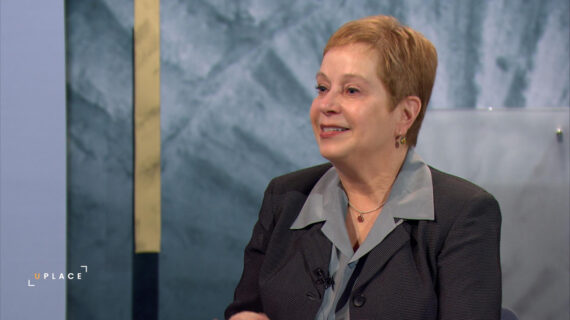
Julie Plier, Freelance Lexicographer, Luanne von Schneidemesser Senior Editor for the Dictionary of American Regional English Julie Plier, freelance lexicographer and Luanne von Schneidemesser, senior editor for the Dictionary of American Regional English, talk about Wisconsin words and discuss how various ethnic and cultural groups have influenced and enriched the English spoken in our state.


Copy and Paste the Following Code to Embed this Video:
Wisconsin English Words
cc Ladies and gentlemen, today we're here to have Luanne von Schneidemesser-- I was going to say, tricky word, "here today," as well as Julie Plier. Plier. Sorry, Plier. It's been a rough start to today so far.
We're going to take a look at Wisconsin's ethnic vocabulary, I guess is the way I'm going to define it, and looking at how different cultural groups have influenced and enriched the English language here in Wisconsin. So if you could please give a round of applause to Julie and Luanne. We love to have them here.
APPLAUSE
I'm going to turn it on over, ladies. Thank you. I'm Luanne and this is Julie. We're both lexicographers and I work for the Dictionary of American Regional English so you'll be seeing references to that throughout our talk.
Julie got her training on the Thorndike-Barnhart children's dictionaries, if you remember those. Anybody my age probably had them in school. And since then she's been a freelance lexicographer. And it should be added, she also works for the Historical Society, she's a pronunciation editor for children's textbooks.
Okay, we were both part of the Wisconsin English Project in 2007/2008, and we're working, just the two of us now, on a Wisconsin words project. So we'll be happy if you learn something from us, but we'll be even happier if we learn something from you. Words, words used in Wisconsin. We're starting out with ethnic terms that came along with some of the settlers who came here.
And we will also be talking about some of the terms that came with Yankees, the English speakers that came from the east coast and places in between here and the east coast. And, well, there's a lot of ways that words can get into a language. Words are constantly dying out. At DARE, for example, we had questions about what do you call the horse that's closest to you when you plow and what do you call the other horse.
Near horse and far horse. Even the people who knew the terms couldn't get which one was which.
LAUGHTER
So I'm sure by now it's practically dead. There are terms that have been taken over from other parts of the country. In our DARE work we show that enchilada and taco are regional in the southwest. Well, of course, that's all changed with all the food materials that have come up throughout the country.
Some words are created as a need rises. For example, Google. Tweet, now that's not a new word but it's a new meaning to the word. One I heard just recently is the Dracula sneeze, they're worried about the swine flu so you're supposed to sneeze into your sleeve.
LAUGHTER
That's the Dracula sneeze. And each word, as you can probably guess, has its own history, and we're just going to talk about a few. Here's a few words that we consider to be Wisconsin words, but note that words do not follow state lines. You can't say, whoops, there's the border, nobody on the other side of the border is going to speak this way.
So most of the words we'll be talking about are used beyond Wisconsin, but the combination of words we use makes us, or our language, unique. This is from an index by region usage in etymology to the Dictionary in American Regional English, and these are some of the terms that we have at the beginning of the index for Wisconsin. And you notice that most of them say something like chiefly Michigan, Wisconsin, Minnesota or north-north midland, especially frequent in Wisconsin for bubbler, surprise. So this, by the way, is totally on the Web now.
If you go to the DARE Web site, DARE.wisc.edu, and look under "index" you can see all the rest of the words that they have in Wisconsin. The only thing you can't tell is what they mean. You have to look at the dictionary to see what they mean. So common words like bubbler, come with, go by, yeah hey or once, like come here once, budge, are some of the words we think of as being Wisconsin words.
And there are other words referring to the culture of the state like frozen tundra, Vince, dare I say it, Brett, cheesehead, shine, a fairly new word is Sconnie. You might have heard that. We're not talking about most of these but we're throwing in some that you've probably never heard of. The main thrust of this is the ethnic influence on Wisconsin.
This is the ethnic pattern around 1940 and you can tell by the, this color, that's the German, that's the biggest settlement area or biggest group of settlers in the state. The purple is Norwegian. Most of that is in the west or in the south. We've got up around Green Bay, we've got some Belgians up in the north, way in the north if I can find it.
Or there's Finns. So from this list of nationalities mentioned, you can tell that we have a large range of people who have settled in this state. Jim Leary, he's someone who works on Wisconsin folklore, once called it a map of Europe superimposed on Wisconsin.
LAUGHTER
And when you see that, you can almost see why he said that. Okay, we'll start with the biggest group. And as you can tell from my name, we'll actually it's my husband's name, but we're part of this German ancestry. There's a few words that have been taken into United States English from German, and, as you can see, there are Germans everywhere but they tend to congregate most heavily in the southeast.
Scattered elsewhere. So let's take for our first word brat. We have to do that, we're in Wisconsin. How many of you are native Wisconsinites?
Wow! Okay, how many of you are not? Okay. Julie is, I'm not.
I came here for grad school, and I remember the first day I was walking down State Street and I saw this sign that said Brat House.
LAUGHTER
And I thought, what kind of a state is this that has a house just for brats. Well, I was coming from Switzerland and I had been a year in Germany and I spoke German no problem, I'd never seen it called brat, it had always been bratwurst. And it took me a while to figure out what was going on. Brat and bratwurst really started in Wisconsin but with Johnsonville now exporting to every state in the union and probably overseas, it's spread a lot.
Sheepshead. The wandering sheep, Sheepshead Central. Sheepshead Central is an organization that started up as a small Sheepshead club in Milwaukee. But the one I really like is if you look on the Web you can find a Web site for wandering sheep, and that's for Sheepshead players not in Wisconsin.
LAUGHTER
About four years ago, Brad Vogel had an editorial in the "Badger Herald" where he says sheepshead is a uniquely Wisconsin game. And he goes on and talks about some of the people who play the game and some of the people who are on this Web site or this blog. And one of the people ends with the statement, I very well may have been able to graduate in less than six years if not for all the sheeps I played in the Rath. I think Julie's husband was in somewhat a similar situation.
Now you can see these are kind of stylized maps. We took the maps from the Dictionary for American Regional English. And we did it by settlement, history and population. So if the whole map were colored in black dots that would mean everybody said that word.
Well, as you can see here, Sheepshead is mostly a Wisconsin term. And Schafkopf, which is the original German for it, Sheepshead is just a translation of Schafkopf, is also very, very much a Wisconsin term. Bakery. My daughter went to, she grew up here.
She went to school in Washington state, and she called me one day when she was an undergrad and she said, mom, I just said let's go by some bakery and they laughed at me, what's wrong with that? Well, for us, or other people who settled in German settlement areas, a bakery can also be baked goods, as you see on the last line there. At the bakery you buy bakery. This slide is from Green Lake where you can buy fresh bakery.
This is not said all over the country. I see a few looks of astonishment. No, it's not. Believe me, most of the people at her undergrad school had not a clue.
Okay, from little on. How many of you have ever had said this? Or from little up? A few people.
Okay, I haven't heard that, the last sentence here, both adults and children when I was growing up were given a bit of information which seemed obvious to them, they scoffed and said, I have known that from little on. It's straight from the German von wenig auf, just translated. And we use terms like this and don't even realize they've come from somewhere else. Especially when they're translated and they don't have the German, or whatever language it is, connected with them.
There are various ways, as I mentioned at the beginning, that you can get a word into a language and this is one of my favorites. My boss, Frederick Cassidy, at the dictionary, he died several years ago, but back in 1967 he wrote an article and he was talking about -- among other things. He loves folk etymologies. Those are etymologies that you think might be the reason for this word being the way it is.
One of my favorites is Sheboygan. Do you know where Sheboygan came from? Have you heard this story? Well, there was this Indian chief, this is totally off the point but anyway, there was an Indian chief who had several boys and his wife was expecting another child so he came riding up on his horse and asked the woman who was holding the baby in her hands, had just been born, if he finally got a daughter.
And she said, no, she-boy-gan. So you know that's not true, right?
LAUGHTER
That's what's called a folk etymology. There are probably a few people in the world who believe that. So let me just read you a short passage from Cassidy about a geese can. One of my favorite folk etymologies was reported by a friend from a Wisconsin farm where the language background had been German but everyone had now gone over to English.
The farmer was pouring water from the spouted can for his poultry when my friend asked, what's that? A geese can, replied the farmer. Why do you call it that? Because I use it to pour water for the geese.
Of course, the actual source was the German -- and giessen means to pour so it's a watering can or a pouring can. But the farmer didn't know German so he didn't know that but, hey, "geese can" makes perfect sense. Okay, enough German. Let's go on to Norwegian.
Wisconsin is home to the third largest population of Norwegian ancestry in the nation. And up here you can see a map of the whole United States, and you can see that Minnesota has a huge population. The thing that should be noted is this is absolute population not percentage. So large states like California are going to have a lot of things.
As you can see most of them are in the north and in the south, the people of Norwegian ancestry. Some of the words that appear in Wisconsin actually, are listed over there on your left on the slide. Krumkake being one of them. This is a thin cookie baked in a hinged iron and formed into a cone or cylinder while still warm.
Another one is lutefisk. Now we thought maybe a lot of you knew about lutefisk but have never seen it or eaten it so that's what the fish look like.
LAUGHTER
And something on that plate is also lutefisk. Personally, I kind of like the lutefisk cook book part where it says, take one lutefisk, get rid of it.
LAUGHTER
How many of you have actually had it? Wow. How many of you have had it more than once?
LAUGHTER
Congratulations. Okay. Polish. Wisconsin is home to the seventh largest polish population.
You notice, again, mostly Milwaukee area and then around the Green Bay area but especially heavily represented in Wausau and Stevens Point area. This Polish buffet gives you a lot of samples of what's known in Wisconsin. We've got kielbasa, that's duck blood soup. Sounds lovely.
And interestingly, and I know my pronunciation of these is bad, I haven't been around a lot of Polish speakers. Golabki is listed there, it's stuffed cabbage. Kaczki is listed as roast duck. Czarnina and pierogi are not defined there.
Also kielbasa and kapusta. And one of the terms that you might also be familiar with is paczki. This was in-- There's a big center around Michigan by Detroit, where they use these on especially Shrove Tuesday. Now you might look at this doughnut up here and call it a jelly doughnut or a Bismarck or a Berliner, something like that.
That happens in Germany too, actually, where they call it a different name around right before Lent, than they do the rest of the year. I don't know if that's true here, but, in any case, this is especially used right before Lent starts. Usually stuffed with plum if you're original. Yeah, in the Polish area.
Right. Do you want to correct my pronunciation? No. Okay.
Now we go to the Finnish. And I hope most of you did have your lunch or brought it because we're going to keep talking about food.
LAUGHTER
Wisconsin is home to the fifth largest population of Finnish ancestry in the nation. The Finnish settled mainly in northern Wisconsin along Lake Superior. Although Wisconsin has only the fifth largest Finnish population. If you combine it with the populations of northeastern Minnesota and the upper peninsula of Michigan you have the largest concentration of Finns in the country.
The word sisu is a word brought to the US by the Finns and is still used in the area. This is, the sign up at the top is for Little Finland which is just outside Hurley. And there's a good definition here, it's kind of foggy, of sisu, but it's the Finnish character of strength and perseverance. Now, here we go with the food again, I'm going to have trouble saying these, I always do.
Another word the Finnish brought with them when they settled in Wisconsin is mojakka. It's a soup or stew made from fish and then it's called kalamojakka, or from beef and then it's called lihamojakka. The really interesting thing about this is that these are words that are no longer in common use in Finland. The settlers brought them along with them and they stopped using them pretty much in Finland but are still using them in this country.
And there is actually a whole Web site devoted to mojakka, I can't say it.
LAUGHS
Wisconsin is home to the second largest population of Belgian ancestry in the nation. And one of the particular-- Belgians are the group that most particularly influenced Door, southern Brown and northern Kewaunee counties in food. Three of the foods are jutt, which is cooked cabbage and potatoes seasoned with brown butter, pepper, salt and nutmeg, and trippes are the second one here. They're pork sausages made with cabbage and seasonings.
And trippes look a lot like bratwurst, I didn't put a picture up here, and apparently also taste a lot like bratwurst. Luanne and I brought some back from Door County to sample. She put them in her freezer, she went looking for them and they were gone. And her husband had taken them and grilled them up with bratwurst, served them to friends, they didn't know they weren't eating bratwurst.
And the third is kneecaps. I got this picture from the Swan Club in De Pere around St. Patrick's Day. So they have green whip cream on the top of them.
But they're a fried cake sprinkled with sugar with a dollop of whip cream on the top. Now booyah is probably the most well known of the Belgian foods. It's a thick soup or stew traditionally simmered over a wood fire in a large drum and stirred with a canoe paddle. It typically includes stewing chicken, ox tail, beef stew meat, cabbage, potatoes and assorted vegetables.
And it's served a lot at festivals and I've had it. I grew up in Green Bay and we always went to booyah festivals. And there it is. I don't see the canoe paddle but it's being cooked in a large pot.
And now we're going to get away from food finally. And also away from the terms that were influenced by various ethnic groups. And the first one we're going to go to is the word supper club. We're still on the subject of food but this time it's where you eat it.
Other states have supper clubs, so the word itself is not unique to Wisconsin. In New York, for example, they're more like night clubs. And in other states, as in the south mentioned in the next slide, they're true clubs with membership fees. But Wisconsin supper clubs are entirely different.
A real Wisconsin supper club has fish on Friday night, prime rib on Saturday, is never open for lunch. It has cloth napkins, waitresses, never waiters, and sensible shoes.
LAUGHTER
Relish trays, cracker baskets and a salad bar. The salad bar must contain these
items
Cheese spread, three-bean salad, pickled beets and those crinkled cut carrots in French dressing. Jell-O is a vegetable.
LAUGHTER
items
Now this is a term that goes back to my childhood in Door County. It's a word my cousin and I thought my uncle, her grandfather, had made up. However, she and I were talking about it and my husband walked up and said, I know that word. And it just happened at the time there was, my cousin had a friend who was someone I went to high school with who was sitting there and said, I know that word.
They both went to a YMCA camp in northeastern Wisconsin run by the Green Bay YMCA. We all know it as a nighttime skinny dip. And it wasn't an easy one to find Googling but I did find this and this is actually from the upper peninsula of Michigan. The Portage canal that's being talked about is the canal across the Keweenaw Peninsula.
And certainly sounds like the same thing to me. And since I found this, Luanne and I have found two more in Door County. One was from an 80-year-old man who at first said he didn't know it, then recalled that it had something to do with naked on the beach.
LAUGHTER
items
So apparently he did know it, just wasn't sure of the exact meaning. And then we've also gotten one from a Madison native who can't recall where she first heard it but she also went to summer camp in northeastern Wisconsin. Does anybody here know the term? Oh, okay.
You look like you're over 60, right?
INAUDIBLE
LAUGHTER
items
Where are you from? Madison. Oh, okay, you're from Madison. I grew up in northwestern Wisconsin.
Northwestern Wisconsin. That's interesting. That's interesting. But I asked you if you're over 60, because we have found no one who has ever heard of that who is under the age of 60.
So this might be age related. I remember it from Green Bay in a boy scout camp. Another camp.
INAUDIBLE
items
I'd like to talk to you afterward. What about skinny dip? Skinny dip is very common. So now, let's see, here's one more Door County.
LAUGHTER
items
Lawyers.
LAUGHTER
items
You read very quickly.
LAUGHTER
items
Apparently, they're delicious. I've never tried one. But it's Washington Island and from what I understand also upper peninsula calls them. They're a fresh water cod.
And that's the restaurant on Washington Island. Yes, that's the restaurant on Washington Island. You're right, you recognize it. So I was going to have you read it while Luanne came back up here but you've already read it.
Is that supposed to be...
INAUDIBLE
items
No, that's one of the things we asked about in Door County and some of the people said burbo, and the others said burbot. And each one of them was sure that they were right. But it is a freshwater cod. Right.
Actually DARE has this going back to 1847 and that particular quote is from upstate New York. And I love the quote. It says, that is a species of ling, we call it in these parts a lawyer. Notice I'm not from Wisconsin I say "lah-yer" not "loy-yer." A lawyer, I said, why, pray?
I don't know unless it's because he ain't of much use and is as slippery as fish that swims.
LAUGHTER
items
I hope we're not insulting anyone here.
LAUGHTER
items
Okay, here's one you've probably never heard of unless you're in the tobacco trade. Do you know this? Oh, yeah. Very good.
This is a term we've found only in Wisconsin. Case weather, it's used in the Wisconsin tobacco industry. Foggy weather that moistens the tobacco hanging in the sheds and makes it fit for handling and removal. So it was said to be in case in this situation.
It's a warm spell in the winter, usually, during which tobacco leaves soften enough to be handled without breaking. Like recently? Pardon? Like recently.
Like recently, that's right. There's a citation from 1920 from the "Capital Times" talking about case weather at Stoughton. Okay, this is one you probably know. DARE has this going back to 1919 and defines it as a stupid awkward person.
Now we have to say that those citations are not from Wisconsin. For those of us in Wisconsin, it can be a Packer fan, it can be a native Wisconsinite or it can be a triangular piece of foam that's on those guys heads. I think the main meaning for us is a person who lives in Wisconsin. But, as far as we can tell, this was originally a pejorative term, and it was used by people outside the state to talk about Wisconsinites in a negative way.
Well, of course, we just took it and ran with it. So we can laugh at ourselves. Now is this known nationwide? Yes, I believe it is because it you remember back in 1995, there was a plane crash, two people were going back to Superior and there was a plane crash and one of them had a cheesehead hat behind him so he grabbed it, put it on and supposedly it saved him from injuries.
And after that there was a run on those cheesehead hats.
LAUGHTER
items
So the rest of the world knows about them. I'm quite certain that the cheesehead was first used to describe not Packer fans but Milwaukee baseball fans by Chicago White Sox baseball fans way back in the late '70s, early '80s when that was a very intense rivalry. I'm quite certain of that because I'm a big sports fan and following Wisconsin teams for a long time. Great, thank you.
Okay, golden birthday. How many of you know this term? Almost everybody. I have to say, the first time I heard it I didn't have a clue what it meant.
It is, for those few who might not know it, like if you were born on the 21st of a month your golden birthday would be your 21st birthday. If you were unlucky enough to be born on the first of the month, your golden birthday is when you're one. But you know really I have never figured out exactly what it means to have a golden birthday. There's no special party or anything else as far as I know.
In any case, it's now beyond Wisconsin. We now have evidence from Minnesota, the UP, Indiana, Iowa, even Ohio. This might have something to do with the fact that Hallmark cards now has a birthday card for this.
LAUGHTER
items
No, I doubt if that's the only reason but obviously it's...
INAUDIBLE
items
Really? Yeah. My German husband doesn't. Well, she was 30 years old when she came over here.
Okay, I'll see if I can follow up on that. Thank you. Don't you also have the year with the numbers? No.
Because some people would never have a golden birthday, would they? Okay. Of course we can't stop. We're going to finish here shortly so you can have a chance for questions or so you can tell us things, but we can't stop without talking about a bubbler.
This, by the way, is one of the editors at DARE. And what you see behind him are the questionnaires we did between 1965 and '70. There are 1,002 of them and they have something like 1600 questions a piece. Yes?
Just to comment, I have that shirt and everywhere I wear it, it gets noticed. And we have a couple of shirts over here. There's one for bubbler and there's one for cheese curds and they're squeaky. And you can buy them here at the gift shop.
They are sold by the Wisconsin Historical Society. And do you want to hold up that mug? Can you hold up the squeaky cheese mug? And you also can buy mugs.
And they have, I think, refrigerator magnets and a few other things. So yes, it's a very nice t-shirt and usually you will hear comments on it, especially if you're not in Wisconsin. Especially when you turn your back. Right.
And this is what's on the back of it.
LAUGHTER
items
Okay, now I hate to disillusion you, but we're not the only people who use the term bubbler. It's also used in a part of Massachusetts around Boston. We think that the origin of it was the Kohler Company. Back in around 1915, they're marketing area is basically where people say bubbler.
The bubbler was developed in 1885 by, at that time it was called, Kohler Waterworks, and it was one of the ones that stuck straight up. It had a spout up and the water shot out about this far and then it bubbled back down on itself. The arced, as this is, water fountain, drinking fountain or bubbler, came along later. And it's very interesting because if you see maps of where this is used, mostly it's in southeastern Wisconsin but even when Julie and I were up in the Superior area and gave a talk, the people up there, oh, bubbler, that's the first Wisconsin word they named.
In spite of the fact that when you pin them down, a lot of them don't use it. But it's like we know this, we're Wisconsinites. Even if it's not used by everyone all over the state. Okay, there's the, you can see southeastern Wisconsin, right?
And the Boston area. This was a dialect survey of about eight years ago that was on the Web, it was filled out by people on the Web. Okay, there are a lot more words we could talk about but we're kind of running out of time on this. So we had to pick and choose.
I hope you learned a few new words and I hope you saw a few familiar old friends and we'll open it up for questions.
Search University Place Episodes
Related Stories from PBS Wisconsin's Blog

Donate to sign up. Activate and sign in to Passport. It's that easy to help PBS Wisconsin serve your community through media that educates, inspires, and entertains.
Make your membership gift today
Only for new users: Activate Passport using your code or email address
Already a member?
Look up my account
Need some help? Go to FAQ or visit PBS Passport Help
Need help accessing PBS Wisconsin anywhere?
Online Access | Platform & Device Access | Cable or Satellite Access | Over-The-Air Access
Visit Access Guide
Need help accessing PBS Wisconsin anywhere?
Visit Our
Live TV Access Guide
Online AccessPlatform & Device Access
Cable or Satellite Access
Over-The-Air Access
Visit Access Guide


Follow Us