

 Passport






Unlocking the Secrets of Why Black Holes Shine
06/10/13 | 42m 53s | Rating: TV-G
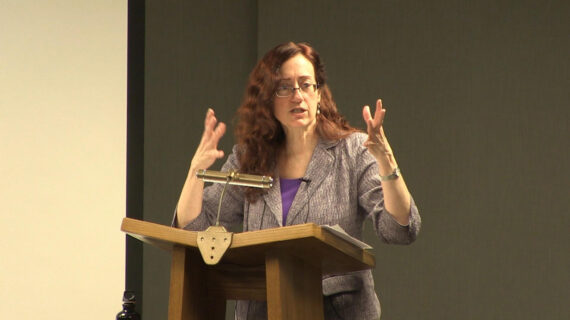
Cami Collins, Research Assistant, Department of Physics, UW-Madison, asks how stars and planets form and why some black holes are the brightest objects in the universe. Collins discusses the underlying physical mechanism which could reveal the answers.


Copy and Paste the Following Code to Embed this Video:
Unlocking the Secrets of Why Black Holes Shine
cc >> Welcome to UW Space Place. This is our guest speaker night. I'm Jim Lattis. Tonight, we are very lucky to have Cami Collins who is a researcher in the UW physics Department. She researches plasma physics and actually does laboratory experiments on black hole physics, which is something I didn't even know was possible until I first talked to her. So she's going to talk to us tonight about unlocking the secrets of why black holes shine. Cami. >> Thank you. All right, so as he said, we've created a plasma experiment in the physics department, and so I'm going to be talking about what plasma is, why we study it, and this plasma experiment we're trying to use to study things in astrophysics. So I'll talk about what's interesting and what we're trying to study. Okay, first let me start with this thought. Equipped with his five senses, man explores the universe around him and calls the adventure science. So, we certainly do learn a lot about our world using our sense and especially our eyes. Our eyes can only pick up a certain part of the spectrum, which is visable light. Of all the light that's out there, we can only see just a very small range. This is because light in the entire electromagnetic spectrum, some of it has wavelengths that are too long or too short for our eyes to pick up. So, for example, radio waves have really long wavelengths, which are the size of buildings. Gamma rays have very short wavelengths, so our eyes can't pick this up. However, recently, especially in the past 20 years, we have been able to picture our universe in the full electromagnetic spectrum, and this is because we have been able to send spacecraft above Earth's atmosphere and use very sensitive instruments to pick up all of the wavelengths in the sky. So this is the Milky Way, our galaxy, in visible light, and when we look at it in radio waves, we see it's actually very, very bright and you see a very bright emission from the disk and we see other spots in here which are distant galaxies emitting radio waves. If we move in higher energy in the electromagnetic spectrum, we see microwaves which are very, very bright. It's as bright as can be. And we see, if you look very closely, we have the microwaves emitted from the Milky Way, very bright in the disk, and then in the very background we see what's called cosmic microwave background radiation which is the oldest light we know of which was emitted at the very beginning of the formation of the universe. So, as we increase, basically as we go to the right in the spectrum, we're getting higher and higher energy light, and so infrared light is emitted from warm gas and plasma, which is what we'll talk about in a little bit. And this is H-alpha light, which is specifically emitted from hydrogen. So we can use this to see where all the hydrogen is in the Milky Way. And this is back to visible. So now that you look at this, it kind of looks a little bit dark and dim and not as fun. And as we continue to go on and see higher energy electromagnetic radiation, we see x-rays and, even further, gamma rays. So some of the energetic light that's being emitted in gamma rays is actually originating from black holes. So we're going to talk about why black holes would radiate such high energy light. But before we get into that, I just want to talk about what plasma is. So most of all the light that we were seeing in the Milky Way, 99% of it is actually coming from plasma. So plasma is actually very common in the universe, but to us we don't usually see it in our every day lives. But from the perspective of our universe, we're actually the rare people. So, plasma is something that happens, you can think of it as the fourth state of matter. So we have solid, liquid, gas, plasma. So we could start with a solid like ice, and as you add heat and melt it, it becomes a liquid, it becomes water. As we heat water, we boil it and produce gas. And then if we heat gas, we produce plasma. So plasma is like what makes the sun and all the stars. So plasma you can think of it as being a collection of positively charged ions and also electrons. Just super charged particles. So plasma is formed, you can look at the structure of an atom, which is a positively charged nucleus which has protons and neutrons, and then there's electrons orbiting the nucleus. And so in plasma, an electron would gain enough energy through heating it, for example, that the electron would pop off, so then you're left with what's called an ion, which is whatever is left over, and then this electron flying around. So this is what makes up a plasma. And so a plasma is like a hot gas, but it contains charged particles, which are electrons and ions, and it can conduct electricity and respond to electric and magnetic fields. So that's the definition of what a plasma is. So we study plasma because for one thing we would really like to do nuclear fusion on Earth. So, nuclear fusion is a process which happens in all the stars, and it happens when two hydrogen ions collide, fuse together, and out comes energy. So this is a very efficient process, and we would like this to happen on Earth. So, on Earth we don't have gravity like the sun has gravity. So the sun is able to collect gas and hold it and make it hot enough and compact enough to create these reactions, but on Earth we don't have gravity so instead we have to make use of magnetic fields to hold the plasma. And so there's a funny thing about charged particles when a magnetic field is present, if the field is strong enough, charged particles will orbit that field in circles. So if we take a magnetic field and stretch it and twist it into the shape of a doughnut, we could confine plasma. And so we need to confine plasma because it's really hot. It has to be really hot in order for fusion reactions to happen. So this is the device which is called a tokamak where we would like to have fusion happen. And so the current effort is to build an actual fusion reactor. And this is something that's being built in France right now. It's called the ITER project. So this represents where we're at in fusion research, and it's a challenge, it's an engineering challenge. For one thing you have plasma in the center of the doughnut which is 150 million degrees C. And then just a few feet away, you have superconducting magnets that are minus 270 degrees C. So this is an engineering feat in itself, and then, on top of that, the plasma doesn't really like to be confined by magnetic fields and it wants to kind of get out and sometimes there are disruptions that happen, so we have to make sure disruptions don't happen because if the plasma does escape, it can damage the wall and melt the walls of the reactor. This is a challenging process, but this is the main motivation for studying plasma physics. There have been some other good things that have come out of plasma. For example, lighting. So, fluorescent lights have plasma inside of them. Neon lights are made of plasma. Many electronics devices have benefited from plasma depositions. So you can deposit very thin films onto semiconductor devices. We also have plasma TVs which contain little cells of plasma. We also have spacecraft propulsion. So these are Hall thrusters that are mounted onto spacecraft and propel them. And, most recently, people have been looking at plasma as a way of disinfecting and also possibly a toothbrush, a plasma toothbrush may be in the works. And also, people have looked at how plasma may be able to actually help heal wounded skin. This is relatively new research, but it's interesting nonetheless. So finally, the third branch of plasma physics is astrophysics. So it turns out in order to understand some of the really interesting questions in astrophysics, we have to know about plasma physics and what the processes are behind these mechanisms that are occurring. Some of the questions that we ask are where do magnetic fields come from? Why do some stars have strong magnetic fields and weak magnetic fields or some stars don't have magnetic fields? What causes solar flares, like the sun? What causes coronal mass ejections? These are really detrimental things that could happen if coronal mass ejection is pointed right to the Earth. It can damage a lot of electronics and satellites that are orbiting the Earth. So we'd like to know if we can predict these. And also, the third question has to do with how stars and planets form. And so, here at UW, we are embarking on what you could probably say is a new frontier in laboratory astrophysics. So we're creating plasmas which are hot and they're fast-flowing, but they are unmagnetized. So this is a lot different than other plasma experiments which use really strong magnetic fields, like fusion experiments. So this is on the opposite regime where we have very weak magnetic fields or no magnetic fields at all so the plasma is unmagnetized. When you have a plasma like this, you can start to study things like how does flowing plasma generate magnetic fields. So this is how we think magnetic fields are generated. And so this is an experiment at UW which has recently been built called the Madison Plasma Dynamo Experiment, and they, oops, we are hoping to answer this question. And the second experiment, the one that I'm going to be talking about today, is called the Plasma Couette Experiment. This has something more to do with how stars and planets form, and, specifically, why does matter rapidly fall inward in accretion disks? This is the question that I'm going to be trying to answer. So, just to give you some scale, this experiment is about one meter tall and about one meter in diameter. You can see it's a cylinder so it has plasma inside. It's a cylinder, and this is about a three-meter diameter sphere. So it's quite a bit larger. Okay, so, virtually all astrophysical objects are formed by this process I mentioned called accretion. So accretion is what happens when a cloud of gas and dust starts to collapse under its own gravity, and before we long we have a disk of flowing, rotating gas and matter which is orbiting a central object like a newly forming star. And so over time as the accretion occurs and more mass collects onto the central object, the disk gets warmer and the central object gets hotter. And then if the gas is heated to more than 10 million degrees C, fusion starts to occur. So this is how a star is born. And the star begins to grow brightly from millions to billions of years. And so we have observed star forming disks, accretion disks. They're small and they're usually very far away so they're kind of hard to observe, but these are images from the Hubble Space Telescope that show protoplanetary disks in the Orion nebula. And so, actually, accretion is a process which plays a role, an important role, in many stages of the life cycle of a star. So when a star begins to die, the hydrogen fuel supply of the core starts to run out, the core becomes unstable and collapses, and then the outer layers expand and cool and we get a red giant. And then after the outer layers continue to expand, the center core left over is called a white dwarf, and that continues to cool. On the other hand, if we have a massive star, you get a red supergiant which can then explode in a catastrophic explosion called a supernova. And depending on how catastrophic it was and the mass of the center core, the supernova could contribute to just becoming a star-forming nebula again, or if the center core is massive, such as 1.4 to three times the mass of the sun, the remaining supernova gas accretes and forms a neutron star. And then if the center core is even more massive, like more than three times the mass of the sun, the center core collapses and forms something that's called a black hole. And so, as you may have heard, black holes are these really strange objects where whatever falls into them is gone forever, and they don't emit any light because they're such strong gravity. And they can also eat other stars and become more massive. And they can eat other black holes and become even more massive. So black holes can grow and become supermassive black holes. And so if they don't emit any light, how do we know that they really exist? Well, one way is to look at the motion of stars that surround the black holes. So this is zooming into the very center of the Milky Way galaxy. And over the course of 16 years, scientists tracked the motions of stars. And you can kind of see that some of the stars are making some weird swinging motions. And if you trace out the orbits, these stars are orbiting what is a massive, not a supermassive but just a massive black hole at the center of our galaxy. And so this is one way we can tell where black holes are, and you can also figure out how massive the black holes are. So, as we'll see in just a few slides, some other black holes are detected because they actually emit light, but not the black holes themselves but the accretion disks that surround the black holes. And so it turns out that accretion disks can sometimes be even brighter than stars. And so we know this by using a technique called spectroscopy where scientists look at the amount of light that is emitted from the object, so in this case of a star, then they plot the amount of light that is collected at each wavelength. So this is short wavelengths and longer wavelengths. The color is sort of like the temperature. Because we're just looking at a star, we have hot emissions so we have a lot of warm light being emitted. So this would be the spectrum from just a star. In the case where there's an accretion disk surrounding the star, the process of accretion, the disk heats up and begins to emit more light. So, actually, the spectrum of light coming from a star that has an accretion disk surrounding it is a lot more bright than if you would just have a star alone. And then, interestingly enough, we can pick out features of the accretion disk. For example, if the middle part of the disk is missing because a planet has formed and used up the material there, we would see a dip in the spectrum. And so accretion disks can actually be brighter than stars, which is interesting. And the reason that accretion disks emit light is this. You can think of the particles in the disk, they have both kinetic energy from orbital motion and gravitational potential energy because this is due to the traction of the mass particles orbiting the central object, like the star. And so when matter falls inward in an accretion disk, it loses some of its gravitational potential energy, but it doesn't lose it; it actually gets converted into heat through friction from collisions in the disk, and a fraction of that energy is radiated as light. So I think a good analogy of this is what happens when, say, a space shuttle comes into the Earth's atmosphere. So, as its gravitational potential energy is decreasing, it's speeding up, it's moving towards the Earth, and then friction with molecules in the atmosphere causes it to heat up and then emit light. And so we can sense the reason that the light is being emitted is because we're losing gravitational potential energy. We can estimate for an accretion disk how bright we would expect the disk to be, and it turns out that it would be proportional to the mass of the central object divided by the radius of the central object times how fast mass is moving inwards in the accretion disk. And so you can see for black holes, which are really massive and really small, the accretion disk can emit a lot of light, and it can be very bright. So, accretion really is a power source which is converting mass to energy. So you can calculate the radiative efficiency or how much energy is released from this process and compare it to other mechanisms. So, for example, the efficiency of burning coal is really not efficient. Nuclear fission, this is what happens in current nuclear power plants where we split atoms and we get energy from that. So it has a small efficiency compared to in the nuclear fusion which is what we were talking about when we join atoms, which is a little less than 1% efficient. But when you compare these processes to accretion, such as accretion around neutron stars and black holes, this is a very efficient process. 25% to even sometimes 40% of the mass accreting inwards is radiating and converting energy and mass into light energy. And so the only thing more efficient than this that we know of is matter anti-matter annihilation. So this is the most efficient process of converting energy from matter. So, we have some evidence of black hole accretion, and this is an example, a really interesting example of what's called an x-ray binary system. So we think it's a black hole that's surrounded by, it has actually a companion star and it's trying to eat the star. So in the process, it's sucking material from the star which is forming an accretion disk. What's interesting is that about 50 seconds or so, if we look at the x-ray emission versus time, and this is a movie of the process, the disk all of the sudden emits a lot of light in x-rays. And this is, what we think is happening is there's a jet that's emanating from this disk. Somehow a jet forms and every 50 seconds or so it shoots out particles, like, 92% the speed of light and then, after that happens, the accretion disk forms again and then it shoots out particles and then this process emits x-rays. So this is a very powerful process, and we don't really know why or how jets are formed. We don't really understand how matter is being shot out from the accretion disk. How is it launched, and how is the jet so well defined and columnated, as we say. And so maybe there are magnetic fields that are getting wrapped around this jet and helping to keep it in a straight line. But this is what astrophysicists are currently trying to study, and these jets are actually very, they expand such huge distances. So this is actually a galaxy. So there's an accretion disk surrounding a supermassive black hole at the center of the galaxy, and just to give you a sense of scale, these are a bunch of stars in the disk and then this is the central disk which is about 400 light years in diameter, and the jets themselves are much larger. This scale is about 88,000 light years. So it's an interesting process. And we see jets very often occurring in accretion disk systems. This is another example. This is actually my favorite active galactic nuclei, as we call them. This is Centaurus A which is actually the closest active galaxy to us. And we see, again, this is a composite image, so it shows the light in x-ray and the light in radio and optical and combines it. And so if you were to see radio waves in the night sky, the jet coming from this galaxy is about 200 times larger than a full moon. So it's just amazing. So we want to know things like how does this happen? How is an accretion launching such magnificent objects? And then finally, quasars are active galactic nuclei which are very, very far away. And these are the most luminous, powerful, and energetic objects we know of in the universe. Some quasars have the luminosity of one trillion suns. So these are evidence that there are some pretty remarkable objects that are being powered by accretion. And so the question that we're asking is, what is the underlying mechanism that powers accretion? Okay, so, what we're trying to figure out is why does the matter in an accretion disk fall inwards? So you can think of just planets orbiting the sun. So planets don't fall into the sun, and the reason they don't fall into the sun is because they have something called angular momentum. So this is a product of their mass times their orbital velocity times the radius of the distance from the sun. And so this is a fixed conserved quantity. Planets are not losing angular momentum, so they stay put. So why an accretion disk would matter, fall inward. So in order for a particle in an accretion disk to fall inward, it would somehow have to transfer some of its angular momentum to another particle. So if it was able to transfer its angular momentum outward, then it would allow the mass to fall inward. Somehow there's a transfer of angular momentum that's happening. And so the question becomes, how exactly do particles in accretion disks transfer momentum? And so one way is through molecular viscosity. This is a process which you can think of as the friction between layers of particles that are moving at different velocities. So you can imagine particles moving fast compared to particles moving slow, and if a fast particle makes a collision with a slower particle, that slower particle would speed up, the fast particle would slow down, and so there's an exchange of momentum. The only problem is that if you were to calculate the viscosity of an accretion disk, it actually turns out that it's very, very small, and it would end up taking longer than the age of the universe to form a simple star like the sun. So there must be some other way for particles to exchange angular momentum. And one possible answer is that there is a type of instability occurring in these disks which is basically enhancing viscosity and making it seem a lot larger. And so it turns out that if you have a disk with conducting plasma, so disks are often hot and the gas, when it gets hot, becomes plasma, and you combine that with rotation, differential rotation which is what we have, just like how the planets orbit the sun, and what this means is that the inner particles are orbiting faster than the outer particles. This is differential rotation or Keplerian motion. And if you have the plasma, the rotation, and then you add a weak magnetic field, so magnetic fields can come from, just large scale galaxies can make magnetic fields. So the magnetic fields can just be permeating disks, star-forming disks, or disks surrounding black holes. There's another way to get magnetic fields which is from the stars themselves. So if you have all three of these ingredients, we think that this is possible that there is an instability which is called the magnetorotational instability, and so I'll talk about this a little bit more. But if this instability occurs, it could act to enhance collisions and enhance, basically, viscosity, make it larger. And this could be leading to fast accretion. And so the magnetorotational instability has a long name, so I'm going to call it the MRI, and it's actually one of the very few plasma instabilities that we can really have a picture of in our minds. There's a mechanical analogy to it. So I'm going to try to describe this to you because I think it's kind of neat. So first you can imagine having a disk which has, so this would be a side view of the disk and this is the top view. And if you can imagine a magnetic field permeating this disk and this disk is rotating just like an accretion disk. So the mass on the inside is flowing faster than the mass on the outside. So if you can imagine having two fluid elements, and when I say fluid elements I would mean blobs of plasma in the disk, these two elements are threaded by the magnetic field. And you can think of the magnetic field as acting as a spring. So you have a spring connecting two fluid elements. And if somehow one of the fluid elements is slightly perturbed so that it would fall inwards a little bit, and maybe the other fluid element would go outwards, you'd have something where you have two fluid elements at different radii and they're connected by a spring, which is the magnetic field. So, the thing is that inner fluid element is actually moving faster than the outer fluid element because of this differential rotation. And so what happens is the inner fluid element is moving faster and it's trying to speed up this outer fluid element because they're connected by this spring. And in this process, the inner fluid element loses momentum to the outer one. So this is transferring momentum, and the result is that the inner fluid element ends up falling to a lower orbit, and the outer fluid element gains momentum and moves outward. So this further acts to stretch the spring, and that even transfers more momentum. This is what we call instability. It's a runaway process. So you end up having mass falling inward to the central object. So this could be what's happening in accretion disks. This is what we call the MRI. Okay, so, this is just an animation of the process. So we have our disks differentially rotating, and then you can imagine a magnetic field connecting fluid elements. And if they were perturbed, the inner fluid element is moving faster, it drags the outer fluid element with it, transfers momentum, and the end is that you have matter falling inward. And so this is how momentum can be transferred. So there have been simulations that I've done showing that, in fact, the MRI can actually lead to mass falling inwards. It can enhance the viscosity of the disk. So this is a very powerful simulation that was done. And you can see what it looked like. The MRI really messes the disk up, makes a lot of fluctuations, or turbulence is what we say. And so it seems like we're done. We have super smart people that made a beautiful simulation, and it seems to work. The thing is that there have been a lot of assumptions that go into simulations, and so simulations are not perfect and there's no way that we could ever attempt to simulate an entire accretion disk from the very small scales to the large scales and the very short time scales to the very long time scales. We just don't have the computational power to do that. And so in order to do simulations like this there have to be assumptions. So this is why it's really important to do experiments because experiments can help to validate simulations. So if you can use a simulation to predict what would happen in an experiment and you're right, then you begin to trust your code. And so the usual argument is that in an experiment you can make limited measurements, so you can stick a probe in certain spots and you can measure whatever quantity you want to measure. You have to remember an experiment is bounded, so it's a little bit different than an accretion disk. You're not trying to make an accretion disk with an experiment. And it's also computationally accessible which means that in some cases simulations can exactly use the same values of density and temperature that you find in the experiment and you can exactly simulate the experiment. And then in a simulation you have complete measurements because you can ask your computer exactly what the velocity or the density of the plasma is at any spot. Simulations also often have boundary conditions. So you have to think about what happens when the particle reaches the edge of you box that you're simulating. But the idea is that simulations can be validated by the results that we learn in experiments. So, in the end, we have to compare what we learn, and, no matter what, nature is always right. Whatever we learn has to be agreeing with what we observe. And so this is why we want to try to do an MRI experiment because the MRI has not yet been observed in the laboratory plasma just by its importance. And so if you wanted to design an MRI experiment, what would you need? Well, you might want to start with a cylinder and have a hot, which means conducting, plasma and you'd want to maybe initially have it unmagnetized because this is exactly what the plasma is like in an accretion disk. It's hot, it's moving, and it's unmagnetized. So we need to make it move, so we'd have to make it spin with differential rotation, which looks like this. So the velocity versus radius. It has to be spinning faster on the inside than it would be on the outside. And this is what Keplerian flow looks like. This is how the planets orbit the sun and how accretion disk flows are. And then finally, in the end, if you had all of that, you could add a vertical B field and then hopefully see this instability that has been in theory for so long but hasn't actually been observed in an experiment. So this is the experiment that we'd like to try this in. This is what we call the Plasma Couette Experiment. Couette is just the name of a guy that studied flow between two cylinders. So we named the experiment Couette. So this is a picture of what it looks like. It's a vacuum vessel. It's a cylinder. It's about one meter tall by one meter diameter. And I'm going to talk about how we actually make the plasma. So we pump in microwaves. So these are the same microwaves you have at home in your microwave, but there's a special wave guide that guides them into the chamber. So this is how we make the plasma. We spin the plasma using what are called cathodes. So they're just basically like light bulbs and they're really hot and they're biased with large voltages. So we can stir the plasma using these cathodes. And then we measure the plasma using probes. So we have robotic probe drives that push probes into the plasma. We can measure quantities versus radius or quantities versus Z, vertical. In order to confine the plasma, we've used very strong magnets. So I'm going to talk about how we confine the plasma. So in order to make a hot conducting plasma, you do have to make sure that you confine the plasma to some extent. You don't want the plasma to be hitting the walls of the chamber. And in order to confine the plasma, the best way to do it is to use magnets, but we've designed our magnet system to be very clever. So this is a picture of the cage of magnets that we use. They're actually permanent magnets, and these permanents magnets are glued to rings. So these rings are, they're actually alternating in polarity. So you can think of a bar magnet, there's a north pole and a south pole. This is a cross-sectional view. This is the center line versus radius. So this would be cutting through the center of this magnet cage. So this is plotting what the magnetic field looks like inside the cage. So these rings, we've arranged them so that the first ring has all of the poles pointing with the north pole facing inward. The next ring up has the south pole facing inward. The next ring up has the north pole. So if you connect the magnetic field, you see it connects to be what's called, we call this a cusp confinement. What ends up happening is that the magnet field from the permanent magnets is really strong at the outside, at the edge, and then it drops off very quickly and leaves a very large volume of unmagnetized plasma inside. And so we've arranged these magnets so they're everywhere. They contain the plasma. There's concentric rings on the bottom and the top of the cage. And then this whole assembly is actually stuck inside of the vacuum vessel. It has to be water cooled because plasma is hot. So this is all the water cooling that we've installed. Okay, and so the second stage is creating the plasma. And so you have to, since this is a vacuum, you have to add some gas so you have something to make plasma out of. So we use usually argon gas or helium gas. And then, as we add the gas, we also turn on microwaves. And so this ends up exciting the electrons and the electrons get so excited that they orbit faster and then they can end up ionizing. So what happens is you have the ions and the electrons and this is how you form the plasma. Okay, and finally, we have to be able to stir the plasma. So the way that we stir it is by using electric and magnetic fields. So there's a funny thing about charged particles. When you have the B field we talked about how charged particles orbited the magnetic field in a circle. Well it turns out if you add an electric field, which is perpendicular to the magnetic field, the plasma or the charged particle has what's called E cross B drift. So it ends up traveling in the direction that's perpendicular to both the electric and magnetic field. So this is due to the Lorentz force is what we call it. So this is a motion of the particle, and so we can use this in our machine. So we can stick electrodes in at the edge where we have a magnetic field. These electrodes can be biased to create and electric field. So we have an electric field, so you can compare maybe this E field that's pointing up to this E field that's pointing up between the electrodes. Then you have a B field. So the E field and the B field are perpendicular and you end up inducing this motion of the charged particles. So, in this case, we've installed what we call anodes and cathodes, which are these electrodes, at the edge of the device, and then we bias them just by applying a voltage with a power supply. And then in this way we can create flow. And this flow is in the -- direction. So it would be into the page on this diagram. So this is how we can create flow. And I'm going to show you a quick movie about how this all comes together in the lab. And so you see we enter the lab, it's a little bit dark because you want it dark in order to really see the plasma. So we turn on the water cooling for the magnets, we turn on the power supplies, we turn on the gas tanks so that we can put gas into the machines, we turn on the ECH or what's called the microwaves, and then when you turn on the microwaves you get a plasma. So you might be able to see, as this moves forward in time, as soon as you turn on the microwaves you get a plasma. So that's what the plasma looks like. This is argon, so it's purple. And if you look inside, you can see those really bright filaments that we're using in order to spin the plasma. So that's what it looks like when you run the experiment. So in reality, we use computers to run the experiment, so everything is automated. So this is what we do versus time. So we pump in gas, a puff of gas, and then as the gas is pumped out by the vacuum pumps, it decreases in time. And then at the same time we puff in the gas, we turn on the microwaves. And then at some other time we turn on this bias which is spinning the plasma. And so this is what happens, and then we can measure the plasma using probes. So we measure quantities like the density of the plasma, how much plasma is in there, the temperature, how hot is it. So you can see how these quantities change versus time. And then the best part about all of this is we actually didn't know if this whole spinning technique would work, and it turns out it works really well. So this is an example of what the velocity profile looks like versus radius. So I had a probe that I put in there to measure the flow of the plasma, and when we were spinning the plasma with those electrodes at the very edge, you can see there's a very large velocity which is almost six kilometers per second in some cases, which ends up being 13,400 miles per hour. And so it's spinning very fast at the edge, and then what happens is, since the plasma has viscosity, this helps to couple the momentum inward. So this is kind of like stirring a bucket of water. If you just stir it on the edge, the viscosity of the water helps to stir and the whole bucket will start to flow. So this is what we're doing, stirring plasma in a bucket, really. So I'm going to show you a movie of this versus time. You can see this dashed line is marking where I'm at in time. And so this is measuring the velocity versus time. As soon as I turn on the bias, you see the plasma spins up, and as the plasma parameters change in time, they're optimized and the plasma gets faster and faster. So this was how we showed that we can actually stir plasma, which people hadn't done before. And so this is what we really made was what's called kind of like solid body rotation where it's just being stirred at the outside. But what we want, remember, is we're trying to make something that looks kind of like an accretion disk where we're spinning the plasma fast in the middle and slower on the outside. And so in order to do that, we've had to install what we call the center stack. And so this is a stack of magnets at the inner boundary in the center of the machine. And in the same way, we add electrodes in between the magnets. And so these are hot filaments. This one isn't hot right now, but as it's heated, it's just like a coil of tungsten, you pass current through it and it gets really hot just like a light bulb would work. So it's really hot, and it's only like three centimeters from these permanent magnets. You might know that if you have a permanent magnet, if you heat it, it will actually demagnetize. So we have to make sure that we keep our magnets cold, otherwise we would not have magnets anymore. And, in some cases, we have accidents because this is very hot, and sometimes things go wrong. So this is part of the experimental process. You have to figure out how to make all of this work. But some of our initial results have been that as we're starting to spin the plasma from the center, you can see that the velocity profile is just starting to spin up in the center. So our goal is to keep spinning the center so that we end up having what's kind of like a Keplerian rotation profile. So this is where we're at right now. We're trying to spin it from the center. At that point, then we can add this vertical magnetic field and hopefully measure the magnetorotational instability. So I just kind of like to think about,
I like this statement
it is in our genes to understand the universe if we can, to keep trying even if we cannot, and to be enchanted by the act of learning all the way. And so, I talked about how we created a hot, fast-flowing, unmagnetized laboratory plasma, and we're trying to observe this really important instability that may be playing the key role in astrophysical accretion disks. And so I just wanted to acknowledge the large group of people that are part of this project, part of making these types of plasmas, especially my PI professor, Cary Forest. And we have a large group of engineers, postdocs, scientists, grad students, and undergraduates. And so I'd like to thank you for you attention and also say that we have these really cool plasma trading cards that I wanted you all to pick up before you left, and this actually, they have a lot of objects that we were talking about today. So you can take those home and look at them more if you'd like. So, thanks.
APPLAUSE
Search University Place Episodes
Related Stories from PBS Wisconsin's Blog











Donate to sign up. Activate and sign in to Passport. It's that easy to help PBS Wisconsin serve your community through media that educates, inspires, and entertains.
Make your membership gift today
Only for new users: Activate Passport using your code or email address
Already a member?
Look up my account
Need some help? Go to FAQ or visit PBS Passport Help
Need help accessing PBS Wisconsin anywhere?

Online Access | Platform & Device Access | Cable or Satellite Access | Over-The-Air Access
Visit Access Guide
Need help accessing PBS Wisconsin anywhere?
Visit Our
Live TV Access Guide
Online AccessPlatform & Device Access
Cable or Satellite Access
Over-The-Air Access
Visit Access Guide




Follow Us