

 Passport




The Wisconsin Idea
09/21/11 | 28m 47s | Rating: TV-G
Katherine Sydor, a graduate project assistant at the Center for Nonprofits at UW-Madison, explores the Wisconsin Idea. She delves into the history of the relationship between the UW-System and the citizens of Wisconsin.


Copy and Paste the Following Code to Embed this Video:
The Wisconsin Idea
cc >> I'm Jeanan Yasiri. Welcome back. We are going to start our conversation today by talking about something that is extremely important here at the University of Wisconsin and really all around the world. It's the Wisconsin Idea. It's something that we sent you a survey on a little earlier, a few days ago, and you provided us with your feedback on what you know and what you don't know about the Wisconsin Idea. And it's also very important here at the University of Wisconsin because we are celebrating 100 years of the Wisconsin Idea. And so with that, I want to introduce my colleague and graduate student here at the UW, Katherine Sydor. Katherine is a project assistant with the UW Center for Non-profits. She is also a master's degree candidate with the UW School of Public Affairs, the La Follette School of Public Affairs, and she'll be providing today's lecture. Please welcome Katherine.
APPLAUSE
>>
Katherine Sydor
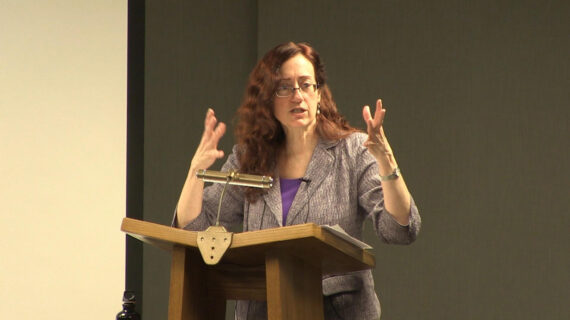
Good afternoon, everybody. We touched on the Wisconsin Idea, I believe Jeanan mentioned it maybe the first day of class. But we're really going to get into it, talk a little bit about the history, and then about the importance of the Wisconsin Idea to everyone in this room, to campus, to University of Wisconsin, and then we're going to talk about how that connects to the themes that we're talking about in this class throughout the entire semester. As Jeanan said, my name is Katherine and I just want to give you a little bit of my background so you understand why I'm giving this lecture, and then you can maybe make some connections between public policy, politics, government, and Entrepreneurialism as we move through the semester. I went to high school in Wisconsin. I went to Hartford. I don't know if everybody is from there. And I went to Minnesota for my undergrad where I majored in history and women's studies. I then moved out to Washington, DC, where I worked for Congress for about four years. I worked for David Obey who used to be a representative from Wisconsin, from northwestern Wisconsin, Wausau, Superior area. And then I worked for a senator from Oregon, Senator Jeff Merkley, for a little while. After that decided I wanted to come back to school, get my master's in public affairs, and that's what I'm doing at the La Follette School right now. It's a two-year program and I'm right in the middle of it. I've got one more year to go. And the La Follette School of Public Affairs is named for Bob La Follette, who we're going to get to in just a little bit during our lecture here. Just a couple notes. A timeline for your notes might be helpful as you're listening to this lecture. You're going to want to take notes on what I'm saying. It's going to help you do the assignment that Jeanan's going to talk about at the end of class. I can put the PowerPoint up on Learn at UW if that would be helpful for you all, and if you have any questions or you want to talk about your assignment, talk about ideas for your assignment, please feel free to email me. You guys all have my email. It's [email protected]. So, what is the Wisconsin Idea? I really hate just talking at you, so I'd like a little bit of audience participation, if that's okay. A little bit of back and forth. That's how we can all learn together. Does anybody want to take a stab at what the Wisconsin Idea is? Does anybody? You guys all responded to that survey. So I'm assuming some people have some thoughts or ideas. Anybody want to help me out, please?
INAUDIBLE
Katherine Sydor
>> Once people get educated, they go out and try to do other forms of service. >> Service? Yeah, good. So she said once people become educated they go out and do other forms of service, which I think is definitely a good definition. Does anybody else have any other thoughts? Sure. >> It helps the--
INAUDIBLE
Katherine Sydor
As far as careers go and other aspects of life. >> So she's saying that it's helping prepare people for their life after college, not just career-wise but maybe community-wise, right? Great. I think those are really good ideas. So just so you know what the survey said, the one that we sent out last week, 42% of you had heard of the Wisconsin Idea before and 31% had heard of the Wisconsin experience. And this is sort of interesting because we've been doing this poll the last year, and this is a slightly higher percentage than what we had gotten last year in the last two semesters. Last year, I believe, it was more around like 20% or 22%. So I think the awareness of the Wisconsin Idea is growing a little bit more. Generally, I think Jeanan's experience in the past, we found that undergraduate students aren't super familiar with it. And I honestly wasn't either until I had come here for graduate school. Graduate students seem to be a little bit more connected with the philosophy behind it. So what we wanted to do is share that philosophy with all of you so that it can be 100% of you all know what it is and can take that into the rest of your classrooms across campus. So I'm going to read a couple quotes from people who responded to the survey and gave their definitions, and the thing I want you to keep in mind is that the definition of the Wisconsin Idea is somewhat fluid. So it can mean different things to different people. There's some general ideas that we want you to kind of stick with. But there isn't one definition and there hasn't been one definition throughout time either over the last hundred years. The Wisconsin Idea is the belief that Wisconsin should have a major research university that contributes to the welfare of Wisconsinites, the country, and the world through new ideas and public service. The Wisconsin Idea is that education is in and outside the classroom. It is a development of the skills and assets that make a student a leader and an innovator. It is also the idea that our education needs to go beyond the classroom and that we are endowed with a liberal education to teach others, to create new things, and to be leaders in a global world in every way. I'm not sure who gave that definition but I really like it. That's really great. It is an idea to create a well-rounded education for all of the students attending UW-Madison. So, like I said, there really isn't one definition. We can kind of think about all of those things as being accurate. Here are a couple more definitions. So in the spirit of the Wisconsin Idea, the university of continues to seek ways to extend its influence beyond the boundaries of campus. So part of the philosophy of the entire Wisconsin educational system is this idea. And it also has broader university implications throughout the world. Some people call it a political philosophy, and that would be progressivism. But the Wisconsin Idea isn't just that. It's a lot of different things and here are some concrete examples. Workers' Compensation. Workers' Compensation is an idea that grew out of Wisconsin using the concepts coming from the Wisconsin Idea. Social security, an idea that was developed right here on campus, and we'll talk about that a little bit more in a little bit. The public regulation of utilities. And the nationally recognized Institute for Research on Poverty. The work that they do on campus here, embodiment of the Wisconsin Idea. And there are a lot of things, like Social Security, Workers' Compensation, laws and policies that have been in place so long that we might not even really think about them as being something that grew out of this idea but they certainly are. It's just that we're so used to hearing about them we don't really necessarily connect them anymore. So just to give you a little bit of history, Charles Van Hise was university president in 1903 to 1918, and he's commonly credited for bringing the Wisconsin Idea really to the forefront of the university. A little background on him. He was born in Fulton, Wisconsin, and he died in Milwaukee. So he was a life-long Wisconsinite. And, like I said, he was the president for 15 years. And he really had some great connections with some other people who developed the Wisconsin Idea on campus. One being Bob La Follette. And we're going to talk about him in just a second. But Bob La Follette, Sr., supported Charles Van Hise's presidency of the university. So there were some great connections between these sort of Wisconsin statesmen about a hundred years ago. And the big thing that Charles did is he created and help implement the University of Wisconsin Extension division which became the backbone of the UW System. How many of you guys have heard of UW Extension before? Pretty good amount, right? It's a pretty big important part of the university system, and, again, this is one of just sort of the embodiment of the Wisconsin Idea that we're going to have little pieces of the university out across the state, spreading out, bringing the knowledge of the university to people out there and also bringing the ideas and the questions that people sort of out in the rest of the state have for researchers to solve here. I'm just going to read the definition of the university Wisconsin Extension system from their website. So University of Wisconsin Extension provides statewide access to university resources and research so that the people of Wisconsin can learn, grow, and succeed in all stages of life. And, again, I want to sort of emphasize the back and forth nature of this relationship between UW Extension and the people of Wisconsin. It's not like UW Extension is just giving out information. They're taking questions back, too. UW Extension carries out the tradition of the Wisconsin Idea, extending the boundaries of the university to the boundaries of the state through its four divisions. They've got Continuing Education, Cooperative Extension, Entrepreneurship and Economic Development, Broadcast and Media Innovations. So that's what Charles did. Another really important character in this story is Charles McCarthy, who was a librarian at the Legislative Reference Bureau, which is still a part of state government. I actually have a friend who used to work there. And in 1912 he wrote a book called "The Wisconsin Idea." And this is really sort of the first time that the phrase was really coined. And the introduction to the book was actually written by Theodore Roosevelt, which is really cool. So Wisconsin was really getting a lot of national attention for this idea about extending the boundaries of the university throughout the state. And Theodore Roosevelt, this is what he said in the introduction. "In Wisconsin there has been a successful effort to redeem the promises by performances and to reduce theories into practice. In no other state in the union has any university done the same work for the community that has been done in Wisconsin by the University of Wisconsin." So this is something that really sort of makes me kind of proud, that this great president wrote the introduction to this book about this sort of, probably at the time people thought maybe a quaint idea that has grown into such a big important part of what we do here. It's just kind of neat to look back on that. And like I said, just remember that Charles McCarthy worked at the Legislative Reference Bureau. So we're going to come back to that again. So, as I already said, we don't want to focus too much on one definition, but in case you do want to write something down, Jack Stark's definition might be something that you might consider taking note of. It's just one person's interpretation but it's helpful to have. And just so you know who Jack Stark is, he's the Assistant Chief Council at the Legislative Reference Bureau. He was and I'm actually not sure if he's still there. But in 1995 he wrote an article called "The
Wisconsin Idea
The University's Service to the State." So as far as I can tell, really, the two big pieces of literature or reference that have ever been written about the Wisconsin Idea have been done through the Legislative Reference Bureau. So there was the one in 1912 by Charles McCarthy and then there was this guy at the Legislative Reference Bureau in 1995 who was like I'm going to write about the Wisconsin Idea as well, and so he kind of gave a lot of the information in his lecture is from Jack Stark's paper. He sort of outlined the history and the timeline of everything. And I think, somebody might correct me, but I believe this is the most complete history of the Wisconsin Idea, and it was published in the Blue Book in 1995-1996. So here's a historical frame of the Wisconsin Idea. Think about the time that Charles McCarthy wrote this book. 1912, right? Turn of the century. Think about what life was like in the early 1900s. The country and the state were beginning to become industrialized, but we were largely still farmland, right? There's a lot of family farms out there. And there was a need for smart development practices, especially in agriculture. So there were all these farmers across the state, across the country, who were growing food, raising cattle, and they were looking for best practices. And this is one of the ways that the Wisconsin Idea really sort of took hold was with this need for knowledge that these farmers had in Wisconsin and the research university being here needing questions to answer. So here are all these questions. How should we grow soy beans? How should we grow corn? How should we raise cattle? How should we make sure that our herds don't become susceptible to all these diseases? Questions like that. And the university provided a lot of the answers. The boundaries of the campus are the boundaries of the state. This is sort of the short definition of the Wisconsin Idea, and I'm not really sure who first said this. But when you think of most big research universities today this might be the philosophy that comes to mind right away. I know there are other universities, North Carolina, South Carolina, other big state-funded universities that sort of ascribe to this philosophy as well, but it wasn't necessarily always like that and Wisconsin was at the forefront of doing this. So that's kind of cool. So now I'm going to go through a couple people who really embody this idea through the work that they've done, through the research that they did at the university and maybe the policies that they helped implement after being here. Like I said, a timeline using dates might help you get a bigger picture of how this has all come together. So let's go back to the first guy, John Bascom. So he was the president of UW, and he believed that students had a moral duty to share expertise broadly. So here's one little side note that I think is really interesting and cool. I was an history major in undergrad so I really like kind of going back and looking at the whole story and seeing what sort of connections you can make between different people. So John Bascom was the president of the university when Bob La Follette was a student here. And Bob La Follette, like I said, was the guy that my public school was named for and he was a Wisconsin statesman, but before that he was just a lowly student at UW. And while he was here, John Bascom was president. John Bascom lived in that house up on Observatory Hill. And that's the La Follette house. That's where my school is housed. That's where the administrators have their offices. It's just an old house. And when John Bascom was president, that's where he lived. And when John Bascom was president he used to have seminars with the seniors at the university, a philosophy seminar. And so you can imagine a hundred years ago, Bob La Follette and John Bascom sitting up at that house where the La Follette School is housed today, having intellectual philosophical conversations where they talked about John Bascom's ideas about students having a moral duty to share what they learned here with the rest of the state, with the rest of society. I think that's really cool. And every once in a while when I'm up at the house talking to an administrator, I like to think about the fact that Bob La Follette was walking around those halls a hundred years ago. So anyway, John Bascom, I digress, he really had the early iterations of the Wisconsin Idea, at least the philosophy. He wouldn't have called it that, though. This is just sort of his ideas floating around in his head. And I would say he probably had a lot of influence on Bob La Follette while he was a student at the university. So he's kind of important to remember. And here comes Bob. So he was influenced by President Bascom's philosophy, and his nickname was "Fighting Bob" and, like I said, he was a statesman. He was governor of Wisconsin, a senator, his son became a senator from Wisconsin, and Bob La Follette actually ran on the progressive party ticket for president. But he did lose that. That was in 1924. But he did carry Wisconsin and he got 17% of the national vote. So even though he didn't win, he got a lot of votes, and his ideas were fairly popular at that time. And he's really considered one of the leaders of progressive politics from the early part of the last century. Like I said, the La Follette School of Public Affairs is named for him. And what's really interesting about the La Follette School, and maybe it's interesting to me because I go there, but written into the charter of the school which was passed by the legislature is that the La Follette School of Public Affairs needs to continue using the Wisconsin Idea in its studies. So what do I mean by that? For example, when you get a master's or you do a PhD, graduate students, a lot of people, they do a thesis, they do like a dissertation, like a big, long paper or a book where they write and they write and they write. And maybe no one reads it. Maybe your adviser reads it but that's about it. At the La Follette School we don't write a big paper. We do a project. And we do a project that is something related to public policy. They are projects that are solving real public policy problems. So like the city of Milwaukee might submit a question to the La Follette School. We've done projects for the city of Madison, for the Wisconsin Department of Children and Families, they maybe don't have the capacity to go through a project and so they submit it to our school and then we learn by doing a real policy project. So we're using what we learn here at the university, the skills and the expertise, our professors help us go through it, and it's a learning experience but it also creates a solid product that is actually used in society. So that's one way that the Wisconsin Idea continues to be used today at the university. And I think that public affairs is a pretty easy way to see the Wisconsin Idea in action, like I said in previous examples. These master's projects are real public policy problems, and so there's a definite connection. You're not just kind of doing it as some sort of intellectual exercise. Here's another guy who can give us a nice concrete example, Edwin Witte. He was born in Ebenezer, Wisconsin, and he was a graduate student in the economics department, and he's commonly called the father of Social Security. And the reason why is because when he was a graduate student at UW in the Economics Department, he actually came up with basically what was the precursor to Social Security. And another interesting connection, he was advising Robert La Follette when Bob La Follette was governor. So he was a graduate student here. He went up the street, talked to Bob La Follette in the governor's office, comes up with these ideas about Social Security, and he actually also worked at the Legislative Reference Bureau. So that's the third time that the Legislative Reference Bureau has come up in the story of the Wisconsin Idea. In 1935, so think about what was happening in 1935, Great Depression started in 1929, he was appointed to the President's Committee on Economic Security, and he took what he had been developing here as a graduate student, his ideas about Social Security, and through his position on that committee actually implemented Social Security on the national level. And he continued to be an adviser in the state and national legislature, he taught as a visiting professor, and his grandson is actually one of my professors at La Follette today. So his legacy sort of continues to live on. But think about what I said. So he's graduate student, he's doing research, he comes up with awesome idea for Social Security, and we have one of most important, arguably, one of the most important pieces of our social welfare safety net still today. And lots of people are still talking about the importance of Social Security, but a lot of, I think, pretty strong arguments can be made that it's an incredibly important part of our government. Here's another guy. Stephen Babcock. And Babcock Hall is named for him over where the Dairy Institute is. And how many of you guys are actually from Wisconsin? The vast majority. So we're all cheeseheads, right? Do you guys know why we're called cheeseheads? You can actually thank this guy. We're going to learn a new little factoid today maybe you can take outside the classroom. In 1890 he came up with a method to test the butterfat content of milk. And using that methodology we were able to better test what was in the milk that was coming off of the farms and then improve the cheesemaking processes. And he developed that test while he was at UW, while he was a researcher here. He also did a lot of research that developed nutrition into a science, which of course today I think we all probably think about that a lot, but think about a hundred years ago, the very beginnings of this science of nutrition. Some other little interesting notes about him. When he died he left his estate to the university, and his home is the oldest continuously operating student housing cooperative in Wisconsin. I'm not sure exactly where it is, but it's got to be around here somewhere. And like I said, the Babcock Institute is named for him, and they continue to do really important work. So the Babcock Institute is this little research institute that writes papers and reports related to dairy farming, basically. And an interesting side note, when I worked for Congressman Obey in Washington, DC, we used the materials that were produced by the Babcock Institute when he were talking about legislation related to dairy farmers in Wisconsin. So that's another example of the information, the research, the work that's being done at the university being taken out all the way to Washington, DC, but for the benefit of everyone in Wisconsin. One of the last ones I wanted to talk about is Gaylord Nelson. Does anybody know, has anybody heard of him before? So he was the founder of Earth Day, and the Gaylord Nelson Institute for Environmental Studies is named for him. And he's a pretty important guy to Wisconsin. He passed away a few years ago, but he was a Wisconsin senator and a governor, and his environmental legacy continues to live on here at the university. He did a lot of work for small business as well, not just environmental stuff. He worked on the Regulatory Flexibility Act which improved the way federal agencies regulated small business, and he worked for the Wilderness Society in 1980. In 1995, he was awarded the Presidential Medal of Freedom for his environmental work in the Apostle Islands. I don't know if anybody has ever been up there. It's beautiful. The Apostle Islands National Park is named for him. So the last people I want to talk about are the Morgridges. So who's heard of the Morgridges? I feel like their name has been thrown around campus a lot in the last couple years. And why? Because they've given a lot of money to the university, which is another way that you can think about the Wisconsin Idea being embodied. They donated $175 million to help students go to the university, and they obviously established the Morgridge Center for Public Service. John Morgridge was the CEO of Cisco Systems, which, if you don't know, is a multinational corporation that designs and sells consumer electronics, networking, communications technology, and services. And he's part of a group of billionaires, you may have heard of this, who have committed to giving the majority of their wealth to philanthropic causes. And think we'll probably talk about more of those people later on in the semester. But it's pretty cool that some of those people have ties to the University of Wisconsin. And so think about the Wisconsin Idea being somewhat circular in this nature. It's supported by the state, the Wisconsin Idea is. It's publicly funded and so it follows that the knowledge and efforts turned out from the university should benefit the people who are supporting us. So that's the taxpayers. So, in closing, I guess the one thing I would like you guys, if you can, to take away from this lecture is think about you're paying tuition but a substantial part of your ability to be here is through state funding. No matter what, some of what pays your tuition comes from the taxpayers of Wisconsin. And think about what that means as far as what you want to do with your education and with your life after you leave this place. It doesn't mean that you need to go into something that's public service related, but it does mean that when you get a job and when you're out there and you've got a great life for yourself, think about what you can do to extend what you've gained through being here, how can you extend that to other people in the state. Benefit the community that helped you get to where you are. That's it. Thanks.
APPLAUSE
Search University Place Episodes
Related Stories from PBS Wisconsin's Blog






Donate to sign up. Activate and sign in to Passport. It's that easy to help PBS Wisconsin serve your community through media that educates, inspires, and entertains.
Make your membership gift today
Only for new users: Activate Passport using your code or email address
Already a member?
Look up my account
Need some help? Go to FAQ or visit PBS Passport Help
Need help accessing PBS Wisconsin anywhere?

Online Access | Platform & Device Access | Cable or Satellite Access | Over-The-Air Access
Visit Access Guide
Need help accessing PBS Wisconsin anywhere?
Visit Our
Live TV Access Guide
Online AccessPlatform & Device Access
Cable or Satellite Access
Over-The-Air Access
Visit Access Guide




Follow Us