

 Passport






The Life and Death of the S.S. Wisconsin
11/03/09 | 34m 8s | Rating: TV-G
Hank Whipple, Former Member, Board of Curators, Wisconsin Historical Society.The same day the stock market crashed in October of 1929, the steamer S.S. Wisconsin sank in Lake Michigan off Kenosha, Wis. Join Hank Whipple, past member of the Board of Curators for the Wisconsin Historical Society, as he shares her story.


Copy and Paste the Following Code to Embed this Video:
The Life and Death of the S.S. Wisconsin
cc >> Welcome to the Wisconsin Historical Museum. I'd like to introduce Hank Whipple. He'll be talking about the life and death of the SS Wisconsin. >>
Hank Whipple
Again, on behalf of the Wisconsin Historical Society, I'd like to thank you for attending. And we're going to be talking about Black Tuesday. Anyone here remember Black Tuesday? Well, do you know what it is? You don't remember it. Do you know what it is? >> ( inaudible ) >>
Whipple
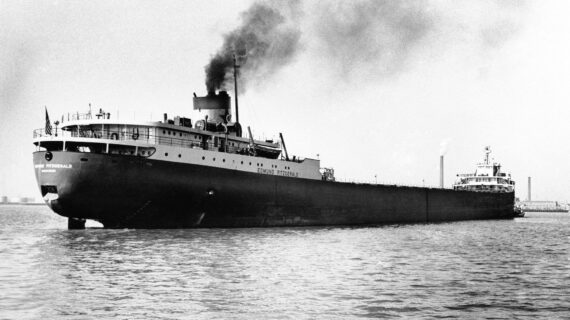
October 29, 1929. It was also the last day, it's always a Black Tuesday, for the SS Wisconsin. One of the greatest of all American sea stories is "Moby Dick." It contains a passage about the hazards of weather on the Great Lakes. It's Ishmael talking at the Golden Inn and he says, "Now gentlemen, in their interflowing aggregate, these grand freshwater seas of ours, Erie, Ontario, Huron, Superior, and Michigan, possess an ocean-like expansiveness. They are swept with Boreal and dismasting blasts as direful as any lash of a saltwater wave. They know what shipwrecks are, for out of sight of land, even though inland, they have drowned many a ship crew during the midnight with all there was left was the shrieking of the crew." End of quote. The SS Wisconsin was US registry number 80861. This is a newspaper photograph of her. She was 215 feet long with an iron hull, and she is now sitting upright on the sand and mud on the bottom of Lake Michigan. The water is 125 feet deep, and the hull is intact except for a hole blasted in its starboard side in the 1930s when some divers, these were hardhat divers, were attempting to gain access to her. All that remains is her steel superstructure. All that remains of the steel superstructure, which was ripped by the force of the sea as she sank, lie scattered like jack sticks on her deck. On her bow, the steering post, capstan and bollard still stand. The anchor chains wound around the stem on the bow and runs out to the sea where it had been dropped. The chimney smokestack has been dislodged, and it's lying across the deck of the vessel with its orange-red stripe with a top black band still obviously visible, and it's the trademark of the Goodrich Steamship Line. The Wisconsin was one of the early all steel steamboats built on the Great Lakes in the 1880s. Even for that day, the majority of the steamers were either built all of wood or with a steel hull and a wooden superstructure. She was designed by the well-known marine architect Frank Kirby. And she was in the cross-lake railroad transit of rolling stock, the old Ann Arbor, this type of thing that -- western group. Her design, however, was extremely innovated for her day. She was built with a double hull, which is not unlike the modern supertankers. She had an ice-breaking bow designed to ride up on the ice, and then crush through the ice with the sheer mass of her weight. This is a standard contemporary ice-breaking bow design. Throughout her life she was regarded as one of the strongest ships on Lake Michigan. She was built for the Goodrich Transit Company of Chicago at a cost of $159,000 at the Detroit Dry Dock facility in Wyandotte, Michigan. She was launched on October 11, 1881. She measured 1183 tons, was 215 feet long, 34 feet wide and the depth of her hold was 14 feet. The steam engine was mounted in the aft section, as you can see back here toward the stern. She had a twin sister. The SS Michigan was launched the same year. Both were in service for the Goodrich Transit Company by the end of 1881. This was a very lucrative railroad rolling stock transport across Lake Michigan from Ludington, Michigan, to Milwaukee. There was much media attention given at the time of the launching of these two vessels. Numerous articles in the papers and publicity about their safety and unusual qualities. The long line of the Goodrich Steamship Company started with a partnership of Albert Goodrich and George Drew, which lasted from 1856 to 1859. The Goodrich Steamboat Line was formed when Drew was bought out by Goodrich and continued till 1874. At that time, Goodrich formed the Goodrich Transportation Company. As part of the company's 1884 promotional material, it was averred that the line served all principal ports and summer resorts on Lake Michigan. The company was reformed and reorganized in 1906 as the Goodrich Transit Lines and continued in business under that name until it went into bankruptcy and liquidation in 1933. During its 75-year history, Goodrich Line served many ports and communities on both Lake Michigan, the shores of Green Bay and the lower Fox River. As I indicated, the company was known by its mark on its smokestack, the red-orange band with the black topping stripe. Goodrich found that the business was declining so he sold the Michigan and the city of Milwaukee to the Detroit Grand Haven and Milwaukee Railroad in 1883. This became the present Grand Trunk Railroad. It connected Canada, Detroit and Milwaukee, causing the company to state that its car ferry service saved 340 miles of shipping and without the necessity of having to go through Chicago. The railroad had recently not renewed its cross-lake contract with Goodrich, deciding to go into competition directly on its own. It operated under the Pere Marquette name. And they had these, I think they went up to 19 or 21, was the highest number in the Pere Marquette series. They went from Ludington, Michigan, to Milwaukee. Wisconsin would change ownership in 1896 when it was purchased by the Crosby Line of Muskegon, Michigan, and renamed SS Naomi in honor of the owner's daughter. Crosby took over the Detroit, Grand Haven and Milwaukee cross-lake transit shipping. He then sold her to the Racine and Milwaukee Steamship Company who, in 1918, changed her name to Pilgrim. Pilgrim was in direct competition with the Goodrich Transit Line until March of 1922 when Goodrich took over that company, forming the Goodrich Transportation Line, and he restored her name SS Wisconsin. As she was completing a cross-lake transit in 1882, she struck the Grand Haven, Michigan, north pier, knocking a hole 12 feet behind the bow that measured 8 feet by 5 feet. No penalties were assessed to the captain and the commanding officer and crew because the range light marking the harbor entrance was out at the time. She docked successfully. They had the bulkhead repaired. And it was the first accident that Captain -- had in 25 years on this lake. The repair cost $3,500. So as to not delay the shipping, the SS Menomonie, who had been laid up in ordinary, that is it's like being mothballed, it's there but they aren't using it, was put into service the next day and dispatched to carry the freight that the laid up vessel wasn't able to do. While in cross-lake transit in March of 1888, she and her sister ship, the Michigan, both became locked in the ice off of Grand Haven. Once in a while Lake Michigan will freeze over. This was one of the years that it froze over. And in spite of its ice breaking capacity they, both of them, were stuck in the ice. There was no loss of life and, unfortunately, the Michigan did get holed and sank before the tug Arctic could get to her and rescue the crew. The wreck of the Michigan was located by divers in 2006. And it's in Michigan waters so it's the Michigan state shipwreck, not one of ours. The Wisconsin was more fortunate than the Michigan. Her crew jettisoned more than a third of her cargo trying to keep her afloat. Using the heavy oak fenders, which they use in docking to protect the side of the ship, she reinforced the hull to prevent the ice from stoving her in. The SS City of Ludington was sent from Milwaukee to her sister. The ice conditions took 14 days to finalize the freezing in. The captain, seeing that she was in distress, thought she was certainly in serious danger of sinking. So the Ludington crew, who went across the ice to the Wisconsin, jettisoned another 300 tons of cargo, thereby raising the hole in her bow above the water line. The tug Arctic did manage to free her, and after two additional weeks of imprisonment she was taken into dry dock costing $40,000 to repair the damage. The next season she did return to the cross-lake traffic. As I indicated, in 1899 her name was changed to Naomi when she transferred to the Crosby Company. She was still running in the car ferry, that is their hauling railroad stock, across the lake. However, while sailing for Crosby, in the middle of Lake
Michigan at 1
00 a.m. on the night of May 21, 1907, she became a victim of the greatest peril on the Great Lakes, fire. It was discovered approximately when she was 28 miles west of Grand Haven on her way to Milwaukee. The -- soon became a raging inferno, seemingly destined to doom the vessel and all aboard her. Fortunately, the smoke and flames were sighted by the freighters SS Kansas, SS --, and the SS Sacks and Curry, all who came to her assistance. A flame precluded the smaller vessels from even getting close to rescue. These were wooden superstructure vessels, and it was just too hazardous for them to approach. Only the -- who had a steel hull, could approach. And with skillful maneuvering by its captain, they brought their bow to the stern of the Naomi, taking all the people off except for those that had already taken to the life boats. Those that were in the life boats then were picked up by the other two vessels. So with no loss of life, the vessel fires finally burned out. When it was cool enough to deal with the ship then the -- towed her into Grand Haven. The damage was so severe that she had to be towed across the lake to Manitowoc where she went under a complete rebuilding, and she was converted at this point now from a railroad car ferry to a passenger liner. This Phoenix-like metamorphosis caused her to be bustled and her main deck widened by six feet. And bustling is a process where they would take out, build it out about three feet. So, I'll call it the white part, now is expanded in three feet over the edge of the black which was the old steel hull. This was a totally steel superstructure. She was given a hundred cabins on two different decks. Her new appointments were the state of the art wood and wood paneling. And she was considered, at that point, the most luxurious passenger vessel on Lake Michigan. This repair and metamorphosis cost $200,000. She went back into service in August of 1909. Crosby was to lose his life in the sinking of the Titanic in 1912. So the Naomi was renamed EG Crosby in honor of dead owner of the firm. And she continued in the cross-lake passenger traffic until 1918 when she was taken over by the United States shipping board during the first world war and subsequently served as a convalescent vessel in New York harbor under the name of General Robert M. O'Reilly. It's wars end. She was purchased by the Seymour Line that became the Chicago, Milwaukee, Racine Steamship Line, operating on Lake Michigan under the name of Pilgrim. Two days after her return to the Goodrich Line in March 24, 1922, she was again sent on to the Manitowoc, Wisconsin, for extensive overhaul and to improve her overnight accommodations. She was now running a parallel course but in opposite directions with the Goodrich SS Illinois, and they're operating between Chicago and Milwaukee. In route in 1923 she encountered a heavy storm from the northeast. A lot of water had gotten into the engine room, the boiler room and the coal bunkers. The ship had sustained a list of port. It made her safety a concern. The captain immediately put into Milwaukee, and it was discovered that the water had entered through a gap in the bustling. Through extensive welding, they assumed that the plates were repaired and the ship was in good condition. A law of the sea is that shipwrecks are attributable to one or more of three factors. Human error, structural or equipment failure and the weather or, if you please, acts of God. SS Wisconsin would prove no exception to this. >> Upside down. >>
Whipple
How we doing now? >> That's better. >> Okay. That's her captain. His name is Morrison, -- H. Morrison, who was first mate at the time of the 1907 fire. And that's his daughter. He was very highly regarded among his peers on the lake. But on October 27, 1929, the Wisconsin had been in a severe equinoctial storm on the lake. Gave her a tremendous beating. Her cargo had shifted. She had put into Chicago. She had successfully passed two inspections a week earlier, and, of course, running another trip is more money. So the more you can squeeze in while the shipping season goes, the more money for the company. These factors may have caused Captain Morrison to decide on the night of October 29, 1929, to leave the safety of the harbor at Chicago and head out
on the lake at 7
27 p.m. He was bound for Milwaukee. There was a growing north-easterly gale. That gale and the warnings of all the Coast Guard stations on the easterly side of Lake Michigan caused many captains to stay in port. But not the Wisconsin. She was carrying four passengers and a crew of 64. A cargo consisting of automobiles, iron castings and a substantial quantity of box freight. The storm soon shifted to the east-northeast with 20-foot towering seas. They're striking her starboard bow and giving her a terrible beating. The voyage would prove to be Black Tuesday for her, as well as the New York stock exchange. And one of the problems on the Great Lakes is not so much the height of the waves as the frequency. Like on the ocean you may have a 30-foot wave, but if it has a quarter mile frequency cycle it's not doing much. But on the Great Lakes they can be 50-foot with 20-foot cycles, and it continues beating, you never actually come off of one without smashing into another. And that's what was happening that night. The SS Illinois had laid up at the dock in Racine, received a
radio message at 12
50 a.m. from the Wisconsin wanting to know about docking conditions in that harbor. She was told that everything was filled up because of the storm. There was no space. So Captain Morrison said, I'm going to try to make Milwaukee. He wasn't able to make Milwaukee. Then he decided, well, I think I'm going to try to make Racine. However, the cargo holds were flooding, the engine room was starting to flood, he was losing steam power. He knew once water got into the boilers that there would either be an explosion or in any case he wouldn't be able to have propulsion. So he headed into the wind, dropped the anchor, let the anchor chain run out and tried to keep up steam as best he could. However, the pressure was lost due to the fact that water was now in the coal bunkers. The coal was now floating around. It was clogging the strainers that are on the pumps, and finally the whole system shut down.
At 2
15 a.m. the radio operator, a 17-year-old fellow by the name of Kenneth Carlson, sent out the first SOS. It would be the first of 17 SOSs that would be sent out that night. The Coast Guard motor lifeboats from Kenosha and Racine immediately responded. This is the Racine boat. Kenosha was the same one. It's a motor powered 36-foot boat. It also has, you can see there's a mast with a sail throwed around it as an auxiliary source of the power. Also, the new steel-hulled fish tug called Search, owned by the Chamber brothers of Kenosha, departed from Kenosha. The Racine lifeboat was commanded by Captain John Olander, the keeper of the station.
He departed at 2
30 a.m. Kenosha boat, under Captain Alfred Christopherson, the keeper of the station, departed 15 minutes later. Each boat had six additional crew men on board. While the keeper was out of the Racine station, his wife took over and was manning the lookout tower at the top of the station. The Kenosha Coast Guard, after an hour of sailing in 20-foot seas, sighted the dim emergency lights of the Wisconsin. They're about two miles from the stricken ship, but it took them an additional two hours until they could get there because of the weather conditions. Christopherson realized that it was too dangerous for his vessel to come along side of Wisconsin. He therefore ordered the stricken ship to lower her lifeboats. Captain Morrison gave the
abandon ship order at 4
30 a.m. The crew, with some of the passengers, began to lower the port lifeboats. The starboard lifeboats, due the listing of the ship, were not able to be launched. That is, if you're like this and you're listing to one side, your lifeboats lower directly so they'd just be lowering onto the deck, and there wouldn't be any way that that half could be used. They did manage to launch five lifeboats and three life rafts. This gave sufficient accommodation for all persons on board. The Coast Guard stood by. The rescuers then commenced taking survivors from the lifeboats, rafts and from the water itself. When they had rescued the survivors from two of the lifeboats and some of the rafts, the Kenosha life saving boat was filled to capacity and had to return to port. The Racine motor lifeboat would rescue 18 survivors after two and a half hours of dangerous and difficult effort. It was then full and had to return to port as well. The fish tug Search arrived an hour later and was going among the debris and picked 15 people up out of the water. Some of them were in such bad condition that the crew members of the fish tug actually had to get into the water to get the survivors on a line and get them back into the fish tug. Each of the Coast Guard boats made several trips to home port and back picking up all of the survivors that they could. At Racine, the SS Illinois was trying to get up steam when it heard the first SOS, but in departing it damaged its rudder and had to turn back.
At 7
10 a.m. the Wisconsin started it's final journey to the bottom. Nine men died including Captain Morrison who was the last to leave the ship. He died of shock and exposure after having been washed out of a lifeboat due to the cold water conditions. Loyal to his captain was chief engineer Julius Bushman. He was an aged crew member. He was encouraged by his shipmates to take to the lifeboat. He refused saying, no, I'm saying with my captain. When he goes, I'll go with him. If he goes down, I'll go with him. Captain Morrison did persuade the engineer to get into a life raft but because of his frail condition he was washed overboard and drowned. Four bodies later floated to shore. Only one was identified. All were buried in a common grave at Kenosha cemetery. At her sinking, the vessel was worth a quarter million dollars and her cargo $200,000. The list of the names of the survivors, those who were hospitalized and those then who were dead, appeared in the November 1, 1929, issue of the Milwaukee Sentinel. The captain general of the transit company showed up the next morning, took over the facilities, taking care of the crew, the survivors, trying to secure cargos. The following few days the roads into shore from Kenosha and Racine were so crowded with souvenir hunters and memento seekers that the -- from the ship would include rafts, lifeboats, oars, cabin furniture, bedding, cooking utensils, 15 pages from the ship's log book and other items. The Coast Guard was assigned according to their regulations to patrol the shore to prevent any further pilferage of this equipment. A full investigation was conducted, and the captain was found not to be at fault. There are numerous awards and commendations given by the communities to the lifeboat crews and the search crew. A gold medal was given to each of them. And at the top it has an eagle with an olive branch. Then there's a sinking ship below that. Then there's a motor lifeboat below that. And it says Wisconsin. >> Were these unique? In other words, has the same model been used before or was it a unique medal? >>
Whipple
It was one that was commissioned by the communities. >> So it was unique? >> Yep, but the concept of giving them was not unique. The hearing found, as I said, no fault with the captain or the crew. Said that the lifeboat crew and the search boat crews behaved in the best tradition of the Maritime Services. But one of the things that happened was a dispute over a body of the drowned 52-year-old black cook LBH Degras. It seems that wife number one, you can see what's coming, her name was June, came to Kenosha to claim his remains on the night of October 29th, made arrangements for the body to be shipped to Chicago. Not doubting her authenticity, the funeral home shipped him home. Next thing enter wife number two, Clara. She telephoned the funeral home saying that she was the legitimate wife. Insurance named her as the beneficiary. She was "appalled" when told about another wife. But she said she had known something about another woman. Kenosha authorities were left to sort out the problem. The remains of the Wisconsin are still where they sank. She was first found in the hardhat divers in the 1930s. They had, in 1932, they tried to gain access to it, and they blasted a hole right here in the side. There are cars, these are the jack straws of the superstructure, what's left. Here's the smokestack. There originally had been three bodies on the ship reported by the hardhat divers. By the scuba diving era of the 1960s, from then on nobody reported any bodies on the ship at all. Well, the Wisconsin now remains to this day a proud ship serving a brand new public. With the advent of the Submerged Cultural Resources Act for Wisconsin in 1989 and the Federal Abandon Steamship Act of 1987, it's no longer legal to remove or damage any of the facilities on a shipwreck. Also, the shipwrecks in Wisconsin waters belong to the state of Wisconsin. The Historical Society is the trustee of all these ships. We've been placing them on the National Register of Historic Places. And at this point Wisconsin has more vessels on the national registry than any other state. So it's a criminal act to do any further damage or remove anything from the ship. However, mother nature isn't subject to the law, and she'll do her official participation in the aging process as time goes on. Thank you. If you have any questions I'll be glad to attempt to answer them for you. ( applause )
Search University Place Episodes
Related Stories from PBS Wisconsin's Blog











Donate to sign up. Activate and sign in to Passport. It's that easy to help PBS Wisconsin serve your community through media that educates, inspires, and entertains.
Make your membership gift today
Only for new users: Activate Passport using your code or email address
Already a member?
Look up my account
Need some help? Go to FAQ or visit PBS Passport Help
Need help accessing PBS Wisconsin anywhere?

Online Access | Platform & Device Access | Cable or Satellite Access | Over-The-Air Access
Visit Access Guide
Need help accessing PBS Wisconsin anywhere?
Visit Our
Live TV Access Guide
Online AccessPlatform & Device Access
Cable or Satellite Access
Over-The-Air Access
Visit Access Guide




Follow Us