

 Passport






Supernova Explosions are Weirder than You Think
11/11/14 | 44m 21s | Rating: TV-G
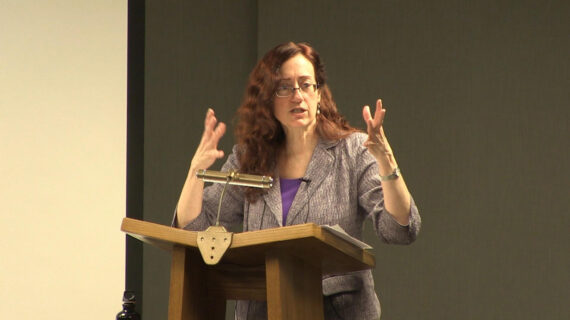
Jennifer L. Hoffman, Associate Professor, Department of Physics & Astronomy, University of Denver, discusses the tools astronomers use to investigate the complex, changing shapes of supernovae. Studying these shapes can teach us about stellar life cycles.


Copy and Paste the Following Code to Embed this Video:
Supernova Explosions are Weirder than You Think
cc >> Good evening. Welcome to UW Space Place. This is one of our guest speaker nights on the second Tuesday of the month, and tonight I'm really pleased to introduce Professor Jennifer Hoffman, who is one of our grads here. She got her PhD in astronomy from the UW-Madison astronomy department in 2002 and is now a professor of physics and astronomy at the University of Denver. So she's visiting here in Madison, and I convinced her to give a talk, didn't take too much convincing, for us tonight here at Space Place. And she's going to give us a talk about supernovas. So, Jennifer, thanks very much for coming.
APPLAUSE
>> Thanks, Jim. Is this on? Great. It is wonderful to be back here, and I'm really, really pleased to be back at Space Place and to be speaking to Wisconsin folks again. It's been a really great visit, and I'll be here about another week. But it's been a lot of fun to be back in my old stomping grounds. So I'm going to tell you a little bit about what I've been studying, mostly since I left Madison actually. Most of this work is what I've done in my postdoctoral research and since graduating. But there's some connections to what I did here. So if you want to talk to local people who know something about this, I can give you some names. So, we're going to start with some fun stuff. Anybody recognize that? How many of you have seen the movie Star Wars? Can I just get a show of hands? Okay, good because I have given this talk before to an audience that was like... The sort of 12 and under crowd, and I thought oh, no, I'll have to do something really different. Okay, so let's talk about Star Wars. Of course there's a famous scene in Star Wars where they blow up the Death Star, and there's an interesting comparison to be made between the original version of Star Wars, which most of you may have seen, I certainly saw it in the original back in '77 or whatever it was, and the remix version that came out a few years ago. When they went back, George Lucas said, well, now I've got all this digital technology, we want to make the effects even better on Star Wars. So they went back and remastered it. And if you play the two side by side, you can see a lot of differences between the original and the remastered version. So I want to show you one thing in particular. So you guys can find this on YouTube, and the address is on my slide. Now I've fast forwarded to really near the end. So we're going to get the big shot here, when they blew up the Death Star, and what we're going to see, I would have done this the other way, but the original is going to be on the right and the new version is going to be on the left. So mainly I just want you to look at the differences, specifically when the explosion happens.
climactic music
>> I have you now. >> What? >> Yoo Hoo! >> Look out. >> You're all clear, kid. Now let's blow this thing and go home!
tune slides down
>> Stand by.
explosion
>> All right, so original on the right, new one on the left. They added in something, right? They added that big old ring. And, in fact, if you watch almost any sci-fi movie nowadays, you're going to see something like that. >> Remember, the force will be with you always.
Star Wars theme plays
>> I'm losing my mouse. Okay. We don't need to watch the whole thing. Although, it's fun. I recommend it. Okay, so if you watch nearly any science fiction movie these days with a big space explosion, you're going to see something like that ring. And my suspicion is that that kind of thing is becoming more common because if you look at photos of atomic blasts on Earth, you see the big mushroom cloud and you see a ring like that that is created by a shockwave basically from the explosion sort of rebounding off the ground. And I feel like they added that in there to make the space explosions look even cooler. Well, you might as yourself, if you're scientifically minded, is that actually realistic? Does it make sense, in space where things tend to be kind of round, to have a big ring on an explosion like that? So I'm going to talk to you a little bit about the closest thing in space to a Death Star explosion, which is, in fact, a supernova, and we'll talk about the shapes that those supernova explosions make. So my backdrops here are pretty pictures of galaxies that have been supernova hosts. You can see the example here. Usually there's an arrow that shows you the supernova. They are named with the year of the explosion and then a letter code after that. So they actually go in alphabetical order to tell which one happened first. So, what is a supernova? And I'm going to here limit myself to talking about a specific kind of supernova called a core collapse supernova. A core collapse supernova happens when a massive star gets to the end of its life, and here's a really nice example that happened in a nearby galaxy to the Milky Way. This happened in 1987. It was supernova 1987A. So this was within the lifetime of most of us here. And this was a naked eye visible supernova. It was in the southern hemisphere, but I know astronomers who were actually able to see this thing with the naked eye. There's the star before it exploded; there's the star after it exploded on the right, and it's a big fireball, basically. So when the Hubble Space Telescope went to look at this object some years later, I don't think HST was even launched until the '90s, so it was several years later that the Hubble was able to image it, it saw something like the image on the right there, which is pretty clearly not round. So that's very interesting. This is what's left over after the supernova has faded away, and we call that the remnant. It's got that interesting ring-like structure. So I'll tell you a little bit about why we think this kind of thing arises here. But let me give you some big picture here. Why do we care? This stuff is cool, I'll be the first one to admit that. But in order to get the federal government to pay for your research, you have to be a little bit more practical about why this stuff is interesting. Why do we care about supernovae other than the fact that they're just giant explosions in space? Well, first of all, they help us understand stars. So the kind of supernovae I'm talking about are the ones that happen at the end of a star's life. And studying the end of a star's life helps us understand what the star was doing before that. They also are the main contributor of new elements into the cosmos. So if you know your history of the universe, you know that the Big Bang created primarily hydrogen with maybe a little bit of helium spread in there and that everything, all the elements that are heavier than that, had to created within supernovae and then distributed through space in order to get to be us. And that distribution happens mainly through supernovae. As Carl Sagan said, we are all star stuff, and this is how that star stuff gets out of the stars and into interstellar space. Now, supernovae are also extremely energetic. Not only do they spread material around, but they also create shockwaves that spread through their galactic neighborhoods and affect their surroundings. So there's actually a couple of different and opposite ways they can affect their surroundings. They might blow away dense material and clear out a cavity around themselves, or somewhere else in their near environment they might actually compress material. That shockwave tends to make things bunch up, and so that compression of gas and dust actually is pretty important for the formation of new solar systems. So supernovae are not only the end of a star's life but they can also help trigger the next generation of star formation. And, of course, they help us map the universe. So supernovae are able to be seen very far away because they're very bright. And so if we know something about their brightness, we can use how faint they appear to figure out how far they are, and we can probe what's happening in very far away galaxies and allow us to understand the structure of space time. So you may be familiar with the discovery of the expanding and the discovery of the accelerating universe. All of these discoveries relied on supernova observations. I saw a question there. Go ahead. >> How does the shockwave, what kind of energy or what kind of wave form does it travel in? >> So the question is, how does the shockwave from the supernova travel in a vacuum? Well, it's actually the case that within our galaxy it's not a pure vacuum. So the galaxy is filled with interstellar dust and gas. So it's much less dense than anything here on Earth, but it's not a total vacuum. So the shockwave travels through this very rarefied medium and allows it to become denser in areas. Great question. All right, so sometimes when I give this talk, especially to kids, I like to have a prop with a balloon. I don't have one today, so you'll just have to imagine that I have a little water balloon or something. If I blow up a water balloon and I hold it so that it's not expanding or contracting, we have a balance. It's a physical principle that if something is in equilibrium, all the forces acting on it must be balanced. So in the case of a balloon that's stable, we have two forces. We have the tension of the rubber or whatever it's made out of that's trying to pull it inward, and we have the pressure of the air that I blew into it that's pushing it outward. And so those two things are in balance, the balloon stays stable. Now, we have a nice analogy between the balloon and a normal star, like the sun, a normal, mature, stable star where what's pulling inward is gravity and what's pushing outward is also gas pressure very much like the air pressure inside the balloon or, for example, the air pressure in your bike tire or your car tire. That's what holds you up against gravity. So the same thing is happening the star. The star would collapse except for the fact that there's a lot of air pressure pushing back outward. Now, think about that balloon again. Suppose you tie it up and put it in the freezer. What happens to it? It shrinks. Yeah. It does shrinks. It gets all crumbly. It's kind of a good experiment. So when the gas gets colder, it has less gas pressure, and so the other force, the tension, will win out a little more. If you take it back out of the freezer and put it on the counter, it will gradually warm up, and it will expand again. So the warmer the gas, the more pressure. That's also why your car tires have a higher pressure if you've driven on them for a while and heated them up. All right, so we need some heat to create this gas pressure, and in a star, the center of the star is where that heat comes from. In the center of the star, we have a process called nuclear fusion going on where four hydrogen atoms come together to form one helium atom, and the results of that nuclear reaction is a little bit of energy. Slight difference in mass between four hydrogen atoms and one helium atom, and that gets converted, by Einstein's famous equation E=MC squared, into a pretty large amount of energy. And of course, millions of these reactions are going on every second. So you have this nuclear furnace in the center of the star that's putting out energy that's heating the gas that is keeping the star in equilibrium. So far, so good. And this goes great for millions of years. Millions to billions of years depending on what kind of star you have. But at some point, you run out. At some point, the star has no more hydrogen to fuse because the hydrogen is a finite, the star is born with a finite amount of hydrogen, and the hydrogen is destroyed by this reaction. It's converted into helium. So there's only so much that it can go through, and at some point, it runs out. Now, the lowest mass stars in the universe have not yet run out of hydrogen. So there are some kinds of stars that have been doing this for the age of the universe, as far as we know. But there are some kinds of stars, the very massive ones, the ones that are much more massive than the sun, that go through this reaction very, very quickly. And even though they begin with much more hydrogen, they live fast and die young, as I like to tell my students. They have a lot of hydrogen, but they go through it really quickly and so it doesn't take them long. It only takes them a few million years to use up all their hydrogen and then what? Right? When the fuel runs out, you have no more heat, you have no more gas pressure, so what happens to your balloon if you poke a hole in it and release the gas pressure? Well, the balloon wants to collapse, and so does the star. So gravity wins, effectively. You take away the gas pressure, and gravity begins to take over. So the star begins to collapse inward. Now, the interesting thing about this process is a star is really huge, right? So it actually takes the outer layers of the star a really long time to figure out, to get the news that the gas pressure has gone away. So it's what we call an inside out collapse. The core of the star collapses first because that's where the gas pressure has gone away. And so the very interior of the star will first collapse. And I love this image of the outer layers of the star briefly suspended with nothing holding them up. It's like in the cartoons when the Road Runner runs off out the edge of the cliff. It's that moment where he looks, no it's the coyote, right? The Road Runner is the one who does it. The coyote runs off the edge of the cliff, and there's a second where he looks around before he falls. That's the suspension of the outer layers. But that doesn't last very long, and they do eventually collapse. >> How long is not very long? >> Yeah, so whenever I say not very long or not very massive or whatever, we're talking in astronomical terms, but this is in fact, this whole collapse is a process that's fairly quick even on human time scales. So we're talking days here, if not hours. So, the core collapses first. And what happens when the core collapses is that the star is massive enough to fuse protons and electrons together into neutrons. So you get a neutron star in the core. And I'm not going to talk about black holes. We can do that afterward, if you'd like to. Most of these stars I'm talking about will form neutron stars. The thing about a neutron star is it doesn't really compress any further. Neutrons are supported by a very strong quantum mechanical effect called neutron degeneracy pressure. And even when the whole outer layers of the star fall down on top of them, they don't give. So that's a hard core of the star, and the entire outer layers fall down but can't crush it anymore, so there's a massive rebound. There's nowhere else for that material to go. It has to bounce back. So we get a collapse and then a rebound with a massive shockwave blasting outward. That is the supernova. So the supernova is all the outer layers of the star first falling inward and then getting propelled outward by the force of this rebound. All right, now, there's a joke in physics. Oh, yeah. That's the ejecta. We'll talk about the ejecta in a minute. So the ejecta is what used to be in the star and now is getting spread outward. All right, there's a joke in physics about the spherical cow. I'm not going to tell it. Again, we can do that afterward, if you want. But, basically, it's a lighthearted way of poking fun at physicists because we tend to assume things are round because that makes the math easier. Things are round, then you can kind of make lots of assumptions about how things behave, and it's a little easier to work through the equations. So, of course, you lose some detail if you assume that things are round. But in space, actually in astronomy, it's not a terrible assumption because things like to be round. Gravity is what we call a central force, and so it pulls inward toward a center in a spherically symmetric way. So the astronomers, actually more than the physicists, are actually justified in assuming things are round. But it turns out that these supernova explosions are actually not. So, how do we know that? Let's talk about how we make this observation that the supernova explosions are not round. Now, I like to tell people that astronomy is kind of an unusual science. It's not really a laboratory science. If you think about the physicists or chemists or biologists you may know, they tend to have laboratories where they go and they do experiments on things and they tweak their parameters and they try a control and they'll make a change and run a measurement and change it and do it again. Astronomers don't really have that luxury. Our laboratory is the universe, but we're not really in control of it, right? It's a little bit more passive in a way. We use our telescopes to view what the universe is showing us. We basically go out, it's like taking a bucket out in a rainstorm, we go out and wait for the light to fall on us. We collect as much light as we can, and we try to learn what we can from the light. But I can't go to a supernova and change something about it and make a new measurement. The nice thing is our laboratory is the universe. So there are lots and lots of supernovae all the time, so that's how we do our controls. We compare one with another. We try to build up statistics over the entire sky and over many, many years. All right, so light is our primary tool. That's pretty much all we have to learn about all these things that are happening very far away So let's talk about light. Light, as you may know, is a wave, or you can think of it as a wave, of electric and magnetic fields, and they vibrate perpendicular to each other and perpendicular to the direction that the light travels. So you have an electric field, you have a magnetic field, they're vibrating, and the whole thing is moving in a direction. Now, normally you have what we call a super --. You have lots of waves all on top of each other, and they're oriented randomly. Now, when I talk about orientation, just for simplicity, I'm only talking about the electric field. It's always perpendicular to the magnetic field, so here I'm just showing one of them. There's really no reason the electric field has to vibrate in any particular direction. So when you have a normal light, source of light, like the sun, the light coming from it is not oriented in any particular way. However, sometimes something can happen to make those light waves align, or at least partly align, to make those electric field vectors preferentially vibrate all in the same plain. That's called polarization. And we can see this on Earth when light reflects off of a surface. When it bounces off of water or the side of a glass building or a mirror, it tends to become polarized in the direction parallel to that surface. So, in fact, your polarized sunglasses are designed with a filter that blocks that particular direction of polarization. So it cuts down on glare by reducing the reflective light that gets through to your eyes. So, basically, what we do in this technique of research is put polarized sunglasses on a telescope. In space, of course, we don't have too many hard surfaces for light to reflect off of, but you can get polarization also by a process called scattering where light travels through a material and interacts with the ions or the molecules of that material. And we see this on Earth as well. When sunlight travels through the atmosphere, it interacts with the atmospheric molecules and bounces around and becomes polarized in that process. Now there's a couple things you can see in this sketch here. One is that the red light from the sun scatters much less than the blue light. And the other is that the wavelength, the color of light, affects the direction of the scatter. So the blue light you're seeing, actually the blue light goes in a couple different directions here. The red light only goes one different direction. There's a relationship between the scattering angle and the wavelength. And also, the amount of polarization is then going to depend on the angle at which the light scatters. So this is something else you can observe if you have a pair of polarized sunglasses. You can take them outside on a sunny day and look at the sky. And it works best if you look about 90 degrees away from the sun. So the sun is over here, you're going to look over here, and just hold your sunglasses up and rotate them around to the blue sky. And what you see, it's a good way to test if your sunglasses are polarized actually, what you see with a polarizing filter is that the sky will become brighter and darker depending on the orientation of your filter. So that means you're blocking out light in one direction and not in another. So this is, again, effectively what we're doing with this kind of measurement in astronomy. We put a polarizing optical element, not usually, well, a type of filter, into the light path of the telescope and we measure how much light comes out the other end. We rotate the filter and do it again. So we have a measurement of the preferred angle at which the light is polarized. Well, okay, so what does that tell us? The type of polarizing process we're talking about has an angular dependence that causes it to create polarization around the edges of a scattering region. So this first picture here with the round shape, that's kind of what you would see if you looked at the sun with a polarizing filter and made measurements of the light polarization at different parts of the sun. You would see that the angle of polarization tends to align tangentially to that circle. But if you went really far away from the sun so that you couldn't see anymore that it was a circle, then all of those polarization vectors, all those little arrows, would basically land on top of each other in your telescope and they would cancel each other out. So the little red shape, the little red starburst over there indicates all those contributions to the polarization are basically adding up to zero. So that means a round scattering region gives you no polarization. But if you have a non-round scattering region, you don't have complete cancellation. So in this second picture here, you see there's more up and down arrows than there are left and right arrows. And that means that when you take this shape very far away, you're going to see a net polarization signal. Not only that, but you're going to able to tell the direction of elongation of that shape by measuring the direction of polarization. So all it takes to know that a supernova is not round is to measure a polarization value. And with that polarization value, you also get an angle and you also have a piece of information then that tells you the alignment of that shape on the sky. Now, actually, of course, the situation is somewhat more complicated because a supernova is a little more complicated than just an elongated structure as well. There's lots of different elements that make up a supernova. There's lots of different structures that can happen inside of it. So let's look at some of those. This is how we know supernovae are not round. What are some of the ways that they can be non-round? Well, first of all, your ejecta, that means the explosion itself, the stuff that's coming out of the star, could be moving, the explosion could be actually elongated. It could be asymmetric. It could be clumpy. That means you could have a non-smooth distribution of material It might be denser in one place than another. You might have little clumps of one element here and another element there, and that would affect the polarization produced. It might be expanding faster in one direction than another. That could happen if maybe it had a binary companion that's preventing it from expanding in one direction. Or if it's located in a very dense interstellar region that prevents it from expanding in one direction. Or if maybe just the explosion itself happens to be faster in one direction than another. Some of the people who are modeling this kind of thing are finding that. So you might have different rates of expansion. And then, finally, it could be surrounded by material that is also producing its own polarization. So all this stuff adds up to give you a pretty complicated signal. Now, here's supernova 1987A again, and this actually is a good example of all those different things I was just showing you. And I should have updated this. There are new images of this thing that are really very cool. So you can Google it. Supernova 1987A latest. But this is a series of pictures that was taken by the Hubble Space Telescope over about a decade as the thing started to change. So I'm only zooming in here on the very central region, not the remnant that was large and ring-like or not the outer rings but the inner rings. And you can see how this thing began to change. That dot in the middle is the ejecta itself. That's what comes out of the star. And you can, if you watch that thing change, you can see that by the end, it's become quite elongated. The ring itself is probably left over from the star before it exploded. So these massive stars near the ends of their lives are pretty violent. They're erupting all over the place. They're spitting out material right and left. So this ring probably preexisted, and now the supernova shockwave is hitting it. And you can see that it's hitting it again in a sort of not smooth way. As the ring lights up, it's doing so piecewise. There's a clump here and a clump here and a clump here until finally by the end you have a whole little string around the edge. So all those different ways, all the asymmetries and all the interactions I was talking about, are happening here and causing a very complicated scenario. Yes? >>
INAUDIBLE
>> We do, but I don't. I'm sorry, that's not a number I have in my head. I can look it up for you. But this is in the Large Magellanic Cloud. So it's pretty close, and it's very rare that we're going to be able to actually observe something like this because this is a neighboring galaxy. So for the vast majority of supernovae, we don't have this nice view. We have to use polarization measurements to infer this kind of thing. So, another question. >> The ring, it explodes into a ring rather than a sphere. Is this because of the motion of the star? >> So, why is there a ring in the first place, is that what you're asking? >> Yes. >> Yeah, so as I said, the ring is probably a remnant of an earlier eruption from the star. And, again, that eruption is something you might sort of naively think would have to be spherical, but these stars, it turns out, they're kind of like when you boil water in a pot and you have a lot of heat coming up through the water, and when it starts to boil, you get these really large sort of convection bubbles. So the surface of these massive stars is like that. The energy is coming out in all directions. So it's not round. In fact, it can, in some cases, be extremely random, the directions in which this mass gets spewed off from the star. Now, in this case, what would actually create a complete ring is not totally clear. It might be interaction with a binary companion. The ring itself, it could actually be a projection effect. It could be something that's longer or elongated but we're looking down sort of from the top. There are a number of theories about this. But that is an example of what we call circumstellar interaction, meaning the circumstellar material was already there before the supernova happened and started to light it up. So, is any of this stuff kind of looking familiar? Go back to the question of the ring, yeah. In fact, we do see rings in space. And here is a little bit more about what they look like. So I'm going to give you an example of a supernova that was called 2004DJ, and this one was also fairly close by. You can see this really big, beautiful galaxy is a fairly nearby object. But this was not close enough for us to see any of those nice shapes in the supernova. All we can see in this case was a star kind of winking on and off, and it's that one on the right there that you can see flashing. All right, here comes a graph, but don't worry, I will explain it. So on the X axis of this graph, we have days since explosion. One of the questions I often get about supernovae is how long do they last. And they tend to last 100 to 200 to 300 days, depending on the type, depending on how bright they are and how nearby they are. This one lasted, you can see, 250 to 300 days. On the Y axis on the left, we have brightness. And don't worry about the numbers so much. Astronomers use a crazy numbering scheme for brightness, but bright is up at the top and faint is down at the bottom. And the black points correspond to the left-hand axis. So we can see, if you look at just the black points, is that the supernova got pretty bright and stayed pretty bright up through about day 50, and then it started to get faint. And then by day 100, it had a sort of change in the slope of its brightness and became fainter still. Okay, so on the right-hand axis we have polarization. And the red squares correspond to the right-hand axis. So we had three polarization observations in the first 50 days, first 100 days, and you can see that one of them has got pretty big arrow bars, but those arrow bars tell you that the polarization was basically zero for the first hundred days. Remember what that means? Zero polarization means round. Now, look at day 100. The polarization point is way up there at the top. Now that number, if you look at over there, is.6. Another question I often get is that doesn't seem very big. That's percent polarization. That means.6 of the light,.6% of a light was aligned in the given direction. That doesn't sound very large, but in astronomy that's actually quite significant. The normal numbers are usually 10 times less than that. Okay, but the point is that between day 70 and day 100 in the polarization measurements we suddenly went from zero to something, and to something fairly large. So, what does that mean? Does that mean that this supernova suddenly went from round to squashed? No, probably not because things don't tend to change that quickly on that kind of a spatial scale. But how can we explain this? Well, we have to think about what's causing it to get fainter in the first place? Because this jump in polarization is happening at the same time as the decrease in brightness. So the two things are linked. So here's what we think is going on. We think that these objects tend to stay bright for the first hundred days because they've suddenly ejected a whole bunch of material and it's dense. It's opaque. You can't see through it. So you have this big opaque fireball that's pretty much round, that just looks like, you can't see anything but that. Okay? But there's only a certain amount of material in the ejecta, right? There's not infinite material. So at some point, the thing keeps expanding and it's got to, at some point, become more transparent as it keeps expanding. So that's what happening at day 100. We have a steep drop in the brightness as suddenly the thing starts to get transparent. As it sort of runs out of material and keeps expanding. So as it becomes more transparent, we see further in, and what we see when we look further in is something that's not round. So it looks like this. The explosion happens. It expands, it stays opaque, but then, at some point, it starts to thin out, and what we see as it becomes transparent is a core that's not round. Let me give you another example This is one I've worked on myself called supernova 1997EG. I didn't label it. Oh well. And this is the kind of data that I tend to work with. So here now on the X axis we have wavelength or color. And it goes from short wavelengths, or bluer colors, to long wavelengths, or redder colors. So kind of a spectrum on the bottom there. And one thing that astronomers like to look at is how does brightness and how does polarization vary with wavelength? Okay, so in the very top, we have the total brightness of the thing, total brightness of the supernova, as a function of wavelength. And you can see that's not flat. There's some interesting bumps and wiggles, and especially those really big bumps are very interesting. Those are called emission lines. Those are signatures of particular elements that are enhanced in this supernova. The second panel, we have polarization. And what you can see about the polarization is it's pretty constant in general over that whole spectrum. Same thing with the polarization angle. It's pretty constant over the whole spectrum in general except that there are some deviations in both cases, and they line up with those lines. So this one that I'm shading in here is a signature of hydrogen. And it's pretty broad. That tells you that it's expanding very quickly. And it's got really big signatures in the polarization and in the polarization angle. But it's also got this really narrow piece here that's behaving differently than the rest. Here's another hydrogen line. It's doing something kind of similar. And this one here is helium, and it's a little bit less dramatic, but it's still got a different behavior. Whoops, sorry. It's still got a different behavior than the rest of the spectrum, which is what we call the continuum. So there's a difference in behavior of most of the light, and then these specific wavelengths which trace specific elements. In particular, the polarization angle is something I'm going to talk about a little bit in the next slide here. So let's look over at the big hydrogen line on the right. And you can see that the polarization angle changes a lot over the region of that hydrogen line. So here's the picture we came up with for this object. The ejecta, the expanding part of the supernova seems to have a specific axis that is giving you the overall average polarization and the overall average direction. But then we've got some other angle that's characterizing the hydrogen. And so that's just offset at a different angle. So that's where the narrow parts of the line are coming from. And then you've got this rotation, that change in polarization and the change in angle between the average and the parts where the lines are happening. So, again, we've got a picture that's telling us we're very non-round. And, in particular, in this case we've got a complete misalignment between the outer regions, which, again, probably came from the star before it exploded, and the inner regions that are tied to the explosion itself. So this kind of line of reasoning is helping us. Yeah, really non-round. This line of reasoning is helping us draw connections between stars and supernovae. So what I'm showing you here are two stars on the left. And, of course, because things don't have a preferred orientation in space, I've taken the liberty of rotating the images around so they all kind of line up nicely, and they make an analogy that I'm trying to make here. These things are not all aligned on the sky, but I've aligned them for you. So these two things on the left are stars. They have not exploded yet, but they are massive stars that probably will explode some time in the near-ish future in astronomical terms. And in both of these cases, you can see there's kind of a similar structure to some of the other things I've been talking about where we seem to have an elongated axis. We seem to have sort of bubbly shapes that are coming out what you might call the top and bottom. And then the third thing is the supernova I was just telling you about. That's just a model because we don't have a picture of it, but it's the model that we came up with from analyzing the polarization behavior. And the last thing is supernova 1987A, which we've now seen several times. And again, that was a supernova that we could take a picture of. It's a pretty rare thing. So I'm aligning these all nicely to suggest that there are some connections between what happens to the star in the final days of its life and what it looks like after it explodes. So this connection is what we can try to understand a little better by using polarization measurements to study supernovae. Of course, we'd like to also use them to study the stars so that we can sort of calibrate the supernova measurements. So that's the gist of my research. I kind of work at that intersection between the massive stars and the supernovae. Yes, question over here? >> We're so dependent on polarization measurements. What does internal scattering, internal to the ejecta, do to polarization of light coming out? And in particular, thinking in terms of radiology, when you try to understand the three-dimensional image from a two-dimensional picture, you've got back-scattering from light going the opposite direction from where we are, that's also going to have extra polarization. But how does that affect what we're seeing and interpreting as three-dimensional? >> Right, good question about the details of what's happening inside the ejecta, all the different kinds of scattering that could be happening internal to the structure, and then the difficulties of taking a three-dimensional situation and sort of flattening it onto the sky. Were you at last week's or last month's talk? Okay, so you should watch last month's talk. Actually, there was some really good discussion of going from 3D models to 2D projections and some really nice computational methods of doing that. The question that you're asking is a really, really good one, and it's something that I kind of haven't touched on here in the interest of simplifying. It's hard to interpret these polarization data. And it is not a one to one kind of thing. I can't look at a polarization spectrum and immediately say, oh, that must be a square. It's very difficult, and it requires pretty sophisticated three-dimensional simulation, basically. And, in fact, we have a guest in the audience, one of my grad students who's currently doing this kind of simulation. So you can talk to her afterward, if you want to hear a little more about it. But we basically have a computer code that simulates the situation. So you set up a scattering region and you tell the code to send photons, particles of light, through it and it models how they become polarized and it models how they become bounced around and it does the back-scattering and you can put in any kind of shape you want and it gives you a three-dimensional model. So then you can tilt the model and look at it from different angles, and that's how we try to get at that question. Now, the tricky thing about models like that is they're really complicated. So you have to be very careful about the constraints that you put on your input parameters, otherwise you can model anything you want. But, luckily, there's usually lots of other constraints from other kinds of observations and from physical theories about how these supernovae behave. So yeah, that's actually the whole other side of what I do. I've been telling you only about the observations, and of course we have to try to explain them using what we understand about physics. So there is another side of this where we're trying to use the models to understand the polarization data. Happy to talk to you more about that, if you like. But we are running a little short on time, so let's recap. I'm giving you just a couple of take-home messages. First of all, I hope you learned something about the polarization of light and how we can use it in astronomy. I like to tell astronomers, in particular, we work really hard to collect a lot of light. Light is all we have. We build enormous telescopes to catch as much of it as we can. We develop really sophisticated instruments and models to understand it. If we don't look at the polarization of light, in addition to its other properties, we're missing out on a whole dimension of information. I hope you remember maybe that supernovae are not spherical cows. That, in fact, they are more like the Death Star, the updated Death Star. So, not the original. But when Lucas and his team went back to redo Star Wars, they actually did kind of have the right idea in the sense that many astronomical explosions turn out to actually have these rings and other asymmetrical and complicated shapes to them. All right, so I'm happy to take whatever questions you have, and thank you again for your attention.
APPLAUSE
Search University Place Episodes
Related Stories from PBS Wisconsin's Blog












Donate to sign up. Activate and sign in to Passport. It's that easy to help PBS Wisconsin serve your community through media that educates, inspires, and entertains.
Make your membership gift today
Only for new users: Activate Passport using your code or email address
Already a member?
Look up my account
Need some help? Go to FAQ or visit PBS Passport Help
Need help accessing PBS Wisconsin anywhere?

Online Access | Platform & Device Access | Cable or Satellite Access | Over-The-Air Access
Visit Access Guide
Need help accessing PBS Wisconsin anywhere?
Visit Our
Live TV Access Guide
Online AccessPlatform & Device Access
Cable or Satellite Access
Over-The-Air Access
Visit Access Guide




Follow Us