

 Passport






The Philosopher, the Priest and the Painter
12/04/12 | 43m s | Rating: TV-G
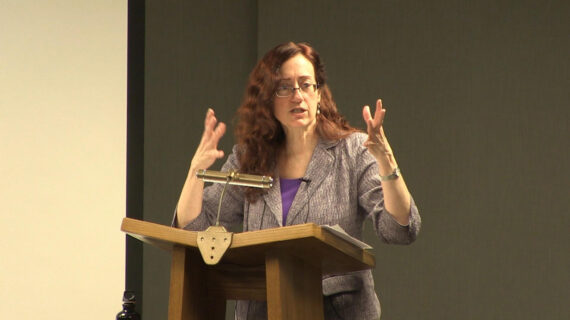
Steven Nadler, Professor, Department of Philosophy at UW-Madison, joins "University Place Presents" host Norman Gilliland for a discussion of the life, times, and philosophy of seventeenth century philosopher, Rene Descartes. Nadler focuses on the mysterious background of an iconic painting of the philosopher which is hanging in the Louvre Museum in Paris.


Copy and Paste the Following Code to Embed this Video:
The Philosopher, the Priest and the Painter
cc >> Welcome to University Place Presents. I'm Norman Gilliland. In the Louvre in Paris, there's a portrait of a middle aged man with long hair and a mustache, a dark mustache and dark hair, and heavy lidded eyes, and he's wearing the black coat and broad white collar that's typical of the Dutch Burgher. Well, that is the iconic image of the great 17th century mathematician and philosopher Rene Descartes. Who painted it? Well, until fairly recently we would have thought the great Dutch master Frans Hals, but it turns out that painting in the Louvre is a copy of another painting. And who painted that one? We don't know. Is it even a painting of Descartes? Well, it remains to be seen. And getting toward the truth is going to require going through some philosophy, some biography, and some history, and my guest to do just that is Steven Nadler. He's a UW Madison professor of philosophy, and he's also the author of the book "The Philosopher, the Priest,
and the Painter
A Portrait of Descartes." Welcome to University Place Presents. >> Thank you. Thank you for having me. >> Now, why are we so fascinated by these portraits in the first place as to whether they are or are not Descartes and who painted them? >> Well, first of all, it's just the casual mystery. We always want to know who it is we're looking at when we're standing in front of a painting. But also, given Descartes' importance for the history of European thought and especially for the sort of scientific world in which we've lived in since the 17th century, we like to know who Descartes was, what he thought, and very often we like to see what he looked like. And I think also, especially for philosophers as important as him, it's good to know some biographical details and historical context. >> He moved around a bit for somebody who became so celebrated in his own time. >> He did. He was born in France and grew up and did his schooling there, but at a certain point, he realized that if he really wanted the peace and quiet that he felt he needed to carry out his scientific work and his mathematical and philosophical inquiries, he had to go somewhere where he wouldn't be bothered by family and friends. His family was pressuring him to become a lawyer. I guess not much has changed. >> Common story. >> Yeah. But also, as he became more well-known for his work, people were bothering him. And, thus, he moved to the Netherlands where he knew that people were generally much more concerned with business and making money and wouldn't bother so much with a Frenchman working on some scientific projects. I also think that he believed the intellectual environment in the Netherlands would be much more opened. There were still, as tolerant, intellectually, as Paris was, you still had to deal with intellectual enforcement by the king and by the ministries. And it was much easier to get things published or to be left along, intellectually, in the Netherlands at this time. >> Well, we have to remember, this is Netherlands circa 1620. It's the same environment of tolerance that attracted the so-called pilgrims to go from England to Holland before coming to what would become the United States. So it was a place of considerable freedom and activity at the same time. >> And also, Amsterdam, where Descartes settles several times, was one of the only places in Europe where Jews could practice openly without any sort of restrictions or where they could live. So, it wasn't the complete toleration that sometimes the myth of Dutch tolerance makes it out to be, especially if you were a Catholic. These Calvinists were not about to start letting Catholics flourish. But a sole Catholic person, like Descartes, was pretty much left alone. >> And so, what was he actually doing to support himself in Amsterdam in these years? >> He was living off his family.
LAUGHTER
and the Painter
>> They were sending from home, huh? >> Yeah, whenever he needed money, he either made a trip back to France or had some properties that he had inherited sold. He came from a fairly well off family, and I think he realized that he didn't need to pursue a professional career in order to support himself. He lived fairly cheaply. He didn't have any grand houses. He just needed some place to live, some food to eat, and some materials to perform his experiments with. >> Well, let's kind of walk through the biography as we walk through this portrait gallery along the way, beginning with this, which I gather is kind of the default portrait of the person presumed to be Rene Descartes. >> It is. And I think there's little reason for doubting it is a portrait of Descartes for reasons which we'll talk about later. But this painting that's hanging in the Louvre does become the iconic image of Descartes. Whenever you publish a book on Descartes, this face is the one that appears on the cover. It's been used by the French government on stamps. It's also been used by various advertisers. If you were to do an Internet search "image of Descartes," this, in some form, would appear, and sometimes in quite absurd forms. >> Contexts. We'll get to some of those. Well, here's the stamps. So, France is still claiming him even though he was an ex-patriot. >> France loves him. There was a book published some years ago called, I'm translating from the French title,
France
It's Descartes or
Descartes
It's France. >> That's a take off on I think, therefore I am. >> They should have done it that way. Or the other way around. He is one of their great iconic heroes, and there are streets named after Descartes, there are towns named after Descartes. >> Let me digress just a bit. In the age of reason when France, during the Revolution, became so enamored with reason, the goddess of reason and all that, I suppose Descartes must have really been high on the pantheon at that point. >> He was on some people's pantheon. In part, because he was the one who, in some degree, helped initiate this age of reason along with people like Galileo and others. At the same time, the hierarchy of the French church and their overlords in Rome did not take very kindly to people like Galileo and Descartes who were, in part, responsible for moving the intellectual world away from the old medieval Aristotelian world picture towards a much more progressive one. >> Well, with Galileo, of course we have the telescope and we have these discoveries of bodies which clearly are moving around the sun and all of that which the most conservative minds would resist in Galileo's time, 1610 roughly, but what kind of things was Descartes doing or was he saying that would make the church uneasy? >> Well, he knew exactly how dangerous these waters could be, and in 1633 he was about to publish a work called The World, and even a casual reading of The World shows that he is defending a heliocentric model of the universe, Copernican model, and not the old Ptolemaic geocentric model. And then, as he's about to publish this, he learns about Galileo's trial and the punishment, and he decides that he'd rather not suffer the same fate. So he withholds his work from publication. And in one of his letters, he tells his correspondent that I'm all set to present this but in light of what's happened to Galileo, I think I'll not do that. So, as a defender of heliocentrism, he had to be very careful. Moreover, his image of how the world works, which is basically a mechanistic picture where everything is explicable in terms of small particles of matter moving, there are no mind-like forms or there's no divine providence guiding these things. The world just comes about by the motion of matter. >> Without a prescribed end point. >> Without a prescribed end point, governed by the laws of nature. This too would seem to be removing God too much from the direction of the world, but it was also perceived, and when Descartes' works were put on the Vatican's index of prohibited books in 1663, a fate suffered earlier by Galileo's works, it was perceived that this mechanistic world picture was inconsistent with various Catholic mysteries, and especially the mystery of Eucharistic transubstantiation. The old explanation used to be that when the priest said the words "this is my body" or "this is my blood," something supernatural happened. >> Right. >> That the appearances of the bread remained but the substance of the bread was taken away and was replaced by the substance of Christ's body. With this new mechanistic picture where everything is just particles of matter and motion, there are no appearances of bread that can remain while you do this hocus pocus with the matter. And so, if Descartes' physics made Eucharistic transubstantiation incoherence, that would not be looked upon kindly by the Catholic church. >> Is Descartes actually doing experiments, or is he doing this all kind of with mathematics and inductive reasoning? >> He's doing everything it seems. Most of your viewers will think of Descartes, they think primarily of I think, therefore I am. If anybody knows anything about Descartes, that's the first thing they think of.
SPEAKING FOREIGN LANGUAGE
Descartes
But in fact for Descartes, that was just a one-shot deal. You go through this exercise of trying to see what you can know, figuring out whether scientific knowledge is possible, how certain is my own existence, how certain is the existence of God, and how certain is the existence of the external world, you go through this exercise once in your life and you establish that science is possible, now let's get onto the interesting work. And the interesting work is mathematics, it's physics, and especially showing that you can come up with an absolutely certain physical count of every single phenomenon in nature. And if you have the right metaphysics and if you have the right conception of matter, of what bodies are, and the right conception of what the laws of nature are, then everything is explicable. And that was his main project. >> First, I can't resist going to this one picture here as long as we're thinking of anything is possible. This is not an original portrait of Descartes that we're looking at. >> No, I think this was his failed attempt to enter the Tour de France.
LAUGHTER
Descartes
Maybe centuries ago. This is an advertisement. This just goes to show you how often that image of Descartes is used. >> So, is Descartes, at this point, already, then, controversial? Not just with the church but with other people? Or are people, as you're saying, just leaving him alone there in Amsterdam? >> Unfortunately, nobody was leaving him alone. He had very strong supporters who often got him into more trouble than he would have if he didn't have anybody pursuing his projects. In the mid-1640s, the Universities of Utrecht and Leiden came down very hard on Descartes and Descartes' followers and their faculties because they thought with this new science that was Cartesian science there was no longer any room for the Aristotelian picture of the world. And the Aristotelian philosophy had become so much a part of the university curricula and also so much a part of theological dogma that it almost became just as heretical to deny Aristotle's explanations of things as it was to deny the dogma themselves. And so you had these followers of Descartes teaching medicine and philosophy in the universities, and the rectors of the universities and their followers came down very hard, and Descartes had to fight, and right in the middle of the 1640s he had to fight a good deal of battles in the academic world and in the political world. >> With whom does he correspond? Was he corresponding at all back a little earlier with Galileo? >> He never corresponded with Galileo. He may have met Galileo when he had made a trip to Italy earlier. But he is corresponding with some of the great minds of the century. Huygens, the great scientist, actually, he was corresponding with Constantijn Huygens, who was the secretary to the Prince of Orange. He also had, in Paris, Marin Mersenne, who was the center of an intellectual universe, and, thus, through Mersenne, Descartes was in contact with Thomas Hobbes, Pierre Gassendi, and other leading intellectuals of the period. >> And what are the ideas that we start to see are groundbreaking from Descartes? >> The notion that human reason alone can establish the fundamental truths of metaphysics without acts of revelation by God. And those metaphysical principles can ground perspicuous, clear, and absolutely certain demonstrations of why things happen as they are. So, for example, one of his more famous theories is the theory of vortexes. That the universe is actually a series of material vortices and everything from gravity to magnetism and behavior of objects in ballistic travel can be explained simply by the surrounding medium and the way in which bodies are affected by other bodies. >> It sounds indisputable today. >> It does. And we have Descartes and Galileo and Leibniz and Newton and other figures of the 17th century to thank for that. >> Now, has he come up with ideas that today we'd say, well, he was kind of off on the wrong track with that one? >> Absolutely. You won't find many Cartesians working in science departments these days. The theory of vortices is not quite right. But, I think, what's important for Descartes, in terms of his legacy, is not the particular explanations he gave for this or that phenomenon. He thought magnetism was explained by the little shapes of these particles as they work their way through matter. >> It's still a tough one today, right? >> It is. >> People still wrestle with that. >> And gravity was the motion of, as smaller particles are moving upwards, which is natural, they pushed downward other bodies, and that's how gravity was explained. But what's important for Descartes in terms of his intellectual legacy is not this or that particular explanation but this model of looking at the world as a mechanistic structure. He had trouble with certain things, like forces. If everything is just bare matter and motion, how do you explain the dynamic forces? And this was something that Leibniz and Newton criticized Descartes for, that he had no legitimate account of dynamics, just the mechanics. >> So Newton would take issue with the sense of gravity that Descartes had. >> He did explicitly. He said, look, Newton would say my job is simply to tell you what the laws of gravity are. What's the causal mechanism behind gravity? He said, famously, I don't feign hypotheses. He didn't want to get involved in metaphysics. >> Uh-huh. >> And part of what he objected to in Descartes was his speculation of metaphysical issues. He thought that was inappropriate for the physicist. >> Yeah but it's almost inevitable, isn't it, that if you're going to explain how things work that somehow you get caught up in metaphysics and philosophy? >> Absolutely. Especially if you're theologically minded in the 17th century. You want to know what the explanation for a phenomenon is, and then you want to know what laws cover that explanation, but then also you're going to want to know why are the laws are as they are. And that's metaphysics. Descartes, interestingly, thought he could deduce the laws of nature from the nature of God. So, it's not as if he was abandoning all theological framework for his science. And he thought that if all you had were particular explanations but you didn't know why the laws of nature are as they are, then your science is incomplete. And I think that we've given up on. I don't think you'll see many physicists doing metaphysics these days. >> One of his contemporaries, though, said that he could not figure out Descartes theology. Here you have somebody who was raised as, and perhaps ostensibly, a devout Catholic on the one hand, but then on the other hand, floating all of these concepts of how you can deduce everything from the rational. >> Right. There's a great deal of debate about how devout he really was, how good of a Catholic he was. One explanation for why he moved to the Netherlands was because he didn't want to be in a Catholic environment. But he did have a very strange theology. He's one of the very few philosophers in all of the history of philosophy who believed that God is not bound by any values or standards or principles whatsoever. Whatever truths there are, whether we're talking about the truths of physics, the truths of mathematics, the truths of metaphysics and ethics, and even the truths of logic are all what they are because God said that that's how they should be. So, if one of the classic problems of philosophy, especially in philosophical theology, is something good because God does it or does God do it because it's good?
LAUGHTER
Descartes
Most philosophers opt following Socrates for the latter. God does it because it's good. So God acts in these ways because that's what moral values demand. Descartes says, well, no. Moral values are what they are because God made them that way, but God could just have well have made them some other way. So it's good barbecues God did it. >> And it's funny, no one has gotten a definitive answer on that one yet. >> Right. I do try to convey to my students that if you take Descartes' approach, it's good because God does it, then any attempt to say that God is good is meaningless because God did this but God could just as well have done that, and so you have a sort of incoherent... >> You have the sense that good, if not relative, it's just... >> Capricious. >> Yeah, capricious. Let's go back to our portrait gallery. Now, this is, I gather, one of the definitive portraits of Descartes? >> As far as I'm concerned, this is the definitive portrait of Descartes. And the one we saw from the Louvre is a copy by an unknown artist of this portrait. >> Now, we can't put them side by side, but the difference that I notice in one and then the other is that the later one, the copy, looks cleaned up, looks a little idealized. >> It's a much more finely produced and polished work. This one, by Frans Hals, is a very rough oil work on panel. I won't say it's a sketch because there's every reason for thinking that's it's a finished portrait, but it also exhibits the kind of roughness that so many of Hals' portraits do show. Whereas the portrait in the Louvre was done by somebody who was just trying to create a polished copy of this. We don't know what the conditions were for the copy, who it was made for, who did it. >> Do we have any sense of why this Hals one was done? What was the purpose? >> Well, I think the general story is correct, that as Descartes was about to leave the Netherlands for Sweden, Queen Christina had invited him to come be her tutor in philosophy. >> We'll get into that a little bit later too. >> Yeah, in the middle of winter. He had a number of very good friends in the Netherlands, and one of these friends was a Catholic priest living in Harlem, Augustine Bloemaert. >> And I think we have him here. >> Right. There he is in an etching. And Bloemaert was very upset about his good friend leaving. Maybe he sensed that he would never see him again, which he wouldn't, and so, according to one of Descartes' earliest biographers, Adrien Baillet writing in the 17th century, Bloemaert brought Descartes to Harlem to have his portrait done so he'd have something to remember his good, departing friend by. And so, it's often assumed without any real proof that that portrait, that rough portrait by Hals, is the painting that was done at Bloemaert's request. >> And you said that's typical of Hals' work, that kind of rough look? This doesn't imply it was something he was doing in haste as Descartes was on his way to Sweden? >> Yeah and especially at this period in Hals', it seems to be the most characteristic feature. So here, for example, is a self-portrait by Hals. This is actually a copy of a self-portrait. We don't know where the original is, but you can see the same roughness in the handling of the paint, the same dark atmosphere, and most of Hals' late portraits had this kind of unfinished look. They're perfectly finished. This was what one recent scholar calls his signature style. A way of calling attention to his use of paint. The same in which modern painters like Pollock or Lichtenstein would do in a much more abstract way. >> Well, it does seem at least appropriate given the subject was very much into the here and now and the real to have this realistic portrait of Descartes. >> It's not a very flattering portrait. >> Well, right but realism often isn't, is it? >> I also think that part of the reference may be due to the fact that it had to be done fairly quickly. Although, I think Hals worked quickly. And so the rough handling of the paint is not only a reflection of his style, but I suspect that Descartes probably didn't have very much time to sit for his portrait at this period. >> And of course we're always reminded of the Dutch masters when we see this. >> Right. >> And Hals was one of those painters? >> He was the greatest portrait painter of the 17th century, in my opinion. He was recognized by his Dutch peers and most of his patrons. In fact, I think at this point while he was alive, almost all of his commissions came from Dutch sources. He was regarded as the best or one of the best. People love Rembrandt's portraits and Velasquez's portraits and Rubens'. All great portrait painters, but there's something about a Hals portrait that really seems to capture something deep and personal about the sitter. You see there's a life and there's a personality that comes through. And partly because it's the lively handling of the paint, but also it's just something about the facial characteristics of Hals' capture, the almost motion of the body in the portrait. >> When I think of Dutch masters, maybe it's from old cigar box lids or something, but I think of those group portraits. Did Hals do those, and what was the story behind those? >> Those are usually commissioned by an organization, a guild or a military troop to commemorate that year's membership, and they were often hung in the halls or meeting places for these groups. And here, too, Hals was very innovative. He doesn't give us these stiff portraits of groups sitting around a table, but rather a very lively company of individuals who are engaged in discussion, bantering, sometimes eating. Rembrandt too, I think, had great innovative things to do with this genre of painting. >> Sure. >> If you just think of the Night Watch where everyone's in motion. >> Yes. And some of his figures in the outdoors too. >> Yes. >> So, did Hals restrict himself to portraiture or do we have other kinds of examples of Hals' work? >> I think almost exclusively portraiture. He really specialized in this genre. >> And then this would be commissions then, presumably. >> Yes. Although, there are a number of his paintings which, while not portraits of known or specific individuals, they are what are called tronies or genre portraits. So, they are of anonymous individuals or anonymous characters in various archaic dress, for example. And so not every portrait is a true portrait but it's a portrait-like rendering of an individual. >> How many Hals portraits do we have, do you suppose, altogether that have come down to us? >> I believe that there's somewhere in the two hundreds. >> Okay, meanwhile, back at Descartes, how many contemporary images? How many images from the 17th century do we have of him? >> If I were to count these up, looks like there is, one, two, three, four, five, six, seven. Seven or eight. >> Here's one here. >> Right. >> This is obviously not a painting. This is a different medium. >> This, actually, I think, is probably even more authoritative in some respects than the Hals portrait. >> And less flattering. >> And less flattering, right. This was done by Frans van Schooten, who actually knew Descartes, and there's good reason for thinking that Descartes sat in front of Schooten while he did the drawing in which this... >> What leads us to think so? >> Because a friend of Descartes says I've seen the picture that van Schooten did of you and it looks like you. >> That's helpful. >> And we also know that Descartes and van Schooten collaborated. Van Schooten's father was the mathematician in Leiden and so was van Schooten, and so there was a personal relationship between these men. So, there's always a question of van Schooten's artistic skills. >> Right. >> But this is probably the most authenticated image of Descartes. We know that that's of Descartes. >> And what was the purpose of that? You see the test around it. It looks like it was for a book maybe? >> It was. And that was very often the way in which a lot of these images were put to use. They were engraved and then reproduced in books. >> This one, of the several that I've seen, what would you say? It's statistically the outlier. This one looks different than the rest. >> It does. In fact, there's another one which will look even more different. This is a drawing by Jan Lievens who was a very important painter in the 17th century. A competitor of Rembrandt's, in fact. And because this is a drawing, this is just a one shot deal. We really don't know the circumstances behind this at all. It is possible, logically possible, that this is the image that was done for Father Bloemaert before Descartes' departure because we know that Bloemaert collected art on a fairly substantial scale. He came from a well-off family. And in his estate inventory, there's a listing of some drawings by Lievens, but none of them identify the drawings as being of Descartes. Whereas, we also know that Bloemaert had, in that estate inventory there are some images that are identified as portraits of Descartes. So I think if the image of Descartes that Bloemaert commissioned on Descartes departure was this one, it would have appeared in the inventory as portrait of Descartes by Jan Lievens. >> And so where does it turn up then? Where do we come across this one? >> It was in a private collection, and now it belongs to a museum. >> So we just don't know its origins? >> We don't know it at all. >> But we know it's definitively Descartes? >> No, we don't know that either. >> We don't know that either. >> That's what's it's called. >> That's what's it's called. It could help to sell it, but you never know. >> Yeah. In fact, for most of these images we really don't know, we know the providence up to going back up to a certain point, but we really don't know the history of any of these except for the van Schooten one which was done for publication. >> Right. And then, we have another painting here, I believe. >> This, I think, is the one that fits in least in terms of family resemblance. >> True. >> The face is a little puffy. He looks very tired. It looks like he needs a good long nap and a shower.
LAUGHTER
Descartes
This is by Jan Baptist Weenix, and again we really don't know the history of this. The reason for thinking that this is a portrait of Descartes is because the book he's holding, in the book it says le monde est une fable which means the world is a fable. And in his writing, The World, which we talked about earlier, Descartes says, and this is a way of blocking the Galileo problem, he says, I'm going to describe a world to you which will come about by the motion of matter, and it'll turn out to be a heliocentric world, but I'm presenting this only as a fable, not as the truth. >> Playing it safe. >> Exactly. And so the book he's holding in this portrait, it says le monde est une fable, the world is a fable, perhaps that's good reason for thinking this is Descartes holding a copy of his work, The World. >> Now, why leave Amsterdam? >> It was getting a little too crowded for him. I think he really wanted a place in the country where he would have access to animals to perform experiments. >> So he was also into biological experiments? >> Yes, in some cases vivisection. He was very interested in the genesis of species. Not in Darwin's sense but the way in which different species grew their young, either through eggs or in the womb. >> Through live birth. >> Through live birth. And so he experimented on the birthing of calves, or at least observed the birthing of calves and the development of eggs from chickens. And so I think the countryside gave him that kind of access. But also, he was really just taking peace and quiet. >> But he, as we've already said, he goes to Sweden at some point. >> Yeah big mistake. >> But he's been invited by Queen Christina? >> She wants him to be her philosophy tutor. She had been exposed to some of his writings by the ambassador, the French ambassador to Sweden who was also a friend of Descartes, and so she decided that she really wanted this philosopher to be a member of her court. He, of course, Descartes was Catholic. Christina was not. Was Lutheran. >> But then she converted, didn't she? >> She converted and Descartes was often blamed for being responsible for her conversion. >> Because she then had to abdicate? >> Right. >> In order to be a Catholic. >> Right. >> So, how does that chemistry work out then? >> Well, we don't know how well he did or didn't get along with Queen Christina, but we do know he didn't like being up there. He really didn't want to go in the first place. As harsh as the Dutch winters are, the Swedish winters are going to be a lot worse. >> Well, he couldn't have had, as wonderful as Sweden is, the intellectual immersion that he would have had in Amsterdam. >> That's right. That's right. Amsterdam and the Netherlands, we had the University of Leiden and many centers of higher learning. He didn't want to leave the comfort of his country house, he had friends, but she made a compelling enough case, or she pushed him hard enough, that he decided that he would go for a short period of time. Unfortunately, by the time he made this decision, the winter was setting in. She demanded he come. He goes up there and she wants her lessons at five o'clock in the morning in the middle of the Swedish winter. And, within a short period of time, Descartes caught a cold and died. >> And that's kind of an abrupt end to our story. >> It is, yeah. While he was there, we don't know if he was able to continue carrying out his experiments. I think he was really cut off from all the things that he wanted to do. >> We don't have writings, to any extent, from him once he got up there? >> We do. He continued to work on his study of the passions. At this point he was writing a work on the human emotions. And he also was planning to continue, or at least finish, what's called the Treatise of Man, which would be a work of human physiology. >> So how long was he in Sweden? >> Just a couple of months. >> And so we don't have any breakthroughs that come to Descartes that come to us from those last couple of months then? >> No and it's a shame because the big project he was engaged on, having written his treatise on the world, which is essentially a work of physics, and then having almost completed what he thought of as his work on human physiology, his next envision project was to be a study of the human soul so that he could then discuss how the soul and the body in the human being worked together. >> He was interested in what I will call unified field theory, wasn't he? Of how all truths kind of hook together. >> Yes. Although, what he wasn't willing to do was subject the human soul to the kind of mechanistic explanation that worked in the world of bodies. He did think that human soul, and this I think would be one of his greatest contributions to the history of western thought, he thought that the human soul was truly an immaterial substance, distinct from material substance. He's what philosophers called a dualist. And so, if you were going to study the soul, you could not possibly study it in the same way you would study bodies. There are no laws of nature governing the soul. This is something that a later philosopher, Spinoza, would disagree with. Spinoza would say there may be this thing called the human mind, which is different in many ways from the human body, but it's no less subject to deterministic laws than the functioning of the body. And Spinoza criticized Descartes because, for Descartes, the mind was what Spinoza called a dominion within a dominion. It had its own realm independent of the laws of nature. >> The question seems to hinge on whether the soul or the mind can exist separate of the body. >> Right. And in one of his works from the early 1640s, the Meditations on First Philosophy, the initial subtitle that Descartes gave this was in which the immortality of the soul is demonstrated because if you can prove that the soul is distinct from the body, then the demise of the body does not mean the demise of the soul. >> And that's where he would part ways, or that's where Spinoza would part ways with Descartes? >> Yes, absolutely. But, again, I don't think that was, I think Descartes was there trying to gain the encourage and approval from the theologians. I don't think his main project was one of theology or religious apologetics. >> Even though he's already done the other two studies that you talked about? >> Yeah. >> And he's concentrating on the soul here, you think it's mostly it was a matter of appeasing the theologians? >> I think he wanted to study the soul to see how the human mind works, but I don't think it was to prove immortality. I think, for him, the more important role of distinguishing the soul from the body was that if you could empty the physical world of all soul-like elements, then your mechanistic physics has a foundation. Whereas, if you think there's an intermingling of spiritual and material in the world, then your physics is going to be very different. >> Yes. Yes. It would be hard to have, what would you say, a physical theory or layout if you have this loophole in it that says, well, this doesn't belong but it exists. >> If bodies fall because they're seeking the center of the Earth, that's very different from saying that bodies fall for mechanistic reasons. >> Let's go back to our portrait gallery. >> All right. >> Here we have a few more. These are all possibly Descartes but probably Descartes? >> This one's a bit of a mystery too. This one's by Pieter Nason, a Dutch painter. It could be of Descartes. It probably is. Again, we don't know the circumstances of its composition. Again, it bears a family resemblance to some of the other portraits, and I think a lot of the identification of these portraits of Descartes is just based on this general family resemblance. >> I always thought the Frans Hals self-portrait looked kind of like Descartes too. >> That's right. There's a certain beer. >> That's right. Beer or beard. Either way. >> Right. In this case, I don't see why we should think it's Descartes rather than just some other Dutch Burgher. >> Yeah, right. There is certain givings there that make many of these people look alike. We have another one here that looks actually a little more like the Frans Hals. This one. >> Yeah, the story behind this one, it was painted by David Beck in Stockholm after Descartes' death. So we can't really say how authentic a portrait it is of Descartes. >> Although, he looks pretty unhappy. >> He does. >> So it could have been from the Stockholm months. >> He looks a little cold, doesn't he? But it really, except for some very general features, if you compare this with that Weenix portrait where you had the rounder, somewhat more fleshy face. >> Yes. >> Or even the Hals portrait which seems to have a firmer structure, the only reason for thinking that this is a Descartes is because, again, transmission of information. We're told that David Beck painted a portrait of Descartes and this is it, going back, I think, at least to the 18th century. >> And so if we come back to Frans Hals again, it looks like maybe, I don't know, the cheekbone's maybe not quite so high. But you have to account for some kind of artistic differences. >> Absolutely. >> If it's not license, it's certainly style. >> Right. But there's something really great about this portrait that you don't see in the other, and I think it's partly because it's painted by Hals. There's a liveliness to this face. He's looking at you in a sort of inquisitive way, and maybe it's because we know it's Descartes. And so what we're seeing here is we're projecting onto what we know about Descartes' inquisitive nature. But the way the eyebrows are raised, the way he's looking at us, the way he's turning, there's a liveliness to this portrait that's not there in that Louvre copy, and I don't think it's really there in any of those other portraits as well. >> Yes. There is personality there that we don't see in some of the others. There is some attitude that comes through. >> And that's typical of a Hals portrait. They're not dead images. They're really lively. >> If we come around full circle, we don't know who painted that portrait in the Louvre? >> We do not. >> But it's somehow based on the Hals? >> In some way. There's talk, as there always is, that this painting by Hals was a preliminary sketch for what was supposed to be a larger, more finished portrait. If Hals did paint a larger, more finished portrait on the base of this, we have no idea what happened to it. There's no evidence that it ever existed. There's no talk about it. And it was thought for some time that the one in the Louvre was Hals' more finished version of this, but I think that's now discredited. >> So how's it identified in the Louvre? Artist unknown? >> Yes, after Hals. >> Uh-huh. >> And maybe it was directly after this but then we'd want to know how did the artist who painted the Louvre painting have access to that Hals sketch? We don't know where that Hals sketch went. Presumably, it was hanging in Bloemaert's house. >> Presumably, yes. >> But we don't know because it's not listed in the inventory of goods at Bloemaert's death, which suggests that if he did own it, he gave it away at some point before he died, but why would he give such a personal item away? We do know that he did give some of his paintings away. In fact, the portrait of Bloemaert himself that was painted he gave to the woman who had been caring for him. So he was willing to give away some of his works of art. Did he give away that one? So either the painter of the Louvre work had access somehow to that smaller, rougher Hals painting or there was a more finished painting done either by Hals or by somebody else, and the Louvre painting is a copy of that painting, or maybe it's a copy of a copy of a copy. >> Well, sure. Yes. That's right. You can't rule out that, can you? >> Right. >> And then we have an engraving also. >> Right. This is clearly based on the Hals painting. This was done by Jonas Suyderhoef, either after the original Hals or after a copy, or a more finished portrait. And this was produced for a Latin edition of Descartes' writings. >> But it's a reversed image. >> It's a reversed image, right. Well, because it was an etching. >> Then it was inevitable then. >> Right. >> Unless they were going to double-etch it somehow. >> Right he would have to reverse it in the etching process. And he also finished it more because if you go back to the Hals painting, you can see that either the painting itself was cropped at some point because you don't really see Descartes' hand holding a hat, you just see some fleshy protuberances down there, but in this etching based on that painting you see a well-formed hand and a wearable hat. >> That's intriguing. >> Yeah. So either that Hals painting was originally bigger and it included the hand and the hat, or this was done after a more finished painting based on the Hals portrait. >> So, if you go over to Holland presumably, what would you look for? What would you be looking for if you would have wanted to really find the holy grail of Descartes pictures? >> I'd be going through attics in Harlem if that's where it still may be. Who knows. There are some people who are really good at finding paintings or documents. When I was working on Spinoza for a long time, the great mystery was what ever happened to this writing that Spinoza supposedly composed after he had been excommunicated by the Jewish community? He's supposed to have written some sort of defense of himself which will lay out the reasons why he was put on the ban, but this has disappeared and nobody has found it. Although, a friend of mine claims to have found it behind a case of Guinness beer in a Dublin pub.
LAUGHTER
Descartes
But then lost it after he drank the case of beer.
LAUGHTER
Descartes
>> Yes, well, he wouldn't be the first person who found truth in a case of beer. >> Some people really have a talent for finding things in archives. That's not my skill. I'm not really much of an archivist in that sense. >> But you have a sense that we have a pretty good idea of what Descartes looked like? >> I do. I think both the family resemblances there, and I don't see any reason for doubting that that Hals portrait really is of Descartes and that it was done for Bloemaert so he'd have something to remember his good friend by. >> Well, thank you for remembering Rene Descartes with us. >> My pleasure. >> Steven Nadler, it's been quite the romp through our gallery and visit through history and biography as promised. >> Thank you for having me. >> I'm Norman Gilliland, and I hope you can join me for the next University Place Presents.
Search University Place Episodes
Related Stories from PBS Wisconsin's Blog












Donate to sign up. Activate and sign in to Passport. It's that easy to help PBS Wisconsin serve your community through media that educates, inspires, and entertains.
Make your membership gift today
Only for new users: Activate Passport using your code or email address
Already a member?
Look up my account
Need some help? Go to FAQ or visit PBS Passport Help
Need help accessing PBS Wisconsin anywhere?

Online Access | Platform & Device Access | Cable or Satellite Access | Over-The-Air Access
Visit Access Guide
Need help accessing PBS Wisconsin anywhere?
Visit Our
Live TV Access Guide
Online AccessPlatform & Device Access
Cable or Satellite Access
Over-The-Air Access
Visit Access Guide




Follow Us