

 Passport






Modern Dairy Farming In China
05/20/11 | 55m 9s | Rating: TV-G
Pamela Ruegg, a professor in the Department of Dairy Science at UW-Madison, discusses the dairy farm structure, the melamine issue, milk quality and safety, animal welfare and the challenges facing the Chinese dairy industry.


Copy and Paste the Following Code to Embed this Video:
Modern Dairy Farming In China
cc >>
Sarah Schutt
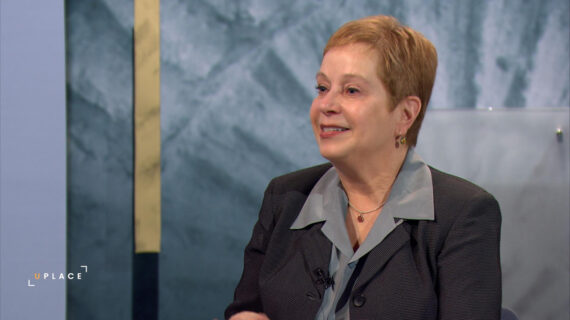
It's my pleasure today to introduce our Global Hot Spots speaker. Professor Pamela Ruegg is a professor and Extension milk quality specialist in the Department of Dairy Science at the University of Wisconsin Madison. She received her undergraduate degree and Doctor of Veterinary Medicine from Michigan State University and completed a residency in food animal herd health and reproductive management and a master's in preventative veterinary medicine from the University of California Davis. Previous professional experience includes private veterinary practice, faculty positions at both Atlantic Veterinary College in Prince Edward Island, Canada, and the College of Veterinary Medicine at Michigan State University and technical service with the Monsanto Company. Her Extension program is focused on improving milk quality and safety on dairy farms. Her research interests are focused on epidemiological techniques to critical issues related to milk quality and safety, and she enjoys bridging the gap between research and practical application on dairy farms. Dr. Ruegg is a frequent speaker at dairy and veterinary conferences in the United States and internationally and is the immediate past president of the National Mastitis Council. Will you please join me in welcoming Dr. Pamela Ruegg.
APPLAUSE
Sarah Schutt
>>
Pamela Ruegg
Thank you, Sarah. And thank you for the invitation to speak here, and most of all, thank you for coming today. This is spring, right? And when I saw this weather today I thought I'm sunk. I'm absolutely sunk. I even, like, contacted my grad students. You can see a row of people there slightly lower than the median age. And I'm like, geez, you guys might want to come to this because I thought maybe they might be the only ones here. So I am glad to be here and have the opportunity to share some of my experiences and to talk a little bit about this really interesting, my experiences in a really interesting country. The kind of mysterious and emerging country of China. I'm going to speak today on milk safety. I'm going to touch a little bit on the melamine issue. I'm going to touch an even shorter amount of time on some kind of interesting things that are going on in China on dairy farms relative to management of some of the byproducts of producing milk. And I'm going to speak of it all from really a ground level area. So be prepared for that. Now before I start, how many of you have been to China? Wow. Okay. How many of you have been to farms in China? Okay. Excellent. Were those dairy farms? No? Okay, great. So I'm really looking forward to the question and answer period at the end because it looks like we've got a lot of knowledge in this room and experiences. Well, the way I'm going to present this today, I can't just start off by presenting about the melamine issue because just like everything in a big kind of emerging country full of people, the context of the Chinese dairy industry directly influences this issue of melamine and the issue of dairy farming. So I'm going to spend a fair bit of time talking about the context of the dairy industry, and it's different than the context of the western dairy industry. So it's very important that we understand this. I'm going to talk a little bit about the Chinese dairy farm structure. I'm going to talk then a bit about the melamine issue specifically and some other milk safety and animal welfare issues. And I'm going to talk a bit about my observations about some of the challenges that are facing the Chinese dairy industry and really the unpredictability really of where that industry is going to go. So I hope that at the end of that time we'll have some interesting conversation. This picture, by the way, was taken at what they call an ancient village in China. I was giving a seminar there or a seminar in a region for a bunch of dairy professionals, veterinarians, and farmers, and in the evening after we finished the seminar, they put everybody on a bus and bused us all up to this area which was an ancient village. And I was kind of surprised when I got on the bus that the Chinese participants were so interested in going to this village. And that, to me, was kind of an introduction to the impact of the cultural revolution there and how so much of really the ancient history and the really older interesting parts, the villages, etc, didn't survive the cultural revolution. And this was, indeed, one place that did. And it was interesting that the people that I was with were just as interested or possibly more interested in touring this area than I was. So before I get into the heart of my talk, though, I need to give a little disclaimer. I am not an expert about China. I am an expert about dairy cows, especially preventive health management of dairy cows. I am not a expert about Chinese dairy agricultural policy, and I don't study China nor do I do research in China. I have, however, been to China three times since 2005. Each of those visits have been about two weeks in duration. I've been to about 30 or more dairy farms in China. Very intense visits most of the time to these dairy farms. I've worked in four different regions of the country. Almost all of the dairy intensive regions in the country. I've met many local Chinese officials, and I've taught intensive technical courses to hundreds of Chinese dairy professionals and veterinarians and veterinary students at two of the veterinary universities there. So I'm not an expert, and today what I'm speaking on is really my experiences and my observations. And kind of my summation from the ground level of these important issues relative to milk safety. Now, when he we think about the context of the Chinese dairy industry, now there's many in the room that have been here, but when I speak to my own family who hasn't been to China or others in my neighborhood who haven't been to China, the context of what it's like this is just not grasped. And probably many of you have felt the same way when you visited there. This is Nanjing, I believe it's Nanjing, and it's one of the beautiful urban centers in China. And the cities, probably most of you in here who've been there would agree, the cities are spectacular. I was in Guangzhou last November, August sometime, I don't know, last fall sometime, right before the Asian games were about to take place. And they were actually doing kind of the rehearsals. They did the entire fireworks show the week before to prepare. They had flowers everywhere. I've never seen such beautiful cities. Everything is new. You've got these spectacular skyscrapers. Lots of light at night and it's just very, very spectacular to see. The urban middle-class is enormous. Several times, when I go there I'm typically not with other people from the US, I'm with Chinese people. And when we go into the cities sometimes in the evening when we're done with work if we're in an urban area, it's just amazing to me the amount of wealth that just the Joe person on the street has. And when you think about China, I think our image more and more is this. And, in fact, just under half of the Chinese population of about 1.3 billion people live in these urban centers. So it's only about half of the population. When we look at the Chinese demographic statistics there's 1.3 billion people in China in contrast to 300 million here in the United States. When we look at the GDP, even though when we visit there we see a lot of people who are living very nice lifestyles, the per person GDP there is about $7,400, whereas the US GDP is about $41,800. Even bigger contrast is looking at the percent of the labor force employed in agriculture. In China, 38% of the labor force is still engaged in agriculture. It's an agrarian society in many ways, even though that's not what we see as being portrayed so much. In the US, the equivalent percentage is about 2% to 3%. So very, very different structure. This is important to understand when you think about policy decisions relative to dairy farming, relative to rural areas because one of the reasons half the population there lives in these cities is that's where the higher paying jobs have been. And one of the desires, often, in these emerging countries, is to maintain a stable rural population. So a lot of the decisions that get made relative to regulating and policy in the dairy sector are influenced by this desire to have people stay in the rural areas. And there are, even though it's a relatively small percentage, there's approximately 57 million people who live on less than $125 per year, not per month, per year. And that's from the CIA fact book. Yesterday I checked that number again because it just seems incredibly low. So the context of this is these tremendous contradictions, and I'm going to come back to contradictions more and more. Look at this skyscraper and then look at 57 million people living at a very, very low rate of consumption. So the take-home on this is beautiful cities, huge urban, middle-class city dwellers but the difference between that and the rural workers is enormous. When you look at the context of the people that typically are working in the dairy industry, most of the rural people are poor. And this is not bad housing for dairy farming in China, but it's very, very different than the last picture we just saw looking at the cities and the new structures there. And when you look at dairy farming as part of the overall agricultural sector in China, it's important also to recognize that just like here most of the time, dairy farming is one of the most profitable rural agricultural activities. So there's an advantage in maintaining dairy farming and promoting dairy farming that goes beyond just having a high protein and high quality protein source available for the consuming public. So there's a real advantage on that. And so these are just things we have to think about when we're looking at the context. Now, the last time I was in China we were in, I think this was in Nanjing, and in Nanjing, which is in the southwestern part of the country, in Nanjing it's got thousands of years of culture and Chinese history. And in Nanjing there's a learning center there that was very, very famous decades-- Thousands of years ago. It's very interesting, we were touring kind of around there, we went by there, we went into a museum and there was this kind of a diorama. And I only have two pictures that I took of it, but it points out a really interesting thing about Chinese culture that I really think still applies today. In this fable, so the only way I knew this fable is I asked the people I was with, I said what does this show? And they instantly told me this story. There was this very poor peasant who was very smart and managed to get admitted into this famous learning center in this region. He went to the school and he got the very top marks. And the person, historically at this time, who got the top marks was then married off to the local noble or the emperor's daughters in that region. And so this is the emperor's daughter and the queen, and what this is, so he's there to get married, this diorama is a little bigger, and in comes marching his actual wife with his children. And they're complaining that, hey, he can't marry her and become enormously wealthy because he's already married to us and we have a right to him even though he won the top marks. And it's kind of looking at this contradiction between the enormous wealth and the ability to achieve through education and then also the rights of the lower and the poorer people. And I put this in here simply because those same aspects of the culture apply today in many ways. And it's pointed out a little bit here. This is, if you could see the sign behind here, this says the Shanghai Institute of Dairy Science, and this is a brand new facility. This was actually on the inauguration of their new laboratories last year. Their laboratory facilities are way better than mine. Beautiful new facility in Shanghai. And this guy right here, Dr. Fang, is one of the team members, one of the PhD scientists there, and he is the son of an absolute peasant. An absolute peasant in a rural area. And when you talk to him, how did he end up in the Shanghai Dairy Institute? It was because he was a very good student and worked very, very hard. So the meritocracy in China is very true. And it goes back a long time and that's, again, one of the contradictions is yes it is very possible to achieve but, boy, there are some constraints around that. So there's a lot of people like that working in the dairy industry as well and having an impact there. But, as I get into the melamine scandal, I can't talk about it nor can I talk about the challenges that face the Chinese dairy industry without being very overt about the problem of corruption. This is a one-party rule, and in any one-party rule anywhere in the world, and in other places that don't have one-party rule, it's very easy to develop corrupt governments. And Transparency International ranks governments around the world using what they call a corruption perception index. It's my understanding that this is a legitimate scale looking at ways to compare corruption across different countries. The scale is one, meaning highly corrupt, to 10, meaning highly clean. The best score out there for countries right now is 9.3, and those countries are Denmark, New Zealand and Singapore. They all are tied at 9.3. The worst score is Somalia at 1.1. The China score is not so hot. It's about 3.5, indicating, and if you look at it on a map it's coded orange. Orange is slightly less corrupt than bright red. So it's in the bottom of the pack relative to corruption. For comparison sake, the US score is 7.1, just to give a frame of reference to the world we live in, which is towards the top of the pack. It's not the best. There is corruption here, but it's way better than China. And this issue of corruption has enormous impact on the ability to guarantee safe, high quality food products coming out of China, and I'll show you why in a few minutes. One of the problems we get into in ensuring safe and high quality food products is the gap between the farm workers and the government officials relative to societal status, relative to income, and relative to education is absolutely enormous. This is a woman delivering feed on a large, this is actually a large industrialized dairy. This is a veterinarian who is one of the local government officials in one of these regions. We met her at her office. She drove up in her brand new Mercedes Benz. Okay? She's a government veterinarian. I am a veterinarian. I know veterinarians all around the world. I know many veterinarians who work for government. I have never seen a government veterinarian drive up in a Mercedes Benz.
LAUGHTER
Pamela Ruegg
This is, I was actually trying to get to know her a little bit and she's really nice. She invited me to come and spend time at her vacation home. And I was asking her how do you kind of do this? And she said, well, I'm involved in several of the livestock businesses here. Okay, conflict of interest here. Conflict of interest where we have our regulatory officials involved in regulating businesses they're involved in. Some of this is growing pains on a country that is rapidly developing an economic system and some of it is a result of a government structure that isn't very flexible. Another issue that we have to think about as we think about the ability to produce high quality food products is simply rural land management. Rural land in contrast to land in, and in some cases around, cities, rural land can't be privately owned. This is really important when you think about farming because when you think of the culture of farming here, our farmers farm why? Because they love the land in many instances. And when they think about their futures, what they're typically thinking about is assuring futures for? Future generations in the same place. In China, the farmland is leased for approximately 10-year periods. I was on one farm there with a guy who was in the eighth year of his lease. He was one of the best farmers that I've interacted with in China. On his farm we're talking about his plans for the future and he said, I'd like to expand. And I said, well, how do you do that? And he pointed at the local government official across the table from us and said, well, he has to agree to let me do that. Okay. The local land committees must approve all expansions, and it's not like necessarily our zoning committees here as much because the land is owned by the local area. So the investment in farms is, thus, smaller, and it's more uncertain as a farmer whether or not you should really invest in a facility because your long-term ability to recoup that investment isn't necessarily as secure. So this is another very important issue relative to looking at the ability to produce safe, high quality food and really to move a dairy industry along. Okay, that's about all the context I'm going to talk about. Let me get into a little bit of the heart of the dairy farming issue here and the safety and quality issues that we see. First of all, let's take a look at what's happened to dairy production in China. I put together some stats from 1999 through 2010. First of all, let's look at this top line. This is the total production of milk in the United States in millions of pounds. So that's approximately up here, almost two hundred billion pounds of milk in the United States. That would be our total production last year. This little Bucky bar graph down here represents what? Wisconsin production. And actually it's kind of interesting, it might look flat because the overall scale is so high, but in fact, there was a slightly declining period at around 20 billion pounds per year. It declined a little bit in the early 2000s but the trend is actually upward in Wisconsin. Slight trending upward which is the first time since I think the mid-'80s or early '80s that we've seen that trend. And then the red chart or bar graph is Chinese milk production. And what you'll see is there was just incredible double digit growth in Chinese milk production. We're looking somewhere around 20% to 30% annual growth. A lot of that was from adding cows, increasing the number of cows milking in China from about 2002 all the way up to 2008. But since 2008, milk production has actually declined because of? Melamine. And we'll get to that in a minute. This melamine scandal, this melamine milk contamination has had on enormous impact on dairy production, and it has an continuing impact, you can see that 2010 milk production in China was actually even lower than 2009. Would you look just as, again, a frame of reference, when you think about milk here we tend to think about, we're in Wisconsin so what do we think about? Cheese, right? We think about cheese here in Wisconsin because about 95% of our milk here in this state turned into cheese exported from our state. It's an economic driver in our state. In China people don't eat cheese. It's not a normal food so much. Although, there's starting to be increased consumption of it. What they consume is UHT milk and milk powder, and, of course, there's a big movement by the Chinese government to increase the consumption of fluid milk of children in order to encourage better nutrition in children. So what we're thinking primarily in China is mostly fluid milk. Now, in the United States the way that our dairy supply chain works on most places is dairy farmers individually produce milk. The biggest farms load it on to trucks, and those trucks drive directly to a processor. But the dairy farmers own the farms, they own the cow, they produce the milk, and the truck brings it to the processor. Smaller farms, like about 13,000 of the farms we have here in Wisconsin, you'd have several farmers producing milk, storing it in a bulk tank, and a truck driver, private truck driver, would go around and load the milk from the bulk tanks into his truck and drive it to the milk processor. Those are our two main supply chain models. In China, we've got things that are a little bit different. In China, we have many, many small farms. So you have many individual small farmers, and those farms may be so small that a middle man, for example, not necessarily even a big truck but maybe even smaller than that, there might be a milk collection center where they bring their milk and they dump it into a larger container or there maybe farms that are slightly large enough so they may have a small container that then gets picked up and commingled with many other farms. But the take-home point here is between the individual small farmers and the processor, there's somebody in the middle. Commingling milk from many, many farms, making it almost untraceable, actually, as to the origin of the commingled milk. That's one model. Second model would be, well, there's a lot of small farms in one region so they've taken these small farms and they put them into what they call dairy gardens or dairy villages where maybe you have 15 farms all on the same land mass, every one may be living there and they all milk the cows in one central facility. The cows are housed in separate barns, but they're milked in one central facility going into one tank which then goes to the processor. That's a fairly common model as well. And then finally, we've got giant vertically integrated milk processors. And this is where we've got usually a very large agricultural firm. Maybe the owner is some company based out of Hong Kong that is an expert in pork production, and they've been wildly successful in pork production so they've decided diversify into milk production. And they're completely vertically integrated where you've got a corporate farm that milk goes directly into processing. So three very different structures than what we have here in the US. So this would be an example of the smallest farm. 85% of the dairy farms in China, in fact, contain about one to five cows. That supplies about 70% of the milk. There are approximately 1.5 million very small farms. So that's a very different structure. When you drive down the road you may see cattle out grazing. And these would represent that structure. In fact, all of those cattle may belong to several different people. They may have someone out there watching them. And then they'll bring them back, they'll milk them, that would be supply chain model one. This is the supply chain model two. These are the these dairy villages or dairy gardens. In this example, here you've got these different barns. The different barns all contain the different little herds of cattle and each barn may be managed completely different. One farmer may be a really good farmer and the next farmer, well, may be not so good. And then they're all together milked in one standard facility. And these are what we call whey jars. So when each individual farm is milking their cows, the farmer would then record the amount of milk that fills up in these jars on each cow, and then at the end of the milking he's got a little slip with how much milk out of the whole bulk tank that his cows have contributed. So the milk is all commingled but each little herd is individually owned. And then we've got urban corporate farms. And these urban corporate farms would look like, on the surface in many instances, very similar to our privately owned larger farms here in the US. And just as a frame of reference, 99% of dairy farms in the United States are privately owned. 99% of those farms are typically family businesses. Even the biggest farms are usually family businesses. Here, you've got an urban corporate farm, these are usually corporately owned, and you see things like very sophisticated, this would be a rotary milking parlor where the cattle get on at one point, milking unit is attached, the cattle ride around on a carousel where they're being milked, and then they'll get off. And then you see more concentrated housing units. And then you get into some of the biggest farms. This is a picture I took last fall, and these are the type of farm that are owned by these very, very large agricultural firms. So very, very different structures. Within China there are just a few very large companies that actually dominate the large scale production sector. This is a picture of an observation room on one of those. If you look hard at this, and it doesn't show up very well, this is a model of the entire facility. These are pictures of the owners of this farm with important politicians. And this window looks out over the milking facility. I have never seen anything equivalent to this in anywhere in North America, and I've seen several of these in China. This picture is on the wall in another facility, and even though they're showing beef cattle, those little brown things are not dairy cows, even though they're showing beef cattle, these beef cattle icons are representing the places where this agricultural firm has dairy farms. And you can see that this one particular firm has dairy farms in all of the important milk producing regions in China. It's a very big producer of milk. And I think there's three or four of these processors that actually end up processing a large proportion of all the milk in China. In these big industrial farms, they use, of course, a Chinese industrial model. This, again, was a picture I took last fall. Very different from what we see here. This is employee housing. It's just like making iPhones, to a certain extent. The employees are migrants who have moved there to work on this farm. They may or may not know anything about dairy farming or dairy cattle. They're employed by the farms, and they live in these little houses using this typical model. So it's a very, very different structure. One of the things that has struck me every time I've been to China is this thing that I guess I'd refer to as cognitive dissonance. Cognitive dissonance basically means you look at something and it'd be like I look at your sweater and you say my sweater is red. She's got a blue sweater on. And I say, oh, it looks like it's blue. And you say, no, no, it's red. Cognitive dissonance basically means that what you see doesn't really compute with reality or what you're told. And so most of the farms that I go to in China, the bigger farms, have these beautiful pictures depicting cows doing what? Grazing and happily wandering around pastures. This is exceedingly rare. On this farm, and be prepared for this, this is what the cows looked like. Okay? So this is the reality that what you see is not what's being marketed in many instances. This is not an unusual situation on Chinese farms, I'm sorry to say. Now, we do have some of these vertically integrated farms. This is an example of one of these vertically integrated farms. You can see this is their sign. They show they've got deer. They've got crops. They've got their processing plant, I'll talk a little bit more about that later, and they've got their cows. Again they're showing their cows on pasture or in beautiful free stalls. And this is, again, another sign in the processing plant from this particular facility. This is, I think it's pretty nice looking bunker silo, but this is the reality on this farm, there are not pastures. This is where the cows are housed. So, again, what you see and what the reality is just doesn't compute. Now, productivity is an issue as well that impacts the ability to produce high quality products in China. The estimated annual milk per cow in China is about 960 gallons per cow each year. That's about 40% of the US productivity which is about, on average, almost 2400 gallons per cow per year. And the big reason beyond that picture I just showed you that really shows not a very high performance-oriented facility, they have many problems with nutritional management. This is corn stover. In the US this would almost never be fed to cattle. It's too low in energy. And there they basically are using the grain for other purposes so they're feeding byproducts which is environmentally sound but have very low nutrient quantities. So the amount of yield is much less. Okay, let's get into the milk quality issues. I'm just assuming that everyone in here doesn't know how milk quality is measured or assured here in the US so I want to spend just a minute talking about that. High quality milk is produced when farmers have management systems in place, when they work with their veterinarians and other advisers to ensure that the cows are healthy. They also, then, have to harvest it hygienically. It has to be cooled rapidly and then the milk is routinely monitored for the presence of inflammatory cells that indicate that the cow may have mastitis. It's monitored for the number of bacteria which can originate from either the udder but more commonly from non-hygienic milking or inadequate cooling. And milk is monitored routinely for the presence of adulterants. And when I say adulterants I mean things, anything in milk that isn't there when the cow produces it, when a healthy cow produces it, let me say that. So adulterants would be anything like antibiotics or pesticides or sand or water or anything that isn't in the naturally produced product. And the problem is when you think back to what I've told you about the context of the Chinese dairy industry, 1.5 million small farms, very little regulatory apparatus well in place, not a lot of agricultural education programs at the ground level, many Chinese farmers really aren't well educated about how to measure or produce milk quality. And you also have to be in the context of many of them are struggling to survive. And you know when you think about the hierarchy of needs, the cow's not going to be at the top if you're not able to move your own needs up a fair way. So this is one of the issues. Now, here in the US, every dairy farm has to have a license and those licenses come along with an inspection schedule which is done by our state regulators according to actual national standards for milk quality. In China, the local veterinary authorities are responsible for ensuring milk safety. And this is one of their trucks going to a farm. However, just like I showed you that woman that, the woman veterinarian, many of these local regulatory veterinarians and authorities are also engaged as local partners in the dairy operation. So this is some potential for conflict of interest here. And it's been my observation that this system is not very effective. Oversight, compliance, and understanding of the proper way to regulate milk is seriously inadequate in China. And this is going to impede the development, and has impeded the development, of their dairy industry. Okay, that brings us to melamine. 2008, how many of you heard the melamine milk contamination issue? Everybody heard about it. And those of us that work in the dairy industry here in the US were not happy about that because anything anywhere in the world that decreases the consumer trust in our product that we work very hard to produce in a high quality fashion ultimately impacts our industry here. So just overall it's not very difficult to adulterate milk. It's not that hard to do it. You can add water, you can add antibiotics, you can treat a cow and not withhold her, which is what is supposed to be done. So the production of safe, high quality milk depends on having A, integrity of producers and processors. We have to have a culture of quality. We have to have producers that are able to meet their own needs so they can focus beyond their own needs. And we have to have producers that are well educated and aware of the risks. And there's many people within our system that work on these areas. We also have to have transparent and effective milk testing and regulation. And the producers have to actually believe that the regulatory system is effective. So in 2008 approximately 300,000 Chinese people were sickened by ingestion of milk containing melamine. At least six babies died of kidney failure. And there were 22 separate dairy processing firms which were identified as selling this contaminated milk. Melamine does not belong in milk. And the babies that died, died when they were sold infant formula that had been produced with milk that had had melamine added to it, intentionally. So how did that melamine get in the milk? Well, farmers are paid based on how much milk they produce, the volume of it, and the amount of unusually fat and protein in that milk. It's measured and then their milk payment is adjusted. The reason for this is if you add water to your milk, what will happen to your concentration of fat and protein? It will go down. So you measure the fat and protein, you also measure the freezing point, essentially, of milk. That's done routinely here in the US to try to detect if this happens. So here's an example. I didn't have any examples from China, and if I did they'd be in Chinese and none of us could understand it, but this is an example of this in India at a milk collection center, which would be very equivalent. These are individual farmers. Here's the quantity. This is 2.1 liters produced with 5.8% fat and 8% solids, nonfat. That's water buffalo milk which is why it's got so much fat in it. If you look along here, most of these are in that range until you get down here. You've got this one, 1.2 liters, 3.5% fat. Does not compute for water buffalo milk. Okay, a little water was probably added to that. So that's how the testing is really done. And this is the reason melamine was added to the milk. Melamine contains nitrogen. When the laboratory tests are done to look for protein, they're really looking for nitrogen. And adding nitrogen compounds to diluted milk will artificial increase the protein content and mask the dilution with water. Very simple. People were cheating, and the melamine was intentionally added in an attempt to get around the system. So this scandal is really pretty interesting. 2008 was the year of the Beijing Olympics. And if you read through the time line on this scandal, the dairy processors and Chinese authorities knew about the melamine in the milk prior to the Olympics, but they didn't want any bad publicity so they suppressed that information. Now remember people died as a result of this. And the way it was exposed is even more interesting. One of the big three processors in China is called Sanlu. Fonterra is an enormous milk cooperative from New Zealand, and Fonterra purchased 43% of Sanlu. So they're a minority partner in this processing plant. The Fonterra group learned about the melamine contamination, could not get the Chinese authorities to act, went to the New Zealand prime minister. Now where was New Zealand on that corruption scale? It was one of the best in the world. The New Zealand prime minister exposed the scandal. Contacted the Chinese authorities. So questions remain about the ability to regulate food safety. These are pictures of the regulatory system in a dairy village today. So here's the farmers producing milk. This camera is in that milking parlor taking video of that process. Then in the milk house, this is the milk tank, there's a camera up here honed in on the lid. And outside this farm where they unload that tank, there's a camera honed in. Those video feeds go to the local veterinary authorities in an attempt to reduce adulteration of milk. This is a completely ineffective milk regulatory process. You cannot regulate and produce high quality food by putting cameras on people. What you have to have is a system of integrity. And that's shown in some of the recent milk safety problems. In 2010, 2100 tons of milk powder contaminated with melamine were found. The authorities are saying that was leftover from 2008. Okay? February 2011, huge incident with milk contaminated with leather protein, and in April 2011, 36 people were poisoned, three babies killed by nitrate added to milk. The Chinese authorities have just released a statement saying that was an intentional contamination by a rival dairy firm. I don't know if it was or not. In fact, this is a recent statement about the outcome of a protest, one of the fathers of one of babies who was sickened, but did not die, was protesting and suing and he got thrown in jail for that. And if you read this, which I don't think you really probably can see it very well, basically he's been released and he said oh, he made a terrible mistake in complaining about this. That he should have better trusted the authorities. So there is some movement by Chinese authorities to attempt to improve the quality and safety of the milk. There's an aggressive attempt this year since January 1. What they're trying to do is reduce the number of processing plants. If they reduce the number of processing plants, then there's less firms that they have to regulate and test. So in 2011 they said every plant needs to have a new production license, and they're expecting up to half the processors to close. But this quality, in my mind, still remains an enormous potential issue. This is a vertically integrated processor that I was at last year. This is vertically integrated. The dairy cows' milk was pumped directly from the farm on a daily basis into the processor and processed. Beautiful processing facilities, way too big of a facility, but beautiful state of the art processing facilities. I asked the manager of the processing plant how long does the milk last after it leaves, you know, the shelf life? Three days. Three days shelf life. Equivalent milk in the US would probably three weeks. Okay, I'm going to finish up, but I'm just going to run you through very quick some other issues. Other issues, really important issue, completely unregulated use of veterinary medicines in dairy cattle. Very prevalent. In talking to veterinarians and in talking to professors at veterinary schools, there's just a big gap yet in the understanding and evolution of really how to use medicines in the best preventive healthcare. This is an area that's seriously lacking. This is a real picture from my hotel window last September. And this is, I'm on, I think, the 21st story. I think is Nanjing as well. And you can see that there's serious pollution and environmental problems. One of the interesting things and positive things that I've seen a little bit in the Chinese industry, it will be interesting to see how it evolves, though, relative to this pollution and environmental issues, is manure technology. Here's a manure pond on a, this is a large industrial dairy which has housing for all the employees. And you can see that the employees have located all these beautiful little vegetable gardens, really well cared for vegetable gardens which they're fertilizing with the manure, basically, from that. That's the small scale, but what you've seen is the development of much larger processing, including methane digesters and the development of very sophisticated manure processing facilities that are processing the manure in immense automated systems. This is a type of, like, aerator that moves through this system on an automated basis. That they're actually, on this farm, were telling me that manure is more valuable right now than the milk. They're selling that manure after it's been processed as fertilizer. So they're really doing some interesting things from that standpoint. However, there's a lot of challenges to the Chinese dairy industry. Hygiene is an enormous challenge. These are real farms, these are real situations, and they're more common than not. Animal care is an issue. This animal, I was walking around with the manager of this facility, two other farm facilities, and back here there are approximately 30 employees raking manure. It's a manual version of the fertilizer production facility. This heifer had gotten herself stuck on this pipe and nobody noticed. I noticed. I stopped and I said we need to help that heifer. But the culture was not such that that was even seen by many of the people working there. So animal care is an issue that's going to need to evolve. Facilities are a problem. I took these pictures either last year or the year before. From a technical standpoint, the problem is with the translation of the ideas. From a technical standpoint, one of the things we like to say is calves, baby calves often do well if they're in kind of incubator type things or isolated from other calves. But this facility is horrible. So there's no air movement here. It would be very hot. It's dirty. They've taken a concept which on paper is a good idea but it's been implemented incorrectly. And this place was even more interesting. This would be, in the US, in free stall technology, which is a common way we house cattle, we often like to have sand-bedded free stalls. So here you've got sand-bedded free stalls and you've got dividers. These are state of the art dividers to keep cows separated, but they're installed upside down. Okay? I was walking around the facility, I pointed to these with the manager and I said, hey, where did you get that idea? Oh, yeah we heard that from so and so, we read about these, what do you think of those? I said, yeah, they're great, but you in the US, we would have installed them the other way. And there's a reason they're installed the other way. It's because this area right here is supposed to be on the bottom so the cow's body doesn't impact it and so you don't get things like pressure sores. There's disease challenges. This is the only picture I have ever taken of a dairy cow being milked on one quarter. Cows have four teats. Normally they're milked on four, occasionally you'll see them milked on three, I've never seen them milked on one. And the reason is because of subclinical disease in that udder. And then this is facility-related lesions on cattle. So lots of disease challenges. Okay, just want to conclude. This is, were any of you here? Probably some of you were here. This is the tomb of Sun Yat-sen, and to me this just epitomizes the contradiction. Here you've got an enormous complex devoted to the guy who died where? Where did Sun Yat-sen go?
INAUDIBLE
Pamela Ruegg
Well, he was, you know, Taiwan, basically. He was the anti-Mao and he's honored. He's got a beautiful tomb, and it just epitomizes the contradictions in this country. Chinese dairy industry has all of those contradictions and more. It's in a period of rapid change at all levels. The evolution of this industry is greatly influenced by the need to maintain a stable rural economy, and the development of this industry is impacted by many of the challenges of managing a rapidly changing rural society. And ensuring the quality and safety of domestic milk production is going to continue to be a challenge for the Chinese industry. And that industry, remember that milk production graph went up and then fell off? Those numbers won't turn around unless the confidence of both the Chinese consumers and the worldwide dairy community can be restored. So thank you.
APPLAUSE
Search University Place Episodes
Related Stories from PBS Wisconsin's Blog



Donate to sign up. Activate and sign in to Passport. It's that easy to help PBS Wisconsin serve your community through media that educates, inspires, and entertains.
Make your membership gift today
Only for new users: Activate Passport using your code or email address
Already a member?
Look up my account
Need some help? Go to FAQ or visit PBS Passport Help
Need help accessing PBS Wisconsin anywhere?

Online Access | Platform & Device Access | Cable or Satellite Access | Over-The-Air Access
Visit Access Guide
Need help accessing PBS Wisconsin anywhere?
Visit Our
Live TV Access Guide
Online AccessPlatform & Device Access
Cable or Satellite Access
Over-The-Air Access
Visit Access Guide




Follow Us