

 Passport





Lincoln's Pragmatism: Abolition and States' Rights
03/23/14 | 34m 37s | Rating: TV-G
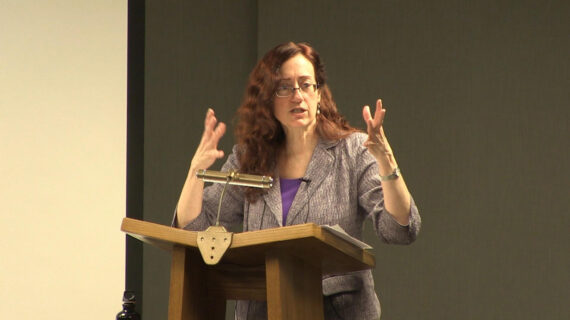
Edward Gimbel, Assistant Professor, Political Science, UW-Whitewater, delves into the dilemma that President Abraham Lincoln faced between preserving the Union and the emancipation of slaves.


Copy and Paste the Following Code to Embed this Video:
Lincoln's Pragmatism: Abolition and States' Rights
cc >> I'm Kari Borne. I'm from the office of Continuing Education at UW-Whitewater, and I'll introduce today's speaker. Dr. Ted Gimbel is in his second year in the political science department at UW-Whitewater, having worked previously at Winona State University in Minnesota. So the cold doesn't bother him. He teaches courses in political theory, including the history of political thought. He is particularly interested in political thinkers who attempt to reconcile our fine points of compromise between seemingly incompatible political philosophies. Outside of his duties at the University, he is an avid cyclist. You may see him commuting on his bike across Starin Road in the mornings, and he enjoyed watching the Winter Olympics, as we all did, recently. Dr. Gimbel's lecture today is titled "Lincoln's Pragmatism; Plotting a Course Between Abolition and States' Rights." Welcome.
APPLAUSE
>> Thank you. Thank you very kindly for the introduction. Can everybody hear me all right? Just want to make sure our microphone is doing its job. All right, excellent. As Kari mentioned, I'm a political theorist at the University. So I study the history of political thought, going all the way back to Plato and Aristotle. I'm teaching a course on ancient and medieval political thought right now, and all the way up to the contemporary period. And one of my really favorite courses to teach is on American political thought. It draws so much on some of the history of political thought that I'm very interested in, and it's particularly relevant to our contemporary situation, I think. So I'm really excited to be giving a lecture here today on the political thought that it is really characteristic of Abraham Lincoln here. Now, pragmatism is maybe not the most exciting or most thrilling of political virtues, but I kind of want to make the case today that it's really essential, and that it's really particularly important to understanding the unique political virtue of somebody like Abraham Lincoln. Given a seemingly impossible task, a really difficult dilemma, he was able to this chart a course that preserved the Union, and accomplished the emancipation of slaves, as well, a very, very difficult task indeed, and one I'm going to be interested in sort of laying out for us a little bit here today. So I want to start us off here with a little bit of a dilemma, if you will. So this is, I think, a really interesting way of presenting the puzzle that Lincoln faced. So this is a quote from Steven Kautz, who is a political theorist at Michigan State University. He says, "Certainly the people shall rule in a democracy, but they will from time to time rule unjustly as tyrants. In such a case, when the people betray justice, what are the tasks and duties of the democratic statesmen? How can a democratic statesman respect both the rightful claim of the people to rule in a democracy, and the claims of justice that are denied by that people?" Now what Kautz is really hitting on here is something that political thinkers have been struggling with all the way back to Athens, and it's something that is frequently talked about as the tyranny of the majority. And it's been seen as a real issue that democracies seem to be prone to. When you put politics in the hands of the people, you're risking the possibility that the people will use that power to oppress some small group among them, to become, rather than a democracy, something more akin to a tyranny. And that raises real problems for us when it comes to issues of political justice. What happens when the majority of people prefer a policy that is tyrannical? That offends the rights or in some way oppresses a group of people? Is it an affront to justice in that sense? We're faced with a very real political problem, and I want to suggest that this is exactly the kind of political problem that Lincoln faced throughout the course of his presidencies. So in very specific terms here, when we're looking at the dilemma that confronted Lincoln in his career, I want to suggest that on the one hand, we have the arguments put forward by advocates of states' rights, something that you'll hear a little bit more about, I believe, as this lecture series goes on throughout this semester. And I want to say that they have, really, a couple of major points to their argument. On the one hand, people who are arguing for states' rights really wants to affirm the legitimacy of what they frequently called the Southern democracy. Basically, the right of Southern states to determine their own political destiny, even if and especially when that meant going in a very different direction than the majority in the North. Second, advocates of states' rights frequently made cases that denied the claim of justice for enslaved peoples. As we'll see here in a little bit, many of the arguments made by advocates for states' rights simply denied that slavery was an injustice. They would make the case that not only was it not unjust, it was actually to the benefit of the enslaved peoples. On the other hand, we have people who are advocating for abolition, basically, the exact opposite set of arguments, right? For the one, denying the legitimacy of the Southern democracy, making this case that, no, the people of the South cannot choose their own political destiny if that means denying rights to a massive population. And second, affirming the claims of justice for enslaved peoples, making this case that slavery is an injustice and must be ended. These are two radically opposed positions, and we're going to take a look here towards the first part of this lecture at a couple of people who are making these arguments on the one side and the other before turning to Lincoln, and trying to see how he attempted to negotiate this tension here. So to begin with, the argument for states' rights maybe the argument that will be somewhat less familiar to some of us. In arguing for this case, we have the people of John C. Calhoun and George Fitzhugh, a couple of interesting individuals taking part in this debate. So to begin with, the argument for Southern democracy. This sternlooking gentleman here is John C. Calhoun. Now, early in his political career, Calhoun was understood to be a great nationalist, arguing in favor of the Union as a whole. He was a vice president, and stood very strongly for the nation as a whole. John Quincy Adams described him as being above all sectional and factional preferences early in his political career. Nonetheless, as his career progressed and particularly as a senator for South Carolina he emerged as a major theoretical defender of this argument of states' rights. So this is how he ends up putting his argument. If the numerical majority were really the people, and if to take its sense truly were to take the sense of the people truly, a government so constituted would be a true and perfect model of a popular constitutional government. Calhoun here is saying, if it was simply a matter of counting hands, then that could potentially be a kind of justice. If counting hands gave us an idea of what the people really want, then that procedure would be just. But as such is not the case, as the numerical majority instead of being the people is only a portion of them, such a government, instead of being a true and perfect model of a people selfgoverned, is but the government of a part over a part, the major over the minor part. Calhoun here is making the argument, essentially, that legislation favored by those in the North, and possibly imposed on those in the South, was a form of majority tyranny. He argued that the views of Northerners simply did not represent the will of the people writ large, and for those positions to be imposed on Southern states was simply wrong. He's invoking this common idea of the tyranny of the majority, casting the Southern states as the oppressed minority in this situation. Now, this is a very interesting argument for a bunch of reasons. This concern about tyranny of the majority was something that was voiced very clearly by the founders at the time of writing the Constitution. Madison believed that that problem would not express itself in the United States, because people had too many crosscutting interests. He really believed that very powerful factions would have a very hard time forming in the context of American politics. Calhoun argues Madison was just wrong. The institution of slavery has given us exactly such an issue that divides the country in two, a majority party and a minority party. And Calhoun is attempting to make this argument that the majority party in the North is attempting to impose its will on the South, and to do so is essentially unjust. So that's the argument made by the state's rights advocates for the Southern democracy. In addition to that argument, there's also a case made for the justice of slavery. Now this is, in some ways, the more headscratching part of the argument here, but again, it's one that actually was reasonably common at the time. One particularly vocal proponent of this position is this gentleman, George Fitzhugh, and he has the following to say. "The Negro slave is free to, when the labors of the day are over, and free in mind as well as body. For the master provides, food, raiment, house, fuel, and everything else necessary. The Negro slaves of the South are the happiest, and in some sense, the freest people in the world." Again, the sheer absurdity of the position is apparent, but it's something that Fitzhugh really, really adhered to. He included it as part of a broader critique of the economy of the Northern states, arguing that the Northern labor, the wage labor was actually far worse off than the Southern slave. This really encapsulates a big part of this argument from the states' rights position. That dilemma that we started with, the idea of the possibility of tyranny majority, the possibility of violating the rights of the people, violating justice is something that was viewed very, very differently in the South. As far as they were concerned, the justice of slavery was not at issue. What was at issue was the justice of imposing a political solution on the people of the South. That's one of our opposing sides here. Radical in its way, radical in its interpretation of the Constitution, radical in its views on slavery. On the other side of the argument, we have those arguing for abolition. And here is a couple of representative voices. I've sort of singled out William Lloyd Garrison and Frederick Douglass, two very different individuals making, in some senses, similar kinds of arguments. Again, very clearly opposed to the arguments made by those arguing for Southern democracy. So to begin with, William Lloyd Garrison. Garrison was a journalist highly critical of both slavery in the South, and the complacency toward slavery that he saw in the Northern states. He was a firebrand. Very, very strong in his opinion, and widely hated clearly throughout the South, but also in many corners of the North, as well, for his very strong opinions. Also, as we'll see here in a moment, a highly religious man, and that clearly motivates a good portion of his argument. So here's his take responding to the Fitzhughs of the world, his take on the injustice of slavery. "No man has a right to enslave or imbrute his brother to hold or acknowledge him, for one moment, as a piece of merchandise, to keep back his hire by fraud, or to brutalize his mind by denying him the means of intellectual, social, and moral improvement." Very characteristic view here in terms of the injustice of slavery from the perspective of the abolitionist, and again, the argument that very much carried the day. And the argument that we perhaps identify with more clearly, historically. In addition, Garrison argued very strongly against Calhoun. Against the Southern democracy, we have this longish quote that is really very characteristic of Garrison and his rhetorical style here. "Therefore, we believe and affirm that all those laws which are now in force, admitting the right of slavery, are therefore before God utterly null and void; being an audacious usurpation of the Divine prerogative, a daring infringement on the law of nature, a base overthrow of the very foundations of the social compact, a complete extinction of all the relations, endearments, and obligations of mankind, and a presumptuous transgression of all the holy commandments, and that therefore they ought to be instantly abrogated." Again, very characteristic of Garrison for a couple of reasons. For the one, you'll notice a very strong religious rhetoric here. The appeal is for, the most part, to God and to God's justice. Secondarily, to the idea of natural law, natural justice. The idea that the enslavement of one man by another is something that so offends our natural sense of justice that it must be ended as a practice in the world. So he appeals very broadly to religious authority, appeals very strongly to the sense of natural law. What he doesn't particularly appeal to is the Constitution. Garrison was no constitutionalist. He was a strong enemy of the Constitution as a document that, in fact, entrenched certain practices that kept slavery alive for decades. Garrison, too, was a radical. He saw no compromise. And again, to an extent, that's a very admirable position. He seems to have justice and morality on his side. But Garrison saw no problem with sacrificing anything, up to and including the Constitution and the Union in the service of abolition. So to put all of this in very stark terms this opposition, this dilemma that we're talking about here. This is a quote from Frederick Douglass. "It is not light that is needed, but fire. It is not the gentle shower, but thunder. We need the storm, the whirlwind, and the earthquake." Very common kind of sentiment among the abolitionists, right? We don't need moderation. We don't need to be trying to deal moderately or softly with these issues. Now is a time for strong statements, for strong action. Douglas, himself a selfeducated, emancipated slave escaped and earned, eventually, his freedom was a strong advocate for abolition, and an adviser to President Lincoln, who was frequently very critical of Lincoln for being too moderate in his approach to abolition. I'll talk about that in just a moment here. Again hammering home the starkness of this contrast. We have Garrison saying no compromise with slavery, no Union with slave holders a very sort of famous phrase of his. But on the other hand, Calhoun abolition and the Union cannot coexist. From these perspectives, it's very much an either/or. For the abolitionist, slavery must end, even if it means the dissolution of the Union. For the advocate for Southern democracy, states' rights, abolition and the Union cannot coexist. They cannot survive alongside each other. If the Union pushes for abolition, that will be the end of the Union. That's simply all there is to it. Again, two very extreme positions in some ways faced off against each other at a critical moment in American history. And right in the middle of that, we have Abraham Lincoln, making what I want to suggest is a very pragmatic kind of argument. So in order to understand that, it makes sense to talk a little bit about the moral and political convictions that we see expressed in some of Abraham Lincoln's thought, in his writings, in his speeches. And I think that this is really clearly on evidence in a speech that he gave in Peoria, Illinois, 1854. Okay, so 1854, relatively early in Lincoln's political career. This is essentially when Lincoln starts to come to national prominence, arguing about the major issue of the day the expansion of slavery into new territories. This is an expansion that Lincoln, in his heart, was deeply opposed to. But we can see in his speech in 1854 that he understands, in a way that perhaps the abolitionists or the state's rights advocates don't, the stakes of this dilemma. So, on the one hand, in this speech, he makes the following statement on slavery. "This declared indifference, but as I must think, covert real zeal for the spread of slavery I cannot but hate. I hate it because of the monstrous injustice of slavery itself." Lincoln, in no uncertain terms, calling out against the injustice of slavery as an institution. His heart cries out against it. He sees it as being a tremendous injustice. That point, at least, seems to line up pretty nicely with what the abolitionists are saying, but Lincoln is also acutely aware of the politics of slavery. In the same speech, he has the following to say. "Much as I hate slavery, I would consent to the extension of it rather than to see the Union dissolved, just as I would consent to any great evil to avoid a greater one." Again, this is in the course, the context of a single speech at a pivotal moment in Lincoln's public life. And I want to suggest that this is actually an attitude that Lincoln holds to quite consistently throughout his public career. Having a very deep moral conviction against slavery, and trying to deal with that in the context of a seemingly impossible political situation. Now, this moment in 1854, I think you guys had another speaker, Dr. Haney, who was talking about exactly this moment, how significant this was in the march toward the Civil War, essentially trying to decide what to do about these new territories. This is the moment where Lincoln really interjects himself into this debate. So what do I mean when I'm talking about Lincoln's pragmatism in terms of his dealing with this dilemma, dealing with this tension? Well, I want to sort of start off by saying a few things that Lincoln is not, a few things that I don't mean when I refer to Lincoln as a pragmatist. On the one hand, I definitely don't want to say that Lincoln's views are in some way milquetoast, watered down, kind of benign or boring. Most of his contemporaries who listened to his speeches or who spoke to him about his views speak to his passion on these issues. His condemnation of slavery was not qualified for the most part. He was a passionate individual in this sense. So when I say "pragmatic," or refer to himself as being a pragmatist, I don't mean simply that he's watering his views down in any way. Additionally, I don't want to seem to be suggesting that Lincoln was merely cynical in his politics, attempting to appeal to one audience or another, attempting to present a false view of himself in order to gain political power. I don't see much evidence for that in Lincoln's public speeches, either. Finally, there's a phrase that's gotten a lot of currency in contemporary politics, the idea of a flipflopper the idea of somebody who changes their views from one moment to the next seemingly for political gain. As it turns out, as an editorial comment, I don't think flipflopping is that bad. I think changing your opinion based on new evidence is actually an admirable trait for somebody to evidence. Nonetheless, that's not what I mean by pragmatism in the case of Lincoln. And again, I don't see him as being somebody who's making these kinds of course corrections for the sake of political expediency or convenience. Instead of that, I want to suggest a few interesting characteristics of Lincoln's views here. His views are moderate in a true sense. I think moderation, too, gets kind of a bad name in contemporary politics, but it's a supreme virtue, I want to suggest, in times of crisis. Moderation doesn't refer to being unprincipled, sacrificing one's principles in that way. Instead, it's about being pragmatic and somewhat realistic, realizing that a more radical political stance might actually compromise your goals in the long term. In that sense, Lincoln was pragmatic. He attempted to steer for a more moderate course that would give his bigger values the opportunity to survive and to flourish, where a more radical stance would have been far less likely to have been successful. I also want to emphasize that there are elements of Lincoln's approach here that are remarkably consistent. Now I know that the last speaker in the series actually emphasized the dynamic nature of Lincoln, how in different contexts, speaking to different audiences, we see some really interesting changes in his rhetoric. And I believe that's absolutely true. But behind the rhetoric, the principles that we see expressed are, I believe, really remarkably consistent. Finally, we also see in Lincoln's thought a remarkable patience, an almost superhuman patience, it might seem. In the face of political events that would easily inspire rash action, extreme action he was widely criticized for being too patient, too moderate, too slow in his approach. Frederick Douglass himself criticized Lincoln for this on numerous occasions. Not going far enough, not going fast enough. But Lincoln had the patience not to sacrifice in the name of that instinct for immediate radical change. I've said a couple times that Lincoln was not going to sacrifice his greater political interests and his greater values because of this instinct for a more rash kind of action. I want to suggest this his real overriding concern here was, in fact, Union, maintaining the union throughout this difficult time. Early in this process, when the choice seemed to be a choice between abolition and Union, Lincoln chose Union. We see this very clearly in that speech at Peoria, Illinois. Lincoln sympathized with those who were seeking abolition. Their desire was his desire, the desire to see the end of this institution. But at that moment in history, Lincoln saw that pursuing that abolitionist agenda in the way that a Douglas or a Garrison would have preferred would have been fatal to the Union, and he chose the Union. Later in his career, when the choice was different when it was a choice between the dissolution of the Union through secession on the one hand, or the possibility of preserving the Union through war Lincoln again chose preservation, accepted war not as something desirable, but as something that was necessary in order to preserve this greater Union. Lincoln understood that without the Union, the goals of the abolitionists could not be met. If the Union dissolved, abolition would simply never happen. The approach of the Southern Democrats had to be countered precisely because it endangered the Union. It's tempting to see inconsistency here, to Lincoln avoiding conflict and sanctioning the continuation of slavery on one moment, and then embracing war in the name of emancipation the next. But in light of this idea of Lincoln as a pragmatic thinker, a different kind of narrative emerges. We have a quote from 10 years later, a speech that, again, I think we've looked at already in this lecture series the Second Inaugural Address, 1865. This is what Lincoln has to say at that point. "All dreaded war, all sought to avert it. While the inaugural address was being delivered from this place" four years earlier, referring to his first inaugural, "devoted altogether to saving the Union without war, insurgent agents were in the city seeking to destroy it without war, seeking to dissolve the Union and divide effects by negotiation." He's referring here to secession, to the movement by Southern states to simply opt out. That was a threat to the Union. "Both parties deprecated war, but one of them would make war rather than let the nation survive, and the other would accept war rather than let it parish. And the war came." This is an interesting and sort of striking statement in the context of this larger speech, because I think Dr. Haven emphasized last week this is in the context of a speech that is about reestablishing the Union as the war was winding down in some ways, with malice toward none. That's the speech. Lincoln still takes a moment to highlight that there was within the United States a faction that would see dissolution, and that war was forced upon those who would seek to preserve the Union. Again I want that to suggest that this is really illustrative of that political pragmatism of Abraham Lincoln, resisting more radical calls on both sides of this issue, and seeking to navigate a middle course that would achieve the ends of the abolitionists while still preserving the Union. Now, with all of that in mind, there are a couple of things that I want us to sort of dwell on here a little bit as we conclude, and before I ask for any questions or thoughts that you guys might have. For one, we have to be a little bit careful here not to engage in too much hero worship. My tone here has been very celebratory. There's a lot to admire about Abraham Lincoln. But it's worth noting that, by our own standards, Lincoln was no egalitarian. He hated slavery, saw it is a tremendous injustice, but he was not one to argue for the moral, intellectual, or political equality of slaves or former slaves. He advocated for abolition, but that's not the same thing as advocating for equality. He was also, by the standards of an advocate for democracy, somewhat problematic. In order to preserve the Union, Lincoln was willing to adopt radically antidemocratic policies. Again, that's something that we need to come to terms with in understanding what Lincoln was about here. We may accept some of these flaws as being necessities of his time while still acknowledging them as flaws to a certain extent. In addition, I want to sort of note that with that in mind, Abraham Lincoln is very much a model of the American statesman, warts and all literally and figuratively in this case. Abraham Lincoln really does struggle with the legacy that had been left to him by the American founders, specifically with reference to the issue of slavery. There's a somewhat famous quotation from Thomas Jefferson referring to this problem of slavery. Jefferson wrote, "But as it is, we have the wolf by the ears, and we can either hold him nor safely let him go. Justice is on one scale, and selfpreservation on the other." Even at the time of the founding, somebody like Jefferson himself very problematic when it comes to the issue of slavery in the United States understood this tension, understood this dilemma. We have the wolf by the ears. We can't safely end slavery. We can't justly keep it. And the founders of the Union left that problem as one for future generations to solve, and it fell to Lincoln to navigate that. Also, like the founders again, we see in Lincoln this tendency towards compromise, towards moderation, towards a kind of middle road. So with respect to slavery, again taking up the legacy of earlier American political thinkers, and with respect to this idea of pragmatism or moderation in general Lincoln very much taking up the mantle of earlier thinkers in American political thought. I also sort of want to note here in conclusion that these ideas these virtues, if you will of pragmatism, prudence, and moderation are very much underappreciated, I think, in contemporary politics. And understandably, right? They're not as headlinegrabbing as the politics of extremism. But without these virtues pragmatism, prudence, and moderation the Union would have dissolved several times over. I think that bears consideration in our contemporary political context. Okay, I feel like I've spoken enough, and I want to make sure that we have some time for any thoughts or questions, or comments that you guys have. So we'll hand it over to you. >> And otherwise, let's go ahead and thank Dr. Ted Gimbel for his lecture. Thank you. >> Thank you.
APPLAUSE
Search University Place Episodes
Related Stories from PBS Wisconsin's Blog







Donate to sign up. Activate and sign in to Passport. It's that easy to help PBS Wisconsin serve your community through media that educates, inspires, and entertains.
Make your membership gift today
Only for new users: Activate Passport using your code or email address
Already a member?
Look up my account
Need some help? Go to FAQ or visit PBS Passport Help
Need help accessing PBS Wisconsin anywhere?

Online Access | Platform & Device Access | Cable or Satellite Access | Over-The-Air Access
Visit Access Guide
Need help accessing PBS Wisconsin anywhere?
Visit Our
Live TV Access Guide
Online AccessPlatform & Device Access
Cable or Satellite Access
Over-The-Air Access
Visit Access Guide




Follow Us