

 Passport





Gaylord Nelson
04/20/10 | 41m 46s | Rating: TV-G
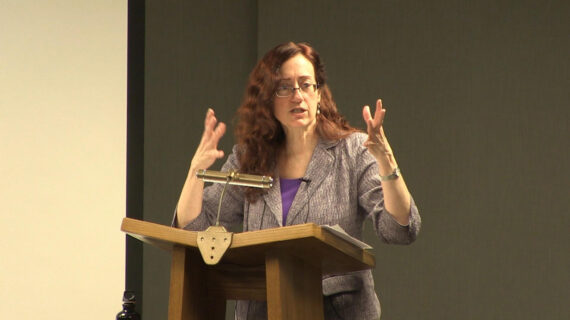
Sheila Terman, Cohen Author Sheila Terman honors Gaylord Nelson, the founder of Earth Day, by talking about his early life all the way through his 32 years of public service to the country and the state of Wisconsin.


Copy and Paste the Following Code to Embed this Video:
Gaylord Nelson
cc >> Welcome to another edition of History Sandwiched In. You probably have trouble not noticing that Earth Day will be coming up in two days. It will be the 40th anniversary so the 41st Earth Day. We're celebrating it here at the museum. We have a whole exhibit about Gaylord Nelson right on the first floor. There's also some information on the political history of Gaylord Nelson at our headquarters building on the other side of State Street on campus. And we have been lucky enough to have, today, a speaker about Gaylord Nelson and Earth Day. It's Sheila Cohen, who's been kind enough to grace our museum with her presence today. Now I just want to mention, there's a series of books called Badger Biographies. Some of you have seen them. Supposedly they are for young readers, but let me tell you, they are for everybody. And we here at the staff consult them all the time. They're wonderful books. And our speaker today has written two of them. First of all, "Mai Ya's Long Journey." And our speaker met Mai Ya because our speaker was an English as a second language teacher, and Mai Ya was one of her students. So Ms. Cohen wrote a biography of her. Now more to the point, the governor and senator, Gaylord Nelson, the originator of Earth Day and we'll especially be happy to celebrate his presence and we have here, let's welcome our speaker, Sheila Cohen. ( applause ) These books are here in our bookstore, and Sheila Cohen will be happy to sign them for you. Thank you, so much. >>
Sheila Cohen
Well, hello to everyone and thank you so much for coming inside on a gorgeous day like this. I truly appreciate it. Gaylord Nelson, as many of you may know, gave 32 years of public service both to our country and our state. And yet I've noticed a lot of people who are under the age of 30 sort of look at me with glazed eyes when I say I've written a book about Gaylord Nelson. It's not until I say that he was the founder of Earth Day that they realize who I'm talking about. But Gaylord Nelson did so much more than found Earth Day. There is so much that he contributed to our country and our world. In fact, so much so that I asked one of my invited friends to start singing "There's No Business Like Show Business" when I go overboard, just like at the Academy Awards. Somebody has got to start humming "There's No Business Like Show Business" because there's so much to talk about. I think the best place do begin would probably be at the beginning. So let's see, that's not what I want. >> Hit the little button on top again. >>
Cohen
Okay. >> May I? >> Certainly, yeah. I hit the one that's supposed to have it go forward. >> Just a second, we'll get it. >> Okay. I suppose I could also use this. >> I'm sorry, just a minute. >> Sure, I could use the arrows on this, I would guess. >> No, we'll get it, eventually. >> Okay. >> I'm sorry about this. >> That's all right. It was working just before I started. >> Yes, it was. But the gremlins have come. >> Do you want me to try the arrows on the machine? You can start humming "There's No Business Like Show Business" already. Okay. >> I'm sorry, ladies and gentlemen. >> So there he is and at this time I believe he was Wisconsin state senator. But I think the best place to start would be with the beginning because Wisconsin and Clear Lake, Wisconsin, in particular, were so much a part of who this man became. He was Gaylord Anton Nelson. He was born on June 4, 1916. And the kids in the neighborhood, understandably, thought that Gaylord was a pretty large name to stick on a little boy, and so one of them started teasing him and calling him "Happy" which, at the time, was the only connotation you could give to the word gay. So Happy stuck with him and stuck with him, actually, until he graduated college. Gaylord was one of four children. He had two older sisters, Margaret and Janet, and a younger brother, Stannard, who happened to be born exactly two years to the date of Gaylord's birthday. So they shared birthday parties. Generally they got along pretty well, but at times Gaylord was known to sort take advantage of his advanced age and status, and a case in point would be at a Clear Lake picnic when a person gave Stannard a nickel, excuse me, a dime, and gave Gaylord a nickel. And Gaylord held the two coins up to his brother and said, "Look, mine is bigger, I'm sure I can buy a lot more ice cream than you can." And of course Stannard, not knowing any better, traded. And so years later, possibly out of guilt or just his sense of humor, Gaylord sent his brother a check for $500 saying, "This is for the interest on the loan, plus criminal penalties." ( laughter ) They lived in a small house in Clear Lake, but the ideas coming from that house were very big. And there was a lot of modeling of leadership and public service. His father was the area family doctor, which was very important. He was the only one out of two that were around in the area. And this is an area in Clear Lake called Doctors Corner. Sometimes Gaylord would go with his father when things were still, when there was a lot of snow on the ground because at the time there really weren't adequate snow plows to plow the streets, and he would go with his father in the sleigh to make house calls. If any of you remember when doctors still made house calls. And he saw at the time, I think it sort of infused him with the idea that public service was a very, very special thing. Sometimes they would go in their Model T car. And that car will come into play a little bit later. Gaylord's mother was also a leader in the community. She was a nurse at the local hospital and she was an activist. She was heading the women's suffrage movement and was extremely happy in August 1920 when Woodrow Wilson finally gave women the right to vote. Both of his parents were extremely interested in politics. And their man was Fighting Bob La Follette. They really liked the ideas that he advocated for, the populist reform ideas. And he had actually split off, not entirely from the republican party, but as a wing of the republican party called the Progressives. When he died in 1925, his son, then called Young Bob, ran for his seat in 1926 for the Senate and leading the Progressives. And it was at this moment that Gaylord Nelson feels he had his epiphany about wanting to become a politician. He went in that car that we talked about, the Model T car, with his father to Amery, Wisconsin, and in Amery Young Bob La Follette was giving a whistle stop tour. And at that time everybody from everywhere gathered around if there was any politician on hand, and he saw that people were cheering and Young Bob was spouting all these lofty ideas, and he said to his father on the way home, "You know, I think I want to be a politician." But he said, "Young Bob La Follette has such good ideas maybe there won't be anything left for me to do by the time I get there." ( laughter ) Well, there was plenty left for him to do. One of the largest forces in Gaylord Nelson's life was Clear Lake itself and the atmosphere there. It had two very pristine lakes. There were forests all around, and Gaylord used those as his classroom, as his learning tools. He spent hours out in the woods just exploring nature or fishing or swimming, skating. He felt so much freer in that atmosphere than he did in the straight rows of seats in the classroom. So really the classroom, though he was very bright, the classroom was not very appealing to Gaylord. And he didn't really apply himself very much. But in spite of the fact that Gaylord was not particularly fond of school, he was particularly fond of the kids that went to school with him and they were with him. And I think as proof of that, when I was looking in the archives at the State Historical Society, there were letters that he saved from classmates who had wished him well when he had rheumatic fever and couldn't come to school. And in those days rheumatic fever was very dangerous. It was a fatal disease because there weren't any medications to take care of it. So, fortunately, he recovered from that but saved the letters. And this one says, let's see, I think there was something that said, oh, yeah, Ms. Parks says, one of the letters said it would be very good if you came back to our school picnic and even if you were on crutches we think you're going to be there. His favorite compadre was a good friend by the name of Sherman Benson. And these guys got into a little bit of trouble in Clear Lake. And in Clear Lake, town of 700, everybody knew who you were so everybody knew what was going on. And at one point, for some odd reason, they thought it would be very funny to put a heifer in the living room of the local banker. They thought he needed a little sense of humor. So they did things like that, but they were pretty harmless and just a little bit mischievous. Let's see. Oh, yeah, I think there probably wasn't much of a dull moment when Gaylord was around. This is a letter that he wrote to his mom saying, at age 13, "I took the car all by myself," while she was away and couldn't do very much about it. Gaylord, as he got older, and still high school was not the thing for him, but he loved the extra curricular activities and one of those was playing the trumpet in the high school band. Years later when a reporter asked him why he thought he was on Nixon's enemy list in the early '70s he said, "Because Nixon was probably in Clear Lake and heard me play trumpet in the band." ( laughter ) He was also a leader there. He was captain of the football team and captain of the basketball team. But oddly enough, when he was asked to give the graduation speech for his 39 classmates and their parents, he got very, very nervous, feigned illness and never went to his own graduation from high school. So here's a man who made hundreds of speeches later on influencing people and still in high school that's how he felt. He really didn't feel prepared when he graduated high school. He didn't feel prepared to go on to college. He tried a couple of junior colleges in the state. And he just felt he wasn't ready yet. So he came back home and he joined the Works Progress Administration which was part of Franklin's Roosevelt's program to put people to work during the Great Depression in the '30s. After a year of shoveling gravel he decided perhaps he was ready to go to college. ( laughter ) So, in fact, he did. He went to San Jose State College in California where his two sisters had gone before him, and he was ready because he got straight As and graduated with honors. So here's a picture of Gaylord and his mother, and I think his mother has this kind of look on her face like, "thank goodness." ( laughter ) It's over. After he graduated from college, he decided that he was going to go on to law school at the University of Wisconsin. And he did that. And oddly enough, he met up again with his mentor, young Bob La Follette. La Follette was running again on the Progressive ticket for a Senate seat, and Gaylord, immediately then, became head of the Young Progressives on campus and worked and worked for him in his campaign to the point where he barely was able to take enough courses to graduate with his class in 1942 but he did that. And in 1942, of course, World War II was already going on and six months prior to his graduation Pearl Harbor was attacked. So he decided he was definitely going to enlist in the army when he got out. And he did that. He went to officers candidate school and became a second lieutenant in charge of an all African American unit. It was the first time that Gaylord Nelson had ever really brushed up against discrimination and segregation. He realized that his own troops were not able to go into the same places that the white troops were able to go. Their barracks were less than the classic barrack. And even the officers were not able to go to the officers club, to the pool. And Gaylord was appalled by this and vowed to himself that if and when he became a politician, he was going to take care of that. He was later shipped, with his group, to Okinawa, but just after he was shipped there, we had bombed Japan and the war was over. But one of the best things about being in the army, he thought, was meeting his wife Carrie Lee Dotson. She was a nurse and he had met her at the first base at Indiantown Gap. And, coincidentally, she was then sent to Okinawa shortly after Gaylord, and they re-met and decided that they were definitely going to see each other when they got home. And in fact, they were married in 1947. Now Carrie Lee was and still is a sort of no-nonsense gal. She tells it like she sees it. And when she was asked many years after their wedding what she attributes to the successful marriage when Gaylord was such a busy man and away from home so much, she just didn't miss a beat and said, "That's easy, we're both in love with the same man." ( laughter ) Gaylord did not lose his political ambitions, and, in fact, ran for Congress in 1946. Now at this time the Progressive party had disbanded. So the Progressives were going either to the democratic party or to the republican party, and a lot of them weren't sure which to do. As a matter of fact, Gaylord joined the republicans, ran on a republican ticket in 1946 for Congress and was defeated. In 1948 he decided that the democrats were more suited to his way of thinking, and he ran then for state Senate and won the election. Unfortunately, it was so imbalanced. He was one of three democrats in the Senate against 27 republicans. So if we think things are contentious now, I think we have to go back in history a little bit. They were contentious then too. Being true to his beliefs, he proposed a bill that would integrate the National Guard here. Truman had already integrated the regular armed services in 1947, but the National Guard was still not integrated. So he proposed this bill and with the republicans he was totally defeated on that. But a republican senator then proposed the exact same bill and it won unanimously. And the Wisconsin National Guard was integrated. Things like that kept going on. He kept proposing bills that didn't get anywhere. Finally, in 1951 he was able to propose a bill that did pass and it was the state equal rights bill. And that gave people, that forbid people to be discriminated against on the basis of their nationality or their creed, which was added to the bill that had already come out about forbidding discrimination against race. So he was pretty tired of this, and so he decided that to get things done he should really run for governor. And, in fact, he did run for governor and was very, very successful. He moved to the governor's mansion which was a huge change for the family. And I might add that Gaylord Nelson was the first democratic governor that Wisconsin had had in decades. And so when he moved to the mansion it was a huge move because he and Carrie Lee had lived in the Bush, the Greenbush neighborhood of Madison. And then moved into a modest house in Crestwood. And so going into a home like this was quite a change, but the Nelsons managed to keep their casual lifestyle. And how could they not? They had a five-year-old little boy, a three-year-old little girl. The five-year-old was Gaylord Anton Jr. The three-year-old is Tia Nelson, who is still in Madison, and their dog, of course, Wags. And Tia Nelson, when I was doing the interviews for this book, she told me a very funny story. If you see the staircase in the back, it was a rather winding staircase, and the Nelsons entertained a lot of dignitaries. But kids will be kids. She and Jeff stood at the top of the landing one night when a dignitary was saying goodbye to Gaylord right in the middle of the hall, and they decided, wouldn't it be fun to fill balloons with water and drop them down on the guest's head? And so they did. And, of course, Gaylord feigned being upset with his children, but Tia told me she thought she saw a twinkle in his eye. And I think maybe he was remembering his own escapades with the cow and the banker's house. I don't know but he kept his sense of humor, and he kept his casual demeanor. In 1961 another child came along, and this was their youngest, Jeff. When I was interviewing Carrie Lee, in her very honest way, she said, I think people were surprised that such things were going on in the governor's mansion. ( laughter ) And even though such things were going on in the governor's mansion a lot of wonderful legislation came out of that period too. One of them, and the most notable, was the Outdoor Recreation Act Program. And that was based on a one-cent tax for cigarettes that was put into a fund to buy up and preserve lands in Wisconsin. Which is very similar to what still goes on today in the Stewardship Program of buying lands and preserving them for people to enjoy. It was such a notable thing that Gaylord Nelson became titled the "Conservation Governor." And other states followed in his lead. Everybody wanted to know how he did this and what he did. He also preserved waterways such as the upper St. Croix. I don't know if any of you have been on that, but it's just a beautiful place. And the... >> Namekagon. >> Thank you. That river. ( laughter ) So he did so much to preserve the beauty of our state. And there he decided after two terms as governor to run for US Senate. He felt that he could take his ideas to a national level. And so, again, he ran and was quite successful. People, young and old, already knew of his accomplishments and really admired him. He spoke to young people and old people and rural people and urban people. And he had such a sincerity about him. He was such a natural person that people really felt he had their concerns at heart and that he was really listening to them. And he spoke to people of all walks of life. One of the first things he did when he became US senator was to take advantage of the fact that we had quite a popular president in John F. Kennedy. And he wanted to John Kennedy to get on board with him in his conservation ideas. So he wrote him this letter and sure enough, and he said there is no domestic issue more important to America in the long run than conservation and the proper use of its resources. Well, Kennedy liked that. And less than a month later, he was doing an 11-state tour which included Wisconsin and included particularly the Apostle Islands because Gaylord Nelson really wanted to turn the Apostle Islands into a national site which eventually happened. Gaylord's friend, dear friend, Mr. Hanson, led a private tour of the Apostle Islands, and I had a chance to talk to him, oops, there we go, I had a chance to talk to him, and he said it was one of the greatest events that ever happened in the Ashland area. People came from all over and heard Gaylord Nelson and Kennedy talk about the wisdom of preserving our environment. How many of you have been to the Apostle Islands? Oh, good. So you know how beautiful it was. Although Kennedy was assassinated, as we all know, in 1963, Johnson carried on with the work and put a Wilderness Act into law which again preserved so many wonderful places, not only in Wisconsin, but around the whole country. And spawning from that was the National Trails Act which preserved places like the Appalachian Trail going all the way from, I've skipped a little bit, I'm going to go back again, I thought I was going to go back again, I'll get to that in a minute, the Appalachian Trail on the east coast, the Pacific Coast Trail all the way from Canada to southern California, and the North Country Trail which goes all the way across the top of the country from New York to North Dakota. Have any of you enjoyed those trails at all? Okay, okay. I haven't and this book, doing the research on this book has certainly made me want to do that. Thanks okay, I'm already on that slide now. >> Okay, I'll get rid of it. >> No, no I don't want to get rid of it, that's the slide I'm on. >> That's the end of it? >> Yeah, this is a new slide. But you're going to start humming. You said you would start humming. Another thing that he did was take on the chemical companies. Nobody had the nerve to do something like that. But if any of you remember, in the 1950s they went around with huge trucks down streets where kids were playing and fogged the whole area with DDT. You could hardly breathe, you could hardly see. And they were finding out that DDT was actually destroying the egg shells of birds and so that there weren't as many birds being born, and there were some studies that were beginning to show that it had some carcinogenic effects on human beings. So Gaylord really took them to task and eventually, in 1957, DDT was banned for use like that. Well, while we're doing, he also took on the pharmaceutical companies, and thanks to Gaylord Nelson we now have warnings on our medical bottles telling us what some of the side effects are. Before that time, we didn't have that. Okay, so he became a very popular US senator and, in fact, on his next campaign for his next term, he did a whistle stop tour very much like his mentor that started the whole ball rolling in Amery, Wisconsin. So it was a La Follette memory. Here's a picture of his daughter, Tia, which she happens to love, and so do I because if you look at their two expressions, you can almost tell she's going to follow in her father's foot steps in one way or another. And in fact, today, she is the Executive Secretary of the Wisconsin Board of Commissioners of Public Lands that sets aside funds that have been gotten from public lands and uses them for, among other things, preserving forests. So I had to include that. Okay, aside from the environment, Gaylord Nelson inherited some very tumultuous times. One of those times was the McCarthy era. And although McCarthy was already dead by the time he became a US senator, McCarthy had died in 1957, HUAC, which was the House Un-American Activities Committee, was still rearing its ugly head and accusing people, falsely, of communist affiliations and that sort of thing. Gaylord was very familiar with McCarthy because he was a state senator from Wisconsin and had actually joined a truth squad, they called themselves, a democratic truth squad that followed McCarthy to his various appearances and challenged him on some of his accusations. Before McCarthy's 1952 reelection, Gaylord Nelson held hearings in Wisconsin for the purpose of really inquiring about McCarthy's tactics. And so when he was a US senator, it wasn't hard for him to join in when people wanted to abolish HUAC. And he said, these investigations threaten the very freedom that most sharply distinguish our democracy from the communist system. He was very outspoken and not afraid at all to stand alone. Other senators were really cowering, they didn't want to make any waves. But eventually HUAC was abolished. Another thing that was going on was the Civil Rights Movement during Gaylord Nelson's term. And although Brown versus Board of Education was passed in 1954, it didn't really entirely do away with segregation and discrimination, particularly in the south. And Gaylord Nelson then was a cosponsor of the Civil Rights Act of 1964 and signed that act to make it final for desegregation to occur in the southern schools. And, if that wasn't enough, Vietnam War was also raging. And Gaylord Nelson did not agree with the Vietnam War. He actually was so opposed to it that he was one of three senators that didn't vote to appropriate when Johnson asked for $71 million of more appropriations for the war. And being one of only three, he said you obviously need my vote less than I need my conscience. Well, in 1969 something occurred that made Gaylord really want to concentrate again on - I have to say goodbye to my husband, thank you for coming. ( laughter ) He really wanted to concentrate on the environment again. It was a time, I don't know if you remember, when the Exxon Valdez spilled tremendous amount of oil into the waters off of the coast of California. Birds were totally saturated with this oil and couldn't fly. Animals and fish were lying on the beach. It was really a miserable time, and Gaylord thought something has to be done. So he got together with a young lawyer, an activist by the name of Denis Hayes, and together they developed Earth Day. He got the idea because at that time there were Vietnam teach-ins to teach people about the war and to actually get them to be aware enough and to even protest the war at that time. So he thought if we can do that about the war, why can't we do that about the environment? And so on April 22, 1970, the first Earth Day was held. And it was a huge success. 20 million people gathered all over the country. Kids were doing all kinds of things to help clean the environment. And people were becoming very aware of it. I don't know if any of you wore that ecology button, do you remember that? Everybody was wearing the ecology button like people are wearing their colored rubber wristbands today. And people were planting trees, classes were doing all kinds of things, helping the environment. Kids were picking up playgrounds and public places, putting things in garbage bags and into trash bins. And there was just a tremendous awareness going on. There were so many kids that wrote to Gaylord Nelson about the environment that he decided that he was going to compile these letters in a book and he did that. And so this is one of his fourth grade constituents from Madison, Wisconsin. It says, "Now, how to solve this problem? One, you could scrape it off. Two, you could send down skin divers to cut it up." Talking about the weeds in the lakes. "Three, you could cut it up, then scrape it off because I want to have some fun in our lakes so get to work right now." ( laughter ) So obviously kids were quite involved. Earth Day continued on until today and we're approaching it very shortly. And this is a picture of the Raging Grandmas who are still around. And I found out that there is a woman in the first row who is part of the Raging Grandmas. Yay, Raging Grannies. ( laughter ) In 1990 there was another very large spill, and Gaylord Nelson decided at that time why not get the world involved in Earth Day because what we do certainly affects the rest of the world and what they do affects us. And so he did. And at that time, 200 million, not 20 million, but 200 million people came out to participate and 141 countries. So I think in many ways Earth Day had its influence all over the world. Legislation was very important. Nixon actually formed the, I'm blocking on the name, energy... >> Environmental Protection Agency. >> Oh, thank you. Thanks very much. Yes, the Environmental Protection Agency which exists until this day. And so many laws were made that actually, in the decade from 1970 to 1980 more laws were made to protect the environment than in any other decade in our history. And this was all due to Gaylord Nelson's Earth Day. It included the Clean Water Act, the Clean Air Act, the Safe Drinking Water Act. Lots of things that we take advantage of today. Although Gaylord did such wonderful things, he was defeated in his bid for fourth term as US senator. In part because of the political backlash against the Carter administration at that time. But he certainly did not stop working on his passion, and he became the consul to the Wilderness Society which also works on preserving lands. As part of his job, he would go around the country and talk to children and grownups all over about the importance of keeping our environment clean. And one of the places that he loved going to most was Clear Lake, Wisconsin, where he was from. This building was recently built, it's not his original grammar school, but it was built and it was named the Gaylord A. Nelson Educational Center. One of the teachers told me, when I went up there to do my research, one of the teachers told me that one of the last times he came up, a little first grade boy raised his hand and he was really, really serious and he said, "Mr. Nelson, how does it feel to be named after our school?" ( laughter ) And Gaylord, very seriously, said in return and didn't laugh, he just said, "It feels mighty good." In 1995 Gaylord Nelson was given the Presidential Medal of Honor by President Clinton. It's the highest honor anyone can get as a citizen of the United States. And he said, this is Clinton's words now, "As the founder of Earth Day, he is the grandfather of all that grew out of that
event
the Environmental Protection Agency, the Clean Air Act, and the Clean Water Act." I'm sorry, I have a misprint there. "He also set a standard for people in public service who care about the environment and try to do something about it." And as we think about Gaylord in his legacy, he died on July 3, 2005, but his legacy certainly lives on. And I think if he were here to talk to us today he would say
this
as we think about the richness of the world in which we live, its forests, its clean blue waters and all of its varied life forms, we must understand our actions, our actions affect all of them. And I think that that would be a message he would like to leave with all of us. Now when Gaylord was 86, he died at 89 so this was three years before he died, he published a book called "Beyond Earth Day." And so he, at the age of 86, would go to various book shops, do book signings, talk to the public about his book, but his voice was failing due to age, due to illness, and so he explained that to his audience and he said, "So since I can't talk to you very long, like Henry VIII said to one of his many wives, Anne Boleyn, I'm not going to keep you long." ( laughter ) And I hope I haven't kept you too long. ( laughter ) Any questions? ( applause )
Search University Place Episodes
Related Stories from PBS Wisconsin's Blog




Donate to sign up. Activate and sign in to Passport. It's that easy to help PBS Wisconsin serve your community through media that educates, inspires, and entertains.
Make your membership gift today
Only for new users: Activate Passport using your code or email address
Already a member?
Look up my account
Need some help? Go to FAQ or visit PBS Passport Help
Need help accessing PBS Wisconsin anywhere?

Online Access | Platform & Device Access | Cable or Satellite Access | Over-The-Air Access
Visit Access Guide
Need help accessing PBS Wisconsin anywhere?
Visit Our
Live TV Access Guide
Online AccessPlatform & Device Access
Cable or Satellite Access
Over-The-Air Access
Visit Access Guide




Follow Us