

 Passport






Willow Creek Farms
11/17/11 | 26m 46s | Rating: TV-G
Travel to central Wisconsin to visit with Tony and Sue Renger, owners of Willow Creek Farms. Willow Creek produces some of the best award winning Berkshire pork in the state and they process and smoke all of their own meats. Tour their charcuterie facility, smokehouse and the pastures where the happy pigs roam free. Then, visit the Madison Club for the first SlowPig event put on by chef Dan Fox.


Copy and Paste the Following Code to Embed this Video:
Willow Creek Farms
cc >> Behind this completely innocuous office-looking facade, is actually home to one of the best charcuterie and Berkshire pork producers in the country. Willow Creek Farms, run by Tony and Sue Renger. On this episode of Wisconsin Foodie, we travel to central Wisconsin and Willow Creek Farms. We meet with Tony and Sue Renger, and peer behind the scenes as they craft their charcuterie, as well as see the cutting edge smokehouse operation, and then tour the pastures with the farmers themselves. Next, we come to know why these pigs are so treasured with four of Wisconsin's best chefs at SlowPig, a celebration of heritage bred pig at the Madison Club. It's a different kind of snout to tail on this episode of Wisconsin Foodie. If you're into pork, if you follow any of that on a culinary angle, you know about these guys. What they've been doing puts them in the place and the palette of some of the best chefs in the Midwest. And quite frankly, I can't wait to get a tour and taste some of their work. It's the Rengers of Willow Creek Farm! >> Hi. >> Hello. >> Hi, nice to meet you. >> Pleased to meet ya. >> A pleasure. Pleasure, pleasure. >> So you came out to see us all the way from Milwaukee? >> It was a beautiful drive. It's gorgeous. I don't have to tell you guys that. You see it every day. >> Oh, yeah. You just look right out the window and look at the bluffs, and stuff, it's beautiful. >> We thought we'd show you how we start off the product, and then take you out to the farm to show you the farm, and do some sampling there. >> So, I do get a good pork meal at some point? >> You do. >> That's really why I drove. Let's tour the plant. >> All right. >> Okay. >> This is our pride and joy. >> This smells amazing. Can I just take a minute and do...
breathes in deeply
Oh, yeah! >> We'll even make it a little bit better here, because we'll open it up here. What we're doing is we're smoking hams, cottage bacon, and hocks right now. >> That, ladies and gentlemen, is some pork. >> But the thing that makes this so amazing is besides the farm and the charcuterie, I also own half of a small manufacturing company. And our manufacturing company built this completely from scratch. I think this is what makes us really unique, probably in the United States. We raise the hogs. We do the processing here. And we built the majority of the equipment through our other company. >> I mean, you guys are really sort of straddling two worlds, because you're doing things in a traditional way, but this is also clearly the cutting edge of technology. This is not your great-grandfather's smokehouse. >> You want to see the rest of the facility? >> Yeah. >> What this is, is it's a cooked area. Once we bring it out of the smokers, it goes in the cooler. We have to keep the cooked and the fresh separate from each other. >> It makes sense. >> So what they do is, is this is where they're primarily going to be slicing the ham and the cottage bacon. This is our freezer here. >> Uh, I'll take this rack! This is like pork heaven. There's bacon. There's fresh Italian sausage. There's all these great jowl cuts. >> Well, we've got the spareribs. >> There's pork hocks! There's spareribs! >> This is a St. Louis style rib. What we do is slice all the sides off and square everything up. Actually, what we've been experimenting with, is we've been smoking it in the smoker. >> Ooh, I bet that's really good. >> It's incredible. We're thinking about adding that as a product line right now. There's your cottage bacon. >> Oh, please! I know about 40 dozen chefs that are jealous that I'm standing next to basically a quart of leaf lard right now. >> You want to take that? >> And I'm going to bribe some friends for free dinner from here on out. I love this, too. I've got leaf lard and cottage bacon, and I'm on my third room. This is the room where the men are working. >> All right, this is our fresh room. This is where everything starts. The carcasses come in, they break them down. They'll make the sausages. They'll prep the hams. They'll prep the bacon, cottage bacon. What we've got here, we're kind of proud of this, we bought this from Germany. >> That is the coolest bacon slicer I have ever seen. >> So what you can do, is you can design it as far as telling it how many pieces to slice. It comes out very, very consistent. So what it does, is it will go into a vacuum packed package. >> And that's the fabulous bacon that we can buy at co-ops and places like that from you guys, right? >> Exactly. Then what it does, is it goes into here. >> That's the vacuum packing? >> Yep. Last year, at the Wisconsin Association of Meat Processing, we got Reserve Champion for our bacon. We got Grand Champion for our ham this year. And a lot of it is due to the quality of the pork, but a lot of it is also due to the quality of our smokers. >> You guys rock. >> We have exceptional employees. We have Dan here, and Dale here. They do a wonderful job for us, and are detailed about how they take care of things. >> What Dan's got here, as he can show you, you know, how we do the sausage. >> What kind of casings are you using, Dan? >> These are hog casings. What we're making here is an Andouille sausage. >> That is impressive. That's impressive. Here's where you twist them off into the size? Yep. It takes a finesse. Don't let anybody be fooled. It looks like a simple flick of the wrist, and just sort of an eyeing up. But I've done it. It's a lot harder than it looks. It takes a real finesse. >> You've got to remember, Dan's been doing this for 30 years. >> Wow, your arms must be really tired.
laughter
And to do it with any kind of efficiency, and any kind of consistency, it's just not that simple. Where do we go next? Lead on! >> All right, I guess we go to the farm. >> Nice! This is where the heart of what Willow Creek does happens. This is Tony and Sue's farm. They first moved here in '93, started with ten acres. Now they've got 80, and some very happy pigs. So, I'm going to get to meet some pigs. >> Yeah, I'm going to have to encourage them. We can get some apples here and we can make some friends. It's their ultimate favorite. >> I've got these big pockets, so let's fill them with apples. >> Oh, that should be enough to get them started. You'll have some friends for the rest of your short life.
laughs
This is actually kind of unique here. Like I was explaining, the corn will go from here right to the bin. Then what we'll do, you'll see it, is we chop the fodder and we use that for bedding. Then we compost the manure and it goes back, so everything is a complete sustainable cycle. We basically raise these hogs the way it was raised, probably, in the '60s, the '70s. We take our hogs to market later than other people do. We grow them slower. So they'll typically go to market at about 6-1/2 to 7 months. So they're probably about 60% along. >> Two-thirds of the way. >> Yeah. By comparison, the confinement hogs go to market at 4-1/2 months, so you can see that we're at least 50% more. >> Why do they do that? Is that basically as soon as you can get a hog to market, to turn that dollar? >> Oh, yeah, it's, you know. >> Yep. >> Pump them full of antibiotics and push them as fast as you can. >> Now, those look like some happy pigs. >> What we've got here, is that's a loafing pen. >> Okay. >> And that's the pasture. We look at what we've done with our farm. First of all, we started with the right genetics, at least in our opinion is Berkshire. But it's not just any Berkshire. We work with two farms who are very, very keen on meat quality. That's where we get all of our breeding stock from. The second thing is obviously the environment. These pigs are very mellow pigs. I mean, they, you know. I don't know if you've ever been in a confinement facility, or anything, but if you ever go in there, and usually they won't let you in, I mean, those pigs are climbing up the wall. >> Let's go feed some pigs. >> All right. >> I'm going to go make friends. It's a shame that I have to do this, because I want to be their friend. But you know, I've got to coax them a little bit. All right. Now these pigs are so different. One, because they're a healthy weight and size for their age. Two, because they don't have the rings in their noses. And three, because I can tell, I'm feeding them these apples, which is basically like giving them a big handful of candy, but they're not pumped full of antibiotics and bad feed. So, they're not, for lack of a better term, freaking out. These are wild fed, healthy pigs. >> You're so nice. The way I do it, I toss it right in the middle and it's just like piranhas.
imitates whooshing sound
And away they go. >> Everybody gets dessert. >> Oh, these guys, you know, their diet is, besides our corn and stuff, well, they got zucchini this morning, cucumbers, tomatoes. They have a pretty good vegetarian diet. There's no antibiotics in there. You know, there's no growth accelerants. We don't use any meat byproducts. So I mean, it's just really basic. Well, right here, there's about 85. We've got some pigs on another farm that we rent, as well. So we typically market about 700-750 head a year. >> You were telling me before about how you used Berkshire only. That's what you raise. >> A lot of people claim they use Berkshire. But what they do is they go out and they buy a Berkshire boar and they'll use it for a cross-bred sow. And that quality goes down. It's absolutely the opposite. On the flip side, you know, let's be fair. The negatives with being a pure bred is their litter sizes are smaller. They don't have as big of litters. They tend to grow slower. >> But the quality of the meat? >> Yeah, you've got to give up something to get something. All right, let's go! Shoo! Shoo! Shoo-hoo! Shoo! Shoo! Get up there! Shoo! Shoo! Shoo! Shoo! Shoo! Shoo! >> Correct me if I'm wrong, but this, these pasture-raised pigs is what makes you different, among certainly the other things, but this one single thing is what makes you and your livestock different than pretty much 98% of the industry. >> Our theory is they need to have, you know, sun in their face and rain on their back. >> Me, too. >> Believe it or not, you know, it'll be snowing out, and these pigs will be up here in the snow, because first of all, they're black, and they absorb the sunlight and that. But do you see how much these pigs are walking around? You see all this space that they've got? >> Yeah. >> And they, it's just like an athlete, you know, their muscle tone is so much firmer. You know, if I was, you know, just saying, you know, I want to make as much money as possible, I wouldn't do that, because they basically, it takes them a long time to get them to market, because they're like running off their weight gain, and things of that nature. But you know, you get the quality. >> So it is a two steps forward and one step back. But at the end, the quality. >> That's what we're selling, is quality, you know. I mean, I can't compete with, you know, with the large companies. But you know, we can certainly compete quality-wise. >> You've got chefs and you've got co-ops. I mean, you've got customers that bear that out. >> You know, I grew up raising hogs, and I like hogs. I mean, some people may not. But I mean, these guys have got a lot of personality. >> Yeah, you said these pigs have personality. I've been here about an hour, and they have more personality than some people I know. >> They do. I think this really separates the quality of our meat. I really do. But you can look at the environment out there. I mean, you'd be hard pressed to find pigs in Wisconsin that are raised in a nicer environment. >> Mm-hmm. So, now that you've got me out to your pasture, tell me your story. How did you guys get your start? >> We bought this farm in 1993. It was only ten acres. Over time, we acquired additional land. So we started raising pigs in 2001. And our first customer was L' Etoile. We started at the Eastside Farmer's Market. They had just started that through Willy Street, and they became a customer of ours. It just kind of grew from there. He is like the ultimate break-out artist. >> So, you go to the Farmer's Market and L'Etoile. Tell me some of the other chefs. Who else are you going to sell to? >> Well, we do Stefano. >> In Sheboygan. >> And we do El Dorado. >> Okay. >> We also sell to Metcalfe. >> Willy Street, east and west. >> Roxbury Tavern. >> Yeah. >> We actually sell a lot of half and whole hog orders to individual customers. >> I'm looking at your cycle, your take in the life cycle. They're born all together. They get to socialize right away. They live together in this gorgeous, comfortable-- I mean, it sounds sort of clich. These are really happy pigs. They are living a life they want to live. The feed that you feed them after it snows comes from 20 yards away. Then when you do take them to market, your market, you're completely vertically integrated, you take them about 30 minutes away. >> We sell everything that we raise. I mean, when we started, the first year that Sue and I started, we raised 66 pigs. Now we're doing 750. And they're all sold. >> Yeah. >> You know, so yeah, we do have a good market. We've got a lot of people that appreciate it. >> Despite this gorgeous day and these beautiful animals, I was promised a meal. I don't want to get greedy, but you were bragging before about how good these pigs actually taste on the end of the life cycle. >> That's right. Well, if you help me set the table, then I've got some kielbasa cooking, some bacon, and some ham, and some cottage bacon. >> Set the table. You've always got to sing for your supper, no matter where. >> We're not going to make you wash the dishes, though, so.
Kyle laughs
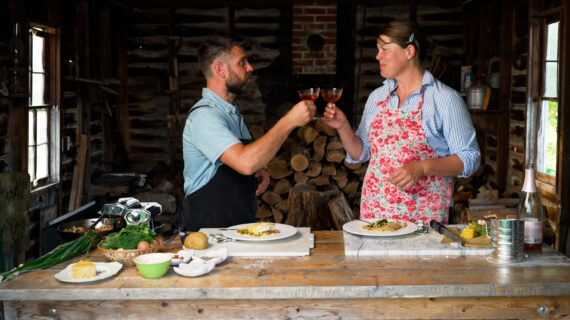
>> I get off easy! What's your favorite product of all the stuff you guys make? >> Well, bacon is my favorite. That's a given. >> This is the ultimate host. Carry his own weight. The Rengers are making me set the table. But I suppose it's okay, because they're going to feed me a fantastic lunch of their pork products, and vegetables from their garden. And they won't make me do the dishes. This is the cottage bacon. That's regular bacon, except it's not regular bacon, because it's Willow Creek bacon. >> Right, the best you can get. >> The best ever. And that is the kielbasa. >> This is kielbasa. >> And you know why they're going to be really great, aside from the fact that you guys made them and they're from your Berkshire pork, is that they're being made in a pan that has had this done 100,000 times. A cast iron pan that has that flavor memory, is one of the nicest things you can give to a carnivore, ever, in your entire life. All right, I've got the plate with the pig. I think that's good luck. You've got to have a block of cheese. >> Whose cheese is that? >> That is from Cedar Grove, up the road. To have a meal in your family farm home with the products that you raised, that I know are fantastically delicious, I don't know how to say thanks any better than, thank you, and I hope you always keep doing what you're doing. >> Thank you for coming. We really enjoyed having you here. >> Let's eat! >> All right. That's a huge fight in the family, three of us like chewy, and two like it crispy. >> I'm not missing some Wisconsin cheese, I'm just not gonna do it. >> No, you can't do that. >> I'm going for two pieces. Anybody else? >> I'll have a slice, please. >> All right. >> I'm going to go for the Polish kielbasa first. Oof, that's really good! I want to do another one, that's so fantastic! It's so radically different. People just can't understand. >> Right. It's very different from a smoked kielbasa. >> Yeah, and I know it may not be for everybody, but it's something that I grew up with. This is just, what a treat. Such a treat. Mm-hmm, this is the cottage bacon. Should I have cut this into a smaller piece?! I don't think so! Go for the gusto! They love this at home. Biting into this, now I understand all of the subtleties of what you're doing with your smoker. I mean, I was impressed before. For so many smoke items, they're just heavy handed. You just get a big wallop of flavor, and you know that you're eating a pork of some sort, or fish, or whatever it is that's been smoked, but the flavor of the piece of meat doesn't come through. There's like four or five flavors that roll out on your tongue when you have this. That's amazing. You guys should be millionaires for what just happened in my mouth!
laughter
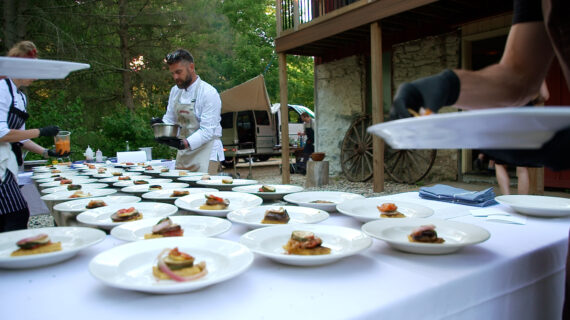
Willow Creek Farms and happy pigs. >> All right. >> Thank you, guys. Thank you so much. Thank you. >> You bet. >> Thank you for everything. >> Appreciate you coming out. >> Hi, my name is Dan Fox. I'm Executive Chef and Assistant General Manager of The Madison Club. The Madison Club is a lot of tradition, history here. We have over 1,000 members. It's a private club, a city club, so there's no golf club attached, or swimming pool, tennis courts. It's all about food, beverage and dining. This is a coming out party for The Madison Club. SlowPig is my event. I'm extremely proud of this event. It's all about heritage pork. The people drive the movement. We brought together some of Milwaukee and Madison's finest farmers, bartenders and chefs. Here we have Willow Creek Farms, Sue Renger. Unbelievable job. We have award winning Berkshire pork. They won two huge awards recently, for both their ham and their bacon. My personal philosophy, as far as cooking, is all about the ingredient first. You need beautiful ingredients to create a beautiful dish. That's why I started raising my own pigs. I want to highlight the beautiful products. We have beautiful pigs. I think the flavor of what everyone is going to taste today is going to tell the story. It is very much a challenge to raise the animals, and be the chef, and assistant general manager all at the same time. So it's really working with very talented people. The actual farmer that does all the farming every day, his name is Micah Nicholes. Micah is a very talented guy. >> I'll have a pork rind. So, this is pig skin, the kind that competes on Sundays. The kind that wouldn't have me on the team when I was in high school, and the kind that I love to put in my mouth. Ready for the crunch. It's the best kind you'll ever get. >> It's very interesting, bringing together Milwaukee chefs and Madison chefs. We might have a fight later on, we're not quite sure. You know, we'll see how the battle goes once the judging comes out. But no, it's very much about camaraderie. It's very much about sharing information. We have L'Etoile and Graze. They do an unbelievable job. I'm a huge fan. They're located right on the square. I really can't say enough about this restaurant. James Beard award winner in their history. They really have taken the whole local food movement, and just exploded. All right, we have Roots, out of Milwaukee. We have Chef Paul here, Dan Jacobs over there. He's taking a little--
laughs
They do an unbelievable job with pork. And second, again, they've taken the local food movement in Milwaukee, and they're teaching other people what this is all about. >> Tory, what are you serving here? >> This is the English pork pie. We take all of the insides, so the heart, the kidneys, some liver, and we put some ham in there and put a little stock with bacon in there, and we bake it inside of a vodka crust. It stays nice and crispy. Old school English pork pie. >> I like to cook what I want to eat, so for me, pork pie, nachos. I've got a board full of sausages. You know, this is everything I want. I've got bacon ice cream. Sunday night at my house, brother.
laughs
>> So this is basically an elegant ode to Scrapple. Scrapple is usually all that other stuff boiled down, intestines, heart, kidneys, the whole nine yards. This is just a little more delicate version. It's in this great crust with this yummy fruit compote. It's homespun American pig gourmet. >> What we want out of this event is to build more awareness behind pork. We want to teach people again, that fat is flavor. It's not going to kill you. That we really need to expand outside of cheap commercial pork. >> Hi there, chef. What's happening? >> Get yourself a corn dog. >> Oh, dude, are you kidding? When a James Beard semi-finalist nominee and rising star turns to you and says after his hug, "Get yourself a corn dog," that's pretty much what you do. I didn't know that sausage wrapped in a little cornmeal with tiny, tiny little tomatoes could be so fabulous. >> And fois gras mustard. >> Oh, yeah, right, of course. >> We will dress up our corn dogs.
laughs
>> Fabulous, Mr. Fox. Nice to meet you, man. >> Nice to meet you, as well. >> So what was your sit up in bed, "Oh, I've got to do this" moment? >> I think it was the first time I tasted one of the pigs that came off Micah Nicholes farm. >> Mm-hmm. >> I said, oh, my god, this pork is awesome. Everyone needs to try it. I'm not kidding. >> And you thought, I'll basically remake one of the most prestigious clubs in the state, a couple of blocks from the capitol, full of good chefs, and we'll just eat pig? >> Yeah, well, it's such a beautiful venue here. Madison needs events like this, and The Madison Club needs events like this. >> Thank you, buddy. >> Thank you so much. >> Thanks for representing the state like this. >> Oh, it's my pleasure. >> Major underwriting support for Wisconsin Foodie  isprovided by the Dairy Farm Families of Wisconsin and the Wisconsin Milk Marketing Board. For more information or recipes, visit eatwisconsincheese.com >>
Be sure to follow Wisconsin Foodie online at
WisconsinFoodie.com There, you'll find articles and recipes, and specific segments of the show, and anything else you might want to know about Wisconsin Foodie. You can also, for more up-to-date, live content, check us out on Facebook, or follow us on Twitter.
Search Episodes
Related Stories from PBS Wisconsin's Blog




Donate to sign up. Activate and sign in to Passport. It's that easy to help PBS Wisconsin serve your community through media that educates, inspires, and entertains.
Make your membership gift today
Only for new users: Activate Passport using your code or email address
Already a member?
Look up my account
Need some help? Go to FAQ or visit PBS Passport Help
Need help accessing PBS Wisconsin anywhere?

Online Access | Platform & Device Access | Cable or Satellite Access | Over-The-Air Access
Visit Access Guide
Need help accessing PBS Wisconsin anywhere?
Visit Our
Live TV Access Guide
Online AccessPlatform & Device Access
Cable or Satellite Access
Over-The-Air Access
Visit Access Guide




Follow Us