Wisconsin Foodie would like to thank the following underwriters for their support. Wisconsin Milk Marketing Board and the dairy farm families of Wisconsin. Illing Company. Outpost Natural Foods Co-Op. Potawatomi Hotel and Casino. Society Insurance. Wisconsin Milk Marketing Board representing the dairy farm families of Wisconsin who fostered a proud history with generations of family-owned dairy farms. Working to sustain the state's economy through job growth and providing acclaimed cheeses and other dairy products. Every product tells a story, and every story starts with a seed. Your story, your product, your company all started with an idea. Illing Company ensures you have the right packaging to help you proudly take your harvest to market. Illing Company is dedicated to packaging your vision. I've had Society Insurance for my restaurant from the beginning because I know they understand my business and how it's evolving and how the industry is evolving. You're going to have the coverage and the support you need for your unique operation. This week on Wisconsin Foodie. What is Michael Fields? So Michael is the patron saint of this time period in biodynamics. And then, the fields are his fields. So this is patron saint's fields. I mean it's cool because it's institutes like this that are starting to change big-scale American farming where they understand that the soil is -- and now, it's scientifically-proven-- a living thing. Right around the corner here, we have the bees. I believe Dan was just out here collecting the honey. My grandfather was a beekeeper. My father, my sister, my son, they all kept bees, and it just seemed to be a natural thing, I guess. So this is the 2015 crop. I'm hoping that today we extract about 2,000 pounds. (rhythmic music) (jazzy music) (chickens clucking) (drink fizzing) (chopping) (sizzling) (jazzy music) (rhythmic music) We're at Michael Fields in East Troy. We're gonna head down into their garden plots where I have the hives located. (rhythmic music) Here we are. First thing we're gonna do is get a little smoke going. It calms the bees. They think... there's a fire when they smell the smoke, and the first thing they do when they think there's a fire... (roaring flame)...is fill themselves with honey. They gorge themselves. And they fill themselves so full that they can't stick their stinger out. So, it not only calms them, it helps the beekeeper. Everybody asks me, "Do you get bit?" (laughs) Bees don't bite, they sting. (laughs) 'Cause once a honeybee stings you, unlike a lot of the other bees, once a honeybee stings you, it loses its life. They only sting to protect the hive. They feel endangered, that's when they come out and sting. My grandfather on the Zinniker side was a beekeeper. Back then, everybody was beekeepers. My father, my sister, my son, they all kept bees, and it just seemed to be a natural thing, I guess. (rhythmic music) What we're gonna do today is remove the honey supers. Everything below that is where the bees live and raise young, and everything above that board is what we call excess honey. And these are referred to as honey supers. They seal 'em up pretty good. (rhythmic acoustic music) So, this is what we're harvesting, right now. These frames are put in empty. And the bees finish drawing them out. And if you look here, every one of these are all cells just like this, but they've got a wax capping on there. And below that wax......is the beautiful honey. (rhythmic music) This honey super, or this box, is beautifully filled. (grunts) This is where the beekeeper gets a bad back. (rhythmic acoustic music) All the bees are below this board. How many bees do you think are in there? 20,000... 30,000. There's a lot of bees in there. Like right now is the peak of the population of the honeybee, and from this point, August, middle of August, the population will start to decrease. Taking the first frame out is always the most difficult. And we do it very slowly so we don't hurt any bees. The young bees are all hatching out, and they're opening this up now to store honey. These caps, and these are the last bees that are gonna hatch, and they've gone through the process. Let's see, we can maybe see this. I don't know how long you wanna watch it, but you can see the head of the bee, and its feelers are coming out. They're chewing their way out. Here she comes. Come on now. Yeah, there we go. (rhythmic music) There. Oh, it's been a long time. (slow rhythmic music) (truck door closing) (engine starting) Now we're off to the honey house to unload this, put it in the honey house, make sure it's in a dry location. We let it sit in there for a few days, all the air moving around, and then we extract it. (slow rhythmic music) This is the Honey Valley. Honey Creek flows through this whole thing, and that's where I get the name of my company, Honey Valley Apiaries. Apiary is "the location of beehives." (slow rhythmic music) (car door slamming) (garage door creaking) (slow rhythmic music) (chiming) Just this year now, I'm starting to retire. My wife and I own a plumbing and heating business. My son is now taking over, so I got the best of all the worlds right now, and I get to enjoy. I got good health, and I get to enjoy beekeeping. (slow rhythmic music) All these are the same supers. At one point, when the super was just about full, I took out a frame, and I put in a special frame with an ultra thin foundation. The foundation is the wax in the center. And, they build comb honey. This one here is a perfect. Even the flaw makes it perfect. (slow rhythmic music) So that is nature's finest right there. That's the perfect food. (slow rhythmic music) Oh yeah, that's good. (slow rhythmic music) So, this is the 2015 crop. We've already been out to the bee yards. We pulled all the honey off the hives. We've stored it in the building for four days, I guess, with two dehumidifiers running and lots of fans and lots of heat. Taking all the excess moisture out of the honey. And now we're taking the honey out of the frames, through the extraction process, and that's what we're doing today. (slow rhythmic music) Today we have Jenny Zinecker and Tim Zinecker and Jake O'Leary, my grandson. (grunts) We take this right from the beehive. Then we remove the frames like this and then we take the frame out. So the machine, the first machine then peels this cap off and exposes the honey. The cappings drop into the tank, and the frame slides further down, and they take it and put it in a big centrifuge or what we call the extractor. (slow rhythmic music) And as it spins......all the honey flies out and down into a tank, and we put it in proper tanks. I can remember 50 years ago my grandfather doing the exact same thing with a hot knife. He would take a hot knife and he would take the caps off instead of this machine. And he would put in a little extractor that held maybe six, eight frames, and he'd turn it with a crank. And it would be a two or three-day process to do the honey from his two or three hives. I'm hoping that today we extract about 2,000 pounds. (rhythmic music) (machine whirring) (slow rhythmic music) What do you find customers and people say about your honey? I'm not a big horn blower, but they all say that they've never had honey that tastes that good. And I think the reason is, is the care that we give the honey all through the season and all through the extraction process, all through the bottling. Putting it in glass is huge. Not heating the honey at all and not straining. We don't strain the honey. We don't run it through a filter. Every once in a while, you'll get a little piece of wax floating on the top. That's a plus. That's a bonus, and I think that adds to the flavor. And it's just God's pure honey. That's what it is. Fill me up one more of those. So, that's probably all we're gonna bottle today then. And then, the last thing that we put on the jar is to let people know that they're buying local honey. Pretty well everywhere that I have my honey, people are buying it for that purpose right there. They're aware that local honey is from all the flowers and the pollen and the nectar that you are familiar with and what you're accustomed to breathing and eating. And somebody gets to enjoy it. (rhythmic music) (slow jazzy music) In the understanding of what is green and organic and lush throughout the state, East Troy, Wisconsin might be underestimated. But in fact, it is the home to the Michael Fields Agricultural Institute. When it was founded in 1984, it was the beginning of something that would have repercussions not just throughout the Midwest and Wisconsin, but for the whole globe. It was a multi-acre incubator to play those things forward the way that the soil is considered a living entity, the way that the air and the critters that interface with it move the planet forward and give us the food that we eat. It was perfectly put in Wisconsin, and it has made all the difference in the years moving forward. (slow jazzy music) Hi, Christine! Hi, Kyle! Great to have you. How are you? - Good, good. The sun has cooperated. Yes, finally. - Do you get to come to work here every day? I do, I do. Our founder had a strong belief in biodynamics. He came from England and his wife was German. They had a German architect come to the United States to build this. He wanted it to be a cathedral to agriculture. Yeah, it has the sense of coming right out of the ground or as if it was here long before many other things. Good, good. - Yeah, yes. This is the newest building on site. So I'm here for the dinner. And to see the green things coming out of the ground and we're gonna tell some stories and I'm gonna understand a little bit more about these fields that are Michael's. Okay. Let me show you around. Cool. (slow jazzy music) What is Michael Fields? So Michael is the patron saint of this time period in biodynamics. And then the fields are his fields. So this is the patron saint's fields. I mean, it's cool, because it's institutes like this that are starting to change big-scale American farming where they understand that the soil is-- and now, it's scientifically-proven-- a living thing. Yes. So, you've got this myriad of things growing here organically. This is where we're growing our cherry tomatoes. We are doing some trials this year. We're mainly a market garden, so we wanna see what tastes best. We did probably seven to ten plants of about 20 different varieties this year. So you're growing for flavor, and taste is primary, and then, if it's the ugly duckling, that's really not such a big deal. Yeah, right. I mean deliciousness is really what you're going for. Yup. I am geeking out on the poetry inside this hoop-house. We have a chocolate cherry and a black cherry. There is Esterina Jaune Flamme. Yes. You wanna try a Green Tiger? Oh, yeah. This is not your typical tomato. No. Yeah. And that also is because we are more of a market garden. We sell at farmers markets. So we need to compete with people's backyard gardens and with everybody else that has the same thing. Competing with people's backyards gardens in Wisconsin over tomatoes. (laughs) It's hard. That's a tough business right there. -
Christine
Right. -
Kyle
This is crazy. Not bad. It's like a watermelon rind mixed with some cream and then a little citrusy bite. (slow jazzy music) So the chef has just pulled in, no? -
Christine
Yes. Tyler Sailsbery from the Black Sheep in Whitewater is gonna be our chef tonight. We've been working with him on the menu and he came out and toured the area a little bit last week. We work with a few chefs, and so we like to give 'em a lot of options. We have regular basil, opal basil, Thai basil, an orange thyme, a regular thyme. So, for a small little garden, we're doing okay. I'd say you're pretty productive. The crabapples and the flowers that we have planted, this big wildlife area behind us, it's all to bring in the native pollinators. (slow rhythmic music) Right around the corner here, we have the bees. I believe Dan was just out here collecting the honey. Which some of it we're gonna be using in our meal tonight. Oh, that's cool. - Yeah. So what's left are just the boxes so the bees can fill them up and make it through the winter. So over here, we have most of our fall Brassicas, a lot of... Brassicas? That would be your kales. So here, you see purple kale, I believe it's called Redbor, Winterbor, and then that's Toscano, the flat leaf back there. And then we have our Brussels sprouts. All Michael Fields is organic. And I know that because I see weeds that are growing just as vibrantly and healthy as the Brassicas and the other things. Mostly my students go to the farmers markets to get them used to selling and marketing and talking about their product. But I was there helping out one day, and I heard one of 'em say, "You know, you should be worried about "the leaves that don't have any bug marks on it." That's a good point. That's a good point. -
Christine
Okay, so now we're to the pepper field. We have anchos, which are......kind of medium temperature range. I don't know if I like where you're going here, lady. We have bananas way at the end, but in between there are jalapeos and our cayennes, and they're hot. (Kyle exhales) I'm trying to be a good guest. Okay, let's go banana. Let's go banana. (both laugh) How bad is this gonna hurt? - That's a banana pepper. Is there a good way to... I mean, look at this gnarly thing. It's making a fist at me. Solidarity. (laughs) - Solidarity, yeah. That's the Lech Walesa, Lech Walesa. (laughs) All right, here goes some heat. (crunching) Oh, that's not so bad. - No, that's not so bad. - You were kind to me. Do you wanna try just a jalapeno? Let's step this up. Whatever is next. The jalapeos are hotter than you think. I think they're all hot. (Christine laughs) I mean, when I was a kid, pepperoni pizza, too spicy for me because of the pepper. (Christine laughs) I'm not kidding. (Christine laughs) So, is this part of the Michael Fields guest hazing program? (Christine laughs) No, just for you. It's so great. (laughs) Yeah, love it. All right, so... -
Christine
Yeah. It's gonna be a little spicy. But we can eat some ground cherries afterwards to get it out. All right. Hold my hand. (laughs) Okay. Good luck. (crunching) Oh, my gosh, oh no. (Christine laughs) This is not my happy place right now, Christine. You can spit it out. It's okay. (laughs) (Kyle spits) I warned you. -
Kyle
Oh, my god! -
Christine
But, hey, thanks for being a good sport. -
Kyle
That's really hot! - They're really hot, yeah. That's legitimately... (Christine laughs) hot. -
Christine
Ground cherries? Yeah, yeah. Where are they? (Christine laughs) Yeah, where are they, like, right now? I'll run. -
Christine
So these are ground cherries, and you just kind of shake 'em. No, these are salvation. (Christine laughs) Oh, they're like little tomatillos. Yeah, but they're sweet. And this will help? Yeah, well, it's not another pepper. No, you promised! (Christine laughs) Is it helping? Oh, we're gonna get some emails over this. All right, what more do we have to do out here? (Christine laughs) Curse you, peppers! Christine, thank you for the mostly painful-- I mean, excuse me, Freudian slip. It's okay. (laughs) Christine, thank you for the mostly painless tour. You mind if I just walk around? No, please. - Soak it up. I actually need to go get ready for tonight and get my game face on. So, yeah, thank you so much for coming out. I'm gonna lose myself in the fields, and I'll see you at dinner. Okay, sounds good. (rhythmic acoustic music) (indistinct chattering) -
Kyle
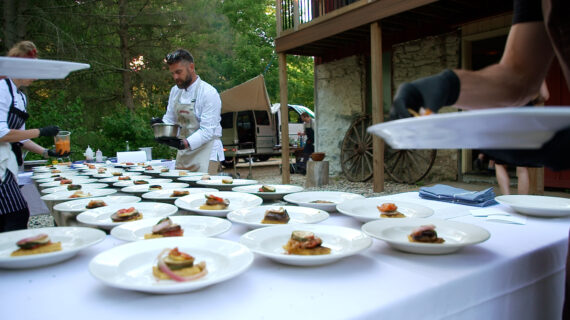
Just over my shoulder is the first of what I hope will be many farm dinners here at the Michael Fields Agricultural Institute. It is a testament to everything that comes out of the ground, and all of the dishes tonight, with the exception of the rabbit, did come forth from this fertile soil. I know it will be delicious. (slow rhythmic music) (indistinct chatter) Okay. Can I get everybody's attention please? (glasses clinking) Okay. I wanna thank everybody for coming out tonight. This is our first stab at a farm to table dinner, and we're just so, so excited that it sold out. I can't even believe it. (laughs) So, thank you so much, everybody, for coming. This has been a dream of mine for a long time. (diners applaud) (indistinct chattering) Bright, tart, nutty, and just the softest hint of that honey. To sit here in the grounds where the bees did their busy work and pulled all those flavors into the hive from which they could be extracted. This is a blessing. (slow rhythmic music) Chef, I am stoked for this. All right, good! Well, I am happy to give this to you. This is our creamy polenta here with of course some good Wisconsin cheese, a little bit from BelGioioso in there. We've got some Wisconsin goat cheese. Wisconsin is a great dairy state for goats as well. We've got a rabbit. It's sustainable rabbit from Regenerative Roots. Of course, there's a tomato sliced, an heirloom tomato sliced, and then our tomato jam right on top of there. So, enjoy. That's sublime......summer eating right there. Oh, man! It's so rich and warm, but lofty. And then you get this fresh shock of tomato that's buried inside there, straight out of the garden. It's so good. That's really nice. (slow rhythmic music) This is how a summer evening should end. This is a testament to who we are. (diners applauding) How we're changing the planet. How Wisconsin's on the edge in the best way for the best things that we can pay forward. (slow rhythmic music) (jazzy music) -
Dan
Nelson, I'd probably get out of that path right there. That's, like, that's the path. -
Nelson
There's one in my hair. -
Dan
There's one in your hair? -
Nelson
I think so. Oh, I got stung, I got stung. -
Dan
Okay, we got a casualty. -
Nelson
Let me go. - Okay. -
Nelson
Yeah, just give me a minute here. That sucked. Ow. What happened, Nelson? (laughs) I got stung. It got caught in my hair and stung my neck. (laughs) How does it feel? It's still burning. It's still burning. I'm trying not to cry on camera. (laughs) -
Dan
That's why I wear a veil. -
Nelson
Yeah. (jazzy music) Wisconsin Foodie would like to thank
the following underwriters for their support
Wisconsin Milk Marketing Board and the dairy farm families of Wisconsin. Illing Company. Outpost Natural Foods Co-Op. Potawatomi Hotel and Casino. Society Insurance. The Wisconsin Department of Natural Resources. Wisconsin Milk Marketing Board representing the dairy farm families of Wisconsin who fostered a proud history with generations of family-owned dairy farms. Working to sustain the state's economy through job growth and providing acclaimed cheeses and other dairy products. Every product tells a story, and every story starts with a seed. Your story, your product, your company all started with an idea. Illing Company ensures you have the right packaging to help you proudly take your harvest to market. Illing Company is dedicated to packaging your vision. I've had Society Insurance for my restaurant from the beginning because I know they understand my business and how it's evolving and how the industry is evolving. You're going to have the coverage and the support you need for your unique operation.


 Passport















Follow Us