

 Passport




Anarchy Acres
07/06/17 | 26m 46s | Rating: NR
Travel to Mount Pleasant to meet home miller and heritage grain enthusiast Charlie Tennessen of Anarchy Acres. See how Charlie and his team of donkeys remain self-sufficient, and learn why Charlie focuses his land on heritage and rare wheat varieties, experimenting from seed to bread.


Copy and Paste the Following Code to Embed this Video:
Anarchy Acres
This week on Wisconsin Foodie. So Anarchy Acres is the name I came up with years ago. My philosophy is that I'm growing extreme organic produce. I think it's extreme because not only do I use all organic practices, I don't use any petroleum. Started baking bread in high school. I'm a veracious reader and I finally found a book that recommended not only grinding your own flour but growing your own flour. Even in your backyard. So that's what I started doing. This is what I'm really excited about. So these five rows-- And I know it doesn't look like a thing. They'll be enough to maybe chew on it, mess with it. But for sure enough seed that I can grow some acres. So I came across a publication. There was University of Wisconsin, I think 1920, Wheat Growing in Wisconsin. And they came up with four recommendations. Could I grow all four of those recommendations from my own alma mater University of Wisconsin? Yeah, this is your unveiling, right? This is your-- This is I believe the first time the Marquee has been grown on a scale in Wisconsin since World War Two. And I get a slice of it? - Yes, you can. It's a big honor to be here. Wisconsin Foodie would like to thank the following underwriters for their support. Wisconsin Milk Marketing Board and the dairy farm families of Wisconsin. Packaging your vision for agricultural products. American Kitchen Cookware is helping food lovers everywhere embrace their own culinary adventure. Outpost Natural Foods, a proud supporter of local, organic in Wisconsin Foodie. Society Insurance. Small details. Big difference. Potawatomi Hotel and Casino. Also with support of the Friends of Wisconsin Public Television. Wisconsin Milk Marketing Board representing the dairy farm families of Wisconsin who fostered a proud history with generations of family owned dairy farms. Working to sustain the state's economy through job growth and providing acclaimed cheeses and other dairy products. Every product tells a story and every story starts with a seed. Your story, your product, your company all started with an idea. Illing Company insures you have the right packaging to help you proudly take your harvest to market. Illing Company is dedicated to packaging your vision. American Kitchen Cookware is proud to support Wisconsin Foodie and helping food lovers everywhere embrace their own culinary adventure. With cookware manufactured right here in Wisconsin, we're working every day to make people's lives better in and out of the kitchen.
upbeat music
car whooshing by
chickens clucking
beverage bubbling
crunching
sizzling
patrons conversing
lighthearted blues music
easy listening guitar music
Just a quick 30-minute drive from one of the state's most populous cities, is a non-descript home with a combine in the drive way and a little plot of a micro farm in the back. The man that owns it is named Charlie Tennessen. He's taken wheats that we used to grow in this state more than a 100 years ago. With gorgeous names like Marquee and Turkey Red. And bring forth flavors that we have not tasted for more than 100 years. Yeah, so Anarchy Acres e name that I came up with years ago. Sebastian. And it's just stuck. Come on. I just do so many things here. And every day is anything can happen day. So, ah, it's been working really well. Come on guys. These are all harnesses that I've-- They have a whole lot of homemade parts and I've had them all together from harnesses that I've either bought or people have given to me. I used to always have Rosie in the middle. That was a really good combination......for handling. But it didn't quite work out with their various strengths, because Sebastian is the strongest and Rosie's the weakest. So about a month ago I switched to have Cassie in the middle and that makes a much more powerful hitch. They work better physically. And I'm self-taught. And they're self-taught, we've all learned together. I did all their training. Come on sweetie.
Charlie's tongue clicking
Rosie. Cassie. Right. Back. Back. Back. Gee.
tongue clicks
Gee. Gee. Easy. Easy. Ho. When Cassie came here, she actually had a fowl with her. No, the fowl didn't belong to me but she could have another fowl. So when she gets too old her fowl can take over her spot. It's forever sustainable. You've never seen a guy that said, "I opened up the shed one morning, "and next to my two big tractors there was a little tractor." It just never happens. But with animals they can even reproduce themselves. And that's basically how animal powered cultures worked for the last 10,000 years.
metal chains clink
metal chains clang
Ho. Sorry guys, back. Ho. Back. My philosophy is that I'm growing extreme organic produce. I think it's extreme because, not only do I use all organic practices, I don't use any petroleum. Right now, each North American eats about three to five hundred gallons of gasoline every year in the form of the tractors and the transportation and about two thirds of that is chemicals. So this system uses none of that. In theory I can stay in this four-acre property and they can just eat the grass, reproduce, give me the power, give me the fertilizer. Ho.
gate lock clangs
People figure they have to go to Mount Everest and do something extreme. I think you can do it in your backyard. I also call it extreme because I like how it sounds. It's as rich an experience as I have ever had in my life, so I call it extreme organic produce for that reason.
chuckles
Ho. Walk on. Today they're going to be pulling a six-inch plow. To pull a six-inch plow well, they have to walk straight within six inches. And you got three animals to walk straight within a six-inch error is a real interesting challenge. So we've got a challenge, we've got creativity. We got companionship. We got sustainability. And hopefully something that's kind of beautiful too. And together we're a team. Gee. Gee and haw are-- "Gee" is hard step over and "haw" is, we haven't heard, because we haven't made any left turns yet. But it just means I want them to step to the side really without moving forward. Good. Good. And I don't know the origin of those. In fact I think our greetings with the world were reversed, Like one is left and one is right. But North America "gee" is right and "haw" is left. If you like I'll make one more turn. We can go back and unhitch and there's some other stuff I would like to show you. Gee.
metal clanging
Ho. What is the origin of the word team. Turned out it's not a bunch of people in a board room with a fancy name. A team is some animals hitched up doing a job. And just to be clear the animals are just for the homestead operation. For the wheat off the farm I need a real tractor at this point. Back. Good. All right guys. Ready. Easy. I dream about doing animal powered wheats on a big scale. I really love what working with animals gives you. Gosh, I love them. I just love them. Ho. So this is what I'm really excited about. And I would just love to have you look at the heritage wheat plot. So these five rows and I know it doesn't look like a thing. But I came across a publication that was University of Wisconsin, I think 1920, Wheat Growing in Wisconsin. And they're looking at yield but also taste, how well it bakes and how well it mills. And they came up with four recommendations. Something called Bacska, something called Wisconsin Pedigree Number Two, which is a selection that they took of Turkey Red that was good in Wisconsin, Red Fife, and Marquee. So I got real excited. Could I grow all four of those recommendations from my alma mater University of Wisconsin? Two of them were pretty easy. Winter wheat was a little trickier because no one was growing Pedigree Number Two and no one was growing Bacska. So here you're looking basically at the second season. This is Bacska that came from the USDA seed bank in Idaho. This is Wisconsin Pedigree Number Two, right here. And then on the ends, right there, you see Turkey Red that came from the USDA grain collection. They'll be enough to chew on and mess with it, but for sure enough seed that I can grow some acres of it next year. And there's also some Spring ones that are even older than Marquee and Red Fife that I'm messing with too. And next time you come you can look at those too.
chuckles
Cassie sweetheart. Sweetie.
gate lock clangs
Sweet.
Charlie's noises scare Sweetie
There you go. Thank you.
groans
We'll take a peak in there later. That's my Marquee seed. That's a small hopper. That's a big hopper. There's so little grass that there's just starting to play with things. If you like, I'm kind of excited to show you some wheat. I had two different wheat test plots. This is where all my Winter was. And I was actually testing three different strains of Turkey Red wheat. And also growing out very ancient varieties or old varieties from the 18th and 19th century. And ah, this is Red Fife. Wheat's a grass. And it's just a grass that has been bred to have a large seed. And that's the head. And if you just mash it up.
crunching
You can see that you get wheat and chaff. And then if you......blow a little bit, most of the chaff will go away. And you're left with wheat kernels. And then what I don't grind into flour, I'll plant. That's the cycle.
laughs
Here you see a Native American solution to the problem of feeding the soil and also predator control. This is called the three sisters or the four sisters. The three sisters are squash, beans and corn. The squash has little prickles on it and it protects the beans and the corn from predators like the deer. The beans are going to climb up the corn and get more sunlight. The fourth sister sunflower is acting also like a pole for the beans as well. This is the first time I've done the three sisters or the four sisters. And it's working really well. If you take care your soil. Grow your soil. Develop the soil. The growing of your vegetables is easy. This is just-- It's an afterthought. Everything you do ideally is to develop soil and then weather and climate comes in and you do what you can. Which another reason why I take nothing away from farmers. No matter what you do, farming is hard. It's creative. It's challenging. You've got your plant and it looks really good in January and February when you're figuring out what you're going to do. But then the season happens and the weather unfolds and you're off to the races on something that's really a fantastic challenge. And it's exciting, fulfilling, no matter how it turns out.
chuckles
I hope that someone more qualified and smarter than me comes along and does this even better. I think people should be as inspired by this as they are by some kid at the Olympics. I want people to get inspired. Come on guys.
country music instrumental
Rosie. They're my best friends. They really are. So. This is my Marquee seed. Marquee is the newest to the foodie right now. Literally I don't think Marquee has been grown in Wisconsin since 1950. And like all my wheat, I'm very concerned about the moisture level. If the wheat is wet and it's stays wet, it'll rot. And I'm going to be really happy if this is a number below 14. And I'm going to do the same with my hopper Red Fife. Part of what we're going to eat tonight came out of this bin.
chuckles
It's not a lot. It's about 40 bushes of Red Fife, but this is all the Red Fife that I harvested this year. I'm laying claim to this is the first stone mill built in the state of Wisconsin in about 100 years. I can't prove it, but the stones are in here. They each weigh about 200 pounds. They're massive.
Seeds rattle
If you're ready I'll fire it up.
machine whirring
The hopper has this very squeaky shoe. And the shoe drives the wheat. We're going through a hole in the top stone. It's a fixed top stone with a hole in it. The bottom stone is being turned underneath. And I can raise that stone up and down. And I get the finest of the flour that I want. The mill has been connected up with a bolting cabinet. The bolting cabinet is going to separate the bran from the flour. Because in this case, I'm going to make a 92% extraction of flour. I do many sessions. I'll do 2 hours in a pop. You know that'll give me 400 pounds. Most of my orders are a couple hundred pounds these days. So it's nice. The scale now is just perfect. It takes a lot of power to make flour. And that's why they've made water wheels and that's why they made steam powered mills. But this is what I've done from most of the last twenty years. I've only had electric powered mill for 6 months now. Even to make enough for a loaf it's twenty minutes of pretty decent peddling. But if I'm going to send a 200-pound order up to the grocery store, I can't do it here. I guess one of these times I'll just take it upstairs and people can play with it during my pizza parties.
laughs
So Turkey Red is mostly associated with Kansas. Was really big in the 1870s. And this is a Winter wheat by the way. I'm going to plant it around September 20th. Red Fife came from Scotland. And I think it's the 1840's and 50's. And they crossed it with an Indian wheat and created Marquee. These are both planted in May of this year. So these are both Spring wheats that are famous in Canada and the United States. Let me just get these babies out here. Started baking bread in high school. I'm a veracious reader. And I finally found a book that recommended not only grinding your flour but growing your own flour. Even in your backyard. That's what I started doing. The same book that told you to mill your own flour also said you got to build your own backyard oven. It's a fun project. Makes good tasting food. All right. The first wheat harvest here was 10 years ago. And that was a 1,000 square feet, you know. It's like the size of your house and probably produced a very pathetic amount of wheat flour. So now I'm renting land off-site. And I'm trying to build a business. I want to be growing 20 or 30 acres of wheat every year. My day job is still software on a small website and my trekking software. But I'm hoping this will be the next thing. My first sale I think was probably to Madison Sourdough. And they bought a big chunk of last year's harvest. Molbeck's is a health food store in Racine. They've been a really good client. Outpost Natural Foods has been buying the grain. Amaranth in Milwaukee is buying some flour. Pine Hill Gardens approached me with the idea of doing a flour CSA. So 31 families have stepped forward and paid me to get a bag of flour monthly. And you're going to meet Lizz Fable tonight, she's been buying my flour and selling it locally for about a year now. I've only baked one of each for this year. So I really haven't practiced. I mean like a lot of home bakeries, I'm a little hit and miss. So I want everyone to try the three different breads and hopefully this will make a statement about local food production. And I wanted to thank all the people that helped me too, because it's been a really fun project. And this interests me and it's passionate. And I think I can scale it up to where it would pay the bills.
ambient guitar music
Need more pizza folks.
Kyle
What I find most charming is that the farm yard has now transitioned into the focus in the backyard. There's a wood fired oven. There are these tremendous heritage loaves of bread that are being sliced open by the two people that have baked them. And then the community that came forth to taste, to talk and to be together. It doesn't really get any better than what's happening here. Thank you. - Hello Charlie. Kyle, how you doing? - Good, how are you? I'm great, welcome to the farm. Thank you. - Welcome to Anarchy Acres. Anarchy? - Yeah. You got crazy burrows at the gate. And I was greeted by chickens. That's probably Marigold. She's kind of got--
laughs
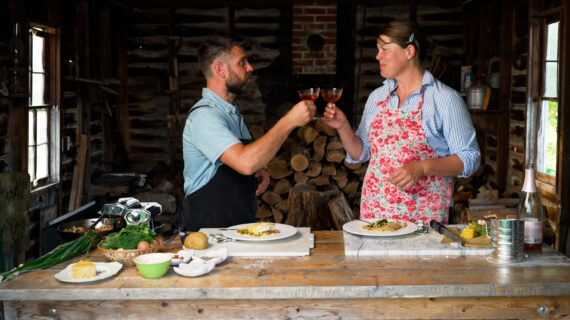
And I smell the wood fire of a pizza oven. We have pizza, we have bread from three different flours today. They were all grown in Wisconsin this year. And 75, 100 years ago they were also grown. They were very important to our history. And I'm trying to reconstitute them and learn more about them. Yes, this is your unveiling, right? This is the I believe the first time the Marquee's been grown on a scale in Wisconsin since World War Two. Can I get a slice of it? - Yes, you can. It's a big honor to be here. So what kind of wheat is in the crust of this pizza? I'm going to run a bunch of just Marquee's. I made extra Marquee dough. These studies that I'm looking at from the teens and the 20s use it as a standard. So that's one of the reasons why I was curious to look at it. And when you finally had it what did you think? I'm still forming my opinion. I've only had a couple of times. That's why everyone has to fill out a survey, so I can figure out what's going on. Hey Bart, how you doing? I love that the chicken's even coming over to see what's going on. Oh, that's beautiful. I'll take it. Put it on the Marquee table.
Lizz
Wow.
Charlie
That's not bad.
Lizz
Yes, it is.
Charlie
Wow. Man. Lizz you want to cut these things open and see what we got? I'll cut the pizza. You cut your bread open.
Lizz
Okay. Okay, dive in guys.
Kyle
Oh, may I? - Go ahead, yeah, yeah. Dig in. - Have a taste, right? It's like a stiff, springy crust. It's hardy. You'd never know that's whole wheat. - Yeah. I like how you-- It's so-- This is like winemakers. Like you're both bread makers. It's the same wheat, right? But how it turns out. Mine always looks better when you cut it on the bias for some reason.
Lizz
That's a good idea. And we have it. Oh that's a beauty. Do you want to do a compare, side by side? Yeah, I mean that's typical. Mine are always denser I don't know why. You know Lizz has been at this for a lot more time.
laughs
I'm going to try a slice of Charlie's. This is ain't messing around bread. First of all it's still warm. - It's wonderful. So there you go. Hello friend. It's got a nice sour dough tang. He uses a little bit older starter batter than I do. It does have that tang. - It's probably two or three days old, mine is 24 hours old. It's kind of mellow though. - But it's had too much. Almost like a rich porter taste at the end. Yeah, baby. - Mm, hmm. That's good bread. - Oh, yummy. And I use his Turkey Red. I've been baking with that all year. It's fabulous. It behaves so much better than any other whole wheat I've ever worked with. Did you eat something Kyle? - I did. And? - I like, well to be candid. The Red Fife, I like yours better than Lizz's. Okay. The Marquee, I like Lizz's a little better than yours. It's a horse a piece or a donkey a piece or whatever the right parlance is on your property with the Turkey Red. I love them both. What do you think? I'm just excited to put three wheats out there, all three flours out there, and see what creative folks do with it and come back. There's been fun stuff coming back already. And I'm sure a lot more is going to come back next year. Thanks for time. - Thanks, Kyle. Come anytime. Beautiful setting. Absolutely. We'll be back for the frogs in the pond and the burrows in the field. If you want to I'll put you to work. All right, let's talk about that off camera. I'm good, I'm good. My days are long enough already. Thanks, Kyle. - Cool.
percussive instrumental
He makes frog right here so you can take that up to him. Frog bread? What do you mean? He just puts the frogs in the bread. What? - Yeah. Special thing. It's like an old Wisconsin thing that they do here. Really?
crowd chatter
laughs
Yes! Yes. I made gold right there. I made gold. I didn't go to journalism school. I don't have-- I would never. There are cooks and chefs. And if I were, I would say I'm not a chef, I'm a cook. You know what I mean. So what would you say that you are. A television host. Wisconsin Foodie would like to thank the following underwriters for their support. Wisconsin Milk Marketing Board and the dairy farm families of Wisconsin. Packaging your vision for agricultural products. American Kitchen Cookware is helping food lovers everywhere embrace their own culinary adventure. Outpost Natural Foods, a proud supporter of local, organic and Wisconsin Foodie. Society Insurance. Small details. Big difference. Potawatomi Hotel and Casino. The Wisconsin Department of Natural Resources. Lamers Bus Lines providing Wisconsin with deluxe motor coach service, school busing and more. Also with support of the Friends of Wisconsin Public Television. Wisconsin Milk Marketing Board representing the Dairy Farm families of Wisconsin who fostered a proud history with generations of family-owned dairy farms. Working to sustain the state's economy through job growth and providing acclaimed cheeses and other dairy products. Every product tells a story. And every story starts with a seed. Your story, your product, your company all started with an idea. Illing Company insures you have the right packaging to help you proudly take your harvest to market. Illing Company is dedicated to packaging your vision. American Kitchen Cookware is proud to support Wisconsin Foodie and helping food lovers everywhere embrace their own culinary adventure. With cookware manufactured right here in Wisconsin, we're working every day to make people's lives better in and out of the kitchen.
Search Episodes
Related Stories from PBS Wisconsin's Blog




Donate to sign up. Activate and sign in to Passport. It's that easy to help PBS Wisconsin serve your community through media that educates, inspires, and entertains.
Make your membership gift today
Only for new users: Activate Passport using your code or email address
Already a member?
Look up my account
Need some help? Go to FAQ or visit PBS Passport Help
Need help accessing PBS Wisconsin anywhere?

Online Access | Platform & Device Access | Cable or Satellite Access | Over-The-Air Access
Visit Access Guide
Need help accessing PBS Wisconsin anywhere?
Visit Our
Live TV Access Guide
Online AccessPlatform & Device Access
Cable or Satellite Access
Over-The-Air Access
Visit Access Guide




Follow Us