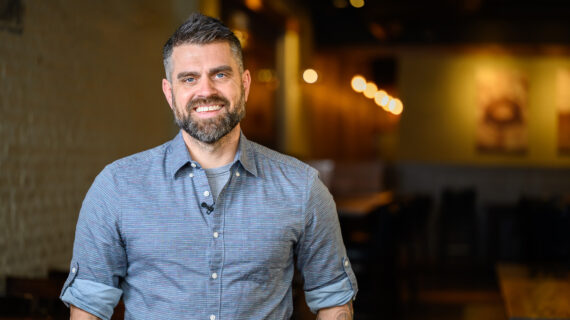
– Luke Zahm: This week on Wisconsin Foodie : - Nelson Schrock: So, I'm Nelson Schrock.
I'm the second-generation cheesemaker at Kingston Creamery.
We are the first and only blue cheese makers in America for the Amish communities.
The adhering to sustainable regenerative farming practices are reflected in our luscious blue cheeses.
- This, this right here, is how I know that this is going to be phenomenal cheese.
So, today, we're at the Owl Farm, and we're anxiously awaiting our guests.
The Owl Farm is a project that Ruthie and I put together kind of during COVID.
The rationale for it was we wanted a space where we could practice radical creativity, radical hospitality, but then also have dinners that bring people together that are transformational as opposed to transactional.
But I have to say, again, it's such a tremendous honor and privilege to have all of you guys here tonight.
[applause] Wisconsin Foodie would like to thank the following underwriters.
- The dairy farmers of Wisconsin are proud to underwrite Wisconsin Foodie and remind you that, in Wisconsin, we dream in cheese.
[group cheers] Just look for our badge.
It's on everything we make.
- Did you know Organic Valley protects over 400,000 acres of organic farmland?
So, are we an organic food cooperative that protects land, or land conservationists who make delicious food?
Yes; yes, we are.
Organic Valley.
- Our all-natural roll recipe has been around since 1830.
No binders or fillers, just pork, salt, and a savory blend of spices that we make ourselves.
Jones: Making breakfast better since 1889.
- The Wisconsin potato and vegetable growers are proud underwriters of Wisconsin Foodie.
It takes love of the land and generations of farming know-how to nurture a quality potato crop.
Ask any potato farmer and they'll tell you, there's a lot of satisfaction in healthy-grown crops.
- Employee-owned New Glarus Brewing Company has been brewing and bottling beer for their friends, only in Wisconsin, since 1993.
Just a short drive from Madison, come visit Swissconsin and see where your beer's made.
- With additional support coming from The Conscious Carnivore.
From local animal sourcing to on-site, high-quality butchering and packaging, The Conscious Carnivore can ensure organically raised, grass-fed, and healthy meats through its small group of local farmers.
The Conscious Carnivore: Know your farmer, love your butcher.
- Also with the support of the Friends of PBS Wisconsin.
[upbeat music] - Luke: We are a collection of the finest farmers, food producers, and chefs on the planet.
We are a merging of cultures and ideas, shaped by this land.
[brats sizzle] We are a gathering of the waters, and together, we shape a new identity to carry us into the future.
[glasses clink] We are storytellers.
We are Wisconsin Foodie.
The Amish strive for farming practices rooted in sustainability and their deep tradition of community.
We're here to meet Nelson Schrock and learn more about the Kingston Co-op Creamery.
– Nelson: So, I'm Nelson Schrock.
I'm the second-generation cheesemaker at Kingston Creamery.
So, our community migrated out of the larger Amish community out east into this area.
The attraction was agricultural occupations, namely dairy.
I would say it starts with our cows.
It starts with our soil.
It starts with our plants.
The harvest.
The methodology leads primarily into the fact that our products are award winning.
So, the Amish in Kingston made a decision to not modernize or go bigger on their farms, but rather start a processing plant where they process their own milk.
Processing milk into cheese is a secondary occupation in our community, with the primary being small family farms.
And these animals all have names.
The Amish dairy farmer will not create production units, but rather these are family friends.
Through regenerative farming practices, we maintain healthy soil conditions, which in turn produces good, healthy, nutritious crops, which in turn produces a good, healthy animal that provides us with our delicious, high-fat, hand-milked cows' milk.
You know, when you're eating our blue cheese, you're eating, you know, from the summer forage, the winter forage, the spring grazing, which is different than summer grazing and so forth.
Milk is transferred to our creamery in ten-gallon stainless steel traditional milk cans, which are delivered daily into our creamery.
[bright music] We have greater than 400 milk cans being delivered a day.
The milk is utilized into a cheese product the day after it has been delivered, primarily into our regular premium blue cheeses, also going into our blends and into aged Gorgonzola.
Everything we do here is using labor from our community.
Cheese is crumbled by hand, packed by hand.
[gentle music] Cheesemaking is not a common profession.
Dairy farming is.
And Kingston considers themselves kind of the pioneer for Amish communities to go national with sales, as that's where consumption lies, is on a national basis.
We could probably count ten cheese plants in America that make cheeses today in Amish communities.
We are the first and only blue cheese makers in America for the Amish communities.
The adhering to sustainable, regenerative farming practices are reflected in our luscious blue cheeses.
– Luke: This is truly one of the most unique cheesemaking rooms I've ever had the pleasure of standing in.
What we have right here are three separate vats of milk in different stages in the cheesemaking process.
So, right here, we can see this is the milk that's been recently pumped in.
It's been inoculated with the Penicillium mold.
But, truly, you see it almost in its raw, natural form.
Immediately to my left, the curds have been cut on this tank.
And you can see that deep separation between the whey and the curd.
It's being slowly agitated, bringing all those enzymatic reactions together.
And on my far left, we have the farthest stage of the process, a cheese that's about to have the whey pulled off and then being put into molds.
This is a representative of a fantastic intersection, truly.
The analog world of the Amish and the modern mechanization of dairy processing all kind of comes straight to the forefront at Kingston Creamery.
And while we're here with our cameras, we're absolutely doing our best job in supporting the cultural values that the Amish community really feels are important to them.
This, this right here is how I know that this is going to be phenomenal cheese.
Look at the color of this milk.
You see the yellow of the butterfat, you can see the swirl of this beautiful, rich cream line undulating on the top, and I know that that is going to create humongous flavor in the end.
I am so excited for this process.
I'm excited to see the process behind the curtain, but I'm so excited to taste the cheese.
The cheese stands alone!
– Nelson: So, milk is brought in, made into cheese the following day.
That cheese is held in our warm room overnight, and then the following day, the cheese is then entered into our cold brine system.
Cheese is brined for 48 hours.
The cheese is then taken out of the brine, allowed to drip dry, and at that point in time, the cheese will be entered into a cheese piercing process.
Approximately 50 holes are pierced into the cheese to allow a uniform entry of oxygen to kickstart the veining process.
The cheese is then entered into a warm room with a higher relative humidity in the room, which is, again, allowing those enzymes and those cultures to kick-start, and at the appropriate age, approximately 21 days old, cheese is then entered into the cold 40-degree room and staged for its final aging, which may be 60 days or 90 days.
And then is taken to our packaging room and released into distribution.
– Luke: We're in the aging cellars now.
So, industry specs require that blue cheese is aged for a minimum of 60 days and Gorgonzola is aged for 90 days.
So, this cheese gets a little bit of time to let those flavors and components develop into each other, which is oftentimes what makes it such a luxurious experience to eat.
For people who think that blue cheese is, like, one flavor note or like, "Ah, I don't do blue cheese," I'm telling you, you're missing out on an extreme world of variety and depth of flavor.
And oftentimes, when I get into a blue cheese, it's like enjoying a really delicious chocolate or candy.
It's so succulent.
It takes you through this wide range of flavor, and then leaves you in this spot that actually fires off oxytocin in your brain, which is the chemical that makes you feel love.
Of all the foods that we have the opportunity to eat in this world, blue cheese and chocolate have been scientifically proven to make you feel love.
This room feels like an entire aging cellar filled with love.
Seriously, if I don't get to try some of this cheese soon, I'm gonna freak out.
This, for me, is the absolute pinnacle of this experience today at Kingston Creamery.
The tasting of the cheese.
So, what I have in front of me is the Breezy Blue.
Now, this is a mixed-milk cheese, and what we are looking for here, or when I taste any blue cheese or Gorgonzola, is that smooth creaminess, punctuated by that salty earthiness that really harmonizes on your palate, much in the same way that a delicious piece of chocolate will do.
After being in the aging rooms and through the entire cheesemaking process, I can tell you that I am literally salivating waiting to give this a try.
Man, that is delicious.
From the first moment that graces my palate, I wanna savor the flavor of that cheese.
And what I initially get is this beautiful balance of creaminess, salt, and of course, that beautiful blue that really takes the earthiness to the next level.
Once that salt kind of dissipates, even for just a moment, with this cheese specifically, there's a little bit of that tang that kind of fills right in behind it.
And the interesting part is that as the salinity falls off my palate, I'm left with that luscious creaminess, that blue cheese flavor.
But then I also have that really nice tang of the goat and sheep's milk cheese.
This just keeps singing.
It is quite-- It's a three-part harmony on your palate, and it eats like it.
This is beautiful, mmm.
Smoked blue.
Creamy forward.
Delicious salinity, ooh.
Well, well balanced between that cream and that salt.
The smoke, it's a very distinct smoke flavor.
It's so familiar and comforting.
And the richness and sweetness of that blue cheese balanced with that smoke... It just keeps going and going and going and going.
This is a fantastic cheese.
I can think of, quite literally, five different ways in which I could use this cheese on its own or working with dishes to really enhance components.
This is a flavor bomb.
I feel emotional when I'm eating this cheese because it's so darn good.
How lucky we are to be alive in this world, in this creamery, sampling some of the finest blue cheeses I've ever had the opportunity to taste, to make new friends, to learn about different cultures that are right next door.
I've always said that in Wisconsin, we have this benefit of, when you wanna travel the world, shake hands with your neighbor, because oftentimes their perspective, while seemingly similar, can be night and day difference.
And that is one of the best reasons to be here, to eat, to love this food.
Because in the end, it connects us all.
Everybody eats.
Ooh, man.
I'm really, really looking forward to taking this back to the caf.
Inside here, I have four wheels of blue cheese, some blue cheese crumbles, basically every application that I could find inside to be able to go back and really sample what's happening here.
This is kind of a sleeper of a creamery in Wisconsin.
As you can see on the outside, it's kind of auspicious, right?
On a small country road in the middle of the state.
But I'm telling you that the flavors and the methods that are used here making this blue cheese are absolutely world class.
Let's get to it.
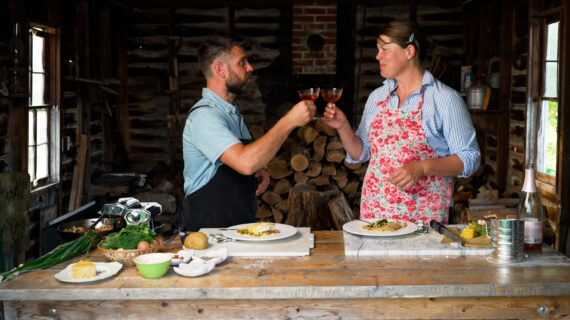
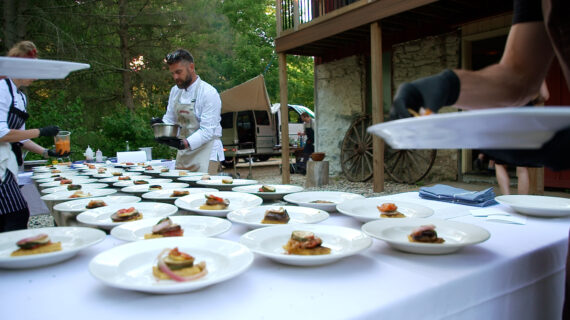
[gentle music] So, today, we're at the Owl Farm and we're anxiously awaiting our guests.
The Owl Farm is a project that Ruthie and I put together kind of during COVID.
The rationale for it was we wanted a space where we could practice radical creativity, radical hospitality, but then also have dinners that bring people together that are transformational as opposed to transactional.
Transactional diners, I mean, you come into a restaurant, you pay the money down, you get your drink, you get your pizza, you're good, you go away.
But we love storytelling so much.
And as part of my job with Wisconsin Foodie, I get to see some of the most compelling food stories in the entire state.
Look at this.
Boo-yah, focaccia!
So, bringing them to the Owl Farm is bringing them into a very special space for us.
And we have amazing people who help us pull this off.
Specifically, the chef that I work with very, very closely, one of my dearest friends and probably my closest cooking colleague, Justin Aprahamian of Sanford in Milwaukee.
He's taken a night away from his restaurant to come and pull off something that is nothing short of incredible here at the Owl Farm.
– Justin Aprahamian: We've got a mushroom broth that's gonna be finished with buttermilk and served with a deconstructed kind of panzanella salad.
Just foraged oyster mushrooms, we caramelized some with the pork trimmings, and then we put some over the wood fire to get a little smoke and kind of concentrate that mushroom to get kind of the depth of complexity in a hurry.
[gentle music] - Luke: One of the things that I think about a lot is talking about farmers as a non-farmer.
It's one of those perspectives that definitely is worth contemplating.
And so, I am really excited today to see some of the best dairy farmers in the entire state come together, where we can showcase some of their ingredients, we can tell the stories of our farmers and food producers, and we can bring them into this space that is sacred and special.
On behalf of Ruthie and myself, we really are excited to welcome you to the Owl Farm.
The Owl Farm, for us, is a way to do dinner a little bit different.
We know that when we have people come into the restaurant, and we're always so excited and honored that people choose to come in and support the Driftless Caf in Viroqua, we don't get a lot of time to interact.
The food that we create is based on your stories.
I am really excited tonight to kind of bring you into some of those storylines as we walk up the valley.
I have this really amazing job where I get to see farmers, I get to see the cheesemakers, I get to see the people that make Wisconsin what we are, a dairy powerhouse.
And to have you here tonight is a dream.
So, my hats are off to you.
Thank you so much for all the hard work that brings you here today.
Some of the dishes that we're actually going to feature at the Owl Farm this evening, we'll start with the housemade focaccia, Westby Co-op Creamery miso-whipped butter, and fresh strawberries.
So, this first course while you guys are getting settled in, this is a woodfired focaccia.
We have macerated strawberries on this plate.
These come from some of our Plain community growers, the Amish.
We have Westby Co-op Creamery butter.
We accented that today with a little bit of maple syrup in that butter.
And then, we have just a little bit of miso in there.
What miso does is it's giving it depth and body.
And this is miso that I made returning from Japan.
Enjoy.
You guys need more bread over here?
Okay, great, here we go.
All of them set up the same way.
And then, my favorite is four seasons of Marieke's Gouda.
Now, Gouda is a cheese that can be aged for a very short amount of time.
As a matter of fact, the young Gouda will have only been aged about 30 days.
What I have in front of you is four generations of the same cheese.
This is our young Gouda.
So, this is aged a minimum of 30 days.
Let's move to the right.
This is the six- to nine-month Gouda.
Let's move down the wheel.
This is the premium Gouda, aged 12 to 18 months.
All right, let's try this last one.
This is the reserved.
We'll clean this up, we'll get our next courses ready to go here.
We'll go from there into a Crave Brothers mozzarella panzanella.
Panzanella in Italian is "bread salad."
So, we're taking some tomatoes that were raised for us by the good folks at Davidson Hollow, which is one of our Amish farmers, and we're going to accent that with anise hyssop.
And then, of course, a buttermilk broth where we've taken mushrooms from the forest and really fortified that broth, put it together, and we'll float some chive oil on top of it.
Should be fantastic.
Crave Brothers mozzarella.
What we wanted to do with that today is showcase it in a way that was, you know, light.
I've got a lot of these locally-produced tomatoes, like, with the caf, it's about 72% of our food bill last year came from within sources within 90 miles of Viroqua.
So, really trying to pull in that community, those small family farms.
This is the pork schnitzel with the Kingston Creamery blue cheese.
Cream on the bottom with a nice base in it, and then pickled rhubarb and some cheese on the top, and then little tiny arugula.
[gentle music] Pork schnitzel with that Kingston blue.
Really nice little cream underneath it.
Fresh arugula, pickled rhubarb.
Just something to kind of cut that richness a little bit.
Good spice chili oil.
So, yeah, we took some chilies, we toasted 'em out.
[bright music] Ragout down, beef sauce.
Yep, I'm gonna finish putting together this prep and I'll come back for the grate.
So this is a quick, on-the-fly Owl Farm-- This is Organic Prairie tenderloin, with, like, a garden kale on the bottom.
Lightly sauted down with some of the trimmings.
And then the sauce is a reduction of cedar, red wine, and...maple?
– Justin: Maple.
– Luke: Yeah, we're gonna hit it with a little bit of Maldon salt, some Parmesan cheese.
This is a very special beef preparation for us.
So, since we opened the restaurant in 2013, every day that we've opened it, I've only had one dish that never changes.
And it's the beef tenderloin, 'cause my mom says, "You gotta have a good steak on there."
And she's not wrong.
We've served up our tender every single day because we like it.
The storyline of it, it's sustainability, it's closed circuit, we believe, and we know that you as farmers take great care of those animals.
And it's our opportunity to honor them one last time.
[upbeat music] The crpe.
All right, good?
Lots of Westby Co-op Creamery butter in there.
And then doubling back down on the Crave Brothers mascarpone.
Got that in that center.
You know, all those bits and bobs of rhubarb and strawberries that we accumulated through the night, you know, basically pulled all the extra prep of that, concentrated it into a little bit of a syrup, moistened the top with that, and then, of course, good old-fashioned Wisconsin maple syrup, just kind of tying it all together.
But I have to say again, it's such a tremendous honor and privilege to have all of you guys here tonight to bring you deeper into conversation and be able to feed you the food from the farmers and food producers of this place.
[cheers and applause] [upbeat music] Would you have any guesses to what the favorite type of raisin of the Amish community is?
– Nelson: I do not.
– Luke: It's a barn raisin.
– Nelson: Okay, I haven't heard that one, but I get it.
- I don't know what you're doing back here with the B-roll, Arthur, but, like, let's wrap it up a touch.
Come on, you're killing me!
It's gorgeous, it's exciting, it's Wisconsin Foodie.
- The dairy farmers of Wisconsin are proud to underwrite Wisconsin Foodie and remind you that, in Wisconsin, we dream in cheese.
[group cheers] Just look for our badge.
It's on everything we make.
- Did you know Organic Valley protects over 400,000 acres of organic farmland?
So, are we an organic food cooperative that protects land, or land conservationists who make delicious food?
Yes; yes, we are.
Organic Valley.
- Our all-natural roll recipe has been around since 1830.
No binders or fillers, just pork, salt, and a savory blend of spices that we make ourselves.
Jones: Making breakfast better since 1889.
- The Wisconsin potato and vegetable growers are proud underwriters of Wisconsin Foodie.
It takes love of the land and generations of farming know-how to nurture a quality potato crop.
Ask any potato farmer and they'll tell you, there's a lot of satisfaction in healthy-grown crops.
Employee-owned New Glarus Brewing Company has been brewing and bottling beer for their friends, only in Wisconsin, since 1993.
Just a short drive from Madison, come visit Swissconsin and see where your beer's made.
- With additional support coming from The Conscious Carnivore.
From local animal sourcing to on-site, high-quality butchering and packaging, The Conscious Carnivore can ensure organically raised, grass-fed, and healthy meats through its small group of local farmers.
The Conscious Carnivore: Know your farmer, love your butcher.
- Also with the support of the Friends of PBS Wisconsin.


 Passport
















Follow Us