

 Passport






Guerrilla Cookie, Three Waters Reserve, Willy Street Co-op
03/26/26 | 26m 56s | Rating: TV-G
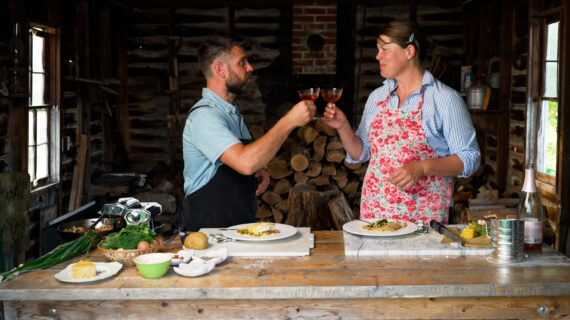
Madison’s legendary Guerrilla Cookie makes a comeback. Luke traces the countercultural treat from baker Ted Odell’s off-grid shack to its revival by Steve Apfelbaum at Three Waters Reserve and Mike Olsen of Elegant Foods. Fueled by the Willy Street Co-op, the cookie returns as a fundraiser for wetland conservation along the Sugar River.


Copy and Paste the Following Code to Embed this Video:
Guerrilla Cookie, Three Waters Reserve, Willy Street Co-op
– Luke Zahm: This week on Wisconsin Foodie: Sometimes, our favorite foods are recipes that are passed down between generations, and other times, we create recipes off of memory alone.
And I'm about to meet with owner Mike Olson to pull together the storyline behind one of Madison's most iconic foods.
Some say it was the food of a revolution: the Guerrilla Cookie.
– Steve Apfelbaum: The Guerrilla Cookie has some sort of following beyond imagination.
– Michael Olson: There certainly is a fascination with the Guerrilla Cookie.
I tell people, you can look it up and you're gonna go down a rabbit hole, and you never know where you're gonna come out.
– Michael: We announced that we were going to, you know, release the Guerrilla Cookie, and I think within a month, we had 10,000 or 12,000 pre-orders.
Who'd have thought we'd be in the cookie-selling business?
So, it was a wonderful opportunity to resurrect or reincarnate an extinct cookie.
– Luke: Wisconsin Foodie would like to thank the following underwriters.
[upbeat music] - Did you know Organic Valley protects over 400,000 acres of organic farmland?
So, are we an organic food cooperative that protects land, or land conservationists who make delicious food?
Yes; yes, we are.
Organic Valley.
- Wisconsin is known for some pretty great things, like football, food, and family.
At Jones Dairy Farm, we're proud to be a Wisconsin company, one that's been family-owned and operated in Fort Atkinson.
Jones: Making mealtime better since 1889.
- The Wisconsin potato and vegetable growers are proud underwriters of Wisconsin Foodie.
It takes love of the land and generations of farming know-how to nurture a quality potato crop.
Ask any potato farmer and they'll tell you, there's a lot of satisfaction in healthy-grown crops.
- Employee-owned New Glarus Brewing Company has been brewing and bottling beer for their friends, only in Wisconsin, since 1993.
Just a short drive from Madison, come visit Swissconsin and see where your beer's made.
- With additional support coming from The Conscious Carnivore.
From local animal sourcing to on-site, high-quality butchering and packaging, The Conscious Carnivore can ensure organically raised, grass-fed, and healthy meats through its small group of local farmers.
The Conscious Carnivore: Know your farmer, Love your butcher.
Also with the support of the Friends of PBS Wisconsin.
[upbeat music] - Luke: We are a collection of the finest farmers, food producers, and chefs on the planet.
We are a merging of cultures and ideas, shaped by this land.
[brats sizzle] We are a gathering of the waters, and together, we shape a new identity to carry us into the future.
[glasses clink] We are storytellers.
We are Wisconsin Foodie.
When I'm looking for inspiration, the aisles of local grocery stores and food co-ops are a perfect way to explore new stories and reflect on old ones.
Today, I'm starting at the Willy Street Co-op in Madison, going deeper down the rabbit hole for a product that connects a few of my loves: the Guerrilla Cookie.
– Anya Firszt: My name's Anya Firszt.
I'm the general manager of the Willy Street Co-op.
Well, Willy Street Co-op started in 1973 by a group of people who wanted to take control of where and how their food was grown and produced.
So, this is our produce department, and we actually have on the wall a sign that identifies the number of local items we have and the number of local-- or, organic items, and that is updated every day.
When you come into this department, you can see who our farmers are.
The signage helps you understand where these products come from, and you get to know your farmer a little bit.
Tipi Produce has been bringing us carrots for, I think, 35 years, and that's just one example of a farmer who has just-- we've partnered with, and we can always count on exceptional carrots from Tipi Produce.
We have the best produce in Madison, and it has a lot to do with not only our vendors, but the care that our employees put into putting out this product as well as procuring it and the love they put into actually stocking it.
Willy Street supports about 450 local producers.
We have been in business for 50 years, and we give back to the community in many ways.
Willy Street is not just a grocery store.
We are a gathering place.
We are considered sort of a place where people come on a social level to meet and greet friends and neighbors.
When I came to the co-op in 1985, I remember seeing Guerrilla Cookies on the shelf, and I wasn't sure the story behind them, but they came in a plastic sleeve with six cookies in it and a photocopied sort of label on the front, and it's my recollection that they would come in and they would sell out very quickly, and we couldn't wait for the next shipment to come in.
Here is the Guerrilla Cookie.
So, for me, this is a real throwback.
This is... This cookie is infamous.
And it makes me think of the love that Ted put into creating this cookie and us selling it.
And then again, the journey that Mike Olson made to re-create this true legacy to this community.
This cookie is just-- Like I said, it's just infamous.
– Steve Apfelbaum: Welcome to Three Waters Reserve, the former Decatur Lake Golf Course and Decatur Lake Country Club that started in 1926.
My name is Steve Apfelbaum.
I'm a research ecologist, and I drew the short straw, and I'm the president of the Southern Wisconsin Land Conservancy.
So, we'll give you the, give you the nickel tour, take you down the trails.
This place was special the first time I walked onto it.
And I had to look beyond the golf course use at that time.
So, in April of 2018, we closed on the property and immediately converted what would be a normal golf course into what you see behind me.
In total, it was about 190 acres, and we bought about 70 acres, the front nine holes of the golf course.
And what's come up in the prairie is about 130 native species of prairie wildflowers and prairie grasses.
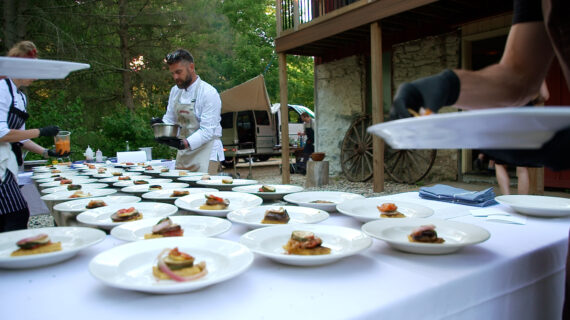
The former restaurant and pro shop that was downstairs are now a field station for training future ecologists and artists and anybody interested in nature and conservation and restoration, and the former restaurant is now a location, a destination venue with a fine restaurant.
We've connected the food of the region here, so a lot of the beef and other products that are served in the restaurant come from local farms.
[bright music] Here's a nodding wild onion.
The city of Chicago is named after this plant.
Chicago, apparently in Potawatomi, the Potawatomi word close to the word Chicago meant "land of stinking onions."
So, this deliciously edible wild onion, that's the namesake of Chicago.
The story of the food, that's been a part of what we've tried to tie to the land and give farmers voice in the food experience here.
We have farmers that come here and eat regularly, and they know they're eating beef from the farm right across the river.
No better way to get to people's hearts and minds than through food, through their stomach.
And that's what we've learned on thousands of projects around the world in my professional life.
It's really becoming the place we hoped it would be, which would be a place to train and celebrate people, celebrate nature, and celebrate people's participation in conservation.
When I moved here in 1980, I immediately sought out the conservation-minded people in the neighborhood.
And Ted Odell was one of the individuals introduced to me as an adamant conservationist.
He lived on the very back of this property.
So, Ted's-- This is all Ted's property here.
And I'll take you back to his shack, if we can find his driveway, which I think is right here.
He lived off grid in a little wood-heated shack.
He is the guy that brought what became known as the Guerrilla Cookie to the Madison market.
Yeah, this is Ted's driveway.
So, you're on the cookie trail right now.
He was a Harvard-trained theologian and a Luddite that didn't believe in technology.
And he lived there for, I don't know, 30 years or something like that.
Ted baked his first Guerrilla Cookie on the wood stove and then eventually opened a bakery called Quercus Bakery in Oregon, Wisconsin.
Welcome to Ted's house.
Ted Odell lived here for many years.
There was a wood stove right here.
And you could see the smoke, the pipe that went through the window, where the vent from the wood stove went.
This is where Guerrilla Cookies were originally cooked, right here, baked.
He shut the operation down in 1990.
He gifted us this property, and it's fully protected as part of this, the Three Waters Reserve.
We found the original recipes to the Guerrilla Cookie on a scratch paper notebook page.
And I asked him if we could experiment with baking that cookie and making it available through the Three Waters Reserve, and he said, "Oh, what a great idea.
What a wonderful idea."
And then the idea of using it to raise awareness and funding for conservation, he was so impassioned by that.
At some point, he passed away without actually helping us understand how to interpret the rather two-dimensional list of ingredients on a, on the scratch piece of paper.
And John Marks and Annie George, another chef that works here with John, spent about six months to a year trying to replicate the Guerrilla Cookie.
And we had a few old-timers that were connoisseurs of how it looked and how it tasted.
And, you know, we did our best to get it where we thought it, you know, should be.
But then, we met Mike Olson, and our first encounter, first meeting with him, it was clear he had also been on the same parallel track, trying to figure out for decades how to, you know, what the ingredients were.
And we had the ingredients, but he had been working on how to mix it all.
You know, the secret sauce is only-- It only works when you figure out how to put it together.
And we had the ingredients, but not the secret sauce.
So, it was a wonderful opportunity to bring our joint ambitions to resurrect or reincarnate an extinct cookie.
[chuckles] Speaking from the, you know, biologist's perspective.
We announced that we were going to, you know, release the Guerrilla Cookie.
And I think within a month, we had 10,000 or 12,000 pre-orders.
The Guerrilla Cookie has some sort of following beyond imagination.
Who'd have thought we'd be in the cookie-selling business?
But every time somebody buys a Guerrilla Cookie, a small percentage of the revenue from that comes to this facility to support, to support this, to support conservation.
And even beyond this land and this property, it supports a larger conservation mission of the organization and the community.
This is such a fertile, rich project with so many sides to the story.
And Ted Odell, he's more than the thread.
He's part of the warp and weave of the story here.
[gentle music] - Luke: Sometimes, our favorite foods are recipes that are passed down between generations.
And other times, we create recipes off of memory alone.
Today, we're at Elegant Foods on Madison's east side, and I'm about to meet with owner Mike Olson to pull together the storyline behind one of Madison's most iconic foods.
Some say it was the food of a revolution.
The Guerrilla Cookie.
- Michael Olson, the founder and owner of Elegant Foods.
We are a specialty distributor.
We try to find things that are different, you know, like, more upscale than what most broadline distributors carry.
The idea, the basic idea was to find products that were not being sold in Wisconsin.
I love the Guerrilla Cookie, and I was really sad when it was not being made anymore.
And I heard that from a lot of other people.
In the fall of '72, I ate them daily for the next four or five years.
I remember, I bought a bag and I ate half the bag before I got back to my apartment.
And I was just like, "These are really good."
There certainly is a fascination with the Guerrilla Cookie.
I tell people, you can look it up and you're gonna go down a rabbit hole, and you never know where you're gonna come out.
And I think it just was, times were simpler.
And there was that anti-war movement going on, and it was crazy.
And the cookie was always there, and people relate to the cookie.
It reminds them of their time in Madison.
So, I think it's kind of like eating your favorite, your grandmother's favorite recipe and, like, it brings you right back to when you'd have Sunday dinner with your grandparents.
About a month ago, we got our new packaging in, and I'm real happy the way it came out.
The design shows kind of water because it's on the Sugar River, where Ted's property was in the Three Water Reserve, the Sugar River.
And so, and then we show a prairie.
I think this is in the spirit of what Ted would want.
You know, he didn't really wanna be known as the Guerrilla Cookie guy, but I think, once he sees, I think he understands that-- Or, would understand that the benefit to wetlands and to his property, and if that's helped at all by this cookie, he would be all for it.
[slow groovy music] - Luke: Michael, we're here today to talk about a very specific cookie, and it's one that has deep ties to Madison's history.
Tell me a little bit about the Guerrilla Cookie.
– Michael: Well, it's kind of a legend.
I went to school here from '72 to '76, '77.
Something that I ate a lot of.
It was made by a guy named Ted Odell.
And he had quite a few different places that he used to make it.
Eventually, he ended up with a bakery in Oregon and a bakery on Bedford.
- Okay.
- And he kept doing that till '91, and then he just... He was done.
- Sure.
[chuckles] - There went the recipe and the cookie, and he went on to living his life.
- Okay.
- And he didn't want anything to do with the cookie.
– Luke: Let's put these together here, and talk me through, I guess, where we're at in the process.
– Michael: I've got my oil in there, and I've got honey and sugar and vanilla.
– Luke: I'm smelling molasses right now, yeah, okay.
The first things first.
Like, molasses or sorghum.
– Michael: Yep.
– Luke: You know, it's got that really deep, earthy smell, which I tend to love.
Like, molasses cookies are my favorite, hands down.
– Michael: Wow.
– Luke: But then you see, like, everything else kind of coming together in here, and it has that sweetness, the richness.
Even as you're inhaling it, I can kind of feel it a little bit on my tongue, which is, you know, my olfactory senses telling my flavor profiles here that this is gonna be delicious.
[laughs] What's the next step?
– Michael: Well, we're gonna take our combination of flour and cinnamon and baking powder, and we're gonna put that in next and just kind of let it come together.
[slow groovy music] Then we're gonna add our oats or rolled oats.
And then, last, we'll put our raisins in there.
- Mmm-mmm!
These cookies smell good.
Growing up as a kid in southwestern Wisconsin, like, we didn't have a lot of, like, really refined, highly processed stuff.
And going to local food co-ops was a big part of, you know, how we got food.
So this, for me, smells probably the same for Mike.
It's a memory, right?
You get the dark richness, again, of that molasses, that sugar, the honey, all those things.
But, like, I know in my palate and in my memory, exactly how the oats and the raisins and all those dark ingredients, like the cinnamon and the other spices are gonna kind of come together with a lot of really beautiful undertones.
And I can see why Mike probably carried these around campus in his backpack.
Calorically speaking, these things are a bomb.
You get so much density in there from the carbohydrates and the sugars that are gonna sustain you through the day, and because it's all fairly innocuous, you could eat these three at a time and still walk away fighting like a badger.
So, I'm excited to scoop these out, see how they bake up, and, of course, give them a taste.
So, you're gonna scoop it, run it up the side?
– Michael: Yep.
– Luke: Okay.
- And then, just, I'm gonna put 15.
So three and five deep.
- Okay, okay.
- And in true, you know, Madisonian fashion, there's a social advocacy piece to these cookies as well.
– Michael: Yep.
– Luke: Tell me about that.
And why is that important?
– Michael: Well, Ted's passion was preserving the Earth, if you will.
And he wanted to reclaim the wetlands where his family property was.
And so, that's what we were setting up.
We're giving 10 cents of every Cookie goes to wetlands restoration to be used down there in Brodhead or wherever in that Sugar River district that they wanna use it.
- I, for one, like tasting the batter, man.
You gotta know what you're getting into.
- Yep.
- Cheers.
- Cheers.
- Mmm, sweet, dark, and the spices.
I get that cinnamon, that molasses.
That's really, really deep flavor, you know, almost like umami.
You get the oats.
Oats are lovely.
I really appreciate a good oatmeal cookie.
Michael, one of the parallels that I see here is, you know, like chasing the ghost of a recipe.
– Michael: Yeah.
– Luke: And the spirit of the '60s and '70s in Madison, as a student who came later, you know, that was always something that I had heard so much about, that time and place, but actually reconstructing this recipe, you must have put almost endless hours to getting to this point.
– Michael: It would take me, at least took two hours to put this together and bake 'em off, let 'em cool down, and then I'd probably do one or two batches a day, probably more like one batch, 'cause I always like to think about what I did and how could I make it better, what direction to go.
And I probably spent better, like, three to four months.
It was a labor of love, if you will.
– Luke: Yeah.
– Michael: Just happy that I got there.
- Me too.
And I'm gonna be even more happy when we get some of these out of the oven and I can actually taste them.
They smell very, very delicious.
I'm excited to see what the hype is all about, man.
- Well, I hope you like 'em.
- I'm sure I will.
– Michael: All right.
– Luke: To the ovens.
– Michael: To the ovens.
– Luke: God, I hope this isn't your Hansel and Gretel moment.
[both laugh] The old deck.
This is cool.
– Michael: Go ahead.
– Luke: Okay.
[gentle music] Mike, the finished product.
These are the Guerrilla Cookies.
– Michael: The truth is coming now.
– Luke: The truth is coming?
I appreciate that, you know?
Sift and winnow, and we get to this point.
The truth is coming.
Years, it sounds like... - Yeah.
- ...of work go into this bite, and I can tell you right now, it smells... I mean, I'm already salivating.
Could be that I'm hungry.
It could be that I've stayed in the kitchen waiting for these cookies to bake, watching with, you know, anticipation.
Mmm.
It's hearty, right?
- That's sustenance.
- Yeah, it eats like a meal.
You get the sweetness, you get that richness, the deep spice flavor, the molasses.
But then, like, the oats and the raisins, there's a lot of good chew in there.
- Yep.
It's as close as-- It's very close to the original.
Not gonna say it's perfectly, but it's close.
- Curating this recipe, and you taste it now, does it still take you back to your undergrad days, running around campus, scraping these out of the bottom of your backpack?
- It's hard to remember 50 years ago.
- I bet.
The '60s, '70s were a wild time, weren't they, Mike?
- And if you can remember 'em, you really weren't there.
[both laugh] - So, this tastes, like, as close as we can get.
- Thank you.
- To the memory of the 1970s in Madison, where, you know, it was one of the centers of the universe.
Thanks so much for taking the time.
- No, I appreciate you coming over.
- Oh, man, this is great.
And we got cookies and milk out of the deal?
Like, this is-- This is a very, very good day.
This is a good cookie.
- Well, let's bake 'em off.
- Okay, let's do it.
Yeah, they don't call 'em rawies, do they?
They call 'em cookies.
So, we should probably hit that step in the process.
– Arthur: All right.
- So, it's very likely that this is the water source that Ted used to make the original cookies, Guerrilla Cookies, 'cause this was the only water source here at his house where he lived for 35 years.
And it's still working.
And may have been... The secret sauce might be right here.
This was Ted's refrigerator.
It was a pit that we backfilled 'cause it went down 25 feet.
But he literally lowered coolers and kept his food cold, cold.
And in the winter, he kept it from freezing in here.
– Luke: Wisconsin Foodie would like to thank the following underwriters.
[upbeat music] - Did you know Organic Valley protects over 400,000 acres of organic farmland?
So, are we an organic food cooperative that protects land, or land conservationists who make delicious food?
Yes; yes, we are.
Organic Valley.
- Wisconsin is known for some pretty great things like football, food, and family.
At Jones Dairy Farm, we're proud to be a Wisconsin company, one that's been family owned and operated in Fort Atkinson.
Jones: Making mealtime better since 1889.
- The Wisconsin potato and vegetable growers are proud underwriters of Wisconsin Foodie.
It takes love of the land and generations of farming know-how to nurture a quality potato crop.
Ask any potato farmer and they'll tell you, there's a lot of satisfaction in healthy-grown crops.
- Employee-owned New Glarus Brewing Company has been brewing and bottling beer for their friends, only in Wisconsin, since 1993.
Just a short drive from Madison, come visit Swissconsin and see where your beer's made.
- With additional support coming from The Conscious Carnivore.
From local animal sourcing to on-site, high-quality butchering and packaging, The Conscious Carnivore can ensure organically raised, grass-fed, and healthy meats through its small group of local farmers.
The Conscious Carnivore: Know your farmer, love your butcher.
Also with the support of the Friends of PBS Wisconsin.
Search Episodes
Related Stories from PBS Wisconsin's Blog




Donate to sign up. Activate and sign in to Passport. It's that easy to help PBS Wisconsin serve your community through media that educates, inspires, and entertains.
Make your membership gift today
Only for new users: Activate Passport using your code or email address
Already a member?
Look up my account
Need some help? Go to FAQ or visit PBS Passport Help
Need help accessing PBS Wisconsin anywhere?

Online Access | Platform & Device Access | Cable or Satellite Access | Over-The-Air Access
Visit Access Guide
Need help accessing PBS Wisconsin anywhere?
Visit Our
Live TV Access Guide
Online AccessPlatform & Device Access
Cable or Satellite Access
Over-The-Air Access
Visit Access Guide




Follow Us