

 Passport






The Visible Scientist
06/17/14 | 54m 49s | Rating: TV-G
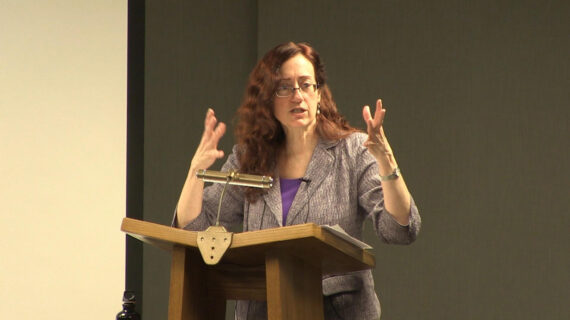
Sharon Dunwoody, Professor, School of Journalism and Mass Communication, UW-Madison, reflects on the history behind communication between scientists and the public. Dunwoody defines the visible scientist as somebody who can adapt to a rapidly evolving communications environment.


Copy and Paste the Following Code to Embed this Video:
The Visible Scientist
cc >> Welcome, everyone, to Wednesday Nite at the Lab. I'm Tom Zinnen. I work here at the UW Madison Biotechnology Center. I also work for UW Extension Cooperative Extension, and on behalf of those folks and our other organizers, Wisconsin Public Television, the Wisconsin Alumni Association, and the UW Madison Science Alliance, thanks again for coming to Wednesday Nite at the Lab. We do this every Wednesday night, 50 times a year. Tonight, it's my great pleasure to introduce to you Sharon Dunwoody. She's one of the most congenial collegial people you'll ever get to meet. And she's going to be talking on one of the topics very near and dear to my heart, and that's called the visible scientist. For a long time people contend that scientists won't or can't share their science with the public. I'm not so sure about that. And it's going to be very interesting to hear what Sharon has to say. She grew up in Indiana, got her PhD at Indiana University, has been a professor here in the School of Journalism and Mass Communication. She was also an associate dean in the graduate school. A very helpful mentor to many people across campus. And I'm looking forward to what she has to say tonight. Please join me in welcoming Sharon Dunwoody to Wednesday Nite at the Lab.
APPLAUSE
>> Thank you, Tom. This works? All right. Indeed, I've been at Wisconsin for many years on the faculty of the School of Journalism and Mass Communication. I just retired a little over a year ago, and I haven't quite got that right yet. But long ago I worked, became, quite by accident actually, became a science writer, got really enamored with that whole world, and then when I went into the professor business, started doing research on the actors in the science communication process. So I've spent most of my career looking at science writers, at scientists, and then at what people do with the information that these folks produce. So tonight I'm going to look at one of those actors, scientists, and reflect on some patterns that have come up out of the many, many surveys and interviews that we've done over the years. I'm not going to lob tables and graphs at you. Instead, I like to tell stories when I'm in this kind of a situation, but I'll try to make sure those stories are grounded in the kind of data that we have. I call this the visible scientist because it's one of my favorite terms, and it's a term that's been in use for a very long time, surprisingly, but it's fair for any of you to really ask, what in the foo is a visible scientist? How do people even define that term? So I thought I would track back to one of the first users of the term, as best I can tell, a woman by the name of Rae Goodell. She's now at MIT, but back in the '60s and '70s she was a researcher very interested in the communication process. And she began interviewing some of the major public scientists of the day in the 1960, Barry Commoner would be a good example, Margaret Mead, and produced this book called The Visible Scientists. It's out of print now, although you can still get it used in various locations on Amazon and other places. But I think Rae is the person who first coined the phrase the visible scientists as a category. So I went back to her book, which I protect fiercely in my library. If I lose it, I'm doomed. And so I went back to her book to see what a visible scientist might be. So here's what Rae contends. A visible scientist is someone who can deftly popularize both science and science related policy issues. So it's not somebody who can communicate just about the research that she's doing, but somebody who also steps up to reflect on the intersection between science and the public. A visible scientist is somebody who can adapt to the rapidly evolving communications environment. Certainly, for many, many years it looked like a pretty stable environment. I was a newspaper science writer, and I've had to move slowly and reluctantly into different modalities. But visible scientists take to these things quickly, and you may all know some scientists who are becoming very well known, for example, for blogs that they do. Again, a visible scientist is someone who can adapt to these kinds of changes. And, finally, the visible scientist is someone who engages in public communication activities in ways that actually foster his or her visibility. Not out of a venial need to be famous, although I suspect for some visible scientists, that's there, but instead doing the kinds of things that try to get to large numbers of people with information about science and science policy. They're not all that common. They're kind of rare birds, but they've dotted the landscape for decades. Some names you might think of as visible scientists are deader than door nails right now. Usually in a lot of name a scientist surveys the first name that comes up is Albert Einstein and folks like that. But again, we still have visible scientists at work today, and what I thought I would do is ask you to just take a couple of minutes and see if you can come up with a name of a visible scientist. You're moving too fast. All right.
LAUGHTER
All these demur people back here who need a little more time. Think for a couple of minutes. Again, remember, visible scientist isn't just a good scientist, but if this is somebody who is a good scientist and a good popularizer. So, now I'm ready to hear a few names. Yes? >> Neil deGrasse Tyson. >> Neil deGrasse Tyson. All right. Yes? >> Richard Feynman. >> Richard Feynman. Deader than a doornail of course, but we're not going to quibble. Yeah? >> Stephen Hawking. >> Stephen Hawking. >> Bill Nye. >> Bill Nye, who actually does have science degrees and what a guy. Okay, who else? Come on. Come on. Yeah? >> Jane Goodall. >> Jane Goodall. There are a few women in this group. Hello, Tom. Yes? >>
INAUDIBLE
>> All right. Yes, yes. He's a great communicator. I'm not going to put him in my visible scientist category, though. >> Michael Mann. >> Michael Mann, absolutely. The beleaguered Michael Mann. Who else? Any other thoughts? Yeah? >> Niels Bohr. >> Niels Bohr. Again, you're picking dead people like crazy. Any other, like, living? Notice the world alive today? >>
INAUDIBLE
>> I heard... >> Tom Zinnen. >> Tom Zinnen, yeah. Well, in fact, how about visible scientists on this campus? You might want to regard Tom and put Tom in that category, but anybody strike you? >> Jamie Thompson. >> Jamie Thompson. Okay, I would say he's a great scientist. The man is pretty reluctant to talk about his stuff. So he's got a little ways to go to get himself into the ending up on The Tonight Show part of it. Yeah. >>
INAUDIBLE
>> Okay, all right. Excellent. >> Bassam Shakhashiri. >> Bassam Shakhashiri. Okay, the ultimate visible scientist. Has been driving popularization for a long time. I think of somebody like Sean Carroll, who's now at Howard Hughes and here. Our weather guys might be a really good example too, Steve Ackerperson and Jonathan Martin.
LAUGHTER
>>
INAUDIBLE
>> Who? >> Brian Green. >> Yes, Brian Green. Another wonderful scientist. There are... >>
INAUDIBLE
>> Who? >>
INAUDIBLE
>> Okay, that's right. Excellent. In physics. E.L. Wilson. Richard Dawkins comes up a lot. Jane Lubchenco, again a scientist who headed up NOAA for many, not many years, nobody does anything like that for many years, but has been a very visible person in the popularization game. So, again, you've done splendidly here because, frankly, most people can't think of a single person, aside from maybe Einstein. And even Einstein isn't coming up anymore. People who do surveys periodically ask Americans just on first reference, don't give it any thought, can you name a living scientist, and almost two-thirds of them can't do it. And then the rest of them, some of these names have already come up. Hawking seems to be the prevailing visible scientist of the day. Watson, Jane Goodall, Bill Nye, Michio Kaku, and Neil deGrasse Tyson, and then a number of other characters probably show up. Now, that's not a very good track record, if you're out there promoting and becoming known. If you can't generate stats better than this, it looks like scientists are not very good at this. But I think scientists today are working very hard to change that, and there is the inestimable Neil deGrasse Tyson with is remake of Cosmos. And then Neil Shubin, again a University of Chicago scientist. Did anybody see It's Time to Meet Your Inner Fish? I really liked that. >> It was wonderful. >> Yeah. A three part series, aired just recently on PBS. Again, he's had a book out for a couple of years now with the same, well, Your Inner Fish, I think, is the title of the book. So again, there are scientists who are working very hard to change the invisibility of science for much of the public. But I'm going to argue here that while they are doing that and they're back like gangbusters, the evolution of scientists as popular communicators has been a very interesting and cyclical one. And so what I want to tell you is give you a brief history of that process because I find it very interesting. It violated some assumptions that I'd been making for many years about scientists. I started, I became a science writer, I began interacting a lot with scientists at a point where they were running from the public, and I'll get to that in a minute. But that wasn't always the case. If you go back to the 19th century, in fact, scientists regarded popularization as part of their job description. They were constantly engaged in giving public lectures. Again, they needed the money for these major expeditions to various locations. But again, they were keenly interesting in what we would call the public understanding of science. This is just one example. This is a woodcut published in the Illustrated London News in early 1854 that shows a promotional activity in which the Crystal Palace company was trying to stoke public interest in its dinosaur displays by staging a formal dinner for 21 scientists that took place inside the full sized mold from which the display's concrete Iguanodon would ultimately be cast. This was not what an Iguanodon ultimately looked like. But again, that's what they thought it looked like. So here again, and these are all scientists sitting there. There are a couple of names spotted around the outside so the newspaper reader might recognize one or two. Bucklin, Cuvier, and so on. So again, very promotional where scientists are really actively engaged in trying to get the public interested in, in this case, these natural history displays. I remember there was a point in the 19th century when all of the scientists who were officers of the American Association for the Advancement of Science, which was the science society in the 19th century, if you were a scientist, you belonged to AAAS, you got Science magazine, every one of the officers, and I can't remember what year this was, had not only published in journals had also published written articles for Popular Science Monthly, which was the dominate popular science magazine of the day. That just was what they did. So back in the 19th century, we had scientists really heavily engaged in popularizing science, playing a major role in public understanding of science. But as we eased into the 20th century, something changed. And all of a sudden scientists began running from the whole popularization process. It took a couple of decades for this to happen, but it happened worldwide. When I read other histories of science communication, I see the same pattern on other countries. But again, scientists went from really thinking that the public could be partners in the generation of scientific knowledge to a very different approach to the public where the public were over there, we're over here, and we just don't talk to each other. Now, there are probably many reasons why this trend happened. One obvious reason is that science was rapidly specializing. And scientists, if you were going to train to be a scientist, there was not a lot of time anymore to do anything else. And so, again, many scientists began to devote more and more time to the process of becoming experts at something and less and less time to sharing that something with wider audiences. But something else was going on as we -- into the 20th century, and that is that science as an occupation was becoming professionalized. And, again, all high status occupations, professionalized, many occupations or some occupations today that are scrambling to professionalize themselves. We won't go into those tonight. But, again, when an occupation tries to professionalize, what it's really doing is making a strong case for its particular value to the culture. And it does it by, for example, arguing that it has knowledge that nobody else has and that other people need. It does that by, for example, delineating educational tracks that you must take in order to become a member of the occupation. If you don't earn, in the case of science, if you don't earn a graduate degree or somehow you're not admitted, it also develops its own language because, again, it knows things that nobody else does. So you come up with languages that other people don't understand. You develop your own reward and punishment systems, and you move them in-house so that members of the occupation are rewarded by other members of the occupation and not by society. And all of this in a very concerted way is meant to create uses and thems. And are a separate subset of the culture, and we are different from all of these people. That was going on early in the 20th century for science. And as with all professionalizing groups, what that meant was scientists began to move away from interacting with the public. They had to create gaps between themselves and other people. And so it no longer was okay to go out and give public lectures or to somehow work with the public in a variety of ways. I came into the science writing world at mid-century, 20th century of course...
LAUGHTER
And I bumped right into this because one of the strong norms that grew in science as well as allied science occupations, like medicine, dentistry, veterinary services and so on, was that, again, the public was just out there and could provide no services to the scientists. So as a journalist, I was kind of shocked when I went in to interview scientists and suddenly found them really quite uninterested in sharing what they knew with the public and, in fact, a little fearful of talking to me. I can still remember the time, I was working down in Texas at this point, and I decided to do a flu story. It was that time of year and, again, it was nothing dramatic going on, but I just wanted to share with the public guidelines for minimizing the likelihood that you could be exposed to those viruses. And I went and talked to a scientist who was studying the flu virus, and we got to the end of the interview, and, again, it was innocuous, it's like wash your hands. I don't know the flu vaccines were in place at that point. And I was gathering my stuff to leave and he said, now, he said, I assume, he said, you will not be using my name in the story. And I said, pardon me? I said, well, yes, I had planned to use your name in the story. Well, no, no, he said, I'm sorry, I cannot allow that, my colleagues would be upset if that happened. And so I ended up, let's forget about the sort of journalistic rules of the game, I basically said, I'm sorry, I said, I cannot write an innocuous flu story and say a virus researcher who would rather not be named said, wash your hands.
LAUGHTER
It's just not going to happen. So that story just went into the commode. But, again, I found that very strange and hard to decipher. But I'll get back to why that was happening at that point. But, again, as scientists moved away from the public, corralled themselves in their labs with no particular reason to talk to policymakers or the general public, several things resulted from that. One was that oddly enough the more disinterested they were in public communication, the more they could actually control the process of science communication. Journalists, other people couldn't make this stuff up on their own. They needed to talk to scientists in order to gather information about the latest studies, to interview scientists at scientific conferences, to be hanging around when the space shots went up at Cape Canaveral. So again, they needed scientists. So scientists, because they didn't need the public as much as the public needed them, basically could call the shots. And there were some very interesting occasions. That was my flu guy who saw absolutely, again I'm not going to let you use my name, and even if that means no story, no skin off my, is it teeth? Skin off my teeth? Does that make any sense? Anyway, but again, and then there's this iconic New Yorker cartoon that came out during the mid-20th century. A couple aging scientists who basically say, one thing I'll say for us, Meyer, we never stooped to popularizing science. So they may have been total failures in any other way, but, by god, they were not going to be caught saying things in public. So, again, scientists really gained a lot of control over what about science we all came to know as a result of, again, not needing to be that involved and actually being able to control what happened. Many journalists, for example, became extremely passive during that era. Some of you may regard this as good, I don't know, but there was and still is very little investigative journalism that focuses on science because a journalist might do something critical, and a scientist would rise up and smite her. And the editor would say, by god, why did you annoy that person? And that would be the end of that individual's career. So, again, controlling the situation was very handy. Incidentally, scientists never thought they were in control. They always thought they were totally helpless, which I suppose was good up to a point. Another result, however, is that this kind of situation led these scientists to know next to nothing about the whole popularization process. So they were extraordinarily naive if they did consent to become engaged with the public or in an interview with a journalist. And most of these scientists in the 20th century were talking about science through the lens of journalism. There were certainly some scientists heavily engaged in their own popularization through books, through exhibits at science museums, but the average scientist was basically working through a journalist. And if you didn't know anything about how a journalist worked, you often made really naive mistakes. So let me tell you about one classic one. This comes from a science writer who won a couple Pulitzer Prizes for his work in the past, and he tells a story about some astronomers who were using the Arecibo Telescope in Puerto Rico and came up, and this was quite a few years ago, came up with something ultimately was a pulsar. And according to John Franklin, the journalist, they were down in the country, they were down with the telescope, and they were trying to figure out what they should do with the information that they had. Aside from publishing and the stuff that all scientists do. But they thought they should be responsible citizens of the world and share what they knew with the public. So they said what we'll do is we'll contact the editor of the largest circulation newspaper in the United States, who was only too glad to hear from them. And, again, some of you, I see we're heavily skewed to the older end of the scale here in the audience, so some of you will recognize this newspaper. Franklin, the journalist, did an educated guess at what the headline must have looked like, and this is not that front page. But basically what they got...
LAUGHTER
Was something like "Aliens contact Earth." And, again, they were front page in the National Enquirer. Again, didn't have a clue about what they were doing other than they thought they were doing the noble thing. So not knowing about these processes can be a problem. And finally a third result is that those who actually did continue to make a commitment to communicate with the public were often punished by the scientific culture for that effort. And again, I'm talking about the 20th century here. Things, I think, I hope, are a lot different now. But again, I can remember this so well. Again, my flu guy who was afraid to have his name in the newspaper because he thought his colleagues would criticize him, or I was working on the east coast at one point at a medical center, and one of the researchers there had been doing some good and interesting work on Meniere's disease, again an inner ear disorder that's quite debilitating, had published, again well regarded scientist. A local journalist did a story for the Sunday edition of the newspaper. Some months later, the researcher applied for membership in the honorary society that's appropriate for his specialty. These are all like rhinological, gerontological, I mean those names. And the society got back to him very quickly and said, you know, no. They said, you allowed your name to be used in a newspaper story, and we regard that as unethical advertising. So we'll give you a year, if you do better, you're welcome to reapply a year hence. That kind of sounds kind of crazy now, but in fact that's what was happening to a lot of scientists. They were being told in no uncertain terms that communicating with the public was actually a bad thing for them to do. And probably the most iconic scientist who had to bear the brunt of this is... >>
INAUDIBLE
>> Thank you. Carl Sagan. Again, this is the original Cosmos series. He sailed through the din and the fury, I think, but I never knew him so never had a chance to talk with him about it. Rae Goodell did include him in her book The Visible Scientists. But again, I think it's no accident that he was never elected to the National Academy. I don't think he ever was elected. I can remember my one close contact with a Carl Sagan product was soon after Cosmos aired, and I don't know about you but admittedly Carl has affectations, but I loved that series. I loved it. He became really an icon to many, many kids. In fact, I put together a session one year at the AAAS meeting. I can't remember what city we were in, and we had Carl on the program. And they had finally had to move our session to the largest ballroom in the hotel because so many people were coming from that city, overwhelmingly young people, to hear him speak. But anyway, so I was on a judging panel for National Science Writing Awards one year, soon after Cosmos ended, and the Cosmos producers submitted a couple of episodes of Cosmos. And I can still remember this so well. The judging panel was a mix of journalists and scientists. The scientists refused to even watch the Cosmos programs. We're not giving this man an award, they said. Not in a million years. And so people, the antipathy was visceral in those late 20th century days. If you were a scientist who really wanted to do this, you had to be very, very strong and willing, again, it's not accident that most of these scientists were senior people. I don't think you could have managed this as an assistant professor just starting your career. But again, extremely caustic blowback that these folks would receive. You sort of wondered why they would go ahead and do it anyway. But now, as we move more into the present, there's actually a sea change, and this has happened literally since I've been paying attention. And I'm so young, as you can tell. So that's in the last 30 years or so. But there has been a literal sea change where scientist who would run from the public, be totally uninterested in having those interactions, now actively seek them out. And it's fascinating to watch. You look around you and you see scientists everywhere, both young and old. Science graduate students, a whole host of people keenly interested in sharing what they know with a whole variety of non-scientific audiences.
You have to ask the question
why? And I think there are, again, a lot of answers to that, probably very individual answers, but one is that there are people out there, and you know some of them, who really are committed to the public understanding of science. So even though this is not something they would really want to do, they will step up and share information of one sort or another. I think of, again you probably know some folks on campus, whenever I think of this kind of committed individual, I think of somebody like Paul Williams, an emeritus professor who developed the fast plant program. He just goes everywhere, and he's not interested in his own aggrandizement at all. He just wants people to have access to an extremely useful tool that classrooms can use in order to study basic science processes. So there clearly are people who really are altruistic. They've always been there. They had to weather a lot of storms in the 20th century, and now I'm hoping it's easier for them here in the 21st. But then I think there are also rewards for public visibility. Now, these rewards have always been there, and my argument is that scientists are just starting to figure this out. They didn't see this for a long time, and now I think they're beginning to get it. So one type of reward is money. Scientists have told us for many years that they think there is a positive relationship between public visibility and research funds. So they have always thought this was the case. There now is some evidence that that is true. The more visible you are, the more likely you are to get largess from people outside, if you will, in some ways, outside of the scientific culture. And in part that's because this kind of visibility, it turns out, offers a kind of social legitimacy for your work. This happens for all people who end up participating in communication processes that make their work more visible. Some of you have probably had these experiences where, again, some of your work is shared more widely, and you begin to hear from a variety of segments of society who want to know more, want you to come talk with them about what you do. And, again, there is a kind of social legitimacy that gets conferred by this sort of public visibility. That's not hard to, it's easy for us to imagine that, but what's really interesting to me is that it turns out public visibility enhances scientific legitimacy. For example, if your work is publicized in some way, keep a journal of the contacts you get, the requests for information that you get. I did this once just to see what would happen, but I've had other scientists who I work with do it as well. It turns out the bulk of the requests that you get for information, for interaction, are not coming from the public; they're coming from other scientists who have seen your work in the kinds of general places that we all use as a form of surveillance in society. We attend to media, we attend to a variety of public affairs information. And, boom, there's a story about so and so. I know that guy. Or the scientist who, again, kept track of the extent to which her work was repurposed and republished, and it turns out a paper that she thought was a pretty insignificant paper that she gave at a conference in York. It was about a really strange ritual. Maybe some of you will remember this. Man opens door for woman. Do you recall that? Okay, well anyway, that was what this was about, and it was not her main research area or anything like that. And at the end of her career, she noted that that paper got more attention than any piece of research that she had done. There have been a couple of interesting studies that also corroborate this. For example, a study that was done, meticulously done, that looked at two sets of research articles published in the New England Journal of Medicine, the top medical journal in the country, perhaps the world, and these two were matched sets of studies. They matched the prestige of the PI, the prestige of the university or research home of the individuals. They were matched in a whole set of factors, but the difference between these two sets of articles was that one got picked up by media, and there those results disseminated, and the other sets didn't. So what the researcher did is a year later, went to and looked up the science citations, citations in the scientific literature. The set that had gotten media coverage had been cited 75% more often in the literature than the set that had not. And even when they controlled, again, for a host of other potential confounds, everything they controlled for made the pattern stronger rather than weaker. So, again, scientists pay attention to this whole process as well. And what I think many scientists are beginning to realize is that public visibility does have benefits. In fact, we have studied these benefits for a number of years and have sort of explored the kinds of things that happen when folks do this. We've done international surveys of scientists. It's a few years old now, but the latest one we did we looked at scientists in five countries, the countries that have the largest R&D budgets, US, France, Germany, UK, and Japan. Scientists overwhelmingly in these settings told us very different stories from what I used to hear when I was a science writer. They said that, yes, they interact with the public in a variety of ways and they do it on a fairly regular basis. And they feel that they are getting, that the outcome of that work is primarily beneficial to their careers rather than negative. Really a big sea change. And they're eager to do more. Scientists today basically have access to training, and here on this campus, for example, there are a whole variety of training mechanisms that are available. Everything from the sort of standard what do you do when a journalist calls that the university communications offers workshops, to actual courses that are offered in a variety of departments. And so scientists increasingly are taken advanatage of those kinds of offerings. And what I'm seeing is a really interesting and dramatic increase in the behavior of scientists, the public communication behavior of scientists. Behaviors that they're actually enjoying rather than viewing as some sort of a duty to which they must commit. Some of them are getting really sophisticated, and, bear with me, I have a slide out of place, so you're going to see something that says thank you. Ignore that. I will thank you in a minute. Okay, but again, today's scientists, again, willing to interact, believes public visibility is good for her career as a scientists, has training options, and sometimes takes advantage of them. Not all of these young people do. But, and this is an important caveat, they always caution us that they have to be careful not to overdo it. They have to keep this popularization activity in alignment with the research that they do. You can see we've interviewed hundreds of scientists now. You can feel the concern still in their voice as they talk about popularization and talk about what they like to do, and then say but you know, really, we have to be careful. If we do too much of this, our colleagues are going to notice. A classic one was one of our, I interviewed a scientist here, a very, very well known scientist for a book chapter I was writing, and he's a scientist who has done a really splendid job, both of his research career and of getting his work out into places where policymakers can see it, where, again, he can be a part of the policy arena. So I sent the draft of my chapter to him and invited him to check it for accuracy, and then it came back to me with a few lines edited. And the line said somewhere in the chapter, but research is the most important thing that I do and I always have to be careful to make sure that I don't overdo the popularization part. So, again, that's a universal refrain, and it does suggest that the scientific culture, despite the fact that it now makes all kinds of rewards available for popularizers. The big scientific associations, AAAS, American Institute of Physics, the American Chemical Society, they all give major awards now to scientists for popularization activities, a very direct, sort of baldfaced bid to say this is good for you. But again, despite all of that and the interest of scientists, there is still some tempering of this, and scientists who are, again, very concerned about the impact of this work on their careers. Now, again, there are some really sophisticated, there's some really sophisticated stuff out there now. The Cosmos series, look at that. What a fabulous series that was. Neil deGrasse Tyson played a huge role in building the narrative for that. Again, very, very sophisticated. I don't know what you thought of the spaceship, but, you know, it was really an interesting series. But a couple of things just as examples of truly sophisticated stuff. These are both in the same year. I'm going to show you an example of something that I think worked and an example of something that didn't. 2009, so you were all born by then, I think, yeah. Again, a group of scientists had been studying a set of bones for, gosh, I think something on the order of 20 years. 15 of them they finally put together a set of articles dealing with Ardipithecus. Again, an early hominid they found in Ethiopia. And the scientists contend that it's the earliest skeleton of a human ancestor verified to date, 4.4 million years old in this case. Those articles were submitted to Science magazine. It all came out in the same issue. And, again, that happens on occasion. But what the scientists also did is a couple of years before these articles came out, they inked a contract with Discovery Channel. And so in the same week the Science magazine article came out, a documentary on Ardi aired on the Discovery Channel. I mean, talk about sophisticated. So they're making a pitch not only to the scientist colleagues but also to the public. It's also risky. Although, again, they'd been spending 20 years staring at these bones. It turns out this discovery is holding up. It remains, I think, judged to be one of the most significant discoveries still. And so, again, here's a case where the scientists took a chance in the popularization domain, and it paid off. These scientists are very well known now for this particular kind of work. The same year, Ida comes out. Ida is a skeleton that was sitting in the bowels of a natural history Museum in Norway for something like I don't know how many years. And a scientist saw it and said, oh, my gosh, I think this is a really significant hominid discovery. Again, here's the earliest link, thought this scientist. The scientist was part of a small team. They spent a couple of years studying these bones and then decided to make a bid for priority in the media. So what they did is they did publish in PLOS ONE, but a couple of years before that happened, or several years before that happened, they set up a grand introduction of Ida. The Ida was given a press conference in New York at the Natural History Museum where the mayor introduced her. I'll call her her because heaven only knows. And then she was toted off to Britain where, again, she was being toasted by a variety of scientists. At the same time the PLOS ONE article comes out, a major documentary called The Link is aired both in the BBC and on the History Channel here in the United States, and there is a book that comes out at exactly the same time. So a huge sort of popular bid, if you will, for priority, not unlike what happened with Ardi. But this one didn't turn out quite as well. The scientists who published the PLOS article contended that Ida, that the characteristics of the fossil placed her in the hominid boat. A bunch of other scientists began looking at those fossils and very quickly countered that this looked like a really, really important early lemur. So not in the hominid line. Again, I think the PI, the Ida PI still feels, or at least contends that it is, but that battle is being lost. So here's a case where the scientists engaged in a very sophisticated popularization effort that may actually have done a disservice because it's not at all clear that this is an important discovery in the way that it was essentially categorized. So, again, becoming sophisticated about popularizing has to be hand in hand with the kind of important evaluation system of science. And one of the things that worries me a little bit as scientists get really good at this is that they are going to move much more quickly than they used to and get the stuff out even before other scientists have had a chance to evaluate the work. Still, the cycle is picking up speed, as they say. Scientists are increasingly gaining skills and communicating with a variety of publics. I think this is ultimately all to the good. It's been truly a delight to hear scientists tell stories in ways that capture the attention of non-scientists. And we've all seen wonderful examples. You don't have to spend a million dollars a segment on something like Cosmos to pull that off. You can do some really wonderful things getting up in front of a group of 14 year olds building interactive exhibits. There are just all kinds of ways of making an impact there. And as these folks have gotten good at it, researchers, like me, the social scientists who actually study these processes, are increasingly getting involved in studying the ways in which public visibility may affect the scientists themselves. So what happens when you're now in an environment where you've always cared about the ways in which you interact with people in your discipline, in your scientific community. You care about communicating with them. Scientists have always written for a living, but now you also begin to care about a variety of other populations. How does that affect the choices that you make as a researcher? The types of topics that you choose? The ways in which you choose to disseminate it, like the examples that we just saw? How does that work? And this whole area of study has a very,
very unpleasant name
medialization. The Europeans came up with it. I don't like it. But there's a lot of this work going on in Europe. And we've done a little bit of it here, again, where we've interviewed scientists specifically to ask them about the ways in which their public image influences their daily work life. And for some, the answer was, the response was, I have no idea what you're talking about, and for others we got some very interesting responses, including scientists who told us that literally interactions with the public have changed the direction of the research that they do, often because they got good tips. We did run into some scientists where fear of work, public reactions to their work actually has driven some changes in their research designs. Some scientists who are clearly no longer working, for example, with animals because the blowback on that can be so dramatic. So, again, there's a lot, it's a very interesting world and a world that we're kind of beginning to get involved in. But that said, this is where now that thank you slide comes up. So, thank you very much, and I'd love to hear some of your reactions to all of this.
APPLAUSE
Search University Place Episodes
Related Stories from PBS Wisconsin's Blog







Donate to sign up. Activate and sign in to Passport. It's that easy to help PBS Wisconsin serve your community through media that educates, inspires, and entertains.
Make your membership gift today
Only for new users: Activate Passport using your code or email address
Already a member?
Look up my account
Need some help? Go to FAQ or visit PBS Passport Help
Need help accessing PBS Wisconsin anywhere?

Online Access | Platform & Device Access | Cable or Satellite Access | Over-The-Air Access
Visit Access Guide
Need help accessing PBS Wisconsin anywhere?
Visit Our
Live TV Access Guide
Online AccessPlatform & Device Access
Cable or Satellite Access
Over-The-Air Access
Visit Access Guide




Follow Us