

 Passport






The Wreck of the Christmas Tree Ship
12/14/11 | 40m 34s | Rating: TV-G
Keith Meverden and Tamara Thomsen, Maritime Archaeologists at the Wisconsin Historical Society, share the legend and history of the Rouse Simmons, also known as the Christmas Tree ship, which sank in November 1912. The ship was transporting Christmas trees from Michigan to Chicago when it disappeared between the Kewaunee and Two Rivers Life Saving stations.


Copy and Paste the Following Code to Embed this Video:
The Wreck of the Christmas Tree Ship
cc
Norman Gilliland
Welcome to University Place Presents. I'm Norman Gilliland. What's so fascinating about a used boat on the bottom of a lake? Well, it may have to do with a glimpse into the past that it provides, or it may have to do with the prospect of lost treasure to be recovered.
It may have to do with curiosity or perhaps the satisfaction of being able to dive down and touch it. One of the most fascinating wrecks of all is the so-called Christmas Tree Ship, and we'll hear about it and what's so fascinating about it from my guests today, and they're Keith Meverden and Tamara Thomsen, underwater archeologists with the State Historical Society. Welcome to University Place Presents.
Keith Meverden
Thank you.
Tamara Thomsen
Thank you.
Norman Gilliland
There are how many shipwrecks in the Great Lakes?
Meverden
Well, in the Great Lakes there's probably over 2,000 shipwrecks total in the Great Lakes, but just within the Wisconsin waters of the Great Lakes, within Lake Michigan, Lake Superior, according to historical records we've documented a little over 700 ships that have gone down in the Great Lakes waters of Wisconsin. But of those over 700 vessels, so far today we've only discovered 150 of them, so there's still a large number out of waiting to be discovered.
Gilliland
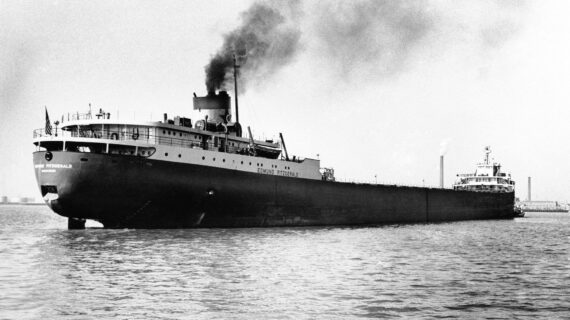
Now that's still a lot of ships. What is so fascinating about this particular one, the Christmas Tree Ship, that we're looking at now? The Rouse Simmons is probably one of the, after the Edmund Fitzgerald, probably one of the most recognized and most celebrated shipwrecks on the Great Lakes. And it's really, since it sank in 1912, the story and the legend that has evolved around the Rouse Simmons and as the Christmas Tree Ship has just kind of grown in proportion each year.
During the holiday season, you can see examples or you can find examples of the Rouse Simmons, the Christmas Tree Ship, all over the place. There's now a play that appears all throughout Wisconsin and the Midwest, and actually I've seen it in Europe and in Texas now, the Christmas Tree Ship.
Thomsen
The Christmas Schooner.
Meverden
The Christmas Schooner, yeah. There's been a number of books written about it. It's a great story, it's a tragic story but it's one that really kind of embodies the spirit of Christmas and just kind of endures and becomes a little more widespread each year. There's also reenactments in a lot of the coastal communities around Wisconsin.
So they'll bring Christmas trees aboard different vessels, fishing ships and I think the Coast Guard participates as well, bringing Christmas trees into the communities and giving the trees away to different families and organizations. So the Christmas Tree Ship was actually kind of a tradition that went back, I guess, long before this particular ship. It's kind of a genre, in a way. The Rouse Simmons wasn't the only Christmas tree ship.
That's forgotten a lot today. There's actually, according to historian Fred Neuschel there's approximately 61 different Christmas tree ships that were captained by 25 different people. So the Rouse Simmons is one of many vessels at the time. But there were a number of vessels that did sail as a Christmas tree ship.
I think this is a picture of another one we have here, Tamara, another Christmas tree ship? Yeah, these are actually examples of one of the Christmas ships that was previously owned by Captain Herman Schuenemann. Actually, the outbound vessel was the ship that was owned by him before the Rouse Simmons. And this is sort of an example of what they would do.
These were actually floating tree lots. So instead of going down to a paved area and having... A parking lot. A parking lot and having trees there for you to select, you would go down for the harbor and you would see the ships with the Christmas trees all stacked up.
The women would come down and string garland and put those up into the rigging, and then they would also have, they would make garlands and wreaths and those would be strung up too. So it was a very festive event for you to go down and pick a Christmas off one of the ships. For what? A dollar or two?
I don't know the exact price they were sold for. A lot of them were given away, and that was one of the reasons that Herman Schuenemann became known as Captain Santa was that he was a very benevolent man. So a good portion of the trees that he brought to Chicago on his own ships were given away to the poor and to churches within the community. Where do the trees come from?
He and his brother's family had a Christmas tree farm up in Thompson, Michigan. And they would hire lumberjack men, to go out into the woods and cut the trees down, and then on the last sail of the year they would load up which ever vessel they owned with Christmas trees, and they were said to be stacked up sometimes up to eight feet high on the decks with very, very little free board. And then they would sail south for Chicago, and it was always very late in the year for them to arrive, but when they arrived it was said that Christmas came to the people of Chicago. That sounds like a risky business, now that you mention it, because obviously you're not going to be harvesting Christmas trees until at least middle or late November, and we've all heard about those November gales and if you have eight feet of Christmas trees iced over on top of your vessel there with, as you say, Tamara, little free board and maybe five foot waves.
Yes. You're asking for trouble. Much more that than. It was a treacherous trade because Captain Schuenemann's brother, August Schuenemann, was actually lost in a wreck aboard the Thal, the S Thal, in 1898 as he was actually bringing his load of Christmas trees to Chicago.
Just north of Chicago he encountered a gale and actually ran ashore and everybody aboard was lost. And actually, Herman Schuenemann didn't sail with him that year because his daughters had been born in November. He had twin daughters and so he stayed home with his wife for the birth. And that was really one of the only years that he didn't sail aboard the Christmas ship with his brother.
The fateful year. Yeah. 1912. Yeah.
I think we have an image of at least one of the Schuenemanns here. Yeah, this was a picture of Captain Herman Schuenemann. He's in the center. He's in the center, yes.
And it was taken in 1910. And this was the year before he bought the Rouse Simmons. Or actually 1909 and this was the year before he bought the Rouse Simmons. He bought a share of the Rouse Simmons in 1910.
So you mentioned that it was referred to as a schooner, how old, what kind of condition was it in by the time we get to 1912, the year in question? The Rouse Simmons was built in 1868 at the McClellan shipyard in Milwaukee, Wisconsin. So it was already 42 years old by the time Herman Schuenemann had purchased the vessel. And a 42-year-old schooner on the Great Lakes is actually pretty ripe in age, and it may not have been in the best of condition when he bought it.
Especially, after 1900 having a three-masted sailing vessel or a self-propelled sail on the Great Lakes, this was long past the golden age of sail. In fact, a self-propelled schooner, at this time most of the schooners had been turned into barges. Their masts were cut down; they were toed behind steamers. So if there was a self-propelled schooner out on the lakes, it actually was so noteworthy where we actually see mentions in newspapers or a steamer would come into port and they would mention that they saw a full three-masted schooner under full sail on the lake.
So it was actually an anomaly by this time. And these vessels were pretty well worn, very decrepit. Since there wasn't a lot of trade to support them, they were actually neglected and probably not in the best shape especially to be sailing in November. So it was actually kind of a nostalgia thing, even in 1912?
Yeah. By the time Captain Schuenemann purchased this vessel it was more of a sales pitch than an actual viable trade to bring these down because he wasn't bringing trees down to Chicago only via the schooners, he also was shipping many trees by rail, but it was kind of like he had built such an aura around Captain Santa. Christmas didn't arrive in Chicago until Captain Santa arrived on the Christmas schooner that he was really kind of compelled to do that and maintain that persona. And actually he only owned about, I think it was a one-eighth share of the Rouse Simmons at the time when she sunk.
So he didn't sail her actively, and really the only time that he went out during his ownership of the vessel was when he went to get the Christmas trees and bring them south. And I think we have an image here of the ship as it, what is it, the last look of it, actually. The last known image of the Christmas schooner. It was Rouse Simmons.
This was published in the Marine Review in 1913. You can tell a little bit about what you see here. This is obviously as the Christmas Tree Ship. You can't really see it in the image too closely but if you look on kind of the left side of the ship you can see the name board Rouse Simmons and there's tomorrow Christmas trees aboard.
And it's obviously a very different image than we saw of the first picture of the Rouse Simmons. It's looking pretty trim there. Here it's looking a little worked over. Yeah, it could definitely use a coat of paint.
And one of the unusual things was the large deck cabin that Captain Schuenemann had installed aboard the boat. It was kind of a deck house where they could build wreaths. They could also carry more cargo. And we need to do a little more historic research into it, but from what can he can tell that he had built this cabin aboard the boat and didn't remove it for the sail north to Thompson, Michigan, and the return trip back.
So as far as we know, it was still installed aboard the boat as they were sailing. So now we have, in addition to maybe eight-foot stacks of Christmas trees, we also have this cabin to make the ship even more top heavy. And also more difficult to handle because you're blocking all your deck space. You have to move all your mast, your booms further up the mast to control the sails, and it makes working the vessel much more difficult.
What do we know about that last trip, Tamara? We know that they departed Thompson, Michigan, on November 22nd, and they began their trip southward. There really wasn't any concern. There are a bunch of rumors that are out there, if you start hearing the legend of the Christmas tree ship story that they spotted rats leaving the ship before...
Proverbial. Exactly, to indicate that there might be something wrong. And there were some people who left the ship early. They just had a feeling that they wouldn't make it.
But they departed and because Captain Schuenemann was so welcoming and so caring, he actually invited some of the lumberjacks to take a ride south. So the best that we understand, there were about 16 aboard when they departed. Would that be more than usual? Yeah, they would sail with typically three to eight.
So it depends on what the load was when they were sailing. How long a ship? How long a trip? How long a trip was it or how long did they remain on the ship?
How long did they make it? How long would it have been under good circumstance? They could have made it in as short as three days, two to three days depending on the wind. So they departed that evening and they began their trip south and as they were departing there was a fresh breeze.
And so it was a good wind and good to be able to get them south and the wind was from the northwest. And so as they began south and they found themselves hugging the coast of Door County, the wind started picking up and she rose to just below a gale. And at that point, something started to go wrong because by the time she had made it south to Kewaunee, Wisconsin, and she was off of Kewaunee by about, was it three miles? Three miles off, and she was sited flying a distress signal.
It was actually in -- which is an American flag flown upside down in her rigging. They wouldn't have had wireless. This is 1912, the Titanic had it but not on this vessel. Not on all vessels, yeah.
And so as they passed the Kewaunee Life Saving Station, they had this distressed signal flying. It was notice and so the Kewaunee station only had, and
this was at 3
00 in the afternoon, and the Kewaunee station only had a rowed life boat. And so they telephoned down to the Two Rivers station, and they telephoned the gentlemen down there and said there's a distressed schooner which is coming your way, be prepared to intercept it. And so they got underway shortly
after 3
00 and began heading north to come around Two Rivers Point, which is now called Rawley Point, and by the time
30-4
00 in the afternoon. They could see almost all the way to Kewaunee. They had eight miles of visibility. And so they could see nearly all the way to Kewaunee and they couldn't spot the vessel.
They said the lake was completely empty. Nothing at all. Yeah, and so just to make certain, they sailed north for an hour. And so as they sailed north, they still did not see anything so they decided to turn out into the lake, and they sailed for an hour out into the lake.
And by this time it had increased to a gale, and the temperature had started to drop. All during the day it had been in the 40s. So there was no snow as the legend says there was parting snow and they saw this schooner that was just through a glimpse in the snow storm and people were yelling help, help. This was not what happened.
And so they sailed out into the lake, and they couldn't find it after an hour of searching in the lake, and so they headed back into Two Rivers not having found the schooner. Well, you have to admire, this is an image, I believe, of the life saving station personnel that we have here. Yeah, you'll see in this image that everyone in this picture would have gone out to try to attempt the rescue on the Rouse Simmons except for little Henry who's Captain Sogee's son who's posing in this picture, and then one of the gentlemen would have stayed behind to stand watch on the life saving station. This gives you some idea of what they were out there in, in a gale.
Yeah, they actually the advantage over the Kewaunee Life Saving Station because, as Tamara said, the Kewaunee station just had a rowed life boat, so manually propelled. But Two Rivers was actually fortunate to have a gas powered life boat, 30 feet in length. And this is an image that would be very similar. It's not the exact boat but very similar to the vessel that they would have been out in the lake in.
So at this point, November 22nd or so. 23rd. The following day. 1912, nobody knows where the Rouse has gone.
No. And there were quite a few calls that were put out to all the ports around the lake. When she didn't turn up in Chicago, they asked for everyone to keep a watch out. They really thought that she would end up somewhere.
It wasn't unusual for a vessel to be delayed and ride out on anchor in some shore or somewhere. So it wasn't unusual that it didn't show up immediately. And for a while, there were notes and messages that would show up, fakes, that people would send or reports that ended up being erroneous that said that the vessel was over in Michigan or had been driven ashore and was behind some islands. And for a long time they didn't give up hope that the vessel had not been lost.
So part of the aura of this particular ship really was with it from the beginning because it had this wave of nostalgia that was riding, Captain Santa Claus, this is kind of the official arrival of Christmas and it's missing in action. Yeah, and also for many, many years it was said right after, too, the storm, there were many captains who had been out on the lakes for many years and they would come in and say that was the worst storm I have ever been in, I'm so lucky to be back on dry land. It's lucky if they'll survive. And that may have been true that it was a bad storm, but the storm had actually picked up after the Rouse Simmons was on the bottom.
So we truly believe that the Rouse Simmons, had she been afloat, that the life saving station, the crew from the Two Rivers Life Saving Station would have seen her and would be been able to perform a rescue.
But probably by 4
00 in the afternoon she was already on the bottom. And it's quite the wreck site, I gather. What we have here is a composite of how many pictures, Tamara? This is a photo mosaic I put together of 242 images that are stitched together that show you what the wreck site looks like today.
And in 2006, the Wisconsin Historical Society along with our volunteer divers went out and conducted a two-week archaeological survey of the Rouse Simmons. For many years there have been hundreds if not thousands of divers who have visited this shipwreck, but no one has systematically looked at it to determine why she sunk. So we wanted to go out and look at what was still there, any evidence that was still there, and try to see if we could determine what caused her to sink. Well, when you say what was still there, what was still there after how many years?
First, it had to be, I guess let's back up just a little bit. How was it found in the first place? It was actually discovered in 1972 by a diver from the Milwaukee area by the name of Kent Bellrichard, but it was actually known that the Rouse Simmons was in this area to quite some time because soon after it went down, a lot of the commercial fishing nets in the area would be pulled up with a lot of evergreens in the trees. And actually, in 1923, one of the commercial nets was brought aboard the fishing boat and one of the crew of the fishing boat found a little object that was kind of wrapped in a wax paper in the nets, and when they pulled it out, they opened it up and they actually discovered it was Captain Schuenemann's wallet and it still had his calling card in there as well.
And newspaper articles that talked about him as Captain Santa. And he had them preserved in wax paper. So unlike a lot of the notes in the bottles that were found to be hoaxes, we actually did confirm this that the wallet was pulled up in 1923 and returned to the family. And the wallet was returned to the family, yeah.
Any genuine notes in bottles from the Christmas Tree Ship? Not that we've been able to confirm. There ere two of them that showed up in the newspapers, but both of them were determined to be hoaxes. One of them washed ashore down by Sheboygan a few weeks later and another one showed up off Sturgeon Bay in Door County.
An interesting reaction to a tragedy that people feel they have to somehow contribute to it. Yeah, and that's part of the reason that the Rouse Simmons, the legend grew around the Rouse Simmons just because it was in the newspaper a lot. You had these fantastic stories about the notes and the bottles, and nobody knew exactly where the Rouse Simmons was in trying to locate it. It literally just sailed into a hole in the lake and they couldn't find it.
So was it finally discovered accidentally or was somebody really actively looking for it. Mr. Bellrichard, he was an avid shipwreck hunter. He's actually credited with a lot of major shipwreck discoveries within Wisconsin.
And at the time, he was out looking for another vessel, the steamer Vernon which sank in the late 1800s not far from where the Rouse Simmons lies today. But he actually found it. He was out there on, I believe, a cold, foggy October day and he found it on the sonar. He was out on the lake by himself.
He did a quick dive down to the wreck. The visibility was very poor. He couldn't spend a lot of time down there, and he saw that he had discovered a wooden schooner, but they didn't actually confirm it by finding the name board until a subsequent dive after that. But it was discovered in 1972.
He goes down there and what? You're saying that the visibility either was or got bad pretty quickly and he had to kind of do this by touch and feel? In 1972 the visibility was really bad in Lake Michigan. So we would be lucky to be able to see each other.
And the wreck lies at 165 feet of water so at that depth with poor visibility there would be no ambient light. So literally, the visibility was extremely poor. You could literally see a few feet and that was it. And plus you have a lot of nitrogen narcosis at that depth which is caused by the thickness of the air that you're breathing and the amount of nitrogen that's in it.
So to be able to stay that long and to be able to spend time researching and determining which ship it is really... For 1972, this is a very advanced dive for a recreational diver. And at the time, they were staying a maximum of six minutes on the bottom before they would have to return to the surface. You can't discover a lot in six minutes.
Not at all, no. But today, with zebra mussels, the lake is really clearing up. And of all the disadvantages of that invasive species, we get very, very clear water clarity conditions. And so I think by some of the pictures you'll see...
On an average day you can see 80 to 100 feet on the wreck. You don't even need to carry a light because there's so much ambient light on that. Thanks to the zebra mussels? They clean the water up a lot.
They need somebody to recommend them, anyway. We've had friends who reported being down on the wreck and being able to look up and see their boat on the surface. That's certainly remarkable at 165 feet. We're looking at the stern here, I guess.
Yeah, this is an image that we took during our survey of the Rouse Simmons in 2006. And here you can actually see where the transom has blown out on the wreck, and this actually helped us determine that the wreck did sink, the Rouse Simmons did sink bow first. So an air pocket was built up inside the hull as she was sinking and that blew out as she left the bottom and caused the transom. Otherwise, the hull is in pretty good condition.
It's very intact. There's very few boards that are missing, and it really is an amazing place to go diving. The Great Lakes, in general, are wonderful places for preserving shipwrecks. Are they because they're fairly deep, they're fairly cold and they're fresh water?
All of those, yeah. A lot of the wrecks on the bottom of the Great Lakes are very well preserved. Prior to the infestation of zebra mussels and quagga mussels on the Great Lakes, you could still see, like in one vessel, in particular, it sank in 1868 and it's in 180 feet off Milwaukee, the Grace Shannon. When we first started diving that wreck before it was covered in zebra mussels, you could still see the name, Grace Shannon, painted on the stern.
It had been down for over 100 years. So the vessels, especially the wooden vessels in the Great Lakes are very well preserved. Especially in Wisconsin and all of the Great Lakes have one of the best collections of 19th century wooden shipwrecks in all of the world because the fresh water, we don't have a lot of the wood eating organisms like they do in saltwater. Of course, fresh water is much less corrosive to metal and iron.
And just because it's so cold. At this depth, typically it's 38 to 42 degrees year-round down there. And it's literally like putting them in a refrigerator and preserving it. Pretty good museum conditions.
Fantastic. Not a probably with barnacles but it sounds as if, Keith, you're saying there is a problem there with zebra mussels covering the wrecks? There is now. The one advantage of zebra mussels is they've improved the water clarity so you're able to see much further and it's a much safer, more pleasant dive.
But the down side to that is they are now covering all the wrecks. And on the outside of the wreck the Rouse Simmons is now covered anywhere from one to three inches by a layer of zebra mussels all over the outside, which has its own problems. It adds weight to the wreck. It's not well documented how detrimental they are to shipwrecks and what kind of damage they are causing, but they certainly aren't helping the matters at all.
What's the significance that it went down bow first? Well, when we did the archaeological survey, one of our goals was to kind of figure out why the Rouse Simmons went down, and if we wouldn't be able to determine why it went down, perhaps we could discover what was going on on the ship. What were the crew doing in the final moments. And one of the things we first noticed when we dived or when we dove on the wreck is usually when a vessel sinks it kind of turns beam to the sea or turns sideways to the wind as it's getting blown along.
And one of the unusual things about the Rouse Simmons, it was pointing directly back into the storm that sank her. So she's on a northwest heading facing back in towards the shore. So we thought that was a bit unusual, so we started looking around the wreck to see why was she in that orientation. We expected her to be completely opposite either facing south or on a southerly heading.
And that's not who we found. So we started searching around the wreck doing a lot of examining the machinery and a lot of the things that are still there, and we found a few unusual things around the windlass area. All of the masts are broken off and pushed forward. And actually, if we go to one of the slides on the screen here, this photograph is actually taken where the foremast would have stood.
So we're actually inside the ship looking forward. You can see some of the deck beams have been carried away. But if you actually look really closely on the bottom of the ship here you can still see the cargo of Christmas trees that are still stacked in their hold. In fact, in the center on the bottom you can still see one with all of the needles still on it.
So they're very well preserved. It's better than the one I got this year.
LAUGHTER
But probably by 4
So it's a great wreck to dive because just the history and the cargo. But when we started looking around the wreck, we started noticing that a lot of the machinery, like the windlass was used to raise and lower the anchors, the crew was actually working to set one of the anchors or preparing to set an anchor right when the ship went down. And that would set the ship right into the wind which would diminish the force against the sails or the mast? Yes it would.
It would help steady the vessel because any vessel that loses power or gets caught beamed in the sea and starts wallowing in the wave trough is pretty much doomed. It's going to be swamped. It's pretty much a goner. So one of the ways to help that is to set an anchor or keep the bow into the waves and into the sea and help steady the ship and make it ride out the storm.
But one of the things that we couldn't understand is no captain in his right mind on a vessel like this would have anchored in 165 feet of water where the Rouse Simmons is. So that was one of the questions we had too. But when we started looking around the boat, it was obvious that they were working to set the anchors because in the image that we saw before all the anchor chains had been pulled up and are in a pile on the deck. And we started looking around the windlass and we found some of the features of the windlass they were getting ready to set the port anchor.
Because in this image, this is actually a picture of me right behind the windlass of the Rouse Simmons, and if you look in the lower left hand side of the screen, you can see on the windlass there's a large iron staple type of appendage sticking out of the windlass. This is actually called a norman pin. We didn't actually quite understand exactly how one of these windlasses worked at the time but we actually found a manuscript that was written by a gentleman by the name of Ludden Wilson around 1900 that he documented this way of life that was obviously being lost at the time. And he documented very carefully how these sailors would work the windlass.
And he documents the norman pin and how everything was used, and we actually confirmed that the crew was actually getting ready to set the port anchor at the time it went down. How does it look in terms of the decking, the actual surface of the ship? That is one of the unusual things about the Rouse Simmons is that a lot of the decking is missing which is kind of unusual because there are a couple other similar vessels, similar schooners, at a similar depth in the same area that do have all of their decking. And this kind of leads the question back to the deck house that we saw in the last known photograph of the Rouse Simmons is one of the remaining questions is whether or not they actually used some of the deck planks to build that deck cabin.
One of the advantages for doing so is you'd be able to get a little more cargo on the boat which would actually make it a more profitable run, but obviously there would be some problems about sea worthiness. When we did our archaeological survey, we weren't able to find any evidence of that deck cabin at all and actually very little evidence of the deck planks. So if they would have had the deck cabin installed on the boat while they were underway, if they would have been in a large sea, any boarding waves would have quickly dismantled that deck cabin, and if they didn't have any deck planks and used them to build the cabin, the boat would have literally just filled with water and sank. So it's one of the remaining questions that we still need to do a little more historic research in to.
But we're not aware of any other ships that had this kind of practice, are we, of removing deck planks just to get more cargo? It seems like a pretty desperate thing to do. Cargoes were actually quite common, but actually in the Christmas tree ships, and specifically with Captain Schuenemann, he's the only person who we've been able to document that had installed and built deck cabins like this for the Christmas tree trade. Because we haven't been able to find any other evidence of any other trade or any other captains using deck cabins like this.
So you mentioned the anchor and the anchor chain, at least, what do we have, anchors seem to be kind of the biggest prize when it comes to underwater archeology, Tamara. What's left in this department of the ship? When the ship was discovered in 1972, the gentleman that first dived on her reported that they had removed the starboard anchor, the starboard side anchor. And they actually brought that up.
There are newspaper articles that show them posing with it. And then that anchor went to the Milwaukee Yacht Club. So if you'd like to see the anchor of the Christmas Tree Ship, you can go down to the Milwaukee Yacht Club and take a look at it. They usually have Christmas lights strung up all around it.
How big would that be? It was about eight feet, I believe, in height. It was a pretty large anchor, wooden stock anchor, and it's on display there now. But there was never a report of what had happened to the port side anchor.
And so when we were down surveying the wreck, we discovered that the port side anchor chain actually comes out of the hause pipe, drops down toward the sand and then comes up over the bow spread, which is not the way that it would look normally if it was sailing at that time. Sounds like it was fouled. Right. And so we thought that perhaps someone in the early days had removed the port side anchor.
And so we began asking around and that was just the way the chain ended up when they had cut it off. And so we started asking around and we started asking as many of the early divers on this wreck what had happened to it. And none of them knew. They said as far as they knew the wreck didn't have an anchor, a port side anchor, and it wasn't there.
And so we actually went back and we were able to get a hold of John Steele's video, John Steele is one of the early divers on the wreck and actually one of the early divers in the Great Lakes who was taking video. And he went down during his six-minute dive and filmed the area of the bow and actually filmed the anchor coming out of the hause pipe dropping down into the sand across the vessel. So it's exactly like it was when they discovered it in 1973, and it was not a result of someone removing the anchor. And unfortunately, we discovered this video in the middle of winter and the video was at the Wisconsin Maritime Museum and we were just so excited.
We were like, when can we get back out on to the lake. We knew it had to be out there somewhere. We knew it had to be there. So the next spring, first thing we went out and followed the anchor chain out and we were able to locate the port side anchor.
And we discovered that it is pretty heavily set into the bottom. And that was what was holding the Rouse Simmons into the wind. It kind of confirmed that the crew was getting ready to set the anchor and they actually had thrown the anchor overboard. Because of the way the anchor set into the bottom and the distance it is away from the wreck, it didn't fall over unintentionally as the boat sank because from the video we saw the starboard anchor was heavily lashed in by heavy chains.
So the crew willfully unhooked it and threw it overboard to help steady the ship. Sure. And there's a few items that we found on the deck, too, when we were doing the survey. We found an anchor hook which they would have used for lowering the anchor away from the ships so they wouldn't have caused damage to the ship when we were putting it down.
But that brings us back to the question, why would they do that? Why would they throw their anchor over in 165 feet of water because with an old manual windlass it would have taken hours to pull that windlass anchor back up. And frankly, they didn't have enough chain on the ship to be able to set the anchor. Well, I was going to ask about that.
That's a lot of chain because you're not talking about 165, you're talking about the hypotenuse of a triangle there. It would be a lot more. In a storm, the rule of thumb is you want a scope or you want the anchor chain to be 10 times the depth of water. So in 165 feet they would have needed over a thousand feet of anchor chain which they didn't have aboard.
So essentially there was just something terribly going wrong, they knew that the ship was doomed and they were just trying to steady the boat perhaps to launch their yawl and get off or steady the boat perhaps until the life saving station could get there. But they definitely knew that they were doomed when they set that anchor over. And we're talking about 16 people on this ship then kind of running around trying to figure out what to do. And unfortunately, the yawl boat wouldn't have been large enough to carry all 16 people.
About 8 or 10 so that would have made it a very, very poor situation for many people aboard. So the anchor is where now? It is northwest of the shipwreck, and it's about 200 feet away. And are you planning to leave it there or are you going to bring it up for your yacht club?
LAUGHTER
But probably by 4
It's actually illegal to remove any artifacts from Great Lakes shipwrecks now since 1988 and the federal Abandoned Shipwreck Act. So when the wreck was first discovered, they removed many of the early artifacts from the vessel which are in maritime museums around much of the state. But now since 1988 it's illegal to remove anything from the bottom. And when we do an archaeological survey, we leave everything in place.
We survey it as it lies on the bottom and we don't bring anything up. 172 feet strikes me, still, as being, even with contemporary technology, a long way down. It is. How many visitors does this ship get?
You'll see hundreds of divers a year go out to it. Over the years there's probably been several thousands of divers who have visited it. It's a very, very popular dive site. On a good day on the lake there will be two or three dive boats anchored down or moored to the wreck and with divers diving it.
So it's actually visited quite often. And it's open to anyone as long as you don't remove anything? It is. And we actually have people that come from all over the world to visit the shipwrecks here, so it's quite a niche tourism market.
Is there a problem at all with divers, even if they don't bring anything up, disturbing things so that it's a little hard to tell, if you're doing, in effect, kind of a forensic analysis of this ship and you have somebody down there, well, this wheel looks pretty nice, oh, it came out. Do you have problems with that? Even the looting isn't as much of a problem as it used to be. Through education, we've educated many of the divers that these are important sites.
They're not nonrenewable and it's important to leave the artifacts there. A lot of times artifacts do get moved around a site. Small, portable artifacts like dishes, cups, plates, things like that. And a lot of people like to move them around and take photographs of them in one area.
And especially with the Rouse Simmons, one of the things is if you dig into the silt, you can pull out Christmas trees that still have all their needles on them. They look like the day they sank. And every year somebody pulls one out and sets it on the boat. And it's very picturesque and it's very romantic but eventually those needles fall off and so they discard that tree and pull out another one.
And eventually you won't have any more Christmas trees. Yeah. So we're trying to discourage people from doing that also. They say take only pictures, leave only bubbles and don't disturb the site.
We have here a picture of what appears to be the ship's wheel, though. Where did that come from? The ship's wheel was discovered in fisherman's net. Do you recall the year?
1991. And it was pulled up about a mile north of the wreck site and then restored by a gentleman named Jim Braatz. And it's on display currently at the Roger Street Fishing Village in Two Rivers. And there was a theory for a long time that the wheel had been lost in that location and that was what caused Rouse Simmons to sink.
That she had had a steering malfunction and that the mizzen boom had swept across the deck and had knocked the wheel overboard. But we were able to, Roger Street and the village of Two Rivers hosts a Rouse Simmons Christmas Tree Ship weekend ever year. It ends up being the first weekend of deer hunting season. But lots of people come out for it to listen to the presentations and to remember the Christmas Tree Ship.
And one of the years we were giving a presentation and one of the fisherman that had brought the wheel up in his nets came forward and we started talking to him, and he admitted that they hadn't been fishing in the area that was a mile north but they had actually come maybe a bit too close to the Rouse Simmons and gotten their nets entangled with this artifact. And by the time they got it aboard and got the nets hauled up then they were a mile north of the shipwreck site. So they dragged it a mile, in other words? Yes.
And that's actually how we know of the locations of most of our shipwrecks today are because of entanglements with commercial fishing nets. It is quite common. They try to avoid them whenever possible because obviously the nets are expensive. But the wheel looked, in that image at least, like it's in pretty good shape anyway.
Yeah, they've done a really good job of restoring it, and they really do a very good job of preserving it at the Roger Street Fishing Village. So if something comes accidentally then the State Historical Society is happy to adopt it? We try to find homes for them, yes. How many sites have you two dived on the Great Lakes?
Quite a few. We've pretty much, we haven't dived all of the shipwrecks in Wisconsin yet. We're trying. We've dived the vast majority of them, and I guess I've dived wrecks and all but Lake Erie.
I don't know how many lakes you've been in. All of them. We actually do this for fun. When we're not working, we're also out on a dive.
It's a job. If it's the same thing you would do if you weren't getting paid then you've got the right job. So what is the Holy Grail? What's the ship that you would really like to find, number one on your list?
The Holy Grail, there's actually only one Holy Grail of the Great Lakes and that would have to be La Salle's Griffon, which is actually, it's not the first shipwreck nor the first European sailing vessel on the Great Lakes, but it is, a lot of people, it was built in the Niagara River over the winter of 1678-1679, and La Salle actually brought it to Wisconsin to Door County peninsula to load furs to take back to France. And once it loaded furs either on the Rock Island or Washington Island area, it set sail and nobody ever saw it again. So the Griffon was the first European sailing vessel on Lake Michigan, it was also Lake Michigan's first shipwreck. And it hasn't been discovered yet so they're still looking for it.
It's been a long time. It sounds like it would be tough. There's been a lot of reports but there's no confirmations yet. Well, happy hunting.
LAUGHTER
But probably by 4
And thanks for showing us through the Rouse and the Christmas tree, I'll call it almost a legendary wreck, although it only goes back just a hundred years now. Yep. With me have been Tamara Thomsen and Keith Meverden, underwater archaeologists with the State Historical Society. It's been a pleasure.
Thank you. Thanks for having us. Hurry back. Thank you.
I'm Norman Gilliland and I hope you can join me for the next broadcast of University Place Presents.
Search University Place Episodes
Related Stories from PBS Wisconsin's Blog









Donate to sign up. Activate and sign in to Passport. It's that easy to help PBS Wisconsin serve your community through media that educates, inspires, and entertains.
Make your membership gift today
Only for new users: Activate Passport using your code or email address
Already a member?
Look up my account
Need some help? Go to FAQ or visit PBS Passport Help
Need help accessing PBS Wisconsin anywhere?

Online Access | Platform & Device Access | Cable or Satellite Access | Over-The-Air Access
Visit Access Guide
Need help accessing PBS Wisconsin anywhere?
Visit Our
Live TV Access Guide
Online AccessPlatform & Device Access
Cable or Satellite Access
Over-The-Air Access
Visit Access Guide




Follow Us