

 Passport






The Science of Chaos
03/26/08 | 1h 5m 11s | Rating: TV-G
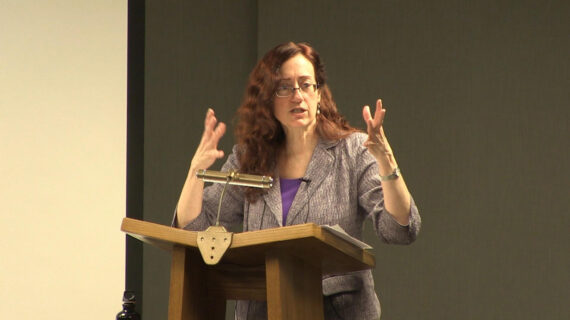
Clint Sprott, Professor, Department of Physics, UW-Madison Learn about the science of chaos as Clint Sprott, a professor at UW-Madison, demonstrates and explains what chaos is all about, and why some people are devoting their careers to it.


Copy and Paste the Following Code to Embed this Video:
The Science of Chaos
cc Our speaker tonight is Clint Sprott. And Dr. Sprott has a bachelor's degree from MIT, which he obtained in 1964. He got a Ph.D.
in physics from the University of Wisconsin in 1969. And his professional interests are, and I have to read this to get it right. In experimental plasma physics and non-linear dynamics. But he's also well-known for 25 years producing educational programs under the title of Wonders of Science, which has been on cable television, and available in lectures and demonstrations at the University of Wisconsin and elsewhere.
So the title for tonight, is the "New Science of Chaos." And I can make the snide remark that anybody who thought this was going to be a talk about American foreign policy in the 21st century, will be surprised, but probably not disappointed! ( laughter ) ( applause ) Thank you. I'm going to talk to you today about my research, which is about chaos, in perhaps more ways than one, but I'm actually not going to say much about the research I'm doing currently, because the topic itself is of sufficient interest, that I would like to give you a little bit of a tutorial and explain what chaos is all about, and why some of us are devoting our careers to it. I'm going to use some software that I'm wrote many, many years ago, called "Chaos Demonstrations" to illustrate many of the points that I'm making today.
It will take just a moment to switch screen modes from time to time, but I'll try to make it quick. If you go out into the real world and measure something, more often than not, what you will see is something that looks like that. Now this could be lots of different things. If you're an economist, this might be fluctuations of some financial market.
If you're an ecologist, it might be fluctuations of some plant or animal species out in the wild. If you're a meteorologist, it might be fluctuations of the rainfall, or snowfall, or temperature data. If you're into medicine, it might be the signal you get from putting an electrode on someone's head and looking at the fluctuations of their brain waves. This could be lots of different things.
Until rather recently, just in the last few decades, when scientists were confronted with something of that degree of complexity, they tended to throw up their hands and say, there's no hope of writing down some mathematical equation whose solution is going to look like that. The best we can do, is to sort of study it statistically. Maybe learn some characteristics of it, but it is far too complicated to model in any simple way. Well, what I'm going to show you today, is that there are many systems that are extremely simple that behave like that, and there are many simple models, some involve mathematics, some don't even go that complicated, that produce behavior that looks very much like that.
Of course, not everything in the real world is not like that. Many things in the real world are highly predictable. An example is a pendulum. If I take this ball and let it swing back and forth, I can predict with a high degree of accuracy where it's going to be, at any time in the future given the initial conditions.
And I can also draw a graph of it, and it simply goes back and forth, back and forth, in a very regular, periodic manner. And there are many things, of course, that are like that in the real world. But not everything is. And I'd like to show you another example on the computer here.
That's the example of a planet orbiting a star. Now this is one of the first problems ever solved in the modern sense in which we think of solving a problem in science. It was solved almost 400 years ago by Johannes Kepler, an astronomer, who was analyzing data from his mentor, Tycho Brahe. And he discovered that the planets orbit the sun in elliptical orbits.
And he was able to deduce many of the mathematical properties of those ellipses. But the important thing from our perspective is that this is a highly predictable kind of behavior. And indeed the earth orbits the sun in an elliptical orbit, it's very nearly circular, so this is more like Hally's Comet, or something, but the important thing is that we can predict where the earth will be many years in advance. In fact, we're so good at predicting things in astronomy, we can even predict when an eclipse of the sun will occur, let's say, years in advance.
And we can even predict where on the earth to go, to stand, to get the best view of that eclipse, many, many years ahead. And that's truly remarkable that the equations of physics known 400 years ago, or 300 years ago, anyway, are sufficiently accurate and precise, and predictable, that we can make those kinds of long-term predictions. But my astronomy friends tell me that if you look throughout the universe, most stars occur not as single stars, like our sun, but as binary stars, or even groups of three or more stars. You might wonder what happens when a planet orbits, not a single star, but a pair of nearby stars.
Well, on the computer, we can simulate that. So here are two stars, they're actually at the center of these two circles. Here's a planet that we started out in sort of an arbitrary way, and you see it's going in a much more complicated kind of orbit. And it looks almost random.
It looks like it's doing whatever it pleases. Now if you think about it, this is truly remarkable, because the underlying laws of physics are exactly the same in these two problems. They both involve laws handed down to us by Isaac Newton 350 years ago. They involve the universal law of gravitation, any two objects are attracted with the force that's inversely proportional to the square of the distance between them, and they accelerate in proportion to that force.
So with those simple mathematical equations, one could write down the equation that is governing this system. And it's basically the same equations in the two cases, but yet the behavior is somehow qualitatively very, very different. And this is an example, the first example of many I'm going to show you over the next hour of what we mean by chaotic motion. So one characteristic of chaotic motion, as you might gather is that it's complicated.
Unlike the simple ellipse, this is a much more complicated kind of motion. It may also surprise you to know that the first problem that I showed you, the so-called two-body problem, a planet plus a star, was solved 400 years ago, but the three-body problem, which I'm showing you here, has never been solved. And probably never will be solved in the sense in which we think of solving problems in science. That is to say, there is no mathematical equation you can write down that allows you to predict where this planet will be at some distant time in the future, in the same way that you can in the two-body problem.
And so it would be hopeless to try to predict an eclipse in this case, more than a year or two ahead. So it's a very complicated motion, and it is unpredictable. And that's one of the characteristics of chaotic motion. Even though it's obeying simple equations, simple laws of nature, we cannot predict, at least for the long-term, what is going to happen.
We can predict the short-term, but if you try to go too far into the future, your predictions fail miserably. Now another characteristic of chaos, besides the fact that it's complicated, and it doesn't repeat, obviously, is that it has extreme sensitive dependence on initial conditions. Now what does that mean. When I started this simulation, I started the planet right here and I let it go, and it did its thing.
You might wonder what would happen if I would repeat the calculation, but start the planet in a little bit different condition, maybe a velocity that's different by one part in a thousand. Well, with the computer, we can actually do that. And that's what this shows. Here, I'm actually doing two calculations and just overlaying the result.
So we have two planets here, but the planets are not interacting. They're just interacting with the two stars, which by the way are not moving, so this is, in fact, a simplification of the real three-body problem. And you see that for a little while, the planets follow one another, but after a while, they begin to separate. And if you watch it longer and longer, you see that this separation grows ever larger.
After a little while, one planet is here and one is way over here somewhere. So you might say, well, this means that you have to know the initial condition to a high degree of accuracy, maybe you need to know it not one part in a thousand, but one part in a million. I can tell you that if you repeated the calculation with the initial condition different by one part in a million, by this time, they would still be doing something different. And it's because the error in the initial condition grows exponentially.
Now the thing you probably all know about exponential growth, is that if you wait long enough, it gets really big. It doesn't matter what you're talking about, and that's the case here. Do you have a question? You don't have an equation to solve this, right?
You do have an equation. You can write down the equation for this, and it's no more complicated than the equation for the two-body problem. And of course, in a sense, the computer is solving the equation, right? Otherwise, I couldn't be making the graph.
But the computer is solving it in a special way. It's not solving it in the way we usually think of solving problems in science. It's not taking an equation, where you plug in a value for the time on the right hand side of the equation, and the left hand side then tells you where the planet's going to be. What the computer is doing, is inching itself along, in tiny little steps, because you can always predict what's going to happen in the immediate future.
But what you can't do is make a long-term prediction, without going through all of the intermediate steps. It's those intermediate steps that allow the error to accumulate and multiply, and to eventually completely dominate the behavior of the system. Now another characteristic of a thing like this. Would you expect this to be a good system to look for interplanetary life or extra terrestrial life?
The seasons would be pretty extreme, wouldn't they, because at times you come very, very close to the stars, and at other times, you're much farther away. So that's a message to the people who look for extra terrestrial life. Don't bother looking around binary star systems. That would be one message of this, if you want to know what it's good for.
That's one example. Now, of course, this is a very old problem. The problems in astronomy, they've been solved long ago, the ones that can be solved, and the ones that can't be solved, this is the best we can do. But there are many other examples of things that have very predictable behavior.
I was about to show you this pendulum that swings back and forth. And of course, if you think about it, all of the methods we use to tell time, basically rely on some sort of periodic oscillation, even our very best clocks, atomic clocks, rely on the oscillations of cesium atoms, or some other kind of atom. So, it is some kind of regular periodic oscillation that allows us to measure time at all. And so it is in that sense that a periodic system, a regular simply behaving system like that, is highly predictable.
Of course, another example of that is this gadget right here. Those of you who are musicians will recognize this as an upside down pendulum. It's a metronome. It beats a very regular pattern.
It's very predictable. If you listen to a few beats, you'll be able quite accurately, to tell me when the tenth beat will occur. Do you have a question? A little bit back to what you said, that it would be possible to predict in the near term, small, little, tiny predictions, but not in the long-term, far out, and that's what the computer does.
Do they have any, or you have any theory, or otherwise, an idea of why that is so? Is it just a fact, without any understanding of it? There is some degree of understanding. You're asking how do we know when the behavior is going to be like this, and when it's going to be like the other one.
How do we know when the system is going to behave chaotically? That's a question that doesn't have a universal answer. We know some of the conditions that are necessary for this kind of behavior, but even when those conditions exist, you can't guarantee just looking at the equations that they're going to have this kind of behavior, without actually putting it on the computer and trying it. So there is a sense in which this is an experimental science.
We're still grappling with trying to understand the conditions under which systems exhibit this kind of behavior, and the conditions under which they don't. Some things are known about it, but by no means everything. It's an active area of research. Okay?
Now with the pendulum, of course, highly regular, highly predictable. But I can modify this pendulum in one small way. I have some little blue gadgets and I'm going to place them underneath the pendulum and let it swing again. Now if you look at the pendulum, especially if you could see it from above, you will notice a very different kind of motion.
It's not simply swinging back and forth, it is wandering around, not unlike what the planet does in the vicinity of the two stars. And in fact, those blue things, as you might have suspected, are magnets. Two of them have their north poles up and two have their north poles down. And inside the tennis ball is another magnet.
It's attracted to two of those magnets and repelled by the other two. And so in a sense, it is very similar to the problem here, of the planet attracted to two stars. And it sort of can't decide which star it wants to be near. It's near one for a while and then it's near the other for a while.
And so that is one of the characteristics. You have a sort of a tension going on mathematically between two competing forces, you might say. And that's a little bit of an answer to your question. One of the sorts of things you need to have for chaos.
And if you just have two things interacting, that is not sufficient, usually, to produce this kind of chaotic behavior. Now you may conclude from this that there's something mystical and unusual about the magnetic force. It does have a certain mystique about it. But, in fact, the equations that describe the motion, are not particularly more difficult when there is a magnetic force involved when there is only a gravitational force.
So it's not that there is something mysterious about magnetism. It's that it introduces an element into the mathematics that allows the possibility of chaos. And we think we understand what it is that does that in the equations. You can understand it, mathematically, in some sense.
Well those are pendulums and there are many other examples of pendulums of various sorts. Here's another pendulum. This is a gadget you used to buy at airport gift shops. I think I bought this one for $8 about 20 years ago, I guess, now.
And normally, you buy it and you put it on your desk and you stare at it and day dream. But, it illustrates some important principles. First of all, it looks like perpetual motion. The thing's been going there ever since I started talking, and it never seems to die.
But of course, there is no such thing as perpetual motion. There's a little magnet in the bottom of that outer ring, and when it sweeps by the base, there's an electromagnet there that senses that it's coming by, and it gives it a little kick. So it's like someone's pushing the swing. So that outer ring is going back and forth in a regular periodic manner, approximately, much like the pendulum before I put the magnets near it.
But if you look at that inner ring, it's going around in a much more complicated kind of fashion. In fact, it is exhibiting chaotic motion. If I had two of these gadgets, and I set them up side by side, much as I did here, tried to start them identically, they would follow each other for a couple of swings, and then they would get out of step. Pretty soon, they would be doing completely different things.
So that's an example of chaos. And, in fact, when I bought this gadget, there was some extra magnets on the inner ring and the outer ring, so when they came by each other, they got a little extra kick. And I reasoned that those extra magnets weren't really essential for the operation of it, and so I ripped them off. And in a great triumph of theoretical physics, the thing worked more or less the same.
( light laughter ) I suspected that it would work because of, in this case, we know the reason, the inner ring is chaotic and the outer ring is periodic. And it's because the inner ring is not oscillating to a very large amplitude. It's just going back and forth, maybe 20 degrees or so. Sorry, the outer ring.
The inner ring, however, occasionally goes over the top. And that's the critical element, that going over the top. That brings into the mathematics something we call a non-linearity. Now what does that mean?
It's a technical term, but it's one that comes up repeatedly in those whole business of chaos. First of all, let's talk about the linear case. The outer ring, when you displace it away from its equilibrium down at the bottom, there's a force pulling it back. That force is proportional to the displacement.
That's what we mean by linear. If you displace it that way, the force brings it back, but the larger the displacement, the larger the force, and they are linearly related. So that's what linearity means. The inner ring, though, when you start to go up at a high elevation like this, the force doesn't keep going up, up, up, up.
In fact, when you get exactly inverted, the force has gone all the way to zero again. It's like a pendulum balanced on its point. There's no force at all there. In fact, it is that non-linearity that is responsible for the chaos.
So you've just learned something, in answer to your question, in fact. A necessary condition for a system to exhibit chaos is that there be some kind of non-linearity in the mathematical equation. So if you write down an equation and it has no non-linearity, without any thought, you can say that can't do this. Now that's not to say that every non-linear system exhibits chaos.
In fact, the two-body problem is non-linear, because remember the force was inversely proportional to the square of the distance. That's Newton's law of gravity. And that's a non-linearity, one over the square of something is a non-linear force. So mathematicians say, non-linearity is a necessary, but not a sufficient condition to chaos to exist.
So you've learned a bunch of things about chaos already. You've learned that it's complicated. You've learned that it doesn't repeat. You've learned that it is sensitively dependent on initial conditions.
And you've learned that it requires a non-linearity. So you're getting to be pretty expert on this by this time. By chaos, do you mean unpredictable? Well, I just defined chaos, in essence.
That is one aspect of it. In the long-term, it is unpredictable. That's right. You can predict the near future, because you know the equations, you can write them down and figure what's going to happen next.
But in the long-term, it's unpredictable. And it's unpredictable because of this sensitive dependence on initial conditions. Now, this was first discovered-- Yeah, back in the back. The near-term predictions, which you say are accurate, are not really accurate, they're only approximations.
Well, that's right. They're typically never better than the error in the initial condition. As you go forward in time, that error grows exponentially. So for a while, it's not very big, but then eventually, it's enormous.
But it's never completely accurate. Never completely accurate. Well, it may happen to be. In fact, I can give you an example.
If I unplug the battery that's keeping this going, I know the long-term solution to this. ( light laughter ) It's going to be sitting there, not moving. So it's not quite true that we can never predict. There are examples of what we call transient chaos, where something goes through a chaotic behavior, but it eventually settles down to something that is quite simple and quite predictable.
And so, there are many examples of these things. Now here's another pendulum. This is actually a double pendulum. It's a pendulum supported by another pendulum.
You're going to have trouble seeing this, aren't you? I can hold it up a little bit. So it's two pendulums. And you can see a complicated kind of behavior, if I start is swinging.
The upper pendulum behaves in a fairly simple way. The lower pendulum is much more complicated. But this is an example of what you were just asking about. I know, eventually, what it's going to do.
It's going to be hanging just like that, no matter how I start it. But yet, in order to get there, is goes through a chaotic kind of motion. Now of course, it comes to rest because of friction. And if I could build this thing without friction, then you might expect it to go on chaotically forever.
Well, it's very hard to do that, but what I can do is add energy to the system at the same rate the friction is removing it. And that's in fact, what's happening over here. That mechanism that's keeping the thing going is adding energy at the same rate friction is taking it out. So let's see if I can do this while holding it.
I'm going to just swing the upper pendulum back and forth in a regular manner. And you see the upper pendulum is now swinging in a regular way and the lower pendulum is now swinging in a chaotic manner. So it's really the same example I showed over here. The upper pendulum is not swinging to a very large amplitude.
It's behaving in a linear fashion, and can't exhibit chaos. The lower pendulum can go all the way over the top, and so it has a strong non-linearity that causes it to behave chaotically. So those are some examples of chaos in pendulums. Here's another curious kind of pendulum.
Here I have an upside down U-shaped gadget. It has two arms on it. One arm is free to swing back and forth, the other arm is rigid, and it also pivots in this way. That's means there are basically two kinds of motion.
One kind of motion has this relatively fixed and this swinging back and forth, like so. There's another kind of motion where this stays more or less up and down and the whole thing does that. But the two motions are obviously coupled together in a fashion. And so if I start it up like this, give it a lot of initial energy, you see those motions cause it to undergo a very complicated kind of behavior.
Now this is a case where I could build two of these devices, try to make them as identical as our shop is able to manufacture them, put them side by side, start them exactly the same, as close as I'm able to do. And you can well imagine that they would stay together for a little while, but eventually, they would be doing totally different things. However, if you wait long enough, because of the friction, you know what the final state's going to be. So this is another example of what we call transient chaos and if there were no friction, it would go on forever.
It wouldn't be a transient, or if we somehow put energy back into the system, that would keep it going forever. So these are examples of chaos in mechanical systems. Now this idea of chaos is really not as unfamiliar to you as you might think. One of the very first things we teach our physics students is the way things fall under the influence of gravity.
And sort of in the first week of the first course in physics, we teach people that when you drop a ball, it falls, and it falls straight down. And we teach them how to calculate from the equations of Newton, how long it takes to hit the ground, how fast it's going when it hits, where it is at any instant after I release it. And I can even do it if I throw it up in the air with some initial condition. You can solve all that, if you've had, even, let's say two weeks of an elementary physics course.
That's a very simple problem, one of the things we teach students. However, if instead of doing it with that rubber ball, I use this little index card and drop it. That time it dropped pretty straight. Let's try it that way.
You can see a very different kind of behavior. Now you can well imagine that if I had a hundred of these index cards, and I started them all as close as I could to the same condition and drop them, there would be cards all over the floor here. And that's because the motion, as it falls is chaotic, it flutters in a way that is very sensitive to the exact starting condition. Now that's curious when you think about it.
These two objects are obeying exactly the same laws of physics. They're both being attracted to the earth by their weight, their gravity. And they both have some air resistance, but yet the motion is somehow qualitatively completely different in the two cases. One is regular motion.
One is chaotic motion. It may surprise you to know, it's only been in the last ten years or so, that someone has actually written down the mathematical equation for that object falling and demonstrating mathematically that indeed it should be chaotic and finding the conditions under which it becomes chaotic or becomes regular. There is a critical value of the size, as you might imagine, and the shape of it that allows it to behave chaotically. Now another thing we teach students, we teach them about rockets.
You know, physics is rocket science. And in the textbook, there are all these nice pictures of what happens when the exhaust comes out the back end of the rocket. The rocket goes that way and there are equations that tell you how to predict how fast the going to go, how far it's going to go. Nice equations.
But when you actually try to do it with a real rocket, I don't have a rocket, but I do have a balloon. I'm going to try this one. So of course, this is a rocket. There's some gas in there, and when the gas comes out that way, the rocket's supposed to that way, and the book shows how that works.
( laughter ) But nowhere in the textbook does it tell you about all of that. At least not in the textbooks that we use to teach our students at this university. And that's because this is a chaotic motion. When it starts to leave, it doesn't go in an absolutely straight line.
A slight departure from straight grows. And in fact, that error in the starting position grows exponentially. Now you can imagine if I repeated this with 100 balloons, tried to start them all exactly the same, there would be balloons all over the room up here, after a while. I don't need to do the experiment for you to realize that's the case.
That's an example of chaos. Chaos is sort of all around us, and we ignore it. We somehow say, oh, let's not think about that. We like to solve problems we can write the equations down and predict what's going to happen.
And in fact, we teach our students that. And so, I've told you something a little bit remarkable. I've told you that we as educators, as physicists, in particular, have sort of swindled our students, and science in general has done this. We have led students to believe, and maybe you share this belief, as I did until very recently, that the essence of science is predictability.
And if you can't predict what's going to happen, you really aren't doing good science. What I'm telling you is there are situations, and they're not at all uncommon, where your best effort to make a prediction is doomed to failure. You will never predict. Another thing we think is basic to science, to the scientific method is the repeatability of an experiment.
You're supposed to be able to do an experiment several times and get the same answer each time. And if you can't do that, then you're not doing science. That's sort of inherent in what we think science is all about. But yet I'm telling you there are lots of examples of simple things in science, even in physics, which in some sense is the simplest of the sciences that deals with things that don't even have a brain.
And yet, you try to do the experiment twice and you get different answers, or ten times and you get ten different answers. So it's a remarkable adjustment in our way of thinking. A sort of a paradigm shift that we have to begin to see science in this broader context. That there are things we can't predict, and that not all of our experiments are, in fact, repeatable.
Now let's talk about this pendulum a little bit. Yeah, you have another question? When you say, starting out those cards or something, exactly the same, I stop at the word "exactly." Did I say exactly? Does that mean "exactly" as far as we can make it the same, does it mean identical?
Yes, I mis-spoke. When I said exactly, I meant exactly to the degree that we are able to do it. Even if we could start them exactly the same, if the cards weren't exactly the same, they would have different behavior. Lots of things have to be exact, besides the initial condition, the parameters that govern the system itself, have to be exactly identical, or you will get this behavior.
It's a very good question, and thanks for correcting me. Okay now, you may have drawn the conclusion that chaos is complete disorder and randomness. And I want to disabuse you of that idea, because all of these examples I've shown you, in fact, can be described in terms of very simple equations that you can write down. And the equations don't have any randomness in them.
And you know at some level this cannot be a random process. It is being governed by what we call determinism, that the future is uniquely determined by the present. It's just that it has this peculiar characteristic that the initial conditions grow. And so, it would be nice if we could examine a thing like that, and convince ourselves that this indeed is behaving chaotically and not randomly.
So I'm drawing a distinction. Something I haven't done before between a chaotic process and a random process. They're different things. The chaotic process, for one thing, is predictable over the short-term, whereas a random process is not necessarily.
Flipping a coin, you don't know the next step, whether your going to go right or left, if you're deciding by the flip of a coin. But if you're deciding by an equation, you know the next step, which way you're going to go. And so randomness and chaos are two different things, but they have a lot in common. So if you see something like that in nature, how do you know that it comes from some simple equation that happens to be chaotic, versus some random process, the Gods flipping coins and deciding where you're going to go next.
Well, there are ways to do that. Let's go back to the simple pendulum. I tried to convince you that the pendulum, if it swings through a small amplitude is periodic, but if it swings through a large amplitude, it is potentially chaotic. So in such a system, if you imagine this pendulum swinging back and forth, being pushed regularly to overcome the friction, but the push is very regular and repeatable.
That's important. If you're pushing it randomly, you would expect it to behave randomly. But the idea is in this outer ring, we're pushing the inner ring in a regular periodic manner. Okay, now imagine that we look at the lower pendulum over there, or the inner ring here.
And we ask, well where is that inner pendulum when the outer pendulum reaches a certain position. Like when it gets there, we could ask where the inner pendulum is. And we could do that, either experimentally, or we could simulate it on the computer. And what I'm going to do is simulate that on the computer.
A pendulum being driven periodically by some external force. Can you actually turn the lights down from back there a little bit? This is hard to see otherwise. So here we have a pendulum.
Now I can't see where I put my pointer. Anyway, here's a pendulum, simulated on the computer. It's a very simple set of equations that most any freshman physics student could write down, except to solve them you have to put them on the computer. So here's a pendulum being driven back and forth.
It's got some friction. The friction is being overcome by this source of energy. So here we have a pendulum that has some friction, but it also has a periodic push back and forth, so it's behaving in a regular periodic manner. Now as with many of these demonstrations, I can push just a little bit harder.
And if I do that, the pendulum will in fact, go to a large amplitude, and even occasionally go over the top. Now you have an example of what we mean by chaotic motion. You notice that the equations that govern the system have not changed. All we've changed is some parameter that is represented by how hard you're pushing.
If you push hard enough, it behaves this way. If you don't push hard enough, it is regular and repeatable. And so, this is another characteristic of chaos. Chaos typically has associated with it a parameter, a knob, if you will, that you can adjust, and for some values of that knob, you get regular behavior, periodic in this case.
For other values of that knob, you get chaotic behavior. And so that's, I guess the fifth characteristic of chaos that I've told you about today. Well, of course, just staring at a thing like that, would never convince a reputable mathematician that this is chaotic motion. You have to do something a little more than this.
And one thing you could do is make a graph of something. Well, you could graph the angle that the pendulum makes versus time. If it's periodic, it would just swing back and forth, the angle would go up and down, up and down, up and down. Let's see what this one is doing.
I've sped the calculation up a factor of a hundred, or so, so you get lots and lots of these cycles to look at. And you see they never obviously repeat. It goes back and forth, back and forth, but not in any evident way. You could also look at the speed with which the pendulum is moving.
If you do that, you get another complicated plot that doesn't obviously repeat. Now it could be that it repeats, but it just takes a very long time, and you've forgotten what it did before, once you see it again. So a better way would be to make a plot, on which the speed is on one axis, and the position is on the other axis. And such a plot, which the computer has been calculating, look the something like this.
Now if this were a regular motion. This would be an ellipse. It would simply be going around and around in this funny space of the speed of the pendulum and the angle of the pendulum. It would be always repeating what it did in the previous cycle.
But here you see a much more complicated kind of motion. It looks like it can go pretty much anywhere it darn well pleases. And if you wait long enough, it will be anywhere. At least within these bounds.
And you may wonder why a chaotic system has such a rigid upper bound here and here. And that's one of the clues that this is not a random process. This is a chaotic process. It's obeying some rules.
And you can see one of the rules is that you can never go lower than this or higher than that. And so this is one way of diagnosing a system to see that you're seeing evidence of chaos. Now remember what it is. This is a pendulum going over the top.
And I'm plotting its speed and its angle at every instance of time. Suppose, instead of plotting at every instance of time, I only plot at certain instances of time, like when the thing that's driving it. If this were the lower pendulum here of the double pendulum, whenever the upper pendulum gets to a certain angle, I would then plot the speed and the position of the lower pendulum. Clearly those dots would be somewhere on these curves, but would that plot fill in the whole space?
Well, let's look and see, because the computer, in fact, has been doing this. You can see, indeed, there are lots of dots here, and they do fall within those bounds that I showed you before, but now you see a more intricate structure. You see an object that goes by the very wonderful mathematical name of a strange attractor. It's a wonderful name.
And it's an attractor in the sense that you can start this pendulum anywhere you want. You can start it up here. High velocity at a certain angle, and you watch it for a little while, and it goes over to here, and then it moves around always staying on this object. And that's the sense in which it attracts different initial conditions.
Now another thing you notice about this, is that it's sort of a complicated thing. In fact, this is an example, this strange attractor is an example of something mathematicians call a fractal. And it's hard to talk about chaos without talking about fractals. Fractals are sort of to chaos what geometry is to Algebra, if you will.
A fractal is the geometric manifestation of the chaotic dynamics. And so if you plot something in the right kind of way that is chaotic, you will typically see such a fractal object. Now there's a whole lecture I give on fractals. It's a fascinating subject in its own right, but I'll just give you the one-minute version.
A fractal is a mathematical object, like a plane or a sphere, that has a peculiar characteristic of being self-similar. Remember back in high school in geometry, you learned about similar triangles? They were the same shape. They had the same angles, but they were just different sizes.
Well, a fractal is an object that is self-similar. That means it contains copies of itself and not just on two scales, but on all scales. Which is to say, that if you zoom in on a piece of it here. What looks like a little band here, you discover are really a bunch of lines, or a bunch of bands with gaps in between, and you can see some of the bigger gaps here, in fact.
If you zoom in on this and then blow it up so it's as big as this, you see this little gap then becomes big again. And as you zoom in deeper and deeper into a fractal object, you continue to see structure. And the structure resembles the structure you saw before you zoomed in. And so, you've learned something not about chaos, but about a fractal.
Now a fractal also has another interesting property. It has a dimension that is not an integer. Now what does that mean? Well, you know that there are various kinds of objects that you learn about in geometry.
A point, or even a set of points has zero dimensions. If you have a line, even an infinitely long line, it has a dimension of one. That is to say, you can specify a length, you can specify where you are along the line with a single number. A surface, like a piece of paper to a good approximation, is a two-dimensional object, or a ball is a three-dimensional object.
You're used to the idea, and you've been trained this way, as I was, that all objects in nature have dimensions zero, one, two, three. And in fancy mathematics, you might have hyper-volumes and things, and four dimensions. But here is an object that doesn't neatly fall into either of those categories. This is somehow more than a very long line that has been wrapped around lots and lots times, but it's less than a surface that has some holes cut out of it.
It has a dimension, in fact, that is greater than one, but smaller than two. And this particular object, you can define the dimension of, has a dimension of about one and a half. There's a way to calculate these things. And there's a whole mathematics that's been built up around fractal objects, because it turns out if this looks like something you might have seen in nature, I'll come back to that in a moment, there's no accident to that.
Because nature is full of objects that have fractal characteristics. They don't satisfy the mathematical definition exactly, but they do have this characteristic that as you zoom in, you see smaller and smaller copies of it. A tree is an example. If you look at the limb of a tree, it looks a lot like the trunk.
And the limb has limbs, and those limbs have limbs, which have limbs, which have limbs. You get the idea. Self-similarity in trees. Or a coastline.
If you zoom in on a coastline seen from a satellite, let's say, in deep outer space, as you get closer and closer, you see more and more structure. It has a kind of a statistical self-similarity. Anyway, those are fractals. And I won't digress any more, except to say that looking for fractals, in a dynamical system, as with the pendulum like this, is an excellent way of determining that you are looking at a chaotic system, rather than a random system.
Because a random system typically will not produce such a fractal pattern. Now remember what this was. These are dots that represent the position of the chaotic pendulum at a particular point in the oscillation of the non-chaotics thing that's driving it. The periodic system that's driving it.
We could, of course, have made a plot at various positions of the driving system. And one thing you know is that if you're driving it in an irregular periodic manner, is that a succession of such movies, or a succession of such pictures, will eventually come back to where it started. And so, you can make it kind of a movie. And one thing you know about the movie without doing it is that it's going to repeat endlessly.
Well, the computer's been collecting data for this. And here's what it's doing. This is like 30 frames, I think. It's kind of slowed down.
I'll see if I can make it go faster here. The computer is showing about 30 frames of this movie. And you can see, it keeps coming back to where it was. Now does this look like something any of you have seen in nature somewhere?
Somebody said waves. It looks like waves. Anything else? Whirlpool, yep.
Snail. Those are all good. You know what it reminds me of? Have you seen those taffy machines that stretch and fold the taffy?
Oops, now I've done it, but that's okay. I'm basically done with this anyway. Okay, if I can have the lights back up. It reminds me of those taffy machines that stretch and fold.
In fact, this is an excellent analogy to what's going on in a chaotic system. And I don't have some taffy. But I do have some silly putty right here, that I bought down at the toy store. If I work this like taffy, I stretch it and I fold it.
The taffy machine does that over and over, and over again. I'm not quite sure what they're doing, but anyway that's how you make taffy. Now, you notice I've made a kind of a horse shoe thing when I stretch it and fold it. So imagine that I do that, and now I do it again.
If I do it a second time, you see the horse shoe has now become two smaller horse shoes. A little hard to hold it in my hand, and we have a bigger horse shoe. So this is how all of that self-similarity comes about. Every time I stretch and fold, I take the structure that occurs on the largest scale and I drive it down to one smaller level.
And so, if I do this a thousand times, the structure of the first, has gone down a thousand levels. If each one gets smaller by a factor of two, it's a power of two to the thousand. It's down to a really, really tiny level. So that's where the fractal comes from.
From the stretching and folding of the so-called phase space. Now I can use this to also illustrate how this comes to be chaotic. Remember these represent all the possible positions and velocities of a pendulum swinging back and forth. I could put two marks on here.
You won't be able to see them, but imagine I put two nearby dots and those represent the initial conditions. And let's say I start on the attractor. It doesn't matter where I start, but for simplicity, let's start there. Now I stretch it.
Well, they're now twice as far apart as they were. When I fold it, they're still twice as far apart as they were. I stretch it again, they're now four times as far apart. Eight times, 16 times, 32 times.
You can see where the error in that starting condition is growing exponentially. It's a very simple geometric way to show where the error in initial condition comes from. Now I just have a couple of other demonstrations. Here's one of my favorites-- Well, let me show you this one.
I like to do things with balls. I showed you a tennis ball. I showed you a super ball. Here I have a ping pong ball.
I'm going to put this ping pong ball in a little petri dish. And the petri dish is mounted on the cone of a loud speaker. You don't actually need to see this, just listen. That's all you need to do.
What I'm going to do is make the speaker bounce up and down. I've got it connected here to an audio oscillator that goes up and down eight times a second. Eight hertz. It's a little below what you can hear with your ear, but you will be able to hear the ball bounce.
Now you notice there's a knob. And the knob I'm adjusting is the amplitude or the volume of that eight hertz sound that's going into the speaker. Now what I want you to notice is that under some adjustments of that knob, it's a little hard to find one right now. For some values of that knob, it's like the metronome.
Maybe the table's a little unsteady, that may be the problem. Let me put the microphone closer. ( rhythmic tapping sound ) Very regular and repeatable, but a small change in this knob, makes a very different kind of behavior. ( random tapping sound ) So that's another example of a chaotic system having a knob that you can turn, and for some values of the knob, it's very regular.
For other values, it's completely chaotic. And the transition can be very abrupt. Now I want to show you another example of the same thing. And this is one of my favorite demonstrations, because you can all go home and repeat it.
You don't need any fancy equipment. All you need is a faucet in your kitchen or your bathroom, that you can open a little bit. So here I have a beaker with water in it. And here's a faucet.
I have a little pie tin here. And when it drips on this, you're going to hear it, when I put the microphone down next to it. I'm going to open the faucet and let it drip, first kind of slowly. And then I'm going to put the microphone down there and let you hear the drips.
( soft, rhythmic dripping sound ) Can you hear that? Couldn't quite hear that? Let's see, what can I do? Let me drip it at a larger distance.
I'll put the plate all the way on the floor. There we go. ( rhythmic dripping sound ) Okay very regular, very repeatable, right? You probably all have a faucet at home that does that, don't you?
( laughter ) It probably keeps you awake at night. Well, if that happens, here's an experiment you can do. Go and adjust the drip rate of the faucet. Open it a little bit to make it drip faster and see what happens.
Let's see if we can do that. ( random dripping sound ) So here we have another system that has a knob, the drip rate. And for certain adjustments of that knob, it's very regular, very predictable. For other adjustments of the knob, it seems to have no pattern.
It seems to be going randomly. But, in fact, it's an example of chaos. If you do this experiment at home, here's something to try. Explore the transition where it goes from regular, periodic, to chaotic, and see if you can hear the following.
What you should hear, as you turn the drip rate up. First of all, it will drip faster, obviously. Instead of drip, drip, drip, it will go drip, drip, drip, drip. That's not very interesting.
But you will reach a certain point, and I won't try to do it here. It's a little tedious. But you'll reach a point where every other drip repeats. It will sound something like drip, drip-drip, drip-drip, drip-drip, drip-drip.
Have you ever heard a faucet do that? I bet you have, if you've paid attention. At certain critical value of the drip rate, it will repeat every other drip. Now here's something even more challenging.
Turn it up a little bit more. What will happen, is it should repeat every fourth drip. It sounds something like drip, drip-drip-drip, drip, drip-drip-drip, drip, drip-drip-drip, something like that. This is what's called a period doubling bifurcation.
In the language of chaos. But you can see what's happening. Instead of repeating every drip, it repeats every other drip and then every fourth, eighth, 16th. It turns out that the amount by which you have to turn the knob is ever smaller when you go to higher and higher periods.
And you eventually reach a point where it's essentially infinitely many drips before it repeats. And that's what we mean by chaos. You've lost the periodicity. And so the period doubling comes from the fact that first it's every drip, period one.
Then it's every other drip, it repeats. Period two. Then every fourth drip it repeats. Period four.
Period eight, period 16, period 32, finally chaos. That's a very nice experiment of chaos that you can do right in your home. Now let's see, I have this one last example. And that's chaos in electrical circuits.
Many years ago, I actually got interested in physics by being a ham radio operator. And when I was a teenager, I used to build all kinds of electronics. And so when I got to college and became a professor, they assigned me to teach the electronics course. I thought I was really sharp at this.
I had been doing this since I was literally a baby almost. And I even wrote a book, "Modern Electronics." And I never knew that there were chaotic electric circuits until about 20 years ago now. And they don't have to be very complicated. Just like all of these other demonstrations, if you set something up in the right way, you can make something exhibit chaos without it being very complicated at all.
And actually, I have a chaotic electrical circuit here. I don't want to get into the details of what's in it, but suffice its to say, it's a very, very simple electronic circuit. In fact, there are many circuits that will do this, that are now known. But this is one I'm particularly proud of, because I invented it.
And you can go out and buy them for $600, they sell them for. The money doesn't go to me. I get nothing. But it's an oscillator.
You've all the experience of having a microphone too close to the speaker and you get feedback? Audio feedback we call it, right? And this is one way to make a system chaotic, in fact. Normally, when a system undergoes feedback, you hear a screeching sound.
A periodic oscillation, very loud, very annoying, you cover your ears, but it's typically not chaotic. And that's because an amplifier typically is made to be a linear device. And at worst, it just eventually saturates and doesn't go any louder. But it is basically behaving in a linear fashion, and that's why there is no chaos.
Now there are many linear electrical circuit components. Those of you who are into this, a diode that passes electric current one way, but not the other way. It's a one way valve, you might say. That's a non-linear element and that's all you need.
A diode in the right kind of circuit can exhibit chaos. I have a little circuit here, and I have it connected up to an audio amplifier, so you can actually hear it. So here is the tone that it's making. I'll hold it near the microphone so you can all hear that.
( monotone ) So you can imagine that this was a tone being made with a microphone too close to a speaker and you're getting feedback to a particular frequency. But there's a knob. And the knob in this case is basically the volume control. As I turn up the volume control, you will hear something interesting.
( tone changes to lower tone ) Now, what was that? First you heard that tone and then you heard that tone. Now those of you who are sort of musical may recognize that the second tone is just one octave below the first tone. They're both kind of low, so it's hard to hear that.
That's the period doubling. We have a knob, we turn it up. And instead of every cycle repeating, every other cycle repeats, so it has two littles and a big. Big cycle, little cycle, big cycle, little cycle.
Period two. And then you have every fourth repeating. Let's see if we can hear that. ( tone goes lower, and then sounds like multi-tone static ) It's a little hard to hear because chaos onsets.
So that's the kind of feedback you would get in an audio circuit that had the right kind of non-linearity. You could produce chaos that way. And so, I hope these examples its have convinced you that chaos is all around you. That it violates many of the principles that you've come to hold near and dear about how science is supposed to operate.
That it gives us a new way of looking at the world when we see complexity in the world, something behaving in a complex way, we now have the hope that there may be some simple explanation. That we don't have to appeal to someone flipping coins or some random process. That it may be that very simple models can produce the complexity we see in the world around us. Of course, there's a lot of interest.
People who want to predict the stock market and understand it, would love to discover that there's some simple model equations you could write down that would at least do sort term prediction. You don't have to be very good at it, just a little bit better than everyone else, and it makes a lot of money for you. Or an ecologist who thinks that they see some animal species about to die, and they say, oh, this is terrible, there must be something we're doing. It might not be anything we're doing.
It might just be inherent in the dynamics of the system that things are going to undergo these fluctuations no matter what. Or the weather, we attribute a lot of things to global warming these days. You see fluctuations of the snowfall this winter and you say, oh, it must be global warming. But maybe not, maybe there's an underlying chaotic dynamic that if we could only understand it and model it with some simple system of equations, we might learn quite a bit about it, without having to appeal to all of the causes and mechanisms that people imagine doing.
Now let me just close with a commercial. If any of this stuff interests you, every Tuesday noon over in Chamberlin Hall, we have a seminar, open for anyone, called "Chaos in Complex Systems." And we basically have people come and talk, typically from around the campus, who are working on systems of this sort, not necessarily chaotic, but systems that exhibit complex temporal dynamics. You're all welcome to come and attend. There's only three or four more, maybe five or six more, to the end of the semester.
But if you're interested in that, come and pick up one of these afterwards. We would more than welcome your attendance. So thank you very much. ( applause ) Can I take a question?
Yes, I'm just wondering what kind of mathematics would describe this system. You can't use linear math. Is that abstract mathematics they use to describe this? Funny, you should ask.
Let's see, I actually have an equation on here that I was about to show. I can show you an example of an extremely simple equation that exhibits chaos. And it may look complicated at the moment, but let me say what it is. Imagine you have some money in the bank and it's earning interest.
And so, the bank is going to calculate your balance next year by taking your current balance and multiplying by some factor. Let's say you're earning ten percent interest. So, next year, you have 1.1 times what you have this year. The year after, 1.1 times that, and so forth.
Mathematically, that's called iteration. And mathematically, it's like feedback, because you're taking the new value and using it as the input to the same equation to get the next value, over and over and over. It's a little like that silly putty, isn't it? You're wrapping it around and around.
Or it's like the audio feedback. Something's going round and round, but in the process, it keeps amplifying. Okay, that's a linear system. Because what you have next year is proportional to what you have this year.
Linearly related and no chaos. You can earn interest forever. Your money is exponentially growing so that's nice, but very predictable even over the long-term. Now, something you all know is that something cannot grow exponentially forever.
Eventually, something's going to stop the growth. The bank's going to run out of money at some point. In an ecological system, you're going to run out of food. Maybe we're going to do this as a society at some point, and our population is going to have to stop growing exponentially.
It actually has already, in fact. The thing that stops the growth is typically a non-linearity. Now the simplest non-linearity you could put in mathematically is to say that, let's say the bank is going to do this to keep from having you develop an infinite amount of money. So the money you have next year is this constant 1.1, let's say, times this year's money.
But now we multiply it by
1-x(n)
. So when X is a small number compared to one in this case, it doesn't do very much. It's a linear growth. But as soon as X starts to approach one, this turns the growth rate down.
So mathematically, this is an equation that does something very realistic. Anything that grows exponentially, it eventually stops it, puts a clamp on it. And this system is capable of exhibiting chaos. That's all you need.
You have to go up to a value of A, that's about 3-1/2, between 3-1/2 and 4. This equation exhibits chaos. It has period doubling. It has sensitive dependence on initial conditions.
It has a non-linearity. Here's X times X, X squared. Everything that I've been talking about is contained in this simple equation. So yes, there are extremely simple equations that exhibit this behavior.
That was a great question. Any others? So does the chaotic system include-- it's inclusive of linearity and regularity. It's inclusive of, but a little greater than that.
Right. Typically a chaotic system has some parameter. In this case the A is the parameter, the interest rate. If you turn that, you will typically have values of it where it's chaotic and values where it's not.
So indeed a chaotic system will almost always have conditions under which it behaves non-chaotically. And somewhat surprisingly, even amidst the chaos, if you have a region where there's lots of chaos, you can turn that parameter a little bit, often, and find a window of periodic behavior, for a small range of parameters. In fact, for this equation, there's an infinitely many such windows, even in a small region of the parameter A. So it's fascinating mathematically.
And this is mathematics that any high school student could do. This is a parabolic equation, a quadratic equation. It's X depends on X and X squared. So any high school student should be able to do this.
It's like a course in algebra. You can program this on the computer and see all of these things that I've been talking about right here. Any other questions? If you drop the index cards many times, and you recorded the distances of the index cards from your feet, how far they have fallen, could you get gaussian distribution, or would you get a fractal distribution?
That's a good question. If you drop the index cards and then look at where they fall and plot the distribution, you'd expect it to be peaked right under your feet and then to die off. I think in that case, you would see something like a gaussian. I don't think you would see a fractal.
So it's not the case that everything you plot is going to give you a fractal. Some things do, but many things don't. So you might still get a gaussian distribution by pooling together a lot of observations, even if they are chaotic? That's right.
Chaotic systems can mimic a random process in many, many ways, and one way is that it can make gaussian distributions. Thank you very much. ( applause )
Search University Place Episodes
Related Stories from PBS Wisconsin's Blog












Donate to sign up. Activate and sign in to Passport. It's that easy to help PBS Wisconsin serve your community through media that educates, inspires, and entertains.
Make your membership gift today
Only for new users: Activate Passport using your code or email address
Already a member?
Look up my account
Need some help? Go to FAQ or visit PBS Passport Help
Need help accessing PBS Wisconsin anywhere?

Online Access | Platform & Device Access | Cable or Satellite Access | Over-The-Air Access
Visit Access Guide
Need help accessing PBS Wisconsin anywhere?
Visit Our
Live TV Access Guide
Online AccessPlatform & Device Access
Cable or Satellite Access
Over-The-Air Access
Visit Access Guide




Follow Us