

 Passport





Race and Citizenship in Antebellum America
03/09/16 | 38m s | Rating: TV-G
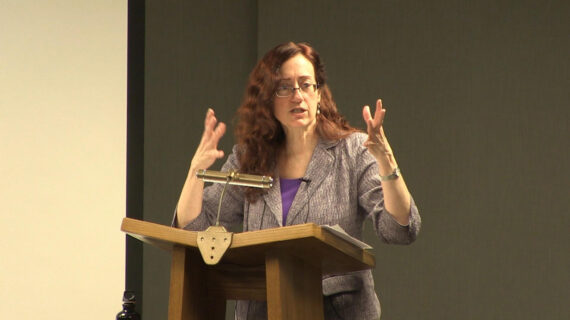
Martha Jones, Professor at the University of Michigan Law School, discusses birthright citizenship for free African Americans before the Civil War and shares the story of African American activist George Hackett.


Copy and Paste the Following Code to Embed this Video:
Race and Citizenship in Antebellum America
My name is Mitra Sharafi, and I teach here at the University of Wisconsin Law School. Professor Martha Jones is Professor of History and Afro-American and African Studies at the University of Michigan. She's also Associate Chair of the Afro-American and African Studies there. She is affiliated faculty at the University of Michigan Law School and Co-director of the Michigan Law Program in Race, Law and History. Michigan has a very dynamic legal history world, and this program is a wonderful example of that dynamism. Professor Jones holds a J.D. from CUNY School of Law. She has a Ph.D. in History from Columbia. Prior to her academic career, she was a public interest litigator and worked in areas including HIV and Disability Rights. She has been the recipient of many honors, including most recently in 2013-2014 a fellowship through the American Council of Learned Societies and the National Humanities Center. She's the author of many publications, and I'm not going to mention them all to you right now. But I will mention some of her books. Her first book came out with the University of North Carolina Press in 2007, and that was entitled 'All
Bound Up Together
The Woman Question in African-American Public Culture 1830-1900.' Last year, in 2015, also with UNC Press, she was the co-editor of a volume entitled 'Towards an Intellectual History of Black Women.' Now forthcoming with Cambridge University Press coming out in a year's time, Spring 2017, is her book, her new book entitled 'Birthright
Citizens
A History of Race and Citizenship in Antebellum America.' She is also at work on a memoir of her own family's mixed-race identity over two centuries and many generations, which sounds absolutely fascinating. Professor Jones is very good at speaking to a broader audience, and she's very active on social media as you can see from her Twitter handle on the screen in front of you. She's written Op-Eds that have appeared in 'The Boston Globe, ' 'The Conversation,' 'Huffington Post' and 'The History News Network,' amongst other venues. She also, I should say, has a wonderful website, her personal website which is connected to her faculty website. And so I highly recommend that all of you pay a visit to see-- get a better sense of all of the varied and fascinating work that she has done. Today she is presenting-- well, she has presented to us, and many of you will have read the pre-circulated chapter, Chapter 1, of her forthcoming book. The chapter is entitled, 'Navigating Free Black Citizenship,' but she's going to be speaking more broadly about the whole book project. So we're going to get kind of an overview, sneak-peak of this very exciting work that will be coming out in a year's time. And the title of her talk today is 'Citizenship
Before Birthright
The Puzzle of Free African Americans Prior to the Fourteenth Amendment.' Please join me in welcoming Professor Martha Jones. (applause) I was reminding Mitra that I was here, I think it was probably five years ago for a workshop where I presented some very preliminary chapters from this book. So there's really a great sort of symmetry for me in being here now at the end of the project because that meeting here, being part of really such an important history in our field, of legal history, being here five years ago really transformed this project. So I'm really honored to come back and talk to you about what, what I figured out since then. "Don't deport my Mom." Here is the sentiment of a child, a U.S. citizen, whose mother had been deemed a non-citizen alien. Today, in 2016, the terms of the 14th Amendment, that 1868 transformation that established birthright citizenship, threatens to separate this child from his mother. The image was on my mind-- this image was on my mind when I was preparing for today. And I heard in it echoes of African American activist Martin Delany writing more than 150 years ago. He was writing about free African Americans when he said, "We are Americans, having a birthright citizenship. Our common country is the United States. Here we were born, here raised and educated; here are the scenes of childhood; the loved enjoyments of our domestic and fireside relations, and the sacred graves of our departed fathers and mothers..." "We are Americans" by virtue of "having a birthright citizenship, natural claims upon the country, claims common to all our fellow citizens; natural rights, which may by unjust laws be obstructed, but never can be annulled." For Delany, constitutional thought was fused to intimate relations of family and of place. So Delany penned these words in 1852, more than fifteen years #*before#* birthright citizenship would be guaranteed by the Fourteenth Amendment. Why did Delany so emphatically insist upon citizenship? He and other free African Americans navigated a nation in which some argued that they were in effect stateless. This afternoon, we'll explore this experience through a lesser known chapter in the history of race, law, and citizenship, the ratification of the Constitution in 1787, and the adoption of the Fourteenth Amendment in 1868, are bookends of our odyssey. During the intervening eighty years, free African Americans faced a muddled circumstance. In response, they invented strategies for protecting persons and property before the law. As we'll see, citizenship sometimes appeared to be in hand, but then it slipped through their fingers. How precarious it was to live lives, raise families, build communities knowing that you might be summarily banished from the physical, from the political, from the legal boundaries of the nation, constitutions. Free black communities emerged out of the American Revolution. Freedom came by way of military service for some and by the acts manumission of revolutionary-- those who subscribed to revolutionary tenets for others. In northern states, court rulings and legislations gradually provided for the abolition of slavery. And by the 1790s, free black communities were permanent parts of cities from Boston to Charleston, from New York to Pittsburgh. Families and neighbors built churches and schools, fraternal orders, newspapers. They built an African-American public culture. Our guide today through this world, and the puzzle of citizenship that surrounded it, is the gentleman you've read some about, George Hackett. Born to free parents in 1807 Baltimore, Maryland, Hackett began his life uncertain about his legal status. He lived until 1870, long enough to formally be deemed a citizen of the United States. Still, Hackett spent most of his life navigating this troubled legal terrain. Neither slave nor citizen, he developed tactics for securing his status and that of his family. Many would deny him formal recognition. And still, as we'll see, Hackett seized the rights that citizenship was said to accord. Hackett was born into this puzzle that was race and citizenship. In 1807, the status of free African-Americans was unclear and largely unexamined. How were they viewed by law? The Constitution offered little guidance. That text was silent, generally, on citizenship, only distinguishing between, you'll remember free people and slave people and Indians. It never addressed the status of those who were, though descended from slaves, now free. The Constitution only gestured at the idea of birthright citizenship, that clause that provided "natural born" citizens were only those eligible to be President. The Constitution guaranteed the privileges and immunities of citizenship, but it did not delineate between who was a citizen and who was not. The Maryland state constitution, the state constitution that was profoundly pertinent for someone like George Hackett, was even more so silent. It did not use the word citizen at all when enacted in 1776. As a result, Hackett's father likely voted, as did other free African-American men, alongside whites early in his life. It was only in 1802 that Maryland's constitution was amended to limit the vote to free, white, male citizens over twenty one. Still, being deprived of the vote was not dispositive on this question. Men like Hackett would argue other citizens, white women and minors for example, were also denied the vote. In constitutional terms, as George came of age there was a great deal of room for interpretation when it came to citizenship and free African Americans. By the time George began his own family - he married in 1828 - the terms of race and citizenship was shifting.
He confronted economic discrimination
black men were excluded in Baltimore and in Maryland, generally, from skilled vocations.
State law imposed restrictions on
travel, the sale of staple crops, ownership of guns and dogs and public assemblies. Free men and women of color were said to be a threat to slavery's stability. Their example might lead enslaved people to refuse the discipline of bound labor. And, formal thinking about citizenship was becoming more complex. The state and federal constitutions remained unchanged. Still, interpretations, new interpretations came into play. One source was the colonization movement. The eighteen-teens saw the emergence of a movement that couched its work in anti-slavery rhetoric while advocating the removal of former slaves from the United States. Slavery would end, colonizationists explained, but never could the US prosper as an inter-racial society. They lobbied Congress and in Maryland quite successfully the state government for support and for the successful establishment of Liberia, a colony on the west coast of Africa. Some free African Americans did accept these inducements, but most, eventually objected colonization and their anti-colonization thought gave birth to organized African American politics. And as important for our story, really gave birth to organized and sustained thinking about citizenship and the Constitution on the part of black activists. Westward expansion also put free African Americans in a legal cross hairs as Congress debated, for example, Missouri's admission to the Union. It was 1821. Missouri was a slave state that proposed a constitution that mandated laws "to prevent free Negroes and mulattoes from coming to and settling in the State, under any pretext whatsoever."
Congress members asked
was such a prohibition in the state constitution some sort of abridgement of the Constitution's guarantee of the "privileges and immunities" of citizenship? The answer turned on whether free African Americans were indeed citizens at all. And the resulting debate is a fascinating one. It unfolds across days. Today it takes up scores of pages in the Annals of Congress. Many lawmakers took the view that free black people were citizens. As one Senator argued, "If a person was not a slave or a foreigner, but born in the United States and a free man going into Missouri, he has the same rights as if born in Missouri." Others saw no conflict in leaving Missouri to bar black migrants. In the end, Congress reached what was at best an awkward compromise. It let the proposed clause remain. At the same time, it admonished Missouri not to enact any law that would impair the rights of citizens from other states, including those of color. It was a modest affirmation of free black citizenship but really one that was quite muddled. So colonization cut against the view that free African Americans were citizens. It promoted this notion that they could be, if not forced, strongly persuaded, strongly urged to leave the United States. And the Missouri debates, on the other hand, fueled the view that they might in fact be citizens of the United States. In Baltimore, George Hackett had married, started a family,
tried his hand at a number of vocations
a waiter, a livery stable operator. We glimpse, I think, his ambition and drive that will take us through this story. He also experienced setbacks. His stable was washed out by a flood that killed his horses. And so as you've read, it's no surprise that George Hackett chose to go to sea. Historian Jeff Bolster explains that sea-faring was among the three or four most common vocations among free black men in port cities from Maine to Maryland. Going to sea was a strategy by which aspiring families sought to elevate their status. Unlike their white counterparts, black sailors were not transients seeking adventure. Black sailors sought to establish their respectability and their leadership at home through service at sea. Hackett served aboard this frigate, the USS Constitution, so aptly named for a book about citizenship. And he joined the Pacific fleet as steward to its commander between 1839-1841. He witnessed the ferrying of diplomats, along with weak efforts by the US Navy to suppress the slave trade. He visited new ports, receiving an education about race and citizenship, receiving a new perspective on how his experiences in Baltimore were linked to this sea change in the age of abolition in the Americas. Here he visits Havana, the gateway to the thriving, still thriving, sugar colony of Cuba; Vera Cruz, a free city in independent Mexico, Rio de Janeiro, Brazil's capital and a slave trading port. Seamen posed a unique set of questions about citizenship.
Some asked
could a free black man command an American merchant vessel when law required that only citizens could command such ships? And these kinds of questions draw actors like the Attorneys General of the United States into the debates over black citizenship. Attorney General William Wirt opined that free black men were not citizens and thus disqualified. On the heels of Wirt's ruling, southern states began to impose "Negro Seamen's Acts." that required black sailors remain confined aboard ship or in a local jail when in port. And at the same time, men like Hackett, free black sailors, along with their white counterparts, carried Seamen's Protection Certificates, certification from the federal government, the US government that they were, in fact, citizens-- documents that were deemed essential to, for example, resist impressment into the British Navy when they were at sea. So during Hackett's tenure on the Constitution, there are, again, these competing views. On the one hand, this view that he is not a citizen coming from Wirt, wearing the Attorney General opinion hat, and on the other hand the Secretary of State authorizing Seamen's Protection Certificates to men like Hackett. Hackett returns to Baltimore after the death of Alexander Claxton, the commodore of the Pacific Fleet. And we find him in 1844 back in that city. Likely, I imagine, and I can only imagine, likely still carried that Seamen's Protection Certificate, right, folded and worn. But as important I think, Hackett carries with him a new kind of legal consciousness that comes out of this experience serving the Navy and being part of the kind of legal culture that, that infused something like the Pacific Fleet. He had a new perspective on race and rights. And Baltimore, when he returns, presents him with new challenges. There's been an in-migration, important, in-migration of German and Irish laborers, new spate of black laws. But he persists. He's an entrepreneur of sorts. He becomes a coal dealer. He becomes a property owner. He becomes, following in his father's footsteps, a leader in the city's Bethel AME Church. And still, Maryland lawmakers are asking the sorts of questions that had puzzled Congress members that had left federal officials a bit unsteady. Maryland seeks to adopt a new constitution in 1850, and they, too, become embroiled in the seeming unresolvable question about free black citizenship. So here the debate turns for Maryland constitution framers on a proposal to guarantee security to "free men" in their persons and their property. Sorry, and I'm going to move us forward. That's the Baltimore city courthouse here. So here, for some of these drafters, this provision seems at odds with another proposed provision in the constitution that authorized the removal at will of free people of color from the state. Lawmakers clashed over many, many days again. Some proposed that black Marylanders were freemen, but not citizens. Others argued they were "denizens," always subject to the power of the state and without rights. Some advocated that free people of color needed "legal protection," while others took the view that only if such persons first conducted themselves unpeaceably could their rights be violated.
A former Speaker of the State Assembly insisted
when "a human being, native, or foreigner, white or black, bond or free, sets his foot upon our soil, he is under the protection of the laws." And they could not reach a consensus after eighteen months. Thus, the final text of the Maryland constitution guaranteed to "free men" security in their property and persons, this included free black men and women. But it also allowed the state legislature to pass "all such laws for the government, regulation and disposition of the free colored population...as they may deem necessary." Once again, free African Americans were accorded constitutional protections, and they were subject to an exception that seemed to make them, at will, vulnerable to removal or banishment. Also in the 1850s, courts entered this debate quite pointedly. The Dred Scott decision is a familiar one to many of you, I'm sure. If you'll recall, Scott, an enslaved man in Missouri-- or a man alleged to be a slave in Missouri, seeks to challenge his status in Federal court. The US Supreme court will conclude that he has no standing in federal courts because he is not a citizen of the United States. And for good measure, Chief Justice Taney will opine that no black person, free or enslaved, can be a citizen of the United States. Maryland's high court took another view the next year. In the case Hughes v. Jackson, Maryland's high court was asked to adopt the logic of Dred Scott to refuse free African Americans the right to sue in state courts. And in that decision Chief Justice John Carroll LeGrand acknowledged that while race or blackness did indeed impose some legal disabilities on black Americans, it would not, in fact it could not, in Maryland, bar them from access to the courts. Why? LeGrand says, "Why? Because there are upwards of 75,000 or 80,000 free African Americans in this state, and it is not possible to imagine a regime in which we relegate them to outlaw status. We rely upon their labor, and they will not labor if they don't have the capacity to come into these courts and to protect their properties and their persons. So here Dred Scott is the case we know most about, but on the ground or closer to the ground in Maryland, high courts are taking an opposite view and guaranteeing to free African Americans a place in the courthouse. So back in Baltimore, George Hackett is well aware of these decisions. He's a regular figure, at the same time, in the city's local courthouse long before high courts determine his right to be there. And I'll give you just a few examples. In the summer of 1844, Hackett was assaulted by a man named John Pitts. I can't tell you what transpired. These are the kind of shard-like records of the criminal court that have survived. But what we do know from that record is that when he was assaulted, Hackett went to the courthouse and sought a remedy. He secured the assistance of a watchman. He charged Pitt with a criminal offense. Did he have an expectation of satisfaction? Well if he did, he got it. Pitt was tried, found guilty and fined a customary $1, plus court costs. Hackett had sworn out a complaint, proffered testimony against a white man, and won a modest satisfaction. Baltimore's Bethel Church was often mired in controversy with Hackett at its center. In 1849, Hackett stood accused of a staging a sort of coup within his congregation, a battle over church finances. He countered strongly that he and his comrades were merely looking to secure the fiscal propriety of the church. But behind the scenes, he worked quite sophisticatedly to influence the court outcome. He masterminded a petition signed by more than 300 members of the congregation, a lengthy, really beautiful scroll that he submitted to the court in support of his position. In the end, the court didn't deem that relevant. But, Hackett's faction did prevail in their right to represent the congregation. And again, here Hackett demonstrates his capacity to use the court to further, not simply his individual interests, but his interest in institution-building in a city like Baltimore. And he does it with great sophistication. Hackett, I mentioned, becomes a coal agent. And for a short time he was relatively prosperous. Still, he depended upon a risky associational economy in Baltimore. And he stumbled, as did many, after the panic of 1857. We find him back in the courthouse in 1859 filing an insolvency petition. It tells us a lot about the world that he had constructed. He was a debtor owing some $880 to a panoply of 15 creditors. But he was also himself a creditor. And he accounts to the court for the $1,100 that are owed to him. To file insolvency, Hackett has to secure, as he does, two white men who agreed to serve as trustees. The three appeared before the insolvency commissioner, and Hackett is given access to the full privileges that insolvency afforded. His obligations were forgiven and his personal property-- the modest furnishings of his home- were preserved. And I think, most importantly, his reputation and his ability to continue to be an effective agent, right, of his own economic well-being was restored. So here, I think we get to glimpse the way in which this capacity to sue and be sued turned out for Hackett to be a
critical tactic
one that refuted the notion that free black people were without rights. Hackett acted to protect his person against assault, his property against debtors, his reputation and public authority against opponents in Bethel Church. The state had not moved to abrogate those rights and banish free African Americans from Maryland, at least not yet. The politics of 1859 transformed Hackett. He was drawn beyond the local courthouse and confronted lawmakers in the state capital. Why? John Brown's October 1859 raid on Harper's Ferry, Virginia, rippled through southern states. In Maryland, the attempt by Brown and his comrades to incite a slave uprising fueled a strong strain of "anti-free Negroism." And a small group of Maryland lawmakers drafted the most draconian black laws the state had ever known. The so-called Jacobs bill, proposed to enslave free people of color, and in the process, deprive them of their property. The prospect of such legislation led some to flee the state. Others, like George Hackett, planted themselves firmly and prepared to fight. Hackett's organized. And remember that church petition strategy that he had developed years before in the battles in Bethel Church is now the one he takes up as he attempts to defeat the Jacobs' bill. He takes a petition signed by hundreds of free black Marylanders to the state capitol.
And they pressed there for what they termed expressly as rights
rights that barred the state from banishing them and enslaving them. Hackett confronted the bill's author and did not waiver. And this is, I think, an apocryphal story about how he actually winds up in a fist fight with Jacobs over the bill. I'm not sure that's right. But I am sure that what he did convey to Jacobs, and this is his language, was a demand for his "Constitutional and legal rights." The passage of the proposed legislation, Hackett explained perhaps quite animatedly to Jacobs, would have been "a great wrong and injustice to
free African Americans
And they pressed there for what they termed expressly as rights
as a body." And finally, a coalition in the legislature defeated the bill. Hackett's approach had shifted from the subtlety of claims in the local courthouse to confronting lawmakers directly. Banishment had always been a threat, and the Jacobs' bill put it front and center. The resulting crisis made clear that without citizenship, free black Marylanders were vulnerable to the sort of exile that constitutional silences, colonizationist schemes and high court disagreements left room for. Looking backward, we realize that Hackett was fully engaged in the one of the critical challenges of the Civil War and
Reconstruction Era
how did former slaves, how did free African Americans stand before the law? From Hackett's perspective, Civil War era debates about race and citizenship must have been both familiar and remarkable. The questions he had taken seriously across a lifetime were now being decided by lawmakers in Washington. And with this we enter what is oftentimes held out as the starting place for the history of race and citizenship. In the summer of 1862, Abraham Lincoln's Attorney General Edward Bates confronted the question of free black captains of coasting vessels. Federal law required, as you've heard, that they be citizens, but Bates stepped in to clarify in a very lengthy treatise on
the subject
"every person born in the country is, at the moment of birth, a citizen...as recognized by the Constitution...and without any reference to race or color or any other accidental circumstance." Free black men would work the waterways as citizens of the Union during the war. George Hackett, the former sailor, knew well the stakes in such a ruling. Congress would enact the first Civil Rights Act in 1866. It defined citizenship and there was birthright,
echoing Martin Delany
"...all persons born in the United States and not subject to any foreign power, excluding Indians not taxed, are hereby declared to be citizens of the United States... without regard to any previous condition of slavery or involuntary servitude."
The act explicated the rights of citizens
"to make and enforce contracts, to sue, be parties, give evidence, inherit, purchase, lease, sell, hold and convey real and personal property, and a right to the full and equal benefit of all laws and proceedings for the security of person and property, as is enjoyed by white citizens." I think here we can imagine Hackett nodding upon reading the Act. These rights, now termed 'civil rights,' were precisely those that he had taken up for many years before in the Baltimore City courthouse. When the Fourteenth Amendment was adopted in 1868, Hackett, and the many other free black Americans who had long strived for belonging, belonging that shielded them from exile and guaranteed them security for their families, their homes and their labor- they must have paused to look back over the years since the ratification of the Constitution to regard the troubled journey that had taken them, finally, to citizenship. But Hackett in turns out didn't pause at all. He didn't wait for the Civil Rights Act or the Fourteenth Amendment before assuming a new sort of belonging in Baltimore City. At the war's end, Hackett could be found leading the local militia, Butler's Guard, having been designated captain of the all black unit comprised of mostly Civil War veterans. Hackett pressed for school reform, condemning separate schools for black and white children in Baltimore City. His interest in politics surged. Hackett joined a local Republican Party club and openly campaigned for black voting rights. In 1869, as black Baltimoreans planned a grand emancipation celebration to mark five years of abolition in Maryland, Hackett was selected as the grand marshal. Yes, he had been recognized or he was being recognized for the kind of leadership, the kind of inchoate, modest, but powerful leadership that he had exercised in the Antebellum decades. Citizenship might be measured by legal pronouncements, but Hackett was busy pushing beyond civil rights to political rights and imbuing the abstract notion of citizenship with meaning on the streets and in the meeting halls of Baltimore. We might say that there are many ending points to this story. Indeed there are dramatic chapters that follow,
though not in my book
the abandonment of Reconstruction, the rise of Jim Crow, the modern Civil Rights movement, the election of Barack Obama. Throughout these subsequent moments, African Americans faced profound challenges, but statelessness was no longer one of them. So I want to close with another vantage point on the question that we began with. What might a nation look like when it creates a class of persons who are outside of law; a class of persons with no relationship to the state? The Fourteenth Amendment answered one question. African Americans were citizens by virtue of birthright. But as historian Linda Kerber has chronicled, the problem of statelessness did not disappear. Such a history requires that we interweave the stories of African Americans with those of Native Americans made citizens by compulsion in 1924; Mexican Americans made citizens by treaty; noncitizen nationals, Filipinos, Puerto Ricans, Virgin Islanders, and still today those born in American Samoa and Guam; and, Asian immigrants who faced long decades of exclusion that barred their naturalization. Today in debates over citizenship and immigration, some advocate the repeal of the Fourteenth Amendment's birthright guarantee. The Fourteenth Amendment is up for debate in what my grandmother used to call "polite company." As we confront these debates, history cannot offer a blueprint. It is not an analogy; it cannot determine our course. Still, the history of free African Americans is a cautionary tale about how a nation can create a category of persons who are outside of the law and have questionable, at best, recourse to it. How can a nation rely upon a community's labor, be home to the emergence of families and the development of a pubic culture, and still fumble citizenship? We should not be surprised that such persons make a way out of no way and craft strategies and tactics to gain what they can to protect their persons and their property and avoid exile and banishment. It is, as we now know, what George Hackett did nearly two centuries ago. Thank you very much. (applause)
Search University Place Episodes
Related Stories from PBS Wisconsin's Blog










Donate to sign up. Activate and sign in to Passport. It's that easy to help PBS Wisconsin serve your community through media that educates, inspires, and entertains.
Make your membership gift today
Only for new users: Activate Passport using your code or email address
Already a member?
Look up my account
Need some help? Go to FAQ or visit PBS Passport Help
Need help accessing PBS Wisconsin anywhere?

Online Access | Platform & Device Access | Cable or Satellite Access | Over-The-Air Access
Visit Access Guide
Need help accessing PBS Wisconsin anywhere?
Visit Our
Live TV Access Guide
Online AccessPlatform & Device Access
Cable or Satellite Access
Over-The-Air Access
Visit Access Guide




Follow Us