

 Passport





Preserving Native Languages in Wisconsin
08/25/15 | 43m 5s | Rating: TV-G
Monica Macaulay and Rand Valentine, Professors, Department of Linguistics, UW-Madison, explore the history of Wisconsin Native American languages, discuss the decline in use of the languages and describe the revitalization projects working to bring back the Ojibwe, Menominee, Potawatomi, Hocak, and Oneida languages.


Copy and Paste the Following Code to Embed this Video:
Preserving Native Languages in Wisconsin
Welcome everyone to We dnesday Nite @ The Lab. I am Fiona McNamara. I'm a undergrad school here at the UW. I work for Thomson who works for the UW-Madison Biotechnology Center.
We do this every Wednesday night, 50 times a year here at the UW Biotech Center on UW-Madison. And it's my honor to introduce to you Monica Macaulay and Randal Valentine. Monica Macaulay is from Madison. She went to college and graduate school at UC-Berkeley.
After she was done at UC-Berkeley, she taught at Purdue University, which is in Indiana. Upon which then she decided to come back to Madison and teach at the UW, which she has been for 20 years now. Rand Valentine is from St. Johns, Newfoundland which is on the east coast of Canada.
He is both a Canadian and U.S. citizen. He went to University of Oregon to study linguistics and then went to University of Austin Texas to get his PhD. In 1994 he came here to UW-Madison to do linguistics and Native American studies.
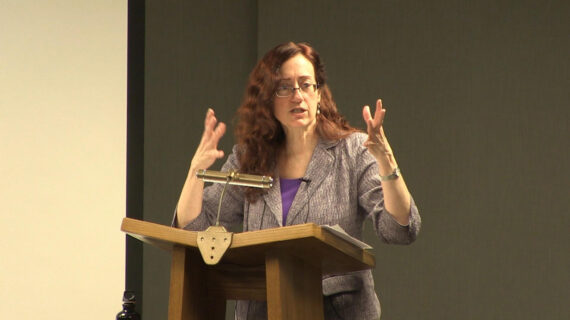
He is now the Director of Native American Studies and he has taught in both Canada and the United States. Please welcome in welcoming Monica Macaulay to Wednesday Nite @ the Lab. (audience claps) The title of our talk is Preserving and Promoting Native Languages in Wisconsin. And in order to contextualize the situation in Wisconsin, I'm going to start off by telling you a little bit about the global picture, about what's going on all over the world.
So as you can see from this website which I picked completely at random, just because I happen to be the President of the Endangered Language Fund. (audience laughs) You'll notice that it says there are currently 7,000 languages spoken in the world and at least half are projected to disappear in this century. The Endangered Language Fund is helping to stem the tide. So this 7,000 number, it's an approximation, we don't really know the exact number, but people always ask, at least I've found in my experience, people always ask, well how many languages are there and how many are endangered and what's the situation?
So let's take both of those questions, How many languages are there now? Probably between 6 and 7,000. How many will be lost? Well the estimates are that between 50 and 90% of the world's languages will by lost by the end of this century.
So even the very optimistic view is that we will lose half of the world's languages. So, one thing that often gets asked is, don't all languages die eventually? Isn't that just a natural part of the evolution? They rise up, then they fall down, it's a natural thing.
Here's a quote from the late Ken Hale from 1992. He says, "Language loss in the modern period is "of a different character than before, "in its extent and in its implications. "It's part of a much larger process of loss "of cultural and intellectual diversity "in which politically dominant languages and cultures "simply overwhelm indigenous local languages and cultures. "The process is not unrelated to the simultaneous loss "of diversity in the zoological "and biological worlds." Why is this happening?
Well, one linguist, Stephen Wurm, describes it as a change in the "ecology of language". And he says just as with species, changes in the alteration in their habitat can cause loss of species. And alteration in the cultural and social settings for languages can cause loss of languages. Another big factor is the introduction of a more powerful competitor just as it is with species.
And you can imagine what those more power competitors would be, I'm speaking one of them to you now. Of course Chinese, Mandarin Chinese, is the biggest and then you sort of go down the list of the world's major languages. So moving a little bit closer to home, narrowing it down to North America, I think most of us know about the history of this country and the kinds of atrocities that were committed, about the diseases, the wars, the various removals that native people underwent in this county. One thing people often don't know about is the era of the boarding schools, also known as residential schools.
And, these were-- Here let me just add this, yeah. These were started-- Richard Henry Pratt is known to be sort of the main founder, I think there were schools before Pratt started his, which is called the Carlisle School, which was established in 1879. But this was really the big one. This was the one that kind of really started the boom and was followed by many many many others.
Richard Henry Pratt was a lieutenant in the Army, and his idea was basically that he would bring native children from all over the country to his school and subject them to a kind of military discipline. And they would have their hair cut, they would be put into gender appropriate clothes of the period for children, and they would be put into school, and they also had to work for their keep at the schools. And these were really extremely harsh conditions for the kids. So here's a picture of some of the students at the Carlisle Indian Industrial School, which is the full name of the Carlisle School.
And you can see all the little kids there. So it was huge. I mean, it was really a lot of kids. The different schools went on for about a hundred years.
The whole span of it is close to a hundred years. And often children were taken either against their will or against their parent's will to join these school, and this had a very, very major effect on language. So, let me read you something about this. "By 1900, thousands of Native Americans were studying "at almost 150 boarding schools around the United States.
"The US Training and Industrial School founded in 1879 "at Carlisle Barracks, Pennsylvania, was the model "for most of these schools. "Boarding schools like Carlisle provided vocational "and manual training and sought "to systematically strip away tribal culture. "They insisted that students drop their Indian names, "forbade the speaking of native languages, "and cut off their long hair. "Not surprisingly, such schools often met fierce resistance "from Native American parents and youth." And there's a very, very famous quote from Richard Henry Pratt that summarized why he thought that this was something that ought to be done.
He said, "All the Indian there is "in the race should be dead. "Kill the Indian in him and save the man." So you can see his approach there was he felt if he could eradicate everything that was Indian culture in these children, then he would educate them and they would be able to go out in the world and be great successes, and this would cure what has been known at various times in our history known as the Indian problem. And, of course, that involves poverty and starvation and a lot of things like that. So, you know, that was the motivation for him doing something like this.
Just to show you a picture from some of the residential schools and also to point out that this was going on in Canada as well, here's a picture of a boy who, on the left it says as he appeared when admitted to the Regina Indian Industrial School, and then right, the right-hand picture is after he's had his hair cut and he's put into his little uniform and everything. Another thing that was going on was religious suppression, and I am going to turn things over to my colleague Rand Valentine here at this point. Well, the point of this is simply that we see with the residential schools, I mean, Monica, perhaps I want to reiterate the point that children were not allowed to speak their native languages. They were punished, typically, if they did, and quite severely at times.
So that was one aspect of the cultural oppression that American Indian people faced. But there was also massive religious suppression, and many of their religions were outlawed. This is very, very important to language as well because, of course, these ceremonies are in the languages and to suppress the religion suppresses the language. It was just a massive cultural suppression.
And we see this, I was at Devil's Lake not long ago, and it puzzled me that why would this beautiful lake be called Devil's Lake? And I thought, well, there are many places around called Devil such and such that if you do a bit of study, you'd discover that's the word for spirit in some Native American language. So I asked my Ho-Chunk friend, Cecil Garvin, about this and he said the Ho-Chunk word is Teewakacak, which Tee means body of water and wakacak means spirit, or so Devil's Lake in Ho-Chunk is translated as "spirits exist there". And so we see this, but you could see just from the way that any spiritual aspect of Native American culture was interpreted as devilish and demonic and that sort of thing, and this is part of that suppression.
Okay, so we see that these, all of these things harmed individuals, physically, psychologically. Massive damage to languages and cultures, and if you think about even a language like English, if you break the chain of speaking one generation, it's gone, you know, it's gone. The language is gone. We can read it on a page, but the language is going to be gone as spoken.
It takes one generation. So you can have a language going for thousands of years. It goes generation by generation from parent to child, parent to child, parent to child. Break that link and it's gone.
And that was one of the real travesties of the residential school system because these kids were so troubled even in their language usage. Imagine if every time you spoke English you were punished. What would your attitude be about this language? So, there was just a massive amount of damage.
Some people forgot their languages. Other people had such psychological issues speaking them that they tended not to, they tended not to teach their children. When they had their own children, they wouldn't speak the language to them often. So this was massively bad.
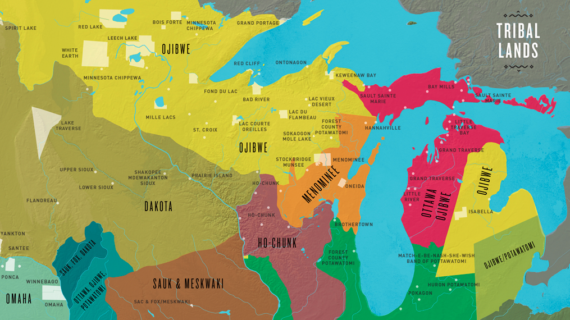
Okay, let's shift to the state of Wisconsin since our talk is about preserving and promoting languages in Wisconsin. It's important to realize that the aboriginal languages in Wisconsin, many of them are spoken in other places. For example, I work with Ojibwe, and it's spoken over a massive area from Quebec to Alberta in Canada and Michigan, Wisconsin, Minnesota, Montana in the states. But let's just go through.
We have the Ho-Chunk Nation, Bad River Band of Lake Superior Ojibwes, Lac Courte Oreilles Band of Lake Superior Chippewa, Lac du Flambeau Band of Lake Superior, Red Cliff Band of Lake Superior Chippewa, Sokaogon Chippewa, St. Croix Chippewa. All of these, other than the Ho-Chunk, are Ojibwe. Then we have the Forest County Potawatomi Indian community, Stockbridge Munsee Band of Mohican Indians, Oneida Nation of Wisconsin, and the Menominee Tribe of Wisconsin.
So quite a few. That's the most number of tribes of any state, I believe, east of the Mississippi River. When we look at these linguistically, what we discover is that some of the languages are related and others are not related. So, several of the languages belong to what's called the Algonquian family.
That includes Menominee, Ojibwe, Potawatomi, and Mohican. The Siouan family is represented by Ho-Chunk, previously called Winnebago, which is an Algonquian word, and the Ho-Chunk prefer to be called what they are called in their language, so they prefer Ho-Chunk. And the Iroquoian family Oneida. Now, when we look at these families, what we're talking about is when we, let's just go back here.
What these four languages that are Algonquian, the reason they belong to this Algonquian family, we can figure this out linguistically, and I'll show you just a tiny bit of how we do that. But the basic idea is that all four of these languages come from the same original language long ago. Whereas, Ho-Chunk comes from a different original language unrelated to the original language that the Algonquian languages come from and Iroquoian as well. A different language unrelated, very, very different.
I mean, people often say as different as English and Chinese are. I'm not sure about that, but very, very, very, very, very different. Unrelated in a way that we as linguistics cannot readily relate them. Well, how do we know which languages belong to which families?
Well, we simply look at words, common words especially. Words like basic numbers, body parts, things that you're not likely to get from another language as opposed to a word like radio, which you might get from another language. But we can look and we can see the word for "two." In Menominee it's nis. In Ojibwe it's niizh.
You notice the similarity there, right? They both start with an N, then they have kind of an E sound, and they end with sounds that seem somewhat related, sa and ja, right? Whereas,
look at Oneida
tekni. See any relationship there? None, right?
Look at Ho-Chunk
nuup, nuup. Right? So we can go through. So we see, ah-ha, something is going on with Menominee and Ojibwe.
They seem related here. Their words are related. Then we look at four. In Menominee it's niw.
In Ojibwe it's niiwin. Again you can see a similarity, right?
But look at Oneida
kay . Right? Joop in Ho-Chunk. Totally unrelated, right?
And then water. Nepew, nibi, we can see a relationship. Ohne-ka and nii. Kesoq, this q is what's called a glottal stop.
Giizis in Ojibwe. But by doing these sorts of comparisons sound by sound, we can start with the N in two and then we can go to the vowel and then we can go to the third consonant, to the third sound, consonant we can pretty much figure out actually what the word probably sounded like in the original language. We can be that confident about this reconstruction. But, obviously, there's no way we can get from Oneida to Menominee and Ojibwe, and that's why we say these are related and unrelated languages.
And when I say unrelated, I mean really unrelated, right? You can see that. Okay, so I'm going to talk a little bit about Ojibwe here. Ojibwe is considered among the most likely Aboriginal languages of North America to survive for very long, mostly because of the large number of speakers in Canada.
But you can see here, these are stats from 2009 collected by Ojibwe people. So they're quite reliable. And you can see the numbers for the communities in Wisconsin. St.
Croix 25, Lac Courte Oreilles 10, Lac du Flambeau 3, Bad River 2, Red Cliff 1, Mole Lake 1. So that's what? 25, 35, 40, 42 speakers of Ojibwe remain in the state of Wisconsin. More in Minnesota.
400 at Red Lake. But you see these numbers are very, very, very low, and in many of these communities, the language is not spoken as a language of common usage, obviously. But people are working very hard, and what I want to talk about here is many, many communities are going to programs of immersion where kids are educated in schools that are wholly in Ojibwe. This is a massive undertaking.
And I'll show you a little bit of what issues are involved. But there's a school in Hayward called Waadookodaading, which basically means helping each other, and this is an Ojibwe immersion school. It's been very successful due to the phenomenal efforts of the fiercely dedicated teachers. Here's Lisa LaRonge.
Her husband also, Keller, is involved in this school. And I just want to show you a little bit of what's involved. When you have, when you develop a curriculum for education and you have to pass all the requirements of the state of Wisconsin, you have to teach certain subjects. Many of these subjects do not have vocabulary in the traditional language.
So you have to come up with a complete curriculum. You have to invent many, many words in your language to deal with that curriculum. So people are undertaking these beautiful projects. Here's one project that was done in Minnesota and northern Wisconsin, and they produced a vocabulary book to help teachers in immersion schools.
And the title of this is Aaniin Ekidong. "How does one say it?" Right? And they gather together, a bunch of very fluent elders. You can see the group of people in this picture.
These young people. Lisa is there, Keller, her husband is there. Linguist John Nichols over in the back on the far right. He just retired from the University of Minnesota.
They work together to study both traditional vocabulary and coin new words that were needed for their educational curriculum. Here is just a couple of examples. I just took one page out of this book. But we can see, I love the fourth one down.
See what that is? That's the at sign, right? In your email address. You need a way to describe that.
So they've come up with abibii'igan. We have condensation, right? Abwebiig. Because obviously this is something that you teach when you teach science and that sort of thing.
And the richness of the language allows you to have things like you see abweyaabikad right up there. Condense on glass or metal because that's because Ojibwe has a classifier system that classifies things into organic solids, inorganic solids, sheet-like objects, string-like objects, etcetera. And so you get these really fascinating words. But things like this, (speaks Ojibwe).
You need to be able to distinguish lower case, upper case, in your language to talk about, to have a basic curriculum. You basically just have to produce a massive amount of vocabulary, design your curriculum, teach it. Imagine doing that. You really have to be very, very dedicated, and these people are and their schools have been successful.
Okay, another project that many people have been working on is the Ojibwe People's Dictionary. We're now going digital. This is another massive project done, again, mostly by people in Wisconsin, I mean in Minnesota, but also people in northern Wisconsin. This is a digital dictionary.
It's online. You can Google Ojibwe People's Dictionary and go there and take a look at this. It's very beautiful, tens of thousands of words, and they have things like, I'm not going to play anything here, but they recorded many, many elders pronouncing words so you can get the pronunciation of words. They give various inflected forms.
Languages like Latin and Greek you may be familiar with, they have what are called inflections so you put prefixes and suffixes on to indicate first person, second person, subject, object, etcetera, etcetera. Well, these languages have very, very rich inflectional systems, and so they give many of these. They even go so far because Algonquian words tend to have more than one meaning component. And so when you learn a concept like run in English, you just learn this word run, but in a language like Ojibwe it's actually a part of a word, ose.
I mean I'm talking about walk. I'm sorry. My example is walk. Walking you use ose to indicate walking and bim is along.
So this word bimose that means he or she walks along, actually has two parts. And this dictionary goes so far as to analyze words, and we can see all the words that have to do with walking, put them together. So all of these words end with ose. Animose means to walk away because anim means going away.
Aagimose means to walk in snowshoes. Aagim is a snowshoe. These are really cool words, are they not? (speaks Ojibwe) That means to walk along on a sandy surface in such a way as to be audible.
(audience laughs) Okay. And this is a beautiful language, is it not? But each of these pieces, along, sound, sand, walking, right? So a learner of these languages doesn't simply learn this long, long word.
I mean, obviously you have to, but it's very, very useful to know the parts and learn the parts so that when you see (speaks Ojibwe) inside a word, you know that means sand. And so a lot of our work, our linguistic work, is doing this kind of analysis and making it available for people to use for their own resource in their language programs. Another issue, I mentioned briefly that these languages have rich inflectional systems. I've made a dictionary that will produce the Ojibwe inflectional systems for verbs, so you get basically all of the fundamentally basic forms of a given verb.
Now, Latin, you may know, was once considered to be the language. The old saying is the brain is a muscle, and the way you exercise it is with Latin inflections, right? And Latin has several hundred inflections, but Ojibwe has around 6,000 basic ones. So to learn this is a daunting challenge.
So what I did is I just wrote code to be able to produce for learners all of these different forms for any verb in this dictionary. And that's another way that we linguists can provide useful tools for people. There are many, many programs being carried out in the communities. One that's been around for a while is the master apprentice program used in many Aboriginal communities.
Basically you take a fluent elder and that person takes an apprentice and that apprentice spends much, much time with this elder constantly speaking the language and learning the language. Here we have Cecil Garvin, who also teaches Ho-Chunk, by the way, here at Madison. He is a fluent speaker, and his son Henning, who came to UW and got an undergraduate degree in linguistics and went back and has done a ton of work with Ho-Chunk. And Henning has become very proficient due to this apprenticeship he's had with his father, and he's really quite a good speaker now due to using this type of approach.
Of course, you need masters, right? You need fluent speakers who are able to take apprentices to be able to do this. Okay, another thing that's being done, you think about children, are they not little linguistic sponges? I'm sitting there trying to learn my new vocabulary word of the day, and if I'm lucky, I might learn 15 a year.
Children learn 5,000 a year, and they don't even have a book to help them. So it's a great opportunity for children to be exposed to the language. The Ho-Chunks especially have these daycare learning centers where elders work with the children and speak Ho-Chunk, and the children get the opportunity to learn the language. And they're really doing quite well with this as well.
Again, you need a lot of fluent speakers who are mobile and able to get out and run around with children. But if you have those, these sorts of programs are very good. Okay, further digital resources. Now this is actually just a screenshot of a dictionary that Mary Ann Corbiere, my colleague who is an Odawa speaker.
Odawa is a dialect of Ojibwe that's spoken in Michigan and the eastern shores of Lake Huron. Ojibwe exists in many, many dialects. So her dialect we have been working on for lo these 20 years making a dictionary. We're still not done, but here she is working away diligently.
We had just taken the ferry across from Bruce Peninsula to Manitoulin Island. We were on the ferry. Does she stop working? No.
That's the kind of dedication she has. But they are able now to put these dictionaries on things like an iPad. It's really wonderful. And the resources that we have, here is just a page.
We are able to give massive amounts of help. For example, we can give many, many example sentences for every word in the dictionary, and it's really a wonderful help to learners. Just to see a simple definition is often not enough, but being able to see lots and lots of examples is something that really helps learners, and digital has really opened this up to us. The problem with digital?
Everything you build lasts about, what? Three years, four years, and then everything's changed. So there's difficulty with that as well. Okay, another thing that I work on is related to Wisconsin because I told you that in the state here we have many Ojibwe communities, but Ojibwe is spoken over a vast area, as I told you.
Here are some of the communities. Only the two northernmost, Fort Severn and Weenusk Peawanuck, those are pre-communities, are languages related to Ojibwe. All of these other communities are Ojibwe communities. Many of them are fly-in villages.
So there's no road to get there. Typically, road spells the end of your language. You know? Because with roads come everything else.
But communities that are relatively isolated tend to have quite robust language. All of these communities have teachers in them. They have school programs. So in the summer, every summer I go to Thunder Bay, Ontario, which I hope some of you have visited.
A beautiful city. And I teach at a program that teaches the teachers from these communities and certifies them to be able to teach in their schools and have good programs. You see just from the little bit of Waadookodaading you know how much is involved in that. You've got to develop vocabulary, curriculum, you have to teach it.
It's just an incredible amount of work and challenge. So this is one of my groups. I taught three classes this summer. This is one of my groups from all over northern Ontario, and they speak different dialects, some of them not mutually intelligible.
They have different writing systems. Some of them write with Roman letters that you're familiar with. Others write with a special syllabic system that doesn't look anything like English. And so all of these people, I mean one of the issues that is dear to the hearts of, for example, these students of mine is that each of their communities has its own heritage and they have their own way of speaking and that's what they see as their heritage.
And so while you can use other materials from other places, your heart is really with your own community's language. So it's also important that people document their local languages, their local oral traditions, things like this. So part of the process is helping them to figure out ways to do that. Here we are.
Okay. -
Monica
But look at Oneida
Okay, so Rand has been telling you a fair bit about various languages that are spoken in the state. One he has not mentioned is Menominee, and I've been working with the Menominee on their language since about 1998. And so one thing that Rand was emphasizing about Ojibwe was that it's spoken over this huge area up in Canada as well as in the state of Wisconsin and also Minnesota. Menominee has a very different situation.
The Menominee reservation is kind of the only place where the language is spoken, and it is spoken by a vanishingly small number of first-language speakers at this point. The kinds of things that I do, one of them is known to linguists as documentation. And this is what a documentary linguist's bookcase looks like. And yes those are boxes of cassettes, in case you're wondering because I did start in 1998.
So I have, I mean this is only a fraction of the documentation that I've done. Another thing that I do just like Rand does, and this is kind of a common thing for linguists working with Native American tribes, is to do dictionaries. And this is the cover of the Menominee dictionary that I contributed to, that a group of us put out some years back. We've done, actually, a couple of dictionaries.
There was a beginner's dictionary, which is sort of like you would see for kids or something. Each word has a picture, and then there's an example of it and the plural of the word if it's a noun, that kind of thing. This one is much more of a standard bilingual dictionary. You can look up words in Menominee or you can look up words in English.
You may notice that this is not a digital dictionary. It's a paper dictionary. And that was actually the preference of the Menominees because a lot of people don't have computers, don't have easy access, don't have access to the Internet. We do actually have a companion site, and so there is an electronic version of it as well.
But it's been very important to have both paper and electronic to make it really accessible. Now, one of the things that I wanted to bring up is I wanted to mention something about what linguists can and can't do. There's a lot of rhetoric out there about, it's become my pet peeve, constantly there will be these articles in the papers, different papers all over the place, saying linguists help save language with two speakers left, or something like that. And linguists can do a lot, but we can't do it all.
We can help communities document their languages And so we record them, we make grammars of them, we work with the recordings, that kind of thing. We can help develop teaching materials. We can help work with people on methods, if we're trained in that ourselves. But we can't save languages.
And that's why I get very offended when I see that in the press all the time. Linguists are not the ones who can save languages. The ones who can do it are the language activists, that is members of the communities involved. And they're the ones who can do it.
Now, I'm afraid that when we talk about these kinds of topics, sometimes the message comes across as sounding very negative, when we talk about the languages are so endangered and everything. That same Ken Hale article that I gave you a quote from before actually has something that's a little bit more uplifting towards the end. He says, "It's important to counterpoise these realities "with another, more encouraging reality, "that of the great energy, courage, good sense, "and optimism which many endangered language communities "and allied support organizations are bringing "to the formidable challenge of ensuring "in this era a position of strength and dignity "for their linguistic and cultural wealth." Language activist is a term that hasn't been around for that long, I don't think, but it's definitely what we use now days to talk about people who have this incredible passion for their language. Like Rand's co-author on the dictionary that he showed you the picture of.
And what we're going to do now is we're gonna show you a very short video. It's just five minutes long. It's about Ron Corn, Jr., who is a Menominee language activist, and he's truly an amazing person. Now, the question is, can I do this?
I have to escape. (steady music) -
Voiceover
But look at Oneida
I first go around and plow my relatives out. A couple aunties and cousins. Then I have my, I call them brothers, you know? That's the way we say it in our language.
Our friends, close friends. We do things in a good mind and a good heart and a good way, and when we need that help, I guess we believe it'll come to us too. (children talking in background) What I'm doing is ensuring that the language goes a generation beyond myself. And I'm going to do that through my kids.
(speaking Menominee) I'm teaching Mimiqua the language using natural immersion. Natural immersion is you just talk about your day the way you would anything else, only it's being done in Menominee. I decided to stay home and teach her the language because it's my last unique opportunity to be able to raise a first-language fluent speaker. I think it's hard for her to want to speak because nobody else does, you know?
There's probably about eight people that speak. We'll call it 10. She's got 10 of 10,000. What's that percent?.001..001%.
So that's a reality check. The language, it could die. The idea that we're trying to preserve is a living language. (speaks Menominee) It lives.
(chants) Every little thing is gonna be all right for me and you Don't you worry about a thing Every little thing is gonna be all right (chants) (speaks Menominee) So there's words readily available for everything in nature. The word for falling snow is (speaks Menominee). The word for snow on the ground is (speaks Menominee). Crusted snow, (speaks Menominee).
We say (speaks Menominee) And the word snowflake is even different yet than both of them. We say (speaks Menominee) (Dad and daughter speak Menominee) The beautiful thing is it's that much easier in the woods because our language is really based on what's going on out there. How do we make that transition into today's life too, you know, because we're not always sugar and we're not always rice and we spend a lot of days at home, in the office, on the road, and we got to learn to express those things too, you know? The language has to make that transition if it's gonna be relevant and if it's gonna survive, you know.
When I was young, my first main teacher, she was starting to get sick and forgetful. One day we were just sitting at her house talking, and she tells me, "Now I can die," she tells me. "For 25 years," she said, "I tried to teach someone this language. "Now today I've done that." Then she continued on in Menominee.
She said, "(speaks Menominee)." She told me. She says, "You know, maybe you're going to be an old man "when you hear these kids talking our language." She said, "I love that. "Don't give up." So, I think that's just a really inspiring video, and I think it really captures the whole notion of what a language activist is incredibly well. His daughter, Miniqua, started first grade, I believe it was, last year, and he says that it's gotten a little bit more difficult because now she's surrounded by kids who speak English.
And this is very typical for a kid who's being raise bilingual for them to go through a period of rebellion and not want to use it and stuff. But he's going to continue speaking it to her. I also just wanted to mention that Ron himself is just a phenomenal speaker, and he's a second-language speaker. But the elder that he mentioned, that he talked about at the end there, he just from an early age decided he wanted to hang out with her, and she just spoke the language to him.
So she really did pass it on to him in a fairly natural way. And so this has just become sort of his passion in life. He's truly an amazing person. So, one thing you may be wondering then is, well, what can you do?
Can you do anything to contribute to this incredibly important cause? One thing you can do, there are definitely some things, one thing is you can educate yourself about the situation of the languages of Wisconsin and the world. You can visit websites of organizations like the Endangered Language Fund, which I told you about before. But there are actually a lot of organizations like that, and if you just sort of Google around on the web for a while, you'll come across many of them, and they have all sorts of information.
Get involved, try to educate others, promote understanding of the fragility of these cultural treasures. And another thing you can do is contact government officials and ask them to support language preservation and promotion. There are federal projects that are in place, and the state of Wisconsin also has some projects in place. There's a funding source that the tribes can tap into, if they've got a project they want to do with their languages, which I certainly hope continues to keep going.
So, with that, I'd like to say thank you very much for listening to us, and we'd be happy to entertain any questions you might have. (audience claps)
Search University Place Episodes
Related Stories from PBS Wisconsin's Blog




Donate to sign up. Activate and sign in to Passport. It's that easy to help PBS Wisconsin serve your community through media that educates, inspires, and entertains.
Make your membership gift today
Only for new users: Activate Passport using your code or email address
Already a member?
Look up my account
Need some help? Go to FAQ or visit PBS Passport Help
Need help accessing PBS Wisconsin anywhere?

Online Access | Platform & Device Access | Cable or Satellite Access | Over-The-Air Access
Visit Access Guide
Need help accessing PBS Wisconsin anywhere?
Visit Our
Live TV Access Guide
Online AccessPlatform & Device Access
Cable or Satellite Access
Over-The-Air Access
Visit Access Guide




Follow Us