

 Passport




Our Brain’s Addiction to Stories
04/07/16 | 37m 50s | Rating: TV-G
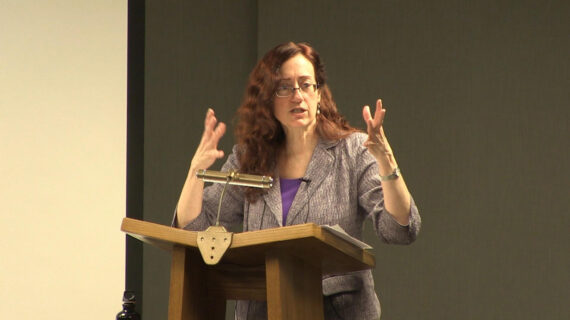
Indre Viskontas, Adjunct Professor of Psychology at the University of San Francisco, explains how the brain stores information and the physiology behind how memories are constructed.


Copy and Paste the Following Code to Embed this Video:
Our Brain’s Addiction to Stories
Thank you very much for coming. It is a great pleasure for me to introduce Dr. Indre Viskontas here to our seminar series at the University of Wisconsin. And you know, I'm gonna just make a few brief comments.
One of the things that I think is fascinating about neuroscience is it really distills the essence of what it means to be interdisciplinary. And I can think of no better example than this, than Dr. Viskontas. So this is an individual who studied as an undergraduate at the University of Toronto, getting degrees in French and in psychology, and then went on to get degrees in music and vocal performance from the San Francisco Conservatory of Music and a PhD in cognitive neuroscience from UCLA.
So this is a fantastically rich and diverse compliment of different disciplines and what we're gonna hear today is how these can all come together. Because really when we study the brain, we have to study it in all of its aspects, and whether we approach it from the standpoint of biology, computer science, computer modeling, if we look at single cells or entire organisms, if we study simple reflexes or higher cognitive processes, the essence is we need to use a very widely interdisciplinary approach and I think we're gonna hear a beautiful example of that today. We're gonna hear a talk about how our brain is "hooked on stories" and we're gonna hear a narrative on how to understand a fundamental way how human beings think at the highest cognitive level, but interwoven with a story about how the brain works. And with no further adieu, I will turn it over to Dr.
Viskontas. Thank you. Thank you very much. (audience applause) Thank you, and thanks again for coming.
Thank you to the public policy and neuroscience program for inviting me and Tara for organizing this visit so beautifully. So as you already know I wear two hats. On the one hand I'm an artist, an opera singer, I perform and I tell stories in that way. And on the other hand I'm also a neuroscientist.
I do research, I do science communication, and often people say to me, well those are such distinct careers, such distinct paths. How can you possibly do both? But ultimately both are after the same thing which is understanding what it means to be human. The difference is simply in the techniques that we use.
So as artists we use our individual experience to illuminate what's universal. As scientists we extract general principles that apply to everyone, but ultimately the goal is the same, to understand ourselves and our place in this universe just a little bit better. So without further adieu then, let's talk about how the brain actually works and how it accomplishes this very important and yet fundamental aspect of understanding ourselves. One of the foundational principles of brain function is that the brain is interested in searching for patterns.
We want to see regularities in the environment so that we can make sense of our chaotic world. It doesn't matter if that means how the climate is changing or how we interact with each other. We're looking for regularities. And in fact, our brain is adapted to err on the side of seeing a pattern where there isn't one rather than missing something meaningful.
So for example, anything that looks remotely like a face we will instantly see a face. We'll even see grumpy cat in the core of an apple, or a drunk octopus who wants to fight in a coat hanger, an owl in another fruit or any kind of face. Faces are extremely meaningful to us. They're extremely important to us and that's why our brain errs on the side of seeing a face when there really isn't one.
We do the same thing when we're trying to understand how different consequences happen from different causes. This, of course, is looking at stimuli as they pass through time. What causes one thing to do another thing. And just to illustrate this, I'm gonna show you a little video of shapes going around a screen.
They're just shapes, I promise you. And yet within a minute, you'll have constructed a story with a beginning, a middle, and an end, and some pretty distinctive characters. (audience laughter) So in a minute we have a very simple animation, but we already have a bully. We have characters that cooperate and protect each other.
We have a good guy and a bad guy and so forth. And it's just a series of shapes. We can't help but see the narrative in this sequence of events. So this brings me to another fundamental principle about the brain, which is how our memory works.
Most of us like to think of our memory as an accurate, vertical representation of what's happened in the past. But in fact that couldn't be further from the truth. We think about memory as say some kind of a file that gets written through encoding and then stored through some process of filing into the brain, and then when we want to get that memory back we just open the file and look at it and read it again. That's how we retrieve the memory.
But in fact, what's happening is that every single time we open that file and take out that folder, we have to rewrite it from scratch. And how we feel in the moment, what we believe politically or otherwise, all of the things that have happened in-between influence how we rewrite the narrative of that particular memory. So remembering is in fact a constructive process. It's not simply a process that happens passively as we record events in the past.
For a lot of people this revelation is a little bit frightening because then they start to worry about their memory and how they can trust it and so forth. But I hope to convince you by the end of this course that maybe this isn't why we adapted this particular way of remembering. Maybe there's something really fundamental and special about how we remember that is something that gives us one of the major advantages to being human. So let's delve a little bit more deeply into how this type of memory works.
Ever since I started being interested in storytelling, from the time I was a little girl, I was really interested in how we remember events in our lives, because essentially the way we identify with ourselves is through this memory of events that have happened to us. That's how we build our autobiography. It's how we build who we think of as ourselves. So for my PhD I studied the part of the brain that lays down new long-term memories of episodes that happen to us.
This is the medial temporal lobe, and in particular one part of the medial temporal lobe called the hippocampus. So let's look at what happens in this particular region of the brain and how it enables the laying down of new long-term memories for autobiographical episodes. So let's start with what's happening right now. You're listening to me talk and there's some perceptions that are coming into your senses, and of course your brain is doing a lot of stuff to those particular perceptions to help you understand and keep track of what's going on.
So those perceptions are going into the middle of your brain, for the most part into your thalamus where there's some processing, and then in the case of vision it's going to the back of your brain. And then from there it's going up into other parallel pathways that are doing a whole bunch of processing as you're encoding what is happening in this very moment. Ultimately it gets to other parts of your brain, and eventually this neural signature gets tracked by the hippocampus, and the hippocampus becomes what we call a convergence zone. So it actually keeps track of all the different parts of your brain that are coactive as you're having this experience.
That's the encoding process. The hippocampus is keeping track of that and it's essentially drawing a little map of the parts of the brain that are active now as you're having these experiences. This little map gets drawn in various ways and that's what we call storage or consolidation. Now let's say you've got that memory in that file drawer and you see me on the street sometime this weekend or in some other place.
I serve now as a cue for you to retrieve this experience, this experience that you're having right now. So seeing me gives you that retrieval cue. It goes into the back of your brain and ultimately other places, and finally it lands back into your hippocampus and it triggers this trace of the memory, especially as you're actively trying to remember where did I see that person before? She looks so familiar.
I just can't quite place it. Let me figure this out. Your hippocampus jumps into work and essentially it reconstructs what was happening in your brain while you were having this experience. This is that rewriting part.
And then it sends signals to those parts of the brain to become active again so you can have the sense of re-experiencing what you're laying down right now. So the fact that I was talking about the brain and it was the neuroscience and public policy seminar and so forth. Over time you might have this kind of re-experiencing a number of times. Probably not with me, but maybe with some other experiences that you have frequently, and so those experience can become consolidated and possibly not even need the hippocampus anymore to be reactivated.
But this is essentially how your new long-term memories get laid down for episodes. They're reconstructed and it's an active process. So what happens to individuals who have superior autobiographical memory? You know sometimes you meet someone and they say, "I can remember everything I did "from virtually every day of my life." It's very rare, but once in a while we meet such a person.
More often than not such a person is overconfident in their memories. In fact, we're not very good at understanding the accuracy of our own memories, and every time we get tested we get informed that in fact our memories are much less accurate than we think they are. Our confidence in our memories is not a good proxy for actually how accurately we remember the details. But there are a handful of documented individuals who do have superior autobiographical memory.
So I'd like to show you a quick clip from a 60 Minutes segment in which these particular individuals were documented. So let's see an example of a person with superior autobiographical memory. Let me give you a date. Let's say January 2, 1990.
Right now I'm remembering the jogging class that I started that morning. And you're actually back there. I'm, I'm, I can feel it. I can remember the coach saying, "Keep going." That was more than 20 years ago when she was 16, a date I picked completely at random, as I did this one.
February 18, 1988. 1988, oh. (laughs) You're laughing. - I'm laughing.
It was a Thursday. I had a big conversation with a friend of mine and that's all I'm gonna say. Louise says she can remember every day of her life since the age of 11. Try to talk us through, can you do that?
Sure. - How it works. Out of the air, April 21, 1991. 1991.
Okay, April 21st. So in the moment between April 21st and 1991, I had scrolled through 25 April 21st's thinking which one is it gonna be? Which one is it gonna be? Okay, 1991, which was a Sunday, and I was in Los Angeles and I had a concert with the American Symphony.
You went to the most thing that happened that day. Right, that was the most-- You probably don't want to hear about, start the day, okay, I got up in the morning and got dressed. And you remember that? - Yeah.
You remember what you had for lunch? Not what I had for lunch that day, but I do remember what I had for dinner the night before. So her memory is very different from mine. I can barely remember what I had for dinner three nights ago, let alone 10, 20 years ago.
There's something fundamentally different in the way that she remembers. And the question is yeah, really, how can we tell whether or not her memories are accurate? Well, we can test it. We can give her a series of dates and we can see to what extent verifiable events that she remembers are true.
Was that actually a Sunday? Was the weather in Los Angeles nice that day? Although that's kind of a trick question 'cause the weather's always nice in Los Angeles. But you know, there are sometimes when it rains and could she actually remember the days in which it rains?
So when psychologists have looked at how accurate these individuals are about their memories they've been extremely surprised. The dark bars there on the right show how accurate most of us are, which is not very accurate. On the basis of these 10 dates, it's the 10 dates quiz. On the first set of bars is the day of the week.
Then there's the verifiable events. Then there's some autobiographical memories. And then there's the total at the end. You'll notice that we're pretty poor at remembering 10 random dates, and yet these individuals are really pretty accurate.
Look at just the day of the week itself. They're almost perfect there. But even when it comes to other verifiable events, they're very accurate. So they really are remembering something very differently than we are.
The question here now is are they having a different decoding experience? That image that I showed you of what's happening in the hippocampus while they're encoding, while they're seeing the different aspects of this event is something fundamentally different happening. And we can test that by looking at how well they're able to encode information and whether it degrades in time in a similar way as it does with us. Do they simply have more to choose from to begin with?
Well, this next figure answers that question. So in yellow that's the data from the individuals with superior autobiographical memory. In blue it's the controls. And you'll notice that in terms of the number of details the controls remember, at one week they don't show any difference in terms of the number of details compared with individuals with superior autobiographical memory.
When we get to a month we see a stark difference. So what's happening in these individuals is not that they're encoding more information, but they're simply not forgetting it. Something different is happening in terms of the way the information is consolidated and how they're retrieving it, but not how they're encoding it. What's true for all of us is that we forget the vast majority of details.
In fact, forgetting curves show that within 24 hours we actually forget most of the details of the things that happen to us. And you know, here we are, the predominant part of our species, so that suggests that there's something maybe adaptive about forgetting. And of course a lot of psychologists are very interested in this, and I will tell you there are a few things at least that are adaptive about forgetting. But first let's keep thinking about these individuals.
So even after 10 years they do show some forgetting, but not very much. So can we see differences in terms of the physical structure of their brains or how their brains function that might give us a clue as to what is happening, why they aren't showing this forgetting. Well, in order to do that I need to introduce to you a couple of important brain regions. So first there's the prefrontal cortex which is the central executive.
It's the part of your brain that is involved in planning and initiating movement and all kinds of social interactions, the sort of very complicated human-like things that we do. Then there are your temporal lobes. That's where the hippocampus lies, in the middle of your temporal lobe, and the temporal lobes are really involved in sort of storing and then eventually remembering these details of events. In these individuals we see larger temporal lobes.
W also see big changes in another brain region called the caudate. And I want you to remember the caudate. We're gonna talk about the caudate a little bit, but one of the things that the caudate seems to be involved in is in some of the symptoms of Obsessive-Compulsive Disorder and also in skill and habit learning, it's the part of our brain that drives skill and habit learning. So these are the brain differences in individuals with superior autobiographical memory and controls.
Now the question is this brain region, the caudate, if it shows morphological differences in these individuals, what can that tell us about how they're engaging with their memories? Well, neuroscience really isn't of any interest at all unless we can see also changes in behavior. So just if I show you what happens in the brain, that's less interesting. But if I can show you how that brain change actually influences or co-relates with behavioral change, that's more interesting.
So let's see what happens in terms of the behavior of these individuals. -
Stahl
: And what about the fact that the caudate nucleus is thought to be involved in obsessive-compulsive disorder? The scientists think there may be just a hint there and exhibit A is Mary Lou Henner's closet. I love organization. I like my shoes a certain way, right foot going this way, left foot going that way, so you can always see the toe and the heel on every pair.
And you'll see that things are very color-coordinated here, but in sections. I always hang like with like and I always have the exact same hangers because then everything slides more easily. All of them have what we think of as OCD-like behaviors. They like to collect things.
They have to have things in just the right order. What about phobias? - Does hypochondria count? Like I hope I don't get this, I hope I don't get that disease.
And you have a little germ thing? I wash hands frequently, yeah. - So do I. In fact I dropped my keys when I was in a hurry driving down here and I went, "All right." So I went back in and like I wrapped, I washed them off, I ran them off.
Yeah, I do that. So there's some symptoms of obsessive-compulsive disorder in these individuals, as well. And in fact, if you look at how many details and how consistent they're remembering is, and you look at their obsessive behaviors, there's a pretty strong correlation. So in fact, these individuals are already approaching their memories in a fundamental different way.
They're kind of obsessing about them. And they talk about how they think about their autobiography all the time. They remember. They enjoy remembering.
They categorize their memories in the same way that they categorize their clothing in the closet. So if they start this behavior already at age 11 or so, or whenever these individuals can start this remembering, then you can see over the course of many years how this kind of obsessive remembering can fundamentally change a person's memory. So what are the consequences of this kind of obsession with remembering? Are they just better at all kinds of memory tasks?
Well, in fact, their not. They don't show any differences on tasks of what we call working memory, which is the ability to hold and manipulate information in mind. They don't show even changes in memory of other sorts, of sort of this kind of like visual memory and visual aspects and verbal aspects of remembering lists of words, for example. If they're not tied to their autobiography, they don't show a boost in their ability to remember.
And where we do see a deficit is in extracting the gist, the sort of fundamental pattern from their remembering. So when we look at their number of peripheral detail, so the top yellow circles are the superior autobiographical memory individuals, they remember more peripheral details. But when we looked to see over time whether they can still remember the gist, they actually show an impairment. So they're less able to remember the gist, which is arguably the most important information because that tells you what is the pattern that sticks around.
That's the forest for the trees. That gives you a sense of the regularities in the environment. And if you get too stuck up on these details, then you don't actually get this overall gist, this overall pattern. Now we know in terms of our own storytelling that what we remember is the gist, not the details.
In fact, when we ask people to repeatedly tell the same story again, it's the gist that remains, but the details can change pretty drastically. We can even see this in people's rememberings of drawings. So here's a very famous study of an original drawing and then all the different instantiations. The gist is kind of there, but even the actual subject of the drawing is changed over time.
So our stories change with each retelling. We can see this also in individuals who have other kinds of memory impairments, so one test of memory is the Rey-Osterrieth Figure. So first what individuals have to do when given this test is copy the figure. So we first have to see do they have the visual-spacial skills to do the copying.
And then we have them do something else for about 10 minutes, and ask them what they remember about this figure. And for the most part, most of us who don't have a memory impairment will remember not all the details, but certainly at least some aspects of the particular figure. But what if you have Alzheimer's Disease? And now you have trouble turning short-term memories into long-term memories, so you don't really remember much about this particular figure 10 minutes later.
What you remember is the gist. And the question is how do you then categorize that gist? What do you do? Well, in some patients with Alzheimer's Disease, they'll actually make something meaningful out of it.
So you'll see at the top rows in both sides you'll see their copying. So they do show some visual-spacial problems, but they're still in this early stage of Alzheimer's okay. But what they remember is something meaningful to them, often faces or houses from this figure. They extract this meaning and that's what remains.
So what can we learn from the fact that our memory is shaped to remember the gist rather than the details, that we reconstruct it every time to remember. Well, putting a memory into the framework of a meaningful story helps us understand what is happening and it helps us extract this gist. And we can even watch this particular process happen in the brain as a story unfolds. So what is one of the sort of most basic aspects of a story?
It's to build tension, right? So if I told you in this particular picture there's an individual who's fishing on a lake, well that's okay, it's a nice picture if not an interesting story. But if I set this up by telling you that in this particular town there's been a serial murderer that has been out, and all of a sudden sometime around dusk when the light goes, all of a sudden you're more interested, right? The stakes are higher.
I'm building suspense, but the picture is the same. But how you interact with the picture has changed because you're putting it into the context of the story. And all great performers tend to understand this. They know that we need to set up the framework.
We need to guide people in terms of how they interact with us from between the audience and whosever on stage. We need to build that tension and if we can appropriately build that tension, then we can give an effective performance and people will stay engaged. That's one of the main benefits of storytelling. Now as a musician I'm really interested in keeping people engaged, of course, because that's what pays my bills.
As a performer I want the audience to continue to come back. And one of the most sublime experiences that you can have as you listen to an engaging piece of music is the chills. You might have experienced this kind of shiver that goes through your body, especially when it's a piece that you really love and you know well. And what's interesting about the chills is that it's actually pretty predictable.
If you get the chills in one particular performance of a piece, chances are when, about 77%, that next time you listen to it you're gonna get the chills in that same part of the piece again. They're predictable and they're reliable. And there are certain aspects of the piece that make it more likely to give you the chills. So for example, when you have the return of the melody, that often gives people the chills.
When you have a big crescendo and a climax and then another sort of pianissimo line coming in, that gives people the chills. When you have a solo instrument coming out of a cacophony, that gives people the chills. Think Whitney Houston's "I Will Always Love You" or the guitar solo in "Hotel California." Now one reason scientists love the chills-- The artists love the chills because it keeps their audiences coming back. Why scientists love the chills?
Because we can measure them. We don't need you to tell us that you're enjoying it. We can see it. We can see it in your bodies.
We can see it in your respiration change. We can see it in your heart rate change. We can see it in how sweaty your palms are. We can measure it.
So we don't need you to tell us. We can actually look at the time course and quickly pinpoint exactly where you got the chills. Well that's great because now we can look to see what in the brain was leading us to that particular moment. So now that we've talked about the hippocampus, I'm gonna have to introduce to you two more brain regions that are important in understanding the chills.
But you know, it's after 4 o'clock on a Friday. It's almost happy hour, so I'm gonna try to simplify this as much as possible. Okay. Just kidding.
Okay, so here's the caudate. The caudate is like a little scientist. She's looking at the environment and tracking down the things that might predict something good or potentially something bad. This is the part of your brain that if you are addicted to a drug, knows what aspects of the environment might predict this drug, and therefore can allow the brain to prepare for it.
This is why rock stars tend to overdose in hotel rooms, not at home. Because the caudate in the hotel room doesn't know that the drug is coming, so in turn the brain doesn't do this kind of homeostatic preparation for the drug and the same dosage of the drug can now be fatal, whereas before the person developed a tolerance because the caudate told them to expect the drug, and therefore they were able to prepare accordingly. So the caudate is the part of your brain that tracks the regulators in the environment that predict reward or something salient. Then there's the nucleus accumbens.
This is the party region. This is the region that spikes when you get that hit of pleasure, or when something really terrible happens, but usually it's pleasurable, right? So we can track dopamine, which is the neurotransmitter involved in both of these brain regions for the most part and we know that when we see a big spike in the nucleus accumbens, the individual perhaps is feeling something great. We know this because if we insert a stimulating electrode into a rodent, into the nucleus accumbens, and we let the rodent press a lever, and that would self-stimulate into that particular brain region, the rodent will do everything it can to keep stimulating.
It will die of starvation before it stops pressing that lever. It is that rewarding. All right, so, here is dopamine for the chemists in the room. So what happens when you're getting the chills?
Well, it turns out, and let's just focus on these two regions, 'cause of course there are other regions involved, but it's Friday afternoon. So let's look at how dopaminergic neurons are activated and sending signals to these particular regions. while a person is listening to music that will eventually give them the chills. During the part of the music in which the tension is building, the anticipation of the chills is building.
The caudate is more active. Don't take my word for it. You can see some data. The light blue line in the top in the anticipation phase is where the caudate is being activated.
When we get to the actual experience of the chills, the caudate activation goes down and the nucleus accumbens goes up. And here we are. So from the perspective of the performer these two regions act in concert and if you don't have this anticipation phase, it's likely that you're not gonna get this nucleus accumbens boost. This is why in a performance if someone just surprises you with a big, beautiful high note it's really not that pleasurable.
But if the person has built up your expectation of this big climax and stretches out that tension, every great composer knows this, every great performer has learned this, that if you can set that up, boy does that release that climax, have a much bigger impact. It's essentially what's happening when we're telling stories. We're setting up this climax. We're setting up this expectation.
We're drawing an individual's attention and then ultimately we get this beautiful release. So it's not just all about the release. There is this important anticipatory phase. And this is why often when I hear people say I'm not gonna go on Twitter while you're talking about that show that I haven't watched.
I don't know how House of Cards ends. I don't know what's gonna happen at the last episode of Game of Thrones, so don't tell me. Don't spoil the ending. We hear these spoiler alerts all the time.
Don't spoil it for me. People are so emotional about these spoilers. Well, this is why I also love psychologists, because we don't take your word for it. We're actually gonna track whether or not spoilers do spoil stories.
And I'm here to tell you that, in fact, they don't. Well, actually Jonathan and Nicholas are telling me from Psych Science 2011. What they did is they had individuals read a whole bunch of stories, different stories, ironic twists, mysteries, just other kinds of nice narratives, and the stories were either spoiled or unspoiled. So they actually were told the ending or they weren't.
And it turns out that not only did people not find the spoiled stories less pleasurable, but possibly there's even a hint of something else. So let's look at the data. The dark bars are the spoiled stories and the mean hedonic rating is scientist speak for how much you liked it. Then we have all these kinds of different stories.
Literary stories, mysteries, ironic twist stories. And the white bars or the open bars are the unspoiled stories. Now notice that in almost every case the dark bars are higher than the white bars. And in fact, some cases those little bars that show the standard error don't overlap, which means that statistically speaking, people are actually rating the spoiled stories as significantly more pleasurable than the unspoiled stories, not the other way around.
Well, this explains why we go to the opera over and over and over again even though we know the ending. This is why we still read Shakespeare. This is why we read our favorite novels over and over and over again. This is why just because you read Game of Thrones doesn't mean you're not gonna watch the HBO show, right?
We actually enjoy the process of the storytelling. We like the anticipation phase. We like to be able to predict what's gonna happen next because we don't remember the details from one story to another. We just remember the gist.
And yet we continue to enjoy that process. It's rewarding to go through it again. Okay, so now I've hopefully convinced you that storytelling is rewarding, that there's some relationship between storytelling and how we remember. That we can even look at parts of the brain that are involved in pleasure and reward and see changes, track them as stories move on.
But the question really for an individual who's interested in public policy is can stories actually change behavior? Are stories an effective way of changing public policy? Changing people's minds? So let me tell you about a study that compared narrative and informational fact-based videos to increase mammography rates in low income African American women.
So in this population there's essentially two, well in every population, but in this particular study they looked at two types of subpopulations within low income African American women. There are some women who were very trusting of the medical establishment and then there's some women who are skeptical of the medical establishment. And to see whether or not stories versus facts could influence their behavior, the behavior being will they go and get a mammogram if they were told that they should? How does watching a video when one domain or another make a difference?
So stories versus statistics. One video was called "Living Proof" and it was a series of excerpts from testimonials by local African American women about their survival cancer and mammogram stories. Another video was called "Facts for Life." It was the facts from the "Living Proof" video narrated by an African American woman. Here are the key findings of the study.
Individuals who watched "Living Proof" as compared to those who watched "Facts for Life" found the video more likable. They were more likely to discuss it with their family. They put up fewer counter-arguments to what they had heard. They demonstrated a higher fear of cancer ultimately.
And a greater intention to get a mammogram. And finally they remembered the facts better at the six-month follow-up appointment. What about the actual behavior of getting mammograms? Well it turns out that for those individuals who were skeptical of the medical establishment, they were much more likely to go and get a mammogram after watching the narrative focused video rather than simply the narrated version.
That wasn't true of the individuals who were trusting of the medical establishment. But this is a way perhaps of us targeting those populations that generally don't want or not as interested in what we have to say as scientists. So we now can see that there are benefits to telling stories even when it comes to public policy. So I just want to end the talk by giving you a little bit more about my own personal experience and how I have found storytelling to be an effective way of disseminating scientific information.
It's extremely effective for me as an opera singer, but let's put that hat aside for a moment. What about in terms of disseminating science? Well, how do you gauge your, I would say, your popularity in the world as a scientist? Well, you look at how many people have read your papers and cited them.
Citation index, it's a pretty measurable way. It has its flaws, but it's one way of looking at how much influence you've had. Okay, so if you go to Google Scholar and you type in my name. My first publication was in 2000.
First citation was in 2001. Total citations, about 1000. My age index, which is a kind of measure of how many papers I have and how cited they are is 17. Now let me tell you that a good citation index for an individual who has 20 years of research is 20.
So I have four more years to get there and maybe I'll get to good. An excellent one is 40, and an outstanding one is 60. So I have 32 papers that were at least cited once, according to Google 47 papers total, but I think that there's some error there. But that's sort of my reach.
Okay, so let's say that out of those 1000 citations I hope at least 1000 people have read those papers, but maybe there's an overlap, but let's give me the benefit of the doubt and say that for each individual citation there's an extra 10 people that have read that paper. So say my total reach is about maybe 10,000 individuals. Well, a couple years ago I co-created a podcast in which I had scientists come on the show. We sort of like to call it the Terry Gross of science.
They're long form interviews in which we interview scientists primarily, but also other public intellectuals. It's called Inquiring Minds and in 127 episodes we have almost 4.5 million downloads. So the reach of one episode, which now is about 30,000 individuals, is more than all of my citations of all the papers that I've ever written. And even if I still quadruple my output as a scientist I still won't reach more than two weeks of my podcast.
People are much more interested in hearing those stories than necessarily reading at least my papers. So when it comes to reaching the lay field, when it comes to disseminating science, it is a key importance that we put things into a way that people find engaging. And what I found most engaging is to tell your story and to tell it effectively. Thank you.
(audience applause)
Search University Place Episodes
Related Stories from PBS Wisconsin's Blog






Donate to sign up. Activate and sign in to Passport. It's that easy to help PBS Wisconsin serve your community through media that educates, inspires, and entertains.
Make your membership gift today
Only for new users: Activate Passport using your code or email address
Already a member?
Look up my account
Need some help? Go to FAQ or visit PBS Passport Help
Need help accessing PBS Wisconsin anywhere?

Online Access | Platform & Device Access | Cable or Satellite Access | Over-The-Air Access
Visit Access Guide
Need help accessing PBS Wisconsin anywhere?
Visit Our
Live TV Access Guide
Online AccessPlatform & Device Access
Cable or Satellite Access
Over-The-Air Access
Visit Access Guide




Follow Us