

 Passport






From Gay Science to Theory Comix
06/23/13 | 43m 1s | Rating: TV-G
Jon McKenzie, Professor, Department of English, UW-Madison, discusses digital humanities, the transformational relationship between information technologies and the arts and humanities. McKenzie also discusses Nietzsche’s Gay Science and how it has been reintroduced through comix.


Copy and Paste the Following Code to Embed this Video:
From Gay Science to Theory Comix
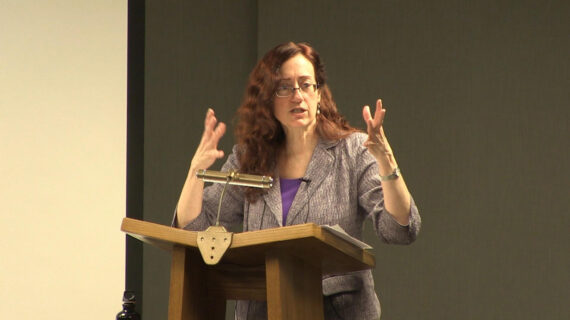
cc >> I'll introduce my colleague, Jon McKenzie, to you. Jon is a professor of English here at UW-Madison, where he teaches courses in performance theory, new media, critical information design. He directs Design Lab, a digital composition center whose mission is to democratize digitality, and he coordinates the university-wide e-Digital Humanities Initiative, an informal network of faculty librarians and technologists, who are dedicated to enhancing the cyber infrastructure of artists and humanists. Jon is the author of "Perform
or Else
From Discipline to Performance," Routledge, 2001, and articles like "Global
Feeling
Almost All You Need Is Love," "Abu Ghraib and the Society of the Spectacle of the Scaffold," "Performance in Globalization," "Towards a Sociopoetics of Interface
Design
etoys, TOYWAR"-- Wait a minute. oh, that's right, okay, sorry. His work has been translated into half a dozen languages. With two others, he is co-editor of "Contesting
Performance
Global Sites of Research, Palgrave 2011. He has produced a number of experimental video essays, including the revelation, I hope I get this right, Jon, Dr. K-- >> It's Challenger. >> "Dr. Challenger," okay, 2012, and "This Vile Display." He gives workshops on performative scholarship and emerging scholarly genres or smart media. His homepage is labster8.net. Please join me in welcoming Jon. >> Thank you, Terry.
applause
Performance
Hi, welcome. My name, again, is Jon McKenzie, and I'm a professor of English. As Terry said, I work on performance in media. I'm very excited to be talking today about Nietzsche's Gay Science and Theory Comix. I should say theory comix are not so much theories about comix, but theory and other research that takes the form of graphic text. I've got a collection of those kind of texts and other ones, artist's books, graphic novels, and some pop-up books here. I encourage you to come up and look at them. Next year, the Humanities Center here and the Institute for Research in the Humanities is sponsoring a Mellon seminar on comix studies. If you don't know this field, it's an emerging field that covers everything from popular and underground comix to Japanese Manga, political cartoons, and graphic novels and essays, essays such as this text called "Nietzsche," which is just out in Italy. It's the story of Nietzsche's life. It's by author Michael Onfray and Maximillien Le Roy. You can see here it is a beautiful book. I've not yet read it, because it's not been translated into English. What it does, it highlights certain moments of in Nietzsche's thought and life. I believe over on the right this is the image of his famous revelation of the eternal return in the mountains of Italy. So I want to preface my presentation by saying that I'm going to focus on what he teaches us about the interface of knowledge and technology. As a philologist, he brings a literary perspective to the origins of western philosophy, science and culture. I'm not an expert on Nietzsche's Gay Science or on comix. And in fact, my gut tells me that to become an expert in either one of these is probably to miss the point. But there's an art of missing the point, and taking pleasure in that, and that's something we call poetry that is alluding to things. My own training is in painting. I have a BFA in painting. I have an MA in English and Film Studies, and a PhD in something called Performance Studies, which is theater meets anthropology in a dark alley. We study everything from theater to ritual, to social interactions, such as the one we're having right now. If I'm an expert in anything, it would be in performance studies, though lately, I've been working in digital humanities and studying emerging forms of scholarship, for example, these theory comix, an example of which we have here. What I'm going to do is frame my presentation first in terms of digital humanities and my work with Design Lab and then talk about Nietzsche's Gay Science and Theory Comix. For those of you that are not familiar with the field of digital humanities, I use this diagram because it's helpful. I coordinate a digital humanities initiative here that has about 40 faculty, technologists and librarians. It's very loose knit. At it's core, what digital humanities does, is address the transformational relationship between information technologies and the arts and the humanities. Books and journals are now electronic. Scholar communication is digital, from soup to nuts, that is, the beginning research, the gathering of materials, the writing. Once that's written in something like Word, it's sent off to a publisher, where it's dropped into InDesign, and then it's marketed through various ways. It's electronic from soup to nuts. Books have become epic phenomenon, this electronic production process. This has happened in our lives. How many of you remember probably going off to college with typewriters, right? I did that in the late '70s. That doesn't happen anymore. Well, maybe it does, but I don't see many students with typewriters. Now, these four areas, let me explain them. Humanities Computing refers to the use of computational resources to digitize texts and then to data mine them. In our department, Professor Robin Valenza does this. Underneath this is New Media Studies, which is really the study of the cultural and social impact of these technologies on our society. Next, we have New Media Practice, which are studio and lab-based production courses. These are teaching people to produce in new media forms. Last, we have digital learning, which is really using digital technologies to enhance the teaching of any subjects. So these top two could be applied to any subject at all. These bottom two are more specific, because they're really focusing on the digital. Now, I should say that I am coming from this area, probably right here. I don't do the quant stuff yet, maybe I will, but that's where I'm coming in from, and where Design Lab comes from. For me, digital humanities is wider than a discipline and deeper than a field, because it's infrastructural. It challenges all the disciplines in all the fields, and connects outward, because there's a fifth sphere. And that is the public. For the emerging knowledge sphere blurs the division between experts and amateurs, campus and community, public and private, and it does so for better and for worse. Google, Wikipedia, MOOCS or massive online courses, these are the markers of the stakes for 21st century research and teaching. The arts and humanities, frankly, face a lot of challenges, but I think the Gay Science and Theory Comix can help us respond. I should say that I am both wary and excited by digital technologies, just as I am about the technology that it's displacing, that of the book. The book has been the most powerful technology that the world has known. It's been a meta technology for about two centuries, allowing us to think about all other technologies. It's now being displaced. We see this, really, shifting from books to these files, and from archives into databases. The important thing though is to recognize that libraries and books were already technology. That's something that we forget about. Why it's clear that digital technology are transforming our research and teaching, it's also clear that IT is embedded in cultural situations, which is something the arts and humanities know a lot about. As I said, I direct something called the Design Lab. It's a digital composition center, which is located downstairs in College Library. It was created to help students enhance the conceptual and aesthetic dimensions of media projects they produce for classes, student activities, and professional development. Design Lab, really, is the culmination of 15 years of my research in the areas of performance theory, new media, as well as teaching studio based courses and workshops in interface design, performative scholarship, and experimental theory. Design Lab is like a writing center. We don't offer any courses ourselves. As far as we know, it's the first general access media center like it. Students come in and they make 30-minute appointments with our TA consultants, and they concentrate on conceptual and design issues. We outsource the technical, the learning of software to other places. Our TA consultants come from eight different fields, because unlike the Writing Center, there's not yet a particular field that we could turn to. They come from communications; they come from art; they come from English; they come from design studies; they come from the Nelson Institute of Environmental Studies. I believe that designing and redesigning knowledge are crucial to the future of scholarly communication, and to higher ed more broadly, and the arts, sciences, and the professions all have a huge role to play. As Terry mentioned Design Lab's historical mission is to democratize digitality, just as in the 19th century, public education democratized literacy. I define digitality as the global re-inscription or remediation of oral, literate, visual, and numerate archives into network databases, and the accompanying changes in social organization, individual practice, and world view. Actually, there's an ontological difference that emerges here, so this is an historical mission. I'll talk about this in relation to Nietzsche in a moment. Design Lab's goal is to make digital design as commonplace as writing and composition. So thus to democratize digitality, Design Lab seeks to democratize design, to bring practice such as video production, web design, and visualization to potentially all students, helping them learn to remediate ideas and experiences into different digital forms, in order to build portfolios of intelligent work. This is the view from one of our media studios downstairs. Design Lab focuses on digital forms because we think these are the means for democratizing digitality. We call these forms smart media. So, smart media are emerging scholarly genres such as Ted Talks, video essays, and Theory Comix. These forms supplement traditional genres, such as books and articles. They open up new ways to structure arguments, present evidence and engage audiences. Smart media draw on a wide range of traditions, such as documentary film and radio, scientific posters, comic books, public speaking, data visualization, on and on. Design Lab has developed resources around 15 different smart media genres, which we have arranged into five families. These are video, presentations, e-writing, imagery, and audio. And we're developing other families, as well, such as games and installations. We believe that these smart media forms are emergent, and that our services must be designed to evolve. We're formalizing many of these forms that are already out there, and also helping to invent others. One such form is the theory comix. I don't know if this is the best term for this, but I define theory comix as any comic or illustrated form whose primary content is conceptual, theoretical, or philosophical. Now, this is a class assignment. I should say, this is an animated view. This thing looks, in real life, much more something like this. In fact, this is the same assignment. What students were assigned here to do, they're given a question, what is your data body. And what this assignment does is turn research questions into quests. So it becomes a quest for finding basically the data that is stored in your name out there on the Internet. This is harder to do than you would think. Now, the point of this is that the question of the student's data body become the quest to find one, and they set out, not so much to demonstrate a mastery of knowledge, but the process of learning. The quest is undertaken with theorists, artists, figures from popular culture and from everyday life. These become characters who either help or hinder the student on their quest. They use a program called Comic Life, which comes with preformatted empty boxes, and you pull in images from the Internet, and then pop-up texts. So in about a half an hour, students can be creating theory comix through Comic Life. Now, what interests me about this is that potentially any research question could be thought through a theory comix. Again, the goal is not the answer, but approaches, hypotheses and dead ends. It's really about the process of research. It situates students in a different relationship to knowledge, to resources, experts, and society at large. Now, I want to turn now to another example of theory comix. This is not a student project. This is called "Radioactive, A Tale of Love and Fallout." It is by Lauren Redniss, who is an artist and writer who also teaches at Cooper Union. This is based on her research of the life and loves of Marie and Pierre Curie. It is presented in a graphic novel form, and it was our Go Big Read book this past year, so UW students could get access to this for free, and there were classes teaching this book, altogether as a collective experience. She works across many different media. What I want to do is show you how she embeds this book within a whole ecology of smart media. She wrote the book. She also did a TEDx Talk, probably done at MIT, about the book. She has her own website here. What's featured in here is an installation at the New York Public Library of her book, okay? Right, sweet, that we all have a nice exhibition of your book. This is the website for the exhibition, but she designed it with her students at Cooper Union. Finally over here is an interactive game that's part of this. So we see a theory comix embedded in a whole ecology of smart media projects. Now, the digitalization of materials allow them to be rematerialized in startling ways, and scholarship becomes content that is translatable into different media forms. Researchers can reach new audiences and make their perspectives relevant in new contexts. Smart media are important emerging forms of knowledge, and as we'll see, I believe that Nietzsche is a crucial figure in their development and in comics more generally. Let's now turn to "The Gay Science." As a researcher interested in emerging scholarly genres, there are three reasons that I turn to Nietzsche. The first is his project of the Gay Science. This is both the specific book and the more general tradition of joyful wisdom or gaya scienza. That's supposed to be Italian. For me, gay science provides the epistemology or the theory of knowledge for digitality. It's one that's based paradoxically in the body, and it's changing interface with knowledge. "The Gay Science" was first published in 1882, and then it was republished and expanded in 1887. The German has also been translated as "Joyful Wisdom." You can see the German. I'm don't know my German, but that would be the word for frolick, so you can imagine frolicking wisdom or knowledge. The important thing is to see science here as not just specific, as what we see as hard science, but a more general wisdom and scientific approach to the world. What is this "gay science"? Nietzsche challenges us to imagine a science or a type of knowing that is based in the material body. That is, in passions rather than in reason. I should note that similarly web designers, and I worked in web firms for about five years, they also stress the primacy of something called "experience design." They're trying to design people's experience, working at this emotional level, as well. Now, despite the appearance that gay science is not subjective, because Nietzsche was suspicious of replacing the divine subject with a human subject, who were fully in control of him or herself, or thought they were. In fact, he's looking not for any foundation at all. You might think of the shift from truth being something that is solid to truth being a river. What happens when truth becomes a river. That's a way to think about what Nietzsche is up to. The gay science is anti-platonic and anti-ideational. We forget that Plato actually invented ideas, and the idea that we think in ideas. That happened at a particular moment. Through textual analysis, we see this invention. Nietzsche was one of the first to discover this. What he does, is he challenges Plato's interpretation of being as idos, or idea. Idos means a form that has a visual outline that sets back from a background. Basically, what Nietzsche said was we became captivated with this form and forgot the becoming that's happening behind us. This is kind of his. Again, one reason that literary scholars love Nietzsche is that he is a literary person. He is reading philosophical texts and interpreting them in a bold manner. The first edition of "The Gay Science" contains this epigraph, a citation from Emerson. I'll read it here. To the poet, to the philosopher, to the saint, all things are friendly and sacred, all events profitable, all days holy, all men divine. Nietzsche was actually a huge fan of Emerson, and some people think that his notion of the overman resonates with Emerson's notion of the oversoul, okay? When we talk about the place of gay science in Nietzsche's life and work, some people see it as a positivistic term, away from kind of an irrational moment early on. But I don't really see it that way. I see it as a change in the style of his thinking, living, and writing. The terms laid out in "The Birth of Tragedy," what he's doing is proposing a science or a wisdom that's based on a hypothetical musical Socrates, where images and words, ideas and logic are set to a musical score, where Apollonian clarity flashes forth to Dionysian rhythms of music. That's to put this in the terms of "The Birth of Tragedy." Now, in terms of Nietzsche's own writing style, what happens is that aphorisms, poetry and comedy displace the academic treaties, prose and tragedy. So what is the gay science more specifically? It's written in a fragmented form and it has many readers. It also introduces or intimates certain core concepts of Nietzsche's later thought; what is the death of God; eternal recurrence; the transvaulation of values; the distinction between noble and common, which is the basis for his genealogy and also his genealogical method, as well as Zarathustra's overman. He also intimates the notion of a double affirmation. Again, this is a gay approach to wisdom. In terms of digital humanities and smart media, my focus is on Nietzsche's epistemology, that is his theory of knowledge and more importantly, it's practice. The gay science is first and foremost a science or wisdom that laughs at itself and indeed, laughs at truth. It's a science based in the body, an affect rather than idos. What we're looking for is a different measure here that's neither logic nor ideation. Emerson himself called himself a professor of this joyous science. Again, I'm looking both at a specific text and a tradition of gay science. In the book, Nietzsche contrasts the comedy of existence with the age of tragedy, which he aligns with religion and Platonism. I would say that he still has a tragic, there's a certain, if you like, tragedy going on. It's like a tragic joyful tragedy, versus a more staid tragedy. Like I said, he's not really giving up on the Dionysians, but he's distancing himself from Wagner. Although he's often criticized, Nietzsche is often criticized as a nihilist, it's important to note that his whole project sees western civilization as nihilistic, okay, basically the notion of another world, an eternal life, and what he called, really, a negation or a walking away from the life that we have here. He's a materialist. Although you may see him as a nihilist, his whole point was to critique, and basically to go and read Plato as a nihilist. You can see why that upset a lot of people. Now, also we should no that la gaya scienzia traditionally means the art of poetry. For Nietzsche, this is not a simple expression of some internal truth, but it's a shift from logos to poiesis. Or if you like, and Heidegger made the same move, no longer thinking about philosophy in terms of logic, but thinking about it in terms of poetry, and a type of making. At the level of truth, Nietzsche is often quoted as saying that truth is an army of metaphors, and I'm paraphrasing. But more specifically, what he does, he moves beyond correspondence and adequation. What that means, the notion of truth, correspondence, the sky is blue, what I say corresponds to the real. This is a realist epistemology. Then there is truth around adequation. That's truth within a formal system, one plus one is two. And if you're familiar with contemporary debate between realist and constructivist epistemologies, they basically are brainstorming. These two notions are truth. What Nietzsche did was move towards a notion of revelation, rather than two notions of truth. It's not a religious revelation that I'm going to point out. All of this is brought back to knowledge and its passion. Again, the whole point of gay science is to see knowledge at the level of passion and affect, but not to see it subjectively. That's the tricky part. So what he called for was an experimental disposition, and he called for living life dangerously. But at the same time, there is a levity. That quote at the very beginning of the Italian graphic novel, translated, "I only believe in a god who knows how to dance." The gay science is leaning toward Nietzsche's grand style, which come out in Zarathustra. That's the emergence of conceptual persona. Characters such as Zarathustra himself, women, acrobats, madmen, dwarfs, animals, I mean, what he'll do in his next text is really something amazing in the history of philosophy. And the gay science is leaning towards it. Perhaps, or maybe even despite or because of this exuberance found in the gay science, Nietzsche also lays out very specific and very prescient research topics. These are basically areas for future research. Has anyone made a study of different ways of dividing up the day or of the consequences of a regular schedule of work, festivals, and rest? What is known of the moral effects of different foods? Is there any philosophy of nutrition? Have the manners of scholars, of businessmen, artisans, and artists been studied and thought about. There is so much in them to think about. Now, these topics read like a storyboard for 20th century sociology, anthropology, and business management. We have here the outline of Nietzsche's genealogical interests in the way that societies create and transform systems of knowledge through our very bodies. This is an interest that will culminate in his Genealogy of Morals. His genealogical method was taken up in the 20th century by Michel Foucault, who if you don't know Michel Foucault, he probably remains the most cited theorist out there in the social sciences. He did genealogical, he called them archaeological analyses, of the prisons, of the hospital, of schools. Foucault was himself gay and died of AIDS, so we get this pun between the gay science and basically the emergence of queer studies and queer theory. The first reason that Nietzsche and the gay science are important for digital humanities is the contemporary changes in our knowledge, that is, the shift that I mentioned before from books to media, from archives to databases. They are transforming the habits and manners of our thoughts and actions. This is happening to us right now. So with orality, that is the Homeric tradition, created spirits who possessed our bodies, and literacy created the notion of selves, know thyself, which for Nietzsche, feigned a certain self possession. What new avatars may emerge with digitality? This is an ontological basis. Is there a new basis of thought that would not be either spirit or possessed, or we are thinking self, the Cartesian self, and what would this be? I'm not going to answer that today. Before moving to a second question, the second reason why Nietzsche is important, I want to step back and address a crucial question that should be asked by anyone who is nattering on about Nietzsche, like myself. And that is, which Nietzsche, and in particular, which Nietzsche for us today? His aphoristic style, his taking of different perspectives and personas, and his exuberant use of poetry and rhetoric, they all contribute to there not being one Nietzsche, but several. We can see this in the very different communities of readers that he has attracted. In his life he actually had very few readers. After he died his sister, Elizabeth, if you don't know, who was an anti-Semite activist, took control of his archive and really controlled the interpretation of his texts. In the early 20th century his first readers were aristocrats, and then the right-wing radicals began reading him. In Italy you had the Futurists and the Proto-fascists, and in Germany you had Hitler and the rise of Nazism, and also Martin Heidegger reading him. On the left, in the 1930's in France, you had Georges Bataille and Pierre Klossowski who were in the College de Socialogie. This is sort of an informal college. They published essays critiquing what the Nazis were doing with Nietzsche. They were trying bolster up another. But in Germany did radical readers of Nietzsche gain state power, totally mobilize in appropriating his theory of the Overman to disastrous effects. If you know Nietzsche's trajectory, the nationalism that was found in the Birth of Tragedy gives way to sustain critique of German culture and imperialism. At the end of his life, probably most of his scorn is directed towards fellow Germans. It took a lot of massaging of his texts to make him into a rabid nationalist. After World War II Nietzsche was banned in Germany. In the US Ayn Rand promoted a Libertarian Nietzsche that remains popular among certain campus conservatives. But Nietzsche's main introduction into US philosophy departments happens with the existentialist Nietzsche and it happens in the 1950s. Our colleague Jennifer Ratner-Rosenhagen has written a book The American Nietzsche. That looks at the crucial role that Walter Kaufmann played. If you've read much of Nietzsche in English you've probably read Kaufmann's translations. Now in the 1960's a very strong new reading of Nietzsche comes out of France. This is associated with people like -- and Jacques Derrida and Michel Foucault, who I mentioned before. These are known as post-structuralists. They were interested in Nietzsche's critiques of Marx and Hagel. They went on to critique Freud and Levi-Strauss. There was a radical critique of the human subject and of the relationship between power and knowledge, institutions and desire. Now this French theory, it's known as French Theory, arrived back in the US in the '70s and '80s, and this is known as The Theory Explosion. It brought with it a new Nietzsche, a post-modern Nietzsche, if you like. Among the people important for this are David Allison, Larry Rickles, -- and Greg Ulmer. Also in the '80s in Germany, Friedrich Kittler, that's with a K, and Peter Sloterdijk are reading, if you like, or reciting, a leftist Nietzsche over there. There's also Gay Nietzsche. A recent book came out that really goes through his personal life, his journals, his letters. It really posits that the secret of Dionysus is Nietzsche's gayness. It's a very provocative reading. So they're making a strong connection between gay science and queer theory. Now my Nietzsche, this all which Nietzsche, comes out of this post-structuralist tradition. Particularly folks that are interested in Nietzsche's relationship to writing and graphi. I use this term, graphi. It comes from Derrida. It's not just media, but also style and technique, technology and infrastructure. Now we can see this graphic dimension most clearly in another counter-mobilization of Nietzsche's Overman. This brings me to my second reason that makes Nietzsche so relevant to digital studies and Theory Comix. And that is Superman. Nietzsche is the first philosopher to generate a world famous comic superhero. Superman is gay science mounted in full-color action. At the same time that the Nazis were creating a monstrous regime based on Nietzsche's Ubermansch, or Overman, two Jewish teenagers from Cleveland were creating Superman to fight Hitler and the Axis powers. Jerry Siegel and Joe Shuster first published Superman in 1933. In 1938 it was picked up by Action Comics. In literary theory, this tactic of appropriating is called re-functioning, or queering. You queer a term because the term queer itself has been queered many times. Okay? In some sense, queering is the transvaluation of values played at the level of words and images. Siegel and Shuster effectively queered Nietzsche's Ubermansch into an alien Superman, and allied him with the United States. This rest is super history. There are Superman comics, TV shows, movies, costumes and toys. The story of Siegel and Shuster has been told in novels and also in a recent story by Brad Ricca. Superman has generated a pop philosophy and a cultural studies topic, almost a field. Now growing out of the '80s Theory Explosion, the post-structualist Theory Explosion, we also get Theory Comix. This is specifically Theory Comix. These are humorous, theatrical and theoretical, and they are precursors for me of smart media, if they are not already smart media. You might note here, Nietzsche's mustache, his intense stare and--
horse whinnies
laughter
Performance
And his affection for horses.
laughter
Performance
This is a very different legacy than Nietzsche's existential one, a much more complicated, more visceral, and more technological. Again, I'm interested in how philosophy is being remediated from logos into graphi of poiesis, different ways to think about this shift. Derridah, Kittler and Ulmer have argued that over the past 150 years the alphabet has slowly been re-inscribed in different media, the photograph, the telegraph, the phonograph, the computer graphics. Theory Comix however, are in no way limited to Nietzsche. There are three or four different beginner series devoted to philosophy and science. And also this form, I would argue, is not limited to these introductory texts, but a part of a broader graphic movement. That is, the graphic novel or the graphic essay. At the top we have Art Spiegelman's "Maus," which is from 1991. It's the first graphic novel to win a Pulitzer Prize. It's based on Spiegelman's family history in the holocaust and interviews with his father. At the bottom right we have "Logicomix" from 2010. Excuse me, 2009. It's the story of Bertrand Russell's quest for certainty and truth in the early 20th century. It's a collaboration by a philosopher, a writer, an artist and a playwright. At the bottom left we have Lauren Redniss's Radioactive which I mentioned earlier. It was nominated for a national book award. You can see these are kind of the high end. I don't think these Theory Comix are going to get any awards, but these are the high end of the genre. The strength of Theory Comix as a genre and help us extend gay science into the 21st century. These strengths include a multimedia evidence track and argument track. You're not restricted just to the text. You can make arguments visually through sound, and you can produce all kinds of evidence. It also has different perspectives. It presents both the results and the messiness of the research process. It stages the social and political context. It dramatizes the life of the researcher. And it's a form that's able to speak to different audiences. This is really what Theory Comix is, to help us think about bringing gay science to the 21st century. Now, in turn, Nietzsche's gay science and the emergence of Superman comics are extremely relevant to understanding and creating Theory Comix and other forms of smart media. Nietzsche's aphoristic style and his striking images, his casts of characters and dialogues, his conceptual persona, and his scenes of anguish, joy and revelation, and the potential of queering words and images. This is really, Nietzsche said, the history of a word is how it's been taken up by different folks, the meaning of a word. That's what is it. These all provide design insights for thinking and working in experiential multimedia formats. How do we retrain our bodies to become a musical Socrates? What organ should we focus on first? How might we invent a gay sci-fi? This brings us to the third reason that Nietzsche is important today. In addition to providing a materialist epistemology and a comic book superhero, Nietzsche also gave philosophy the writing ball. Due to his notoriously bad eyesight, Nietzsche researched and acquired a typewriter in 1882. It's the same year that The Gay Science appears. His friend Paul -- brought him a Malling-Hansen writing ball produced in Copenhagen. As far as we know, Nietzsche is first philosopher to use a typewriter. Which, for me, is why Gay Sci pushed toward gay sci-fi. For the first time, philosophy was composed with fingers operating keys mounted in a spherical shape. Let's imagine Nietzsche at the typewriter. For a writer addicted to jotting down thoughts and revelations while taking arduous mountain walks, sitting and typing must have been a real struggle for him. He mocked Kant for sitting while writing. For him, one could only think while moving around. Okay, you can see. It's a different kind of thinking. So for him to sit down must have been a real chore. Friedrich Kittler argues that the writing ball and other 19th century writing machines created a new, modernist discourse network, and that Nietzsche's own style, and I quote, "change from arguments to aphorisms, from thoughts to puns, from rhetoric to telegram style." Indeed, Nietzsche himself, after working on the machine for a while, wrote this, "Our writing tools are also working on our thoughts." That is, he had the insight that these technologies affect our thinking. So we can imagine him on a Twitter stream today or texting while hiking through Italy. Interesting enough, there are a few surviving sheets of Nietzsche's typing, including this poem about his writing ball. Now we're interested in what Nietzsche teaches us about training the training the body for gay sci-fi. Nietzsche used those same digits to compose and play music. This is one of Nietzsche's compositions here. It's not him playing though, unfortunately.
music scratches and stops
horse whinnies
Performance
Nietzsche collapsed in 1889, throwing himself on a horse that was being beaten in the streets of Turin, Italy. Among the reasons given by scholars for this collapse are syphilis, congenital madness, his father also went mad, his philosophy, his morals. Now in my gay sci-fi story the typewriter did it.
laughter
Performance
Nietzsche survived another decade. He sat up on this porch watching the 20th century approach. As we've seen, others would continue experimenting along the path that he opened up. Here I want to suggest that, in addition to his superhero and typewriter fame, Nietzsche was also the first digital philosopher. His lessons for training the body for digitality lay in his fine fingers, the delicate digits tapping out philosophical notes, poems and letters while also composing and playing classical music. Like Socrates, who some argued bridge both the oral and the literate traditions without ever knowing how to write, I'm going to suggest that Nietzsche bridges literacy and digitality without having owned an iPhone. His revelations came not from the heavens but from the emerging circuits of this discourse of the telegraph and the telephone, upon which was later built the Internet. I think Nietzsche would have enjoyed being in the cloud. I want to conclude by showing one last Theory Comix example, one that brings Superman closer to home and demonstrates the seriousness of smart media. This example comes from the area of healthcare. In Canada, doctors, local communities and government agencies are using comics to reach specific high-risk communities. The Aboriginal Health Network helped develop this comic to encourage young mothers to seek out prenatal healthcare. Again, it was produced by a local community, media artists and a government health agency. In this story, a pregnant aboriginal teenager about to drink a beer suddenly meets a single mom in at a neighborhood party. The woman leads the teenager away from the party and then talks to her about prenatal healthcare. Now interestingly they've also taken this and remediated this into a video. >> Well, you have to look out for yourself. You're baby's brain is just growing and developing now. If you drink you could hurt the way your baby learns and behaves. And she could have physical disabilities too, for the rest of her life! That's called FASD, Fetal Alcohol Spectrum Disorder. It doesn't go away when your baby grows up. It lasts forever, so you have to protect your baby's brain. >> I wasn't going to drink! >> I'm glad. Let me show you something. >> Hey, Gran's house? How'd we get here? What are you doing? Am I dreaming? I'm dreaming, right? >> Just watch. There are pots boiling on the stove and a pile of traditional medicines on the table drying. Mercy enters the kitchen, a rotund superhero, complete with unitard, cape and high boots. >>
laughing
Performance
: What's she wearing? >> You're seeing her for who she represents. >> What's that supposed to mean? You're freaking me out. I'm, like, completely freaked out. I can't wake up. Can you stop this? What are you doing? >> Calm down. Everything's okay. You're safe. I came to get you at that party to show you this. >> What? That my gran's a little, old superhero? >> Exactly. She has so much knowledge and power. You could learn so much from her. Your grandmother is like a superwoman when it comes to motherhood. >> So my gran is like Clark Kent or Peter Parker? >> Not like for real. I'm just showing you the world the way I see things. Your gran's been through it, all of it, from childbirth to raising up a little baby, and a little kid, and the teenage years on, to letting her little bird leave the nest. >> And who are you again? >> I'm Dennis... >> I think the power of this comic is it's ability to translate important health information into a graphic narrative form, dramatizing the issue of prenatal care to reach a specific audience. Like the student project shown earlier, and indeed, like Gay Science itself, the video stages both knowledge and ignorance, finding and failing, which are crucial to living and learning. Who would have thought that Nietzsche's Superman would be reborn as an aboriginal granny making homemade remedies? That is where gay sci-fi will get you. In conclusion, gay sci and Theory Comix have much to give to one another and to us. Gay science offers a different experience of knowledge. One that is more embodied, passionate, graphic and revelatory. And Theory Comix offer us a concrete example of how knowledge enters digitality. It's multimediated, networked, and situated in our bodies, digits and all. Thank you for your eyes and ears.
applause
Search University Place Episodes
Related Stories from PBS Wisconsin's Blog








Donate to sign up. Activate and sign in to Passport. It's that easy to help PBS Wisconsin serve your community through media that educates, inspires, and entertains.
Make your membership gift today
Only for new users: Activate Passport using your code or email address
Already a member?
Look up my account
Need some help? Go to FAQ or visit PBS Passport Help
Need help accessing PBS Wisconsin anywhere?

Online Access | Platform & Device Access | Cable or Satellite Access | Over-The-Air Access
Visit Access Guide
Need help accessing PBS Wisconsin anywhere?
Visit Our
Live TV Access Guide
Online AccessPlatform & Device Access
Cable or Satellite Access
Over-The-Air Access
Visit Access Guide




Follow Us