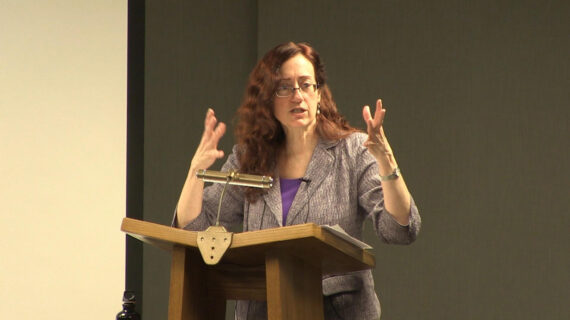
cc Today we are pleased to introduce Megan O'Connell as part of the Wisconsin Historical Museum's History Sandwiched In lecture series. The opinions expressed today are those of the presenter and are not necessarily those of the Wisconsin Historical Society or the museum's employees. Megan O'Connell is the executive director of Shake Rag Alley Center for the Arts. Here today to discuss the history of Shake Rag Alley grounds and to share a bit about the artists who seem to be magnetically drawn to its location, please join me in welcoming Megan O'Connell.
APPLAUSE
Thank you. If you ask anyone who knows me, they'll tell you that I just love to talk about Shake Rag Alley. So, thank you to the Wisconsin Historical Society for giving me the opportunity to do so today. So, without further ado, let's jump right into it.
Visitors from far and wide are drawn to Mineral Point for its reputation of history, art, and architecture. The influence of many artisans are responsible for the reputation of the magical grounds of Shake Rag Alley Center for the Arts. Shake Rag Alley has long been a part of Mineral Point's rich and colorful history, of interesting characters, fanciful artists, and craftspeople who make up Wisconsin's Driftless Region. Through it's unique location, tucked away but presently near the influence of the artist studios in Mineral Point, Shake Rag Alley Center for the Arts has been inhabited by various owners and operators, all with the spirit of supporting the techniques of traditional craft.
In its decade of arts, education, and programming, the arts organization has worked to maintain the groundwork laid by previous owners and visionaries. To better understand this groundwork and the work Shake Raggers have worked so hard to maintain, we'll explore some of the hands that the grounds have passed through, beginning with the miners. But before we get to that, let's chat a bit about the history of art in Mineral Point. And further, how Shake Rag got that interesting name.
The Shake Rag Alley story is similar to the story of Mineral Point. Old buildings that fell into disrepair, artists and community members taking control of them and giving them new life. Basically, the arts bringing the place back to life. In its early days, Mineral Point was a lead mining boom town.
The population in the 1800s exceeded that of Chicago and Milwaukee combined. For many years, the town had a successful zinc works and a train line that brought visitors to town. Eventually, lead mining ended. The zinc works closed and the passenger train stopped running.
The Depression hit Mineral Point hard. As the early industry declined, art and architecture began to emerge, helping to save the local economy of Mineral Point. In the 1930s, Bob Neal and Edgar Hellum began restoring some of the old miners' cottages on Shake Rag Street and converted one into a destination restaurant, initiating tourism in Mineral Point. This site, called Pendarvis, is now owned and operated by the Wisconsin State Historical Society.
Around the same time, the town began attracting artists and crafters who restored the rock buildings and set up their shops. The proliferation of the artists and economy simultaneously strengthened the local workforce hired to help restore the buildings, work in the shops, and provide basic life services to these residents. So, together, the art and architecture culture and the local agriculture community created a place where the creative and entrepreneurial spirit thrives. Back in the day, lead was the key to the city's vibrancy.
Now it's the town's architecture, its indigenous art, and the artisans who reside there. So, how did Shake Rag Alley get that weird name? Local legend is that miners' wives used to shake a rag outside their doors to call their husbands mining the hillsides home for dinner. But, truth is, that story is a little bit fanciful.
In several mining towns, Shake Rag was the name of a poor residential area. The story of Teakettle Annie, the last resident of the remaining 1830s cabin on the Shake Rag grounds, shed some light on the actuality of the poor residential area. Though no one seems to be able to confirm the rumor, it is rumor that Teakettle Annie was a prostitute. Now, let's take a step back to the beginning.
When the lead miners came in the 1820s and 1830s, they camped near the Federal Spring that runs through our campus. They called it Shake Rag Under the Hill. They built log cabins near the spring, and there is one remaining cabin that was occupied until 1958 by Teakettle Annie. The next known owner of Shake Rag Alley was Kenny Ellery.
I don't know much about the grounds in the hands of Kenny Ellery except that he lived in what we now call the Ellery House, and he used the grounds to house his cabinetry business. Kenny Ellery sold the Shake Rag grounds to Al and Edie Felly for $8,733.13 in the 1970s. Al Felly was a Madison artist. He opened up Felly's Flowers, still present around Madison to this day.
Al Felly was dedicated to repairing the existing buildings, building new buildings, and planting gorgeous flowers. He charged admission to what he called Shake Rag Alley. When the Fellys were operating Shake Rag, the log cabin and the potter's house were outfitted with antiques. The Fellys wanted to provide local artists who didn't have their own studios with a space to work.
A potter worked in the potter's barn, a blacksmith in the stone cabin next to the log cabin. The Fellys sold the grounds in 1990. It passed through several unknown hands until the Ridnours purchased the grounds in 2001. Up until 2013, Al and Edie Felly still watched over the Shake Rag grounds from their stone cottage across the street, the Welsh House.
In 2001, Glen and Harriet Ridnour purchased Shake Rag Alley to house their business specializing in British imported antiques. The antique shop was located in what we call the Coach House today. Their daughter, Sarah Carpenter, who is now the Shake Rag Alley bookkeeper, ran the cafe next door to the Coach House. They expanded the cabinet shop in the Shake Rag cafe was a tearoom.
They added the little French cabin to our grounds. They also hosted antique shows and events such as the Woodlanders Gathering, hosted by Sandy Scott and Judy Sutcliffe. Sandy Scott and Judy Sutcliffe made an impromptu decision to buy Shake Rag Alley in the midst of the third annual Woodlanders Gathering. Rustic author and founder of the Woodlanders, Daniel Mack, and many other Woodlanders gave Sandy and Judy the encouragement to jump into the purchase of the Shake Rag grounds.
At the time, Shake Rag Alley was noted in the Wall Street Journal as a prime historic property on the market. The grounds were at risk of being privately bought and closed to the public. Sandy and Judy couldn't imagine that happening. They quickly made an impromptu decision to save Shake Rag Alley.
The Ridnours agreed, and the sale was quickly sealed. The Ridnours allowed contingencies of three months to raise the down payment of $100,000. While raising the funds, Sandy and Judy also had to create a nonprofit organization to own and operate the property. Many generous donors made it possible, and the papers were signed on October 14, 2004.
The school was originally named Mineral Point's Living Art Center. Though, everyone still called the grounds Shake Rag Alley. The name was legally changed to Shake Rag Alley in 2006. Employees, board members, volunteers, instructors, anybody who has caught the Shake Rag bug really, is dedicated to preserving history through the arts.
Instructors Bob Tuftee, Eric Donaldson, Greg Winz, and many others teach blacksmithing workshops. Instructor Cheryl Smeja teaches papermaking among other medias. Instructors Paul Elgin, Todd Kingery, and Jamie Rogness teach rustic crafts in many forms. Our youth program coordinator, Di Sterba, incorporates a Laura Ingalls day into the youth curriculum each year, a form of living history for kids.
The workshop fills up right away and has a waiting list of children anxious to experience life in the pioneer days. The Shake Rag Alley outdoor theater, Alley Stage, frequently puts on historical pieces. One of the first Alley Stage events was a reading of a historical diary. They did My Antonia, based on a work by Willa Cather about life on the prairie.
Coming up this September we'll be doing a play of The Bachelors, a historical drama about Bob Neal and Edgar Hellum, the creators of Pendarvis, which is just up the block from Shake Rag. Aside from historical, educational opportunities, we hold art workshops in a variety of mediums taught by a variety of instructors, some from around the corner, others from across the country. Over 200 workshops in writing, metal arts, drawing and painting, fiber arts, jewelry, mixed media, and culinary arts, among others, take place in the span of a year. And that's just a sample of the creative practices that take place at Shake Rag Alley today.
Next, I'll be using a series of photos to do a walking tour of the grounds at Shake Rag Alley Center for the Arts. With each building we look at, I'll touch a bit on the history. Most of the following photographs were taken by Ben Russell, among others. The sketches that you'll see were done by Lee Taylor Scott in the '70s.
The sketches were given to Al Felly and scanned by Judy Sutcliffe, who passed the digital files along. The first building on our campus is the Stagecoach House, which we call the Coach House today. This building was built in the 1840s as a hostelry for travelers and miners. The structure reflects a design in function of colonial America.
Original appearance would have sported a full length double-decker porch. Today, three quaint second-floor guest rooms with private baths await modern day travelers. The lower level of the Coach House serves as the main office for Shake Rag Alley. Guests and lodgers alike are welcome to relax in the commons area to rest their feet or wait for family members participating in workshops.
The Stagecoach House is the bustling heart of Shake Rag Alley today. Located next to the Coach House you'll find the Carriage House or, as we still call it, the Cafe. The Carriage House was built in 1973 by Robert -- as an antique furniture restoration shop. The carriage barn was connected to the Stagecoach House through the original stone and mortar root cellar, still in use today as a tunnel in between buildings.
In later years, the Carriage House was converted for use as the Shake Rag cafe. Today, the building is used as the box office for Alley Stage and the gathering place for many special events. Next to the Carriage House you'll find the Ellery House, hidden behind a colorful picket fence. The central room of the Ellery House was originally a typical Cornish one-room cut stone cottage of the 1840s or 1850s.
Various frame additions over the years transformed the building into a modern village of the 1920s. Today, the Ellery House is the bustling and vibrant center for the Shake Rag Alley youth program, and imaginative and multiculturally rich arts program. The coordinator of the youth program, Diane Sterba, has transformed the Ellery House into a magical building. There's a wonderful energy abuzz inside, an energy that Di would attribute to the Shake Rag fairies.
Throughout campus runs the Federal Spring. This important source of clean drinking water was the focus of the 1830s mining settlement built within the valley. Residents of Shake Rag Alley cottages were still dipping water from the spring into the mid-1950s. Today, we ask that guests do not drink the water.
A little further up the path, you'll find the blacksmith barn. Built in 1972, this wood and stone structure is a reconstruction based on a photo of the original Klais Pottery. One of Klais' products was a paddle-shaped roof tile. Sadly, he roofed his barn with them, and they were so heavy, the roof collapsed.
The barn houses the Shake Rag Alley blacksmithing and welding program. Next to the blacksmith barn is the Potters House. This brick-walled cottage was constructed in the 1840s and occupied until the 1970s. Note the extreme deflection in the front wall though the roofline is level.
The gable end in front were partially rebuilt in the 1970s by an enterprising young mason who reset eroded bricks with the worn side inward. The Potters House underwent some tuck pointing this past spring by a local stone mason. The Potters House is used today as general classroom space. Next to the Potters House is the French Cabin.
Previous owners of Shake Rag Alley, the Ridnours, purchased this unusual structure in Maine. It was built in Canada and demonstrates the rare piece on piece time frame in log construction technique used by French Canadians. Short, horizontal timbers are fitted into grooves and vertical corner posts. Today, the French Cabin is used as a tool shed for the Shake Rag Alley groundskeeper.
Neighboring the French Cabin is the Log Cabin. This Wisconsin Log Cabin was built in 1830, perhaps as a school a short distance to the east. It may be the oldest schoolhouse in Wisconsin. The Stone Cottage was built around 1840 along with the stone cellar foundation to which the cabin was added.
The house was last occupied in 1958 by Teakettle Annie, who dipped her kettle in the spring each day. When Al Felly developed this site in the 1970s, he repaired and reroofed the structure and added the stone fireplace. Today, the Log Cabin is open on the weekends for tourists to walk through. You can find artists and student artwork displayed there.
Next to the Log Cabin, you will find the Cabinet Shop. This structure was built in the early 1970s from a design by Alan Pape reflecting typical village woodworking operations. A garage door on the left was removed in 2004 to expand floor space for use as a classroom. In 2006, the walls were insulated and sided with boards from a Sun Prairie, Wisconsin, barn.
Today, the cabinet shop is used as general classroom space. Located behind and above Ellery House on the site of a small quarry is Alley Stage. Alley Stage was landscaped and built in the spring of 2007 with much volunteer work and donations. The theater seats 120 people.
The stage is used for a lively summer series of plays and music. Shake Rag Alley's newest addition to campus is the Quonset Hut. The Quonset Hut was most recently a NAPA Auto Parts until Shake Rag Alley purchased the building in 2012. The building is done with phase one of three phases of construction.
The building is a magnificent addition to campus. Just a white oak stump walkway away from the Shake Rag Campus. The building allows us modern amenities some of the other buildings on campus cannot, such as running water and bathrooms on site. The Quonset Hut is a good example of how we strive to repurpose historic buildings for art related purposes.
The buildings, each unique and artistic in their own way, make the perfect campus for our art school. These buildings provide the perfect setting for the creative pandemonium that is Shake Rag Alley today. Art is weaved into every nook and cranny of Shake Rag Alley. From the Little Free Libraries built by local craftsmen to the mosaic shish kabobs nestled around campus to the buildings present on campus themselves, ever changing works of art.
Instructors, students, and guests alike contribute to the creative atmosphere. Instructors teaching on campus tend to leave a trace of their craft behind. John Schakel, a local instructor who has been teaching since day one, has his bent willow chairs on the porch of the Cabinet Shop. Judy Sutcliffe, a founder of Shake Rag Alley Center for the Arts and current instructor, has Hypertufa planters and mosaics nestled around campus.
Students provide the creative energy needed to sustain the school. Their excitement and talent spreads great energy throughout campus. Strangers, guests who have felt inspired, drop off photographs or paintings of the Shake Rag grounds and trickle away without ever leaving their name. Art is present in every aspect of Shake Rag Alley, past, present, and future.
Shake Raggers today work hard to preserve the hands the grounds have passed through. The buildings are kept in historic conditions. The gardens are well maintained. The desire to nourish artists is abundant.
We are introducing kids to art today through our classes to ensure that art continues into the future. Each visitor to Shake Rag leaves a little trace of their art behind, whether it's physical or just the spirit and energy of their craft. The term magical is often used to describe the grounds of Shake Rag Alley. The magic of Shake Rag has been placed there by artists since the beginning.
Each artist that visits the ground leaves behind a trace of their craft, and this contributes to the creative atmosphere. I would encourage everyone to visit the grounds for themselves to experience a bit of that magic and to contribute to the energy. There's something incredibly special about Shake Rag Alley, a spirit, a feel, almost impossible to capture it in pictures or words. You kind of have to experience it for yourself.
You can visit the Shake Rag Alley Center for the Arts website at www.ShakeRagAlley.com. You can find us on Facebook at Shake Rag Alley and Alley Stage. You can follow us on Twitter at handle @ShakeRagAlleyMP and handle @AlleyStageMP, or what I would encourage most is to come visit us at 18 Shake Rag Street in Mineral Point, Wisconsin. Thank you.
APPLAUSE


 Passport



















Follow Us