

 Passport






Lizzie Kander and Her Cookbook
08/18/09 | 30m 27s | Rating: TV-G
Bob Kahn, Author Bob Kann, author of "A Recipe for Success: Lizzie Kander and Her Cookbook," shares stories about Lizzie Kander, Milwaukee's early 20th century culinary wonder. Kander's "Settlement Cook Book" helped young immigrant girls learn to cook nutritious "American-style" meals. The proceeds from her book helped to build Milwaukee's first settlement house and later Jewish Community...


Copy and Paste the Following Code to Embed this Video:
Lizzie Kander and Her Cookbook
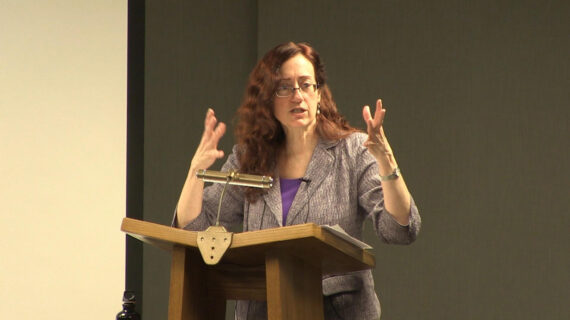
cc Welcome to the Wisconsin Historical Museum, I'd like to introduce our speaker today. His name is Bob Kann, and he's the author of "A Recipe for
Success
Lizzie Kander and her Cookbook." And with that, I'd like to have him tell you a little bit more about that. Thank you. ( applause )
Bob Kann
Thank you. Good afternoon.
Audience
Good afternoon.
Bob Kann
You can do better than that, we're talking about food today. Good afternoon!
Audience
Good afternoon.
Bob Kann
For more than 100 years, this book, the "Settlement Cookbook, the Way to a Man's Heart," has been a loyal friend to millions of chefs around the world. More than 2 million copies of this book have been sold. 34 editions have been printed, this is the most successful fundraising cookbook in history. It was written and collected by this woman here, Lizzie Kander, and I'm Bob Kann, and I wrote a biography of Lizzie Kander for the historical society's Badger Biographies series, a marvelous, marvelous series of biographies of people from Wisconsin, aimed at roughly 4th to 8th graders.
Today what I'd like to share with you are some stories about Lizzie and her cookbook. So, about 1840, Lizzie's parents, John and Mary Black, Jewish immigrants from Germany and England, came to Green Bay. About four years later they moved to Milwaukee, the mouth of the Milwaukee River, and they opened a dry goods store, kind of a general goods store. 14 years later their fourth child, Lizzie, was born.
There are three particularly important things about Lizzie's childhood you should know. One is, she actually worked in that family store of theirs. Back in the 1860s, 1870s, it was very uncommon even for women to work as sales-ladies in stores, let alone girls. But Lizzie's family believed that she should be connected to the community in which she lived.
So from a very young age, she became accustomed to doing things that girls did not typically do. As an adult, she would be doing this through her entire life. Second important thing about her childhood is she was raised in a Jewish family. Her parents were the co-founders of Temple B'ne Jeshurun, which is in River Hills, Wisconsin today, operating 150 years later.
Back then, and today, if you were raised in a Jewish household, one of the things you were taught, it is what's called "tikkun olam," healing the world. It is your responsibility as a Jewish person to do something to make the world a better place. And particularly help those in the greatest of need. Lizzie spent 62 years of her life as an adult and teenager spending her time helping people in need.
Mostly European and Russian Jewish immigrants who came to Milwaukee. Third important thing to know about Lizzie was that her family were German Jewish immigrants, they came in that kind of first wave of German immigrants to Wisconsin, about the 1840s or so. And they were very well settled by the time Lizzie was growing up in Milwaukee, they had acculturated very much. And the German Jewish community had very ambivalent feelings about the next wave of immigrants, the Russian Jewish immigrants who came later.
On the one hand, they considered them kind of family members, and they very much wanted to help them get settled into life in America. On the other hand, they were very embarrassed by them. They spoke a different language, Yiddish, the men had long beards, they looked very different. They were kind of more working class compared to these kind of middle class German Jews.
And so on the one hand, the German Jews like Lizzie's family wanted to help the new immigrants. On the other hand, they wanted to help them quickly and get them out of sight so nobody would actually say they were Jewish, but also, there were justifiable fears that anti-Semitism would rear its ugly head again, and it hadn't gone away entirely. So Lizzie sort of grew up with this ambivalence and you see it in her adult life as well. Her family was a very kind of traditional middle class Jewish family and as a girl she was taught that providing good food, a clean house, spiritual uplift and moral enlightenment for children is the role of a woman, and that's what she was taught as a child and eventually as an adult she would be teaching young Jewish immigrant women those very same values.
So, what was it like being Lizzie Kander growing up in Milwaukee in the 1860s and 1870s? Well, when she went to school, if she wanted to get a drink of water in her class, there was no bubbler or water fountain that you could go to. Back in the 1860s, 1870s, if you wanted a drink, you would go to the back of the room where there would be a big bucket or a big pail. There would be a ladle inside of it.
You would take the ladle, you and up to, I wrote another book on the La Follettes, Bob La Follette had 100 kids in his class at one point in time not far from here in Argyle. You would take the ladle, you would dip it in the bucket, you would take a drink, put it back in so that the next kid could use it. Of course, we're all horrified at this notion now, given what we know about germs, but they didn't know about germs in the 1860s and '70s. So in my book I have a little sidebar kind of about the history of germs to kind of explain to my audience exactly why it was they did this, what we now consider to be an abominable practice.
If you were a kid, unlike Lizzie who was a very good model student, if you were sort of a normal kid who didn't pay attention or got in trouble, who misbehaved, who got caught daydreaming, if your teaching caught you, you would be forced to wear a dunce cap. And you would be forced to stand in a corner... like this. Sometimes for hours at a time.
Some kids were embarrassed by it, some kids very much liked the attention. Well, back in 1874, about, Lizzie graduated from 8th grade and she was about to go to Milwaukee's only high school back then, East High School. Back in the 1870s, in order to matriculate and attend high school, you had to pass an examination. And I have yet to meet anybody, any of my peers, who would not still be in 8th grade had they had to take that examination.
They were incredible, what they expected kids to know back then. There were 11 areas of mastery on that exam, including music, drawing, handwriting. I'll give you a sample of a couple of the questions. Name the river systems of South America, including the three principal rivers of each.
Give an account of the voyage of Sir Francis Drake in 1579. Define the following membranes
and give the function of each
syrus, simovial, mucus. Anybody who could answer all this? Not me, I'd still be in 8th grade. Nonetheless, Lizzie and 99 of her peers, 100 out of 133 kids who took the test, actually passed the test.
I couldn't find the exact test that Lizzie took, but I found one sort of within a few years of the year she took the test so it was very similar to that. So Lizzie went on to high school. Lizzie lived far enough from the high school where she went out to lunch every day. Now, in what I think is a great touch of irony, as an adult she spent her life teaching young women how to cook nutritious, healthy meals for their children.
So, what did Lizzie as a teenager eat, when she had her choice for what to have for lunch? Pickles, popcorn, and crackers. 1878 Lizzie was elected to be the valedictorian of her graduating class, and her graduation speech gives us a little window of understanding into what this, what I think was very audacious, self-confident young woman was like back then. As a 20-year-old in 1878, Lizzie's graduation speech was called "When I'm President." This was 42 years before women earned the right to vote.
This was only six years after Susan B Anthony had tried to vote in a presidential election and she was arrested and fined $100, and the judge ruled the judgment for the case before he even heard it, he was so anti-feminist. Lizzie was not at all daunted by that, to say the least. So Lizzie graduated from high school, and her options were very limited. It was very rare for a young woman to go to college back in the 1870s.
Her family was well-to-do, so she didn't have to find a job, so it was pretty much expected in sort of the middle class Jewish community of Milwaukee that Lizzie would do what many of her peers did, which was do volunteer work and eventually, presumably find a husband and then you'd become a housewife. So Lizzie volunteered for a new organization that her temple had founded called the Ladies Relief Sewing Society. And what that was, was around that time there was a very harsh winter in Milwaukee and the eastern European and Russian immigrants, and other immigrants were starting to come into Milwaukee. Many of them did not have adequate clothing to deal with Wisconsin's harsh weather.
So the Ladies Relief Sewing Society started providing clothing for the immigrants, as well as bedding. This was Lizzie's main volunteer activity for the next decade or so. A couple years later she met Simon Kander, a traveling salesman, eventually he became a very wealthy real estate manager, a businessman, served in the state legislature, they got married about 1884. Never had children, I still don't why to this day, she loved children, her nieces and nephews raved about her.
Might be that she couldn't have children, might be he couldn't have children, I was never able to track down one of those historical mysteries. In any case, about 1890, Lizzie volunteered for a new activity which changed her life. Lizzie volunteered to work as a truant officer. And she was specifically looking at, why were many Jewish children not going to school in Milwaukee?
Well, for the first time, she got outside of her kind of middle class existence and she really saw poverty in the Jewish ghetto firsthand. And I think two things happened when she went into the homes of the poor Jewish immigrants. One was, she was just absolutely astounded at the conditions that she saw. She would see 13 families live in an apartment that was made for one family.
She'd see kids who didn't go to school because they didn't have clothing warm enough to go outside in the winter. She'd see other kids, or learn about kids six, seven years old, who were working in factories six days a week, 12 hours a day. Parents doing the same thing, or seven days a week, or looking for jobs. At the same time she saw all of these adults, many of whom didn't speak English that came here with very little money, very few marketable skills, and I think two things happened to her.
One was she was absolutely appalled at these conditions and so part of her immediately wanted to solve all of their problems, in part because she had a very good heart, and in part because they were an embarrassment to the German Jewish community. The other thing, though, I think she started to develop this great sensitivity and appreciation for the struggles of these families. She saw how hard their lives were, and yet how determined they were to make better lives for themselves and their families. This is my family's story, my family came to Chicago, and when I think about the struggles of that immigrant generation, I think, myself and my wife and now my child, we are reaping the benefits from the courage of that generation 100 years ago.
And I think Lizzie kind of really got it, that these people were really doing everything in their power to escape the horrible life they had back in wherever they came from, to try and make a go of it, and she wanted to help them. Couple years later, Lizzie herself was elected to be the president of the Ladies Relief Sewing Society, and by now she had realized that just providing clothing and bedding was not enough for all of the needs of these immigrants. So she gave $75 of her own money, which nowadays would be about $1500, she convinced her temple to let her use the two basement rooms of the temple, and she formed what was called the Keep Clean Mission. The Keep Clean Mission is basically the first organizational manifestation of what is now the Jewish Community Center of Milwaukee, it was the first Jewish community center in Milwaukee.
The idea behind the name "Keep Clean" is that the body had to be clean before the mind could get accustomed to all of the changes involved in the new culture. There was a two-pronged plan that Lizzie and her fellow women from the temple had to try and help the immigrants. One was, they wanted to get the kids. They wanted to teach the kids American values, good citizenship.
So how do you attract kids to something that's never existed before? Games. They offered games that kids could play for free that they couldn't afford at home. Games like checkers, games like Parcheesi.
For the adults, they offered
something no adult could resist
hot water. Remember, there wasn't indoor plumbing back then. The temple was located right near the Schlitz brewery. They convinced the brewery to pipe in hot water to create a bathhouse inside of the Keep Clean Mission.
And thousands and thousands of Milwaukeeans for the next decade or two took their baths and showers at the community center. It was a big draw. Well, as soon as they opened the Keep Clean Mission, two problems immediately emerged. One was, the kids didn't come there because they wanted to play games.
The kids knew their families were fighting for survival. The kids wanted real marketable skills that they could use. Lizzie, much to her credit, and much to her credit her entire life, responded to the needs and desires of the community. She began offering cooking and sewing classes for the girls, woodworking and industrial arts classes for the boys.
Second problem was, the adults hated the name "Keep Clean Mission." They justifiably thought there was something very patronizing about these middle class women saying, someone needs to keep us clean. They didn't put it in those terms, but they got the message so they changed the name to the Milwaukee Jewish Mission. Well, it kept becoming more and more popular, thousands of people started coming in, they started expanding, bursting at the seams. By 1900, they needed a new facility.
Lizzie enlisted the help of Simon's business cronies. They pledged $1000 a year for the community center. They rented a building near downtown Milwaukee and they opened what was called the Settlement House. Lizzie was its first president.
Well, they expanded services, they had Yiddish newspapers, they had coffee for the peddlers so they wouldn't go into the bars. They had clubs and games for the kids, more and more people kept coming in. And immediately, I think, three problems, seemingly unrelated, that would ultimately be the reason why I'm here today, forged in Lizzie's mind and she solved them all in one fell swoop. Problem number one, she needed more space.
Very quickly it was quite clear they were gonna have to move somewhere, a bigger facility, they were just too popular. Second thing, she needed an independent source of income. She didn't want to be dependent on the largesse of Simon and his friends to be able to make this enterprise continue, she needed something else. The third seemingly-unrelated problem was Lizzie had been teaching cooking classes to young Jewish girls after they went to their regular school day or their job.
Typical of what happened would be that Lizzie would write the recipe on the chalkboard, the girls would have their little notebooks, they would copy the recipes, they would work on them in class, and sometimes they would work on them at home. Lizzie thought this was very inefficient, but remember there weren't copy machines back then. So Lizzie had this idea. What if she put together a fundraising cookbook?
That way, the girls could have their own cookbook, they wouldn't have to copy it in class, and maybe they could make a little money for the community center. So Lizzie went to her board of directors, all men, probably all men she had recruited to serve on the board of directors, and she said, "Will you give me $18 so that I can publish this fundraising cookbook?" And they said, "No." They said, "It's not in our budget." But they said, in something they would come to eat their words in great force, they said, "But we'd be glad to share in any profits from your 'little venture.'" Boy, did those guys learn. Lizzie would never take no for an answer. She printed up a mock-up of the cookbook anyway, she went to a local printer in Milwaukee, she said, "Will you print it?" He said, "I don't know, let me show it to my wife, Gussie." Gussie looked at it, she said, "Print it." He said, "Okay." So he did.
He printed it. He printed 1,000 copies of the book. They gave free copies to the girls in the classes, they sold the rest for 50 cents a copy at the Boston Store, a very rare store that was owned by a Russian Jewish immigrant in Milwaukee. Within one year, they'd sold out all copies of the cookbook, in 1903 they printed a second edition, 1,500 copies were printed, they sold all those out.
1907, same thing, more copies. By the time Lizzie died in 1940, she had edited 22 editions of the cookbook, eventually 34 editions were printed, and it became the most successful fundraising cookbook in history. So what did that original cookbook look like? Well, something like this.
It was called the "Settlement Cookbook, the Way to a Man's Heart." Because back then, and sometimes today, people believed the way to a man, or nowadays it might be a woman's heart, is through their stomach. The book had 174 pages including advertisements and it was divided into two sections. In one section were the recipes. Lizzie gathered recipes from her own experience, from her friends, from the girls in the classes, from their families.
They were recipes for everyone. There were German recipes, hassenpfeffer, marinated rabbit, pfeffernusse, holiday cookies. There were American recipes for doughnuts, pot roast, there were Jewish recipes, gefilte fish, lochshen kugel, which is like a noodle pudding, matzo balls. There were both kosher recipes and non-kosher recipes, things like lobster and oysters.
There were luscious names for recipes, at least for me, like cracker gruel. Cracker gruel's what you served when somebody was sick. Chocolate kiss pudding, fried mush. A quarter of the recipes were dessert recipes and in fact, the Settlement Cookbook became famous as a dessert recipe cookbook, because back then, cooking with processed sugar and flour was just beginning in the 1890s.
So Lizzie, in all of her editions, she was cutting edge. Whatever was the latest food fad, eventually got added to the latest edition of the cookbook. And because Lizzie herself was a very frugal house maker, there was also instructions for canning and preserving. Second section of the book were instructions on how to manage a household.
Back then, cookbooks weren't just recipes, they were trying to teach young homemakers how to actually manage a home. Particularly the new immigrants who didn't know American customs. So there were instructions for things like how to clean the table between courses of the meal. Take the crumb brush and brush crumbs off of table.
How to dust a room. Start with the highest part of the room and work your way down. There was information on whatever the latest cooking, cutting-edge technology was. So back in 1901 that meant they introduced angel food cake pans and Dover egg beaters.
Ramekin tins or whatever they're called. Also, Fannie Farmer had just published her cookbook about 1895, and as with many things in society, they're trying to do everything more scientifically. So now, instead of recipes calling for a pinch of this or a lump of that or a handful of that, they tried to get precise instructions. So in the Settlement Cookbook, if you wanted a teaspoon of something in a recipe, the instructions were to take the bowl of the spoon, fill it with whatever it was, say it was flour, take a knife, scrape it across the top of the bowl, and whatever is left, that would be the quantity that you would include.
Well, as I mentioned before, the cookbook became more and more popular, published, re-published again and again. And one of the things I thought about after I did all this research and I've looked at all the editions of the Settlement Cookbook in the Milwaukee County Historical Society, you can actually see all 34 editions of the cookbook. You could also see Lizzie's editions including the notes she made in the margins as she was editing one book for the next edition. And I did a lot of reading about sort of culinary history and the question that I pondered for a while that I want to share my thoughts with you, was, why did this cookbook succeed when so many others did not?
There had been other fundraising cookbooks. There had been other Jewish cookbooks, but this one was the keeper. This was the one that really worked. Why?
And here's several speculations I have. Ultimately, I think it's Lizzie herself. Lizzie, in our day, would be a CEO of a major corporation. Lizzie was just a tremendous organizational wizard and a marketing wizard.
Think about what she did. As soon as she decided to publish the cookbook, her first plan of attack was deciding which recipes to include. I'm sure she had enough of her own recipes, but she must've thought, if I'm gonna make some money on this, how am I gonna get other people interested in the cookbook? She asked her friends.
So that meant that all of her friends were gonna buy the cookbook, all of their friends were gonna see the recipes that those people put in the cookbook and eventually in Milwaukee in certain circles, it became very competitive to have one of your recipes included in the Settlement Cookbook. She got the immigrant girls, she got their families. Eventually it morphed into new immigrants coming to Milwaukee and eventually throughout the United States, if you wanted to learn how to cook American, and if you wanted to learn how to cook Jewish recipes in America, and if you wanted to learn the way American women run their households, the Settlement Cookbook was the book that you got. And if you wanted to give a wedding present to somebody that was going to help them, the woman, you gave her a copy of the Settlement Cookbook.
I've given this presentation many times in Milwaukee, and I have many, many women who brought with their copies of the Settlement Cookbook that they had received for wedding presents in 1940 or 1950. People keep these cookbooks when they got 'em, and you can see all the smears. And some people can tell, without looking at the book, if I say, "What page is the pot roast recipe on?" They'll say, "It's on page 47 and it's got a smear of whatever, gravy on the bottom." They know their cookbook. So in part, I think, it was Lizzie as a driving force.
Lizzie also was a meticulous editor. As I mentioned, I saw her notes in the margins from one edition to the next, and she looked at every page very carefully. Not just grammar, but she was looking to improve the recipes, weed out what was good, what was bad. One of the ones those of you who are chefs will particularly appreciate, in the original recipe in 1901 for deviled eggs, the recipe called for one cup of curry powder.
In 1903, the recipe called for one teaspoon of curry powder. Somebody must've gotten a big dose of curry powder in 1901. One of my favorite stories tracing the history of different changes in the cookbooks has to do with alcohol. In 1918, Prohibition was passed, or 1919.
The Settlement Cookbook always had had recipes for cocktails, it was very common for middle class men and women to have cocktails. The original book had recipes for mint juleps and Manhattans, and brandy Alexander, dandelion wine, Prohibition passed. Lizzie's wondering, what should she do? She writes the commissioner of Prohibition and says, can I still include alcohol in my cookbooks?
He said, "Definitely not." So from 1919 to about 1933, I think, no alcohol in the cookbooks. Prohibition is ended. Lizzie wants to have "repeal" recipes in the next edition of the cookbook. I heard this story, Lizzie has a great-niece who lives in Chicago, who told me this is a family legend in this story.
So after Prohibition was repealed, Lizzie's nephew Ernie and niece Marie, who were kind of the young flapper types, decided they were gonna help Aunt Lizzie get these repeal recipes. So they offered to come to her house, show her the latest recipes for making cocktails, and she could sample them and then decide which ones she wants in the cookbook, great. So they go to Lizzie and Simon's house in Milwaukee, they've got all these different concoctions together, they advise Lizzie, take a taste and spit it out. However, Lizzie was a very proper Victorian woman.
Lizzie did not believe that food should be wasted. So Lizzie did not spit out the food, instead Lizzie swallowed the food, and much to Ernie and Marie's embarrassment, they left two hours later with Lizzie and Simon passed out on the couch, having tried too many of those recipes. What else? Lizzie had a good sense of humor, she could laugh at herself, in her later days she talked about her portly figure being a result of sampling too many of her own recipes from the cookbook.
I think she was just somebody people understood, if she was gonna take on a cause, she was gonna succeed. So she could get lots of volunteers to help her in her various enterprises. She had minimal ego at best. About 1911, the Settlement House had to move to a new facility.
By this time, the board of directors had eaten crow and they realized that this cookbook was manna from heaven, so they wanted to name the new Settlement House after Lizzie, Kander House. And Lizzie said, "No, I think you should name it Lincoln House, after Abraham Lincoln, who lived in even worse poverty than the immigrants I'm working with." I've thought about that choice she made in modern times. The naming rights are now, we've got the Kohl Center, we've got the stadium in Milwaukee, we've got art museums, and here's Lizzie turning down this opportunity. I thought, what a tremendous, what great values Lizzie had.
So to conclude, what's Lizzie's legacy for us? Well, I would argue that the playground system in Milwaukee is a result of Lizzie and her efforts. The first playground in Milwaukee, reasonably quick playground in Milwaukee, was built with profits from the Settlement Cookbook in 1902 at what's now Golda Meir school, there's a playground there which is near where the Settlement House was. The first preschool in Milwaukee, 1928, was funded with profits from the Settlement Cookbook, at what at that time was Milwaukee Teacher's College, it's now UW-Milwaukee.
For 40 years, Milwaukee had a girls' trade school, because Lizzie was on the Milwaukee school board, and there had been a boy's high school, trade school, and she thought it was unfair that just the boys should have one. And for 40 years, thousands of girls in Milwaukee learned cooking and sewing and millinery kind of skills. And of course, we still have the Settlement Cookbook, that's still being used as I speak today. And still to this day, men and women are taking their copies of the cookbook, and they're using it, or they're passing it on to the next generation so that they, too, will have good recipes to cook and serve their families.
Thank you. ( applause )
Search University Place Episodes
Related Stories from PBS Wisconsin's Blog








Donate to sign up. Activate and sign in to Passport. It's that easy to help PBS Wisconsin serve your community through media that educates, inspires, and entertains.
Make your membership gift today
Only for new users: Activate Passport using your code or email address
Already a member?
Look up my account
Need some help? Go to FAQ or visit PBS Passport Help
Need help accessing PBS Wisconsin anywhere?

Online Access | Platform & Device Access | Cable or Satellite Access | Over-The-Air Access
Visit Access Guide
Need help accessing PBS Wisconsin anywhere?
Visit Our
Live TV Access Guide
Online AccessPlatform & Device Access
Cable or Satellite Access
Over-The-Air Access
Visit Access Guide




Follow Us