

 Passport






This video is no longer available.


Jubilee Singers
I couldn't hear nobody pray, crossin' Jordan Couldn't hear nobody pray, oh, Lord I couldn't hear nobody pray, oh... I couldn't hear nobody pray I was way down yonder by myself I couldn't hear nobody pray... (bird screeches)
NARRATOR
In 1855, a Tennessee slave named Sarah Hannah Sheppard discovered that her daughter Ella had been trained to spy on her by their white mistress. Tormented, despairing, Sarah set off to drown her little girl, then herself. But providence intervened, in the form of an old slave woman.
READER
"Mother caught me in her arms "and while rushing to the river to end it all "was overtaken by Aunt Viney who cried out, 'Don't do it, honey. "'Don't you see the clouds of the Lord as they pass by? The Lord has got need of this child.'" "My mother took courage "and walked back to slavery to await God's own time. Ella Sheppard." Swing low Sweet chariot...
NARRATOR
Ella would fulfill the prophesy in a way Sarah never imagined-- through Sarah's own songs of sorrow and redemption. One day Ella would perform them in palaces, cathedrals, and concert halls with a choir of emancipated slaves and build a great university out of the sacred songs of jubilee. Ella Sheppard's father purchased her out of bondage and fled with her to Ohio, where she learned to read and write and play the piano. At the end the of the Civil War, she returned to Tennessee.
Determined to become a teacher, she enrolled at a struggling school for freed blacks in Nashville named Fisk University. Fisk was a university in name only-- a freedmen's school established in an abandoned army hospital barracks. Fisk was dedicated to training men and women like Ella to educate African Americans across the south. The school was run by the American missionary association, called the A.M.A.
Fisk's treasurer was a zealous missionary from New York named George Leonard White-- a union veteran of Gettysburg and Chancellorsville. White's job was to keep Fisk afloat but he had been a choir master and a band sergeant and his true passion was music. Entranced by the beautiful voices of the young former slaves who studied at the school, he began to assemble the most gifted into a chorus.
READER
"We were especially fond of music "and gladly gave half of our noon hour and all our spare time "to study under Mr. White. "We made rapid progress. Ella Sheppard."
NARRATOR
In Ella Sheppard, George White recognized someone whose passion for music matched his own. White appointed Sheppard assistant choir director, making her, at age 18, the school's first black instructor. Together, White and Sheppard rehearsed the student chorus in popular songs of the day and musical pageants like "The Cantata of Esther." (chorus singing) Swing low... But White was most entranced by the mysterious, moving songs that Ella Sheppard and the students sang for themselves.
They were called cabin songs, plantation melodies, spirituals, and jubilees-- folk hymns composed by slaves for worship and solace. ...Sweet chariot Coming for to carry me home.
MAN
You start singing a song, and when you're singing it first, according to the slaves, you're just singing the words. But after a while, it's almost like therapy. It begins to take the frown out of the face. The shoulders begin to come back to their natural position.
What's happening is you're going through a cleansing process. ...Coming for to carry me home. These people were not readers, they were not writers. They had to sing songs with a few words that they could learn once, carry on forever that everybody could sing at the same time.
So you're going to find spirituals that will say "Swing low, sweet chariot, coming for to carry me home. Swing low, sweet chariot, coming for to carry me home." Just a few words which are going to be sung over and over. (singers vocalizing)
NARRATOR
But education, not music, was the purpose of schools like Fisk University. Under slavery, reading and writing had been forbidden punishable by whipping, imprisonment, or worse. With emancipation, waves of freedmen descended on any school they could find, desperate to learn how to count their new wages, write the new names they had chosen for themselves, read the ballot, and the Bible.
MAN
Oh... this little light of mine...
NARRATOR
When Fisk opened its doors in January of 1866, hundreds of former slaves crowded into day school and night classes at the school's barracks. But the school was continually on the verge of financial collapse. By 1868, it couldn't pay its creditors, or even its teachers. One instructor apologized for asking for her back pay; but it was cold, she said, and she had no shoes.
CHORUS
Let it shine...
NARRATOR
Tuition was $12 a year at a time when farm laborers earned as little as eight dollars a month. As treasurer, George White put up his own savings to keep the school afloat. To collect unpaid tuitions, he wrote letter after letter to already hard-pressed parents.
READER
"We spare no pains or expense in the education of the people. "I write thus plainly and earnestly-- yet kindly-- "because a great and good enterprise "is in danger of being crippled "by this lack of prompt fulfillment "of your obligations. George White." "Dear Mr. White, here is six dollars.
"That is all I have at present. "The times is so hard that I had to use it at home. "Give my love to Ellen and tell her to be a good girl. Rachel Ferguson."
NARRATOR
When students uncovered rusty chains from an abandoned slave pen, White sold the chains for scrap iron to buy Bibles and spellers. To raise more money, White led his choir to neighboring towns to sing for donations, despite the dangers. There was no lacking of opposition to the establishment and maintenance of schools for the freedmen. People who had subscribed to the view that, one, blacks were inferior, they were childlike, they were irresponsible, could not believe that energy and resources should be expended on the training of people who could not absorb the training anyway.
After all, there's talk about their becoming voters and full citizens, especially in 1866 and 1867. And you've got to put a stop to this. (gunfire, horse hooves beating) Night riders like the Ku Klux Klan assaulted and whipped Fisk students for teaching in the countryside. A young choir member, Benjamin Holmes was shot at in his classroom.
And soprano Maggie Porter returned one New Year's to find that local whites had celebrated the holidays by burning her school to the ground. (horse whinnying)
WOMAN
Were you there When they crucified...
NARRATOR
One evening, White and his singers found themselves stranded at a railway depot in a small town and surrounded by a jeering mob.
READER
"Seeing Mr. White among us, word soon traveled "that he was a 'yankee nigger school teacher.' "Threatenings began near evening. "We prayed through song for deliverance. "Mr.
White stood between us and the men "and directed the singing. "One by one, the crowd left off their jeering and swearing "and slunk back, until only the leader stood near Mr. White. "He finally took off his hat "and begged us, with tears falling, to sing again.
Ella Sheppard."
MAN
In times like these Oh, in times like these...
NARRATOR
By 1871, Fisk's barracks were rotting away.
SHEPPARD (dramatized)
"The wind whistled and groaned so fearfully "that we trembled in our beds, "thinking the sounds were the cries "of lost spirits of the soldiers who had died in them. "Privations began to tell on the vitality of the students. There was no money, even for food."
MAN
...down, yeah I need the Lord...
NARRATOR
That fall, George White seized on a daring plan. He proposed to take his singers on a fundraising tour of the north. White believed his young students were convincing proof of what higher education could do for the freedmen. By October, White and Ella Sheppard had assembled and rehearsed their best singers.
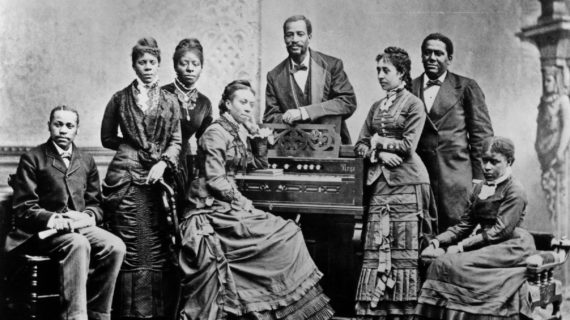
All but two had been slaves. Tenor Thomas Rutling, a former house slave, was almost expelled from Fisk for passing notes to female students. One newspaper deemed him the best tenor in Tennessee. Benjamin Holmes, 23, survived his semester of countryside teaching.
As a slave, he'd secretly taught himself to read and was now a deacon of Fisk's chapel. Like Holmes, 18-year-old Maggie Porter had continued to teach in country schools, uncowed by threats and arson. 21-year-old baritone Isaac Dickerson had been a Confederate colonel's valet in the war. Soprano Jennie Jackson, age 19, was a granddaughter of president Andrew Jackson's body servant.
Youngest of the nine singers was 14-year-old contralto Minnie Tate who, as a free girl, had been taken in by German settlers. The parents of white's singers were afraid to let their children go. Fearing ridicule, even disgrace, his fellow teachers opposed the tour, and the American missionary association refused to help.
WOMAN
George White wanted to target mainly white Christian audiences. And generally, the audiences he was going to be searching for were the same audiences that the A.M.A. already appealed to for support. But there's even more to it than that.
Black singers did not appear on stage during this era, except in the minstrel show. And the minstrel show was a very stereotypical and derogatory image of African Americans. Good, upstanding Christian people did not go to these kinds of entertainments.
NARRATOR
Many freedmen schools had already been crushed by debt and violence. White was convinced that he and his singers had been chosen by God to save Fisk. "'Tis time to root hog or die," he wired the A.M.A. "I'm depending on God, not you." With the last $40 of the school's treasury in his pocket, White took his singers on the road.
READER
"Not one of us had an overcoat or wrap. "Mr. White had an old gray shawl. "Taking every cent he had-- "all his school treasury could spare and all he could borrow-- "Mr.
White started in God's strength October 6, 1871, "with his little band of singers "to sing the money out of the hearts and pockets "of the people. Ella Sheppard."
MAN
Can I ride Ride away to heaven in the morning...
NARRATOR
White's plan was to lead his singers north to perform along the old underground railway starting in Cincinnati and following the network of abolitionist homes and churches that had once relayed escaped slaves to Canada. For their repertoire, White chose European classical and popular songs-- some composed by himself. At their debut in Cincinnati, the audience received them warmly enough but donated less than $50. The next day, news reached the singers of the great fire in Chicago.
They gave all their money to the relief fund and left town empty-handed. Night after night, it was the same story. Crowds loved their singing but the collection plate said it all-- $50 or $60-- barely enough to cover their expenses.
WOMAN
You were staying in flophouses or in boarding houses. You could get your meals there. The meals were nothing to write home about. The rooms were generally dirty.
They were not well kept. The vaudevillians of this period refer to them as "don't-look- under-the-bed rooms." There were probably bugs in the beds. There were probably rats around. There were always signs in the railroad stations saying, "Nigger, read and run." and sometimes there'd be below the sign, scratched on, "And if you can't read, run anyways."
NARRATOR
But no one turned back. "All we wanted," recalled soprano Maggie Porter, "was for Fisk to stand."
BOYER
If the singers don't bring back some money, the school is going to fold, and so that the singers were having to sing at every opportunity. Sometimes they would sing in churches. They would sing for private parties. They would sing for teas.
Sometimes they would ask them to stand on a busy thoroughfare.
READER
"Many a time, our audiences in large halls "were discouragingly slim. "Our strength was failing "under the ill treatment at hotels and on railroads, "poorly attended concerts, and ridicule. "Besides, we were too thinly clad "for the increasing cold of a northern climate. Ella Sheppard."
NARRATOR
The grueling logistics of the failing tour were George White's burden.
ANDERSON
Many times he would have to leave Ella Sheppard with the students, with the rest of the singers, to get ready for the next concert while he went ahead to the next city. There he would have to secure a hall, talk with all of the ministers in the area to try to drum up support, build an audience, advertise. He would have to leave the students at the station because no hotel would take them in and go up and down the streets, knocking on doors to try to find Christian people who would house the singers overnight.
READER
"It is true, we are not received like the Grand Duke Alexis, "but we are willing to wait a little longer "till the good time coming comes. "I feel that our enterprise must be a success, "for God is with us and has given us favor. Benjamin Holmes."
WOMAN
We'll take wing and fly away...
NARRATOR
Week after week, performing with little rest, White and the singers endured rheumatism, coughing fits, bronchitis. Their clothes ran to rags. Sickly Ella Sheppard begged White to send her home, but White refused. He had begun to experiment with the singers' repertoire and now needed Sheppard more than ever.
ANDERSON
Initially, they would have maybe 17 numbers that were "white man's music" and they would include some spirituals, often as encores. But when they saw how those spirituals were received, they began to include more and more spirituals. They arranged them while they were on tour, and that responsibility fell to Ella Sheppard. So here's Ella Sheppard drilling the singers, arranging new melodies, teaching them, practicing the spirituals, all during the time that they're concertizing night after night after night.
It's incredible.
SHEPPARD (dramatized)
"The slave songs were associated with slavery and the dark past "and represented the things to be forgotten. "they were sacred to our parents. "We did not dream of ever using them in public. "It was only after many months "that gradually our hearts were opened to the wonderful beauty and power of our songs."
NARRATOR
On the 16th of November, the weary singers arrived at Oberlin College in Ohio to sing before a national convention of influential ministers. This time, they reached past cantatas and ballads back to the secret music they'd sung behind closed doors-- the sacred songs of their mothers and fathers. Steal away Steal away to Jesus Steal away Steal away home I ain't got long To stay here Steal away Steal away...
BOYER
They started singing "Steal Away." Steal away to Jesus... And all of a sudden, there was no talking. And then they said that you could hear soft weeping and the faces of the people reddened. And I'm sure that the Jubilee Singers were joining them in tears because sometimes when you think about what you are singing, particularly if you believe it, you can't help but be moved.
I ain't got long...
NARRATOR
After their small triumph at Oberlin, word spread from congregation to congregation. Letters and telegrams flew ahead of them, urging other small-town churches to open their doors. Yet the singers still needed a name. After a night of prayer, George White had an inspiration.
"Children," he told the troop, "it shall be Jubilee Singers."
ANDERSON
The name was taken from chapter 25 of Leviticus, from the Bible after the Jewish year of jubilee. The Jewish year of jubilee occurred every 50th year. And in the year of jubilee were provisions for debt relief, provisions for redemption of property, and for emancipation of slavery.
NARRATOR
That winter, White rushed to add more spirituals to the repertoire. Jennie Jackson brought him "I'll Hear the Trumpet Sound." Ella Sheppard taught White her mother's favorite lullaby, "Swing Low, Sweet Chariot." when the Fisk students reached New York in December, it was make or break. Three days before Christmas, Henry Ward Beecher, the most famous preacher in America, had invited them to sing at his weekly prayer meeting. Beecher's Plymouth church in Brooklyn included some of America's richest and most influential families.
If the singers failed here, they wouldn't even have enough money to get back to Nashville.
WOMAN
Oh, Nick...
MEN
Oh, Martha...
READER
"I shall never forget the rich tones of the young men and women "as they mingled their voices "in a melody so beautiful and touching, "I scarcely knew whether I was in body or out of body. Gustavus Pike." "Henry Ward Beecher was on his feet. "and with his hands in his pockets, "he brought out five dollars and told everybody to follow suit. "That was our start.
"Every church wanted the Jubilee Singers "to sing for them from that time on. Maggie Porter." (singer hits high note)
NARRATOR
Even the American Missionary Association dropped its opposition and scrambled to get onboard. It would now take five of their agents, full-time, to accomplish what White and Sheppard had been doing on their own. Touring Connecticut, they brought in a phenomenal $1,200 a week. In New haven and Hartford, hundreds of new fans were turned away.
"I don't know when anything has so moved me," wrote Mark Twain, "as did the plaintive melodies of the Jubilee Singers." In Washington, they delighted President Ulysses S. Grant and a concert hall filled with congressmen and diplomats. "If the Great Book were destroyed today," wrote one reviewer, "it could be recreated out of the fabric of these very songs."
READER
"Success is now at hand. "Our concerts are so well attended "that many are doomed to stand "and many more leave for want of room. "In some cities, excursion trains are going to run "to the places where we sing. "The people seem to be perfectly frantic "about the Jubilee Singers.
Ella Sheppard."
NARRATOR
Now, when the Jubilees encountered northern racism, protests often followed. When the singers were later refused accommodations on Pullman cars, George Pullman integrated the cars himself, and they stayed integrated for another quarter century. When a New Jersey hotel manager threw them out after realizing they were not "black face" minstrels, leading citizens took them in and an embarrassed board of education opened its schools to black children for the first time. "These singers," wrote one newspaper, "are doing a great work for humanity.
"They are, by their sweet songs, molding and manufacturing public sentiment."
SHEPPARD (dramatized)
"New life had come into our bodies. "We sang as if inspired. "We not only paid the debts at home, "we carried home $20,000, "with which was purchased the site of our new school. We returned to Fisk amid great rejoicing."
NARRATOR
They returned to a school under siege. In Nashville, as in many southern cities, northern troops stood guard against vigilantes. The new university president, Erastus Milo Cravath, was determined to oppose white hostility by making Fisk a southern showcase. He set out to build Jubilee Hall-- a grand edifice to capture the imagination of donors and frustrate the torches of the Ku Klux Klan.
MAN
By 1873, '74, in the south there were a series of fires, and many of those places identified as schools for the former slaves come under the torch. But Jubilee Hall will stand as a mighty structure with walls more than 12 inches thick of stone and brick. It would be adorned by a bell tower, which can also serve as a watchtower.
NARRATOR
Building Jubilee Hall was going to take a lot more money. After less than two weeks' rest, Sheppard and White reorganized the Jubilee Singers and took them back on the road. Now they were paid professionals supporting a large entourage of managers, matrons, tutors, and advance men.
CHORUS
Glory, glory, hallelujah...
NARRATOR
In July of 1873, at Boston's World Peace Jubilee, the singers were called on to make themselves heard over a 1,000-piece orchestra, a chorus of 10,000, and a battery of cannons in a colossal performance of "The Battle Hymn of the Republic."
READER
"With voices that rang clear, "reaching the utmost of the vast building, "we took the audience by storm. "Strauss, the German composer of waltz music, was present "and threw up his hat "during the burst of applause which followed. Georgia Gordon."
FRANKLIN
They were representing a new freedman, a new kind of black person. The dignity, the carriage, the voice, and the articulateness of these young people surprised large numbers of northerners.
NARRATOR
Not every northerner was won over. The "New York World" called them "trained monkeys" who sang "with a wild darkey air." The "Newark Evening Courier" listed them as if they were items from a slave dealer's catalog. In Baltimore, a ticket seller refused to sell the singers admission to their own concert. And there was more.
Other black schools began their own choirs. Hucksters passed themselves off as the original Jubilee Singers. All this further popularized the spirituals but cut into the Jubilees' receipts. The singers were forced to seek out new fields for harvest thousands of miles from home.
In April 1873, they set sail for the British Isles. This little light of mine... Only one day after their London debut, the singers were astonished to find themselves performing before none other than Queen Victoria herself. This little light of mine...
READER
"The queen wore no crown, no robes of state. "But it was the queen in flesh and blood. "I saw her, I heard her deep, low voice saying, "'Tell them we are delighted with their songs.' "I wondered why the queen did not speak these words to us. "We were within hearing.
Maggie Porter."
NARRATOR
"They are real Negroes," wrote the queen in her journal that night, "come from America and have been slaves. They sing extremely well together." The queen's pleasure opened every door. Prime Minister Gladstone, the prince of Wales, dukes, duchesses, and earls were transfixed by their songs. And the singers were quickly embraced by evangelicals crusading to save British souls.
At Reverend Charles Spurgeon's vast tabernacle, they sang to a congregation of 6,000. Across England, Scotland, and Ireland, they were a phenomenon. Books and newspapers chronicled their rise from slavery. At concert after concert, their portraits and song books sold out to British fans.
Thomas Rutling and Isaac Dickerson left behind a string of broken hearts.
MITCHELL
These young people are perfect Victorians. They are dressed in Victorian elegance. They deport themselves in a very Victorian manner. Remember, the world was not accustomed to looking at black Victorians.
This may be the inspiration as much as the songs and the music for Queen Victoria to allow her portrait painter to paint a beautiful Victorian portrait of these young Jubilee Singers.
NARRATOR
The British were fascinated by their color. They said Mabel Lewis and Georgia Gordon could pass as English belles, and Minnie Tate as coming from the south of France. Dark-complexioned Jennie Jackson was most sought out of all.
READER
"She had no peace. "She would take her umbrella and beat her way along with it. "One time a crowd was following us, "and when we got to the hotel, "the proprietor had to take the hose to drive the crowd away. Mabel Lewis."
NARRATOR
Mabel Lewis enjoyed teasing her fans.
LEWIS (dramatized)
"One time we heard someone say, "'I am going to speak to some of them "and see if they speak English.' "She came up to me and said, 'Do you all speak English?' "'Ugh?' I said. "'Do you speak English or do you just learn the songs?' "'Baca migly pan mar tu,' I answered. And she said, 'I guess they only sing in English.'"
NARRATOR
In the spring of 1874, the Jubilee Singers returned home in triumph with another $50,000 for the construction of Jubilee Hall. "No one can estimate the vast amount of prejudice which has perished under the spell of their marvelous music," declared the board of trustees. "Wherever they have gone, "they have proclaimed to the hearts of men the brotherhood of race."
MAN
In times like these, yes... Oh, in times like these In times...
NARRATOR
But success in England had come at a price. Worn down by a relentless schedule, an advance man suffered a nervous breakdown. Typhoid fever carried away George White's wife. White himself nearly died of a pulmonary hemorrhage.
Contralto Minnie Tate had sung her voice to shreds. And the nagging cough Benjamin Holmes had urged friends not to worry about turned out to be tuberculosis. Throughout Tennessee and the rest of the south, the hopes of African Americans were being dashed. The Freedmen's Bureau, established by Congress to enforce the rights of emancipated slaves, had been abolished.
Federal troops that had once protected African Americans were gone. Many black schools shut down. Former Confederates took over legislatures and began to replace laws protecting black rights with new segregation codes. And despite all the singers had sacrificed, Jubilee Hall was still only a hole in the ground.
Fisk's president Cravath knew this was because the A.M.A. had been borrowing heavily from the Jubilee Hall fund to stave off its own bankruptcy. Cravath was anxious to get the singers back on the road not just to build up Fisk and Jubilee Hall, but to rescue the overextended A.M.A. Reminding them of their evangelical mission, Cravath prevailed on the exhausted Jubilees to embark on yet a third tour.
In January 1875, George White and Ella Sheppard organized a new troupe of singers. Ella and Thomas Rutling, Maggie Porter and Jennie Jackson were the only original Jubilees left. Among the newcomers was America Robinson, a Fisk student engaged to classmate James Burrus.
READER
"Dear James, this morning, there was combat on our behalf. "A southern man was enraged "because the proprietor took us in. "A northerner told the southerner "that he was a half 'nigger' himself. The southerner attempted to throw the paper "at the northerner "so the northerner struck him on the mouth with a chair.
"Many boarders threatened to leave. America Robinson."
NARRATOR
After long tours of America and Britain, the Jubilees traveled to Switzerland and Holland to test the universality of their music. I'm a-gonna lay down this world Gonna shoulder up my cause... Arriving in Amsterdam in winter of 1877, the singers were mobbed by adoring fans.
READER
"Our arrival created a greater sensation "than a circus in the United States. "We could not go walking or shopping on foot "because crowds of children in wooden shoes "surrounded us so closely that we could not get on. Ella Sheppard."
NARRATOR
They performed for the queen of the Netherlands and raised another $10,000. But the non-stop schedule was wearing out George White and the singers.
BOYER
The voice is the one thing that we can't camouflage. We can't put makeup on the voice and have it come out a different way. So if you have a cold, if you're tired, if you're hungry-- all of these things come out in the voice. So you have not only the physicality of singing and the problems of dealing with-- with working on stage, but you have on top of all that the whole issue of the pressure that these kids are under to prove a point.
The point is that African Americans are educable people, that they are people who can gain from a college education. Many people didn't believe that.
NARRATOR
That summer, White asked Cravath to come help manage the troupe. He got more than he bargained for. Cravath had no musical training, but he had big plans, starting with an ambitious tour of Germany, birthplace of Bach, Beethoven, and Brahms. White was against it.
"I know what is necessary to win musical success in Germany," White argued, "but I see no chance at all to accomplish it." But in the end, the Jubilaums-Sanger were a popular and critical sensation.
READER
"What wealth of shading. "What accuracy of declamation. "Something may be learned from these Negro singers "if only we will consent to break through "the fetters of custom. 'Die Berliner Musikzeitung.'"
NARRATOR
Even when the Germans did not understand the words, they cried and smiled at the same places as English audiences had. At Potsdam, they sang for Kaiser Wilhelm I. As the Jubilees sang, Crown Princess Victoria, daughter of Queen Victoria of England, burst into tears.
READER
"Afterward, she remarked "she hoped we did not think her silly, "but she could not help weeping. "She is in mourning for a child and the song probably reminded her of the lost one."
NARRATOR
"These songs, as you sing them, go to the heart," explained the crown prince. "They go through and through one." In later years, many of the singers would remember these concerts as the crowning triumph of their careers. But this was soon overshadowed by news from home. With conditions worsening in the Tennessee countryside, hundreds of African Americans were fleeing to the cities for refuge, cramming into slums.
Epidemics were rampant. Tuberculosis claimed three Fisk students, among them the Jubilees' old friend and colleague Benjamin Holmes. "We were all quite prepared for his death," wrote America Robinson, "but we all felt it deeply-- everybody loved Mr. Holmes." They traveled from Berlin to Magdeburg Magdeburg to Leipzig-- on and on through Germany.
An astonishing 68 concerts in 41 towns in 98 days-- not including impromptu performances in churches, trains, and private homes. Many nights, only six out of 11 were well enough to perform. Ella Sheppard collapsed and was sent to Holland to recuperate. Then Julia Jackson suffered a stroke.
READER
"About 4:00, she got up and in attempting to get back into bed "fell across it, unable to move herself. "It never entered our minds "that such a dreadful thing as paralysis "had taken hold upon her, but it was even so. "It has left one whole side of her powerless. America Robinson."
NARRATOR
A new baritone named Frederick Loudin blamed Cravath.
LOUDIN (dramatized)
"You have only thought "of how much you could get out of the singers. "Three years killed Mr. Holmes. "Ella is quite gone.
"Jennie Jackson is failing, as all can see. "Still, you seem determined to drive ahead "as if we were all superhuman. "And as fast as we are killed, you put in a new one. Frederick Loudin."
NARRATOR
These were no longer the wide-eyed teenagers who had set out six years before. Most were now well into their 20s. Almost every one of them had been offered opportunities to study at British universities, perform for rival groups, or even strike out on their own. And they knew their own worth.
More and more, they demanded a say in how the troupe would be managed.
ANDERSON
George White was used to running the group and giving clear directions and mandating how things were going to go. But as the membership and the group evolved and became a professional organization, the individual members had ideas equally about how things should go. And they often clashed with George White.
NARRATOR
After a six-week recovery from near-fatal pneumonia, Ella Sheppard rejoined the singers in Germany to find chaos. George White, worn out from illness, railed at the singers he still called his "children" and submitted his resignation. To Sheppard's horror, Cravath accepted it. He was already planning tours of Australia, South America, and the American west.
To keep the troupe alive, Cravath asked Sheppard to take over from White. After prayer, Ella agreed on the sole condition that she and the exhausted Jubilees return to Nashville at the end of their current engagements. There would be no new bookings. Cravath called her a deserter.
SHEPPARD (dramatized)
"Though I live to be an old woman, "the scar of that word 'desert' will remain upon my heart. "As hard as I've worked for seven years-- "late and early, doing extra work-- to at last be called a deserter."
NARRATOR
Ella stood her ground. She directed the troupe for the three contentious months it took to finish their engagements. Even Cravath could see that it was time. Rivalries among the singers had become open.
Morale was low, nerves were frayed. After almost seven years of touring together, singing night after night, the Jubilee Singers had had enough. At long last, the singers started for home. As their ship approached American waters, they sang together one last time.
READER
"Many wept during the evening, "and one lady followed me to our room, weeping, "and threw her arms around my neck "and kissing me, cried, "'I do thank you-- I never felt such music before.' "How much good we might do "not only for others but for our people and hearts. "May our Father forgive us. Ella Sheppard."
FRANKLIN
The contrast between the world that the Jubilee Singers left and the world to which they were returned is considerable. They had been wined and dined and lionized and praised all over the north and all over Europe, and had seen how a human being could live. Bad for them to come back to a world that has deteriorated even since they left.
NARRATOR
Some never did come back. Thomas Rutling and Isaac Dickerson refused to set foot in America and eventually died in England. The years of touring reduced George White to an invalid. Like Benjamin Holmes, he died of consumption.
At his memorial service in 1895, a few of the Jubilees returned to sing his favorite spiritual, "Steal Away." The singers who returned to Nashville were honored by Fisk for raising over $160,000 to complete Jubilee Hall and save their school. But as emissaries of the freedmen, their contributions extended far beyond Fisk University. They had introduced the world to the sacred hymns of their ancestors.
MAN
Lord, I keep those...
NARRATOR
Ella Sheppard eventually returned to Fisk to be the teacher that she had wanted to become when she first arrived in 1868. By the time of her death at the age of 63, she had become one of the most respected women of her day-- a confidante of Frederick Douglass and Booker T. Washington. And Sarah Hannah Sheppard, the mother who had once tried to drown Ella and herself rather than live in bondage, lived out her life in her daughter's house, witness to the fulfillment of a prophesy made back in the days of their bondage under the clouds of the Lord.
CHORUS
When I'm feeling the pull... I'm working for the kingdom Ain't got time to die. 'Cause it takes all of my time To praise my Jesus All of my time to praise my Lord If I don't praise Him, the rock's going to cry out Glory and honor, glory and honor Ain't got time to die
ANNOUNCER
Next time...
JOSEPH McCARTHY
Even if there is only one communist in the State Department, that would still be one communist too many.
MAN
Joe McCarthy turned anti-communism into something bigger than anyone else ever imagined.
McCARTHY
You're not fooling anyone at all, senator.
MAN
He tells a lie, and by the time you've responded to that, he's told three others.
JOSEPH WELCH
Have you left no sense of decency?
ANNOUNCER
"McCarthy," coming soon to "American Experience." Made possible in part by Liberty Mutual Insurance.
Search Episodes
Related Stories from PBS Wisconsin's Blog




Donate to sign up. Activate and sign in to Passport. It's that easy to help PBS Wisconsin serve your community through media that educates, inspires, and entertains.
Make your membership gift today
Only for new users: Activate Passport using your code or email address
Already a member?
Look up my account
Need some help? Go to FAQ or visit PBS Passport Help
Need help accessing PBS Wisconsin anywhere?

Online Access | Platform & Device Access | Cable or Satellite Access | Over-The-Air Access
Visit Access Guide
Need help accessing PBS Wisconsin anywhere?
Visit Our
Live TV Access Guide
Online AccessPlatform & Device Access
Cable or Satellite Access
Over-The-Air Access
Visit Access Guide




Follow Us