

 Passport





Amid rising house prices, Richland Center residents decry development on parkland
A group of residents in the small southwest Wisconsin community of Richland Center says local officials have ignored their concerns in moving forward with a plan to build duplexes on a six-acre green space in the city, where housing prices have increased 76% since 2017.
The Badger Project
December 18, 2025 • Southwest Region


A roadside sign on U.S. Hwy. 14 indicates the population of Richland Center on Feb. 26, 2024. A proposal to build duplexes in a park is generating conflict over housing development in the southwest Wisconsin city. (Credit: PBS Wisconsin)

In the national war for affordable housing, a familiar battle is raging in Richland Center, a little city in the Driftless area that’s surrounded by wilderness and farm fields.
A move to put duplexes on a six-acre village green has pitted some residents against their city government.
“It’s the soccer field, it’s the picnic field, it’s the place where everybody goes,” said Jeri Rust, who grew up in town and now splits time between Richland Center and Arizona.
But “the city needs housing, and we have before us a proposal that would be the envy of any other community,” Richland County Board Chair David Turk said at a September city council meeting.
Since 2017, the average home price in Richland Center has increased from about $102,000 to $180,000, a 76% change, according to Zillow, the real estate marketplace.
Stori Field is the “crown jewel” of the neighborhood, said Greg Dettmann, a resident who grew up in the city and lives across the street.
The field is named for teacher and coach Dave Stori, who revived the high school’s track team in the 1940s. For decades, Stori Field hosted athletic practices and P.E. classes.
“I threw up more than once on that field,” Dettmann, 74, joked about his own time exercising on the field as a kid. “You can’t get green spaces back once they’re gone.”
But Richland Center has between three to six times more parkland than what the National Recreation and Park Association recommends for the city’s population, city attorney Michael Windle estimated. And there are other venues for recreation around the city, he said.
It’s a common fight across the country, as residents resist new housing to keep their neighborhoods from changing.
“When you say it’s easy to find places to build, no, it isn’t,” Mayor Todd Coppernoll said at a September city council meeting. “We don’t have adequate housing stock at any income level, in my opinion.”
Richland Center, like many communities, is struggling to provide affordable housing, especially for seniors, as its population ages and the number of small home builders declines, according to a Richland County analysis.
The community’s median income is lagging behind its median home value, and “there is not enough affordable housing,” according to a Richland Center study from 2024.
The city has struggled to find companies to build. When one developer, Enke Properties, zeroed in on Stori Field and agreed to cover the costs for major expenses like utilities, sidewalks and street lights, the city jumped at the offer. On top of the additional housing, the 16-unit development would also generate about $100,000 in annual tax revenue to be split between the city, county and school district, Richland Center city officials estimate.
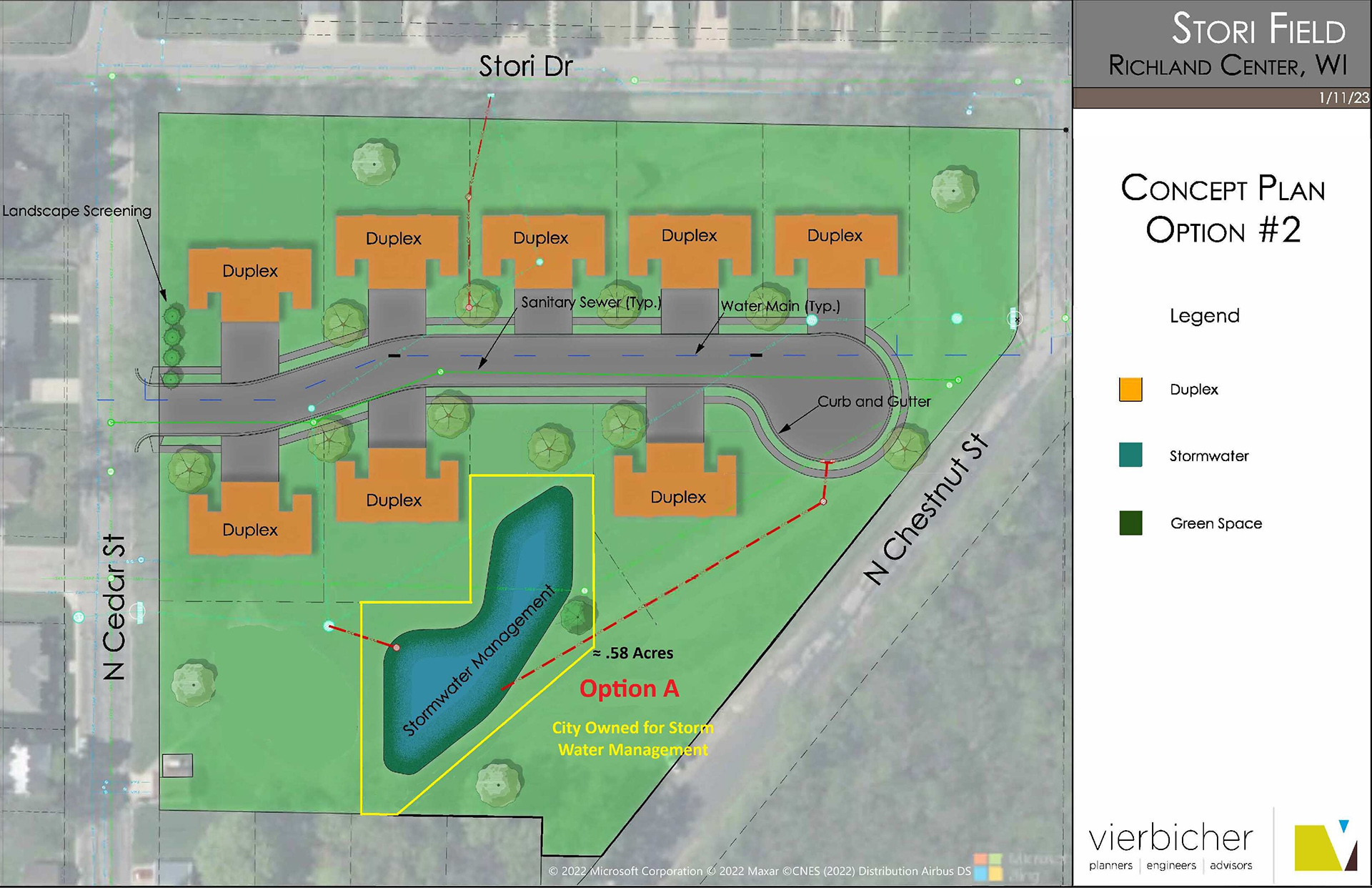
An overhead illustration depicts a proposal for building a series of eight duplexes on Stori Field in Richland Center. (Source: City of Richland Center)
The city greenlit the sale of Stori Field on Oct. 7. In response, but before the transfer officially went through, residents submitted a petition with nearly 700 resident signatures asking the city to prohibit any sale without the voters’ consent. Richland Center has a population of about 5,000 people.
On Nov. 13, the same day the clerk certified most of the signatures, the city rejected the petition, saying it omitted necessary language. The city officially sold the land for $1 to the developer the same day.
“PR-wise, I think they fell on their face,” Mary Collins, a resident of Richland Center and the chair of the Richland County Democratic Party, said of city officials.
But “from a legal perspective, I’m not sure that there’s anything stopping the city in this instance,” said Derek Clinger, a senior staff attorney for the State Democracy Research Initiative at the University of Wisconsin Law School.
Residents submitted a second petition Nov. 21, which the city acknowledged but says conflicts with the Oct. 7 ordinance it passed authorizing the sale.
In Wisconsin, Clinger said, a direct legislation attempt, in this case the residents’ petition, can’t be used to pass a city ordinance that clearly conflicts with an existing city ordinance. But the city’s actions could certainly have political consequences in future local elections, he noted.
Shelly Dobbs, another leader in the push to protect Stori Field who has also taken the issue to the Wisconsin Elections Commission, said her citizen group is considering legal action.
But the city’s focus on Stori Field has angered some who feel there are opportunities for development elsewhere. The city says it is considering more options in addition to Stori Field.
Ellen Kellar Evans owns two rental properties near Stori Field with her husband and had been working to build 19 single-family homes in the city. She said Richland Center even offered them a $1.5 million federal grant for the project. But she said the city’s unrealistic deadlines and the ire she feels about the Stori Field project have changed things.
“We don’t think we can trust them anymore to make good decisions,” she said.
The city has since pulled the grant.
Residents have repeatedly pointed to the decommissioned University of Wisconsin campus owned by the county as an alternative to Stori Field. In response, the mayor asked Turk, the county board chair, to give an update on the campus at a special meeting Sept. 24.
“The campus is a big chunk of land,” Turk said. “Is it ready to be developed? No.”
But in his emails to The Badger Project, Windle referenced a Nov. 19 presentation the city gave at a county meeting about a proposed subdivision on the campus.
“We feel like we were fooled by thinking that couldn’t be available for years,” Kellar Evans said. “I’m very confused, myself, and I think everyone else is. We just don’t understand.”
The campus project, Windle said, would be in addition to Stori Field.
“At this time,” Windle said, “Stori Field is the sole and exclusive property of Enke Properties, LLC.”
The Badger Project is a nonpartisan, citizen-supported journalism nonprofit in Wisconsin.




Follow Us