

 Passport






Harbor View Cafe, Nettie’s Volta
04/30/26 | 26m 48s | Rating: TV-G
Luke travels to Pepin's Harbor View Cafe, a four-decade institution built on cooking to order, local sourcing and dishes like halibut with black butter caper sauce. Then it's on to Plum City, where Nettie's Volta shapes its menu from foraged ingredients and hyper-seasonal Midwestern produce. Explore the quiet culinary depth of western Wisconsin.


Copy and Paste the Following Code to Embed this Video:
Harbor View Cafe, Nettie’s Volta
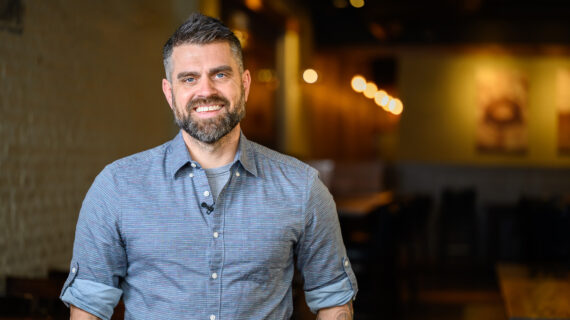
– Luke Zahm: This week on Wisconsin Foodie: In a quiet town of 700 exists a caf that has been around for 46 years cooking nationally acclaimed food: the Harbor View Caf.
At this restaurant, we get to see community in its most pure essence.
What's up, Chef?
It's a tremendous honor for me to be back here in the hallowed grounds in the kitchen of Harbor View Caf.
This place is an institution.
This halibut dish, this has been here since day one.
Just about?
– John Flicek: Yeah, I mean, it's older than I am.
– Luke: This is worth coming to a town of 700 and change, driving from wherever you're at.
Waiting outside by the beautiful Lake Pepin and getting your place in the line at the Harbor View Caf.
[gentle music] Plum City, population 600, give or take.
Home to a restaurant that encapsulates the essence of this place.
Local farmers, food, foraged food, things that are really, truly building an identity of community.
Man, this whole experience is absolutely fantastic.
Being in the restaurant, it feels like time slows down a little bit.
Getting to experience this food and the storylines behind it, it truly feels like I'm in Grandma's kitchen.
Wisconsin Foodie would like to thank the following underwriters.
[gentle music] - Did you know Organic Valley protects over 400,000 acres of organic farmland?
So, are we an organic food cooperative that protects land, or land conservationists who make delicious food?
Yes; yes, we are.
Organic Valley.
- Other sausage makers use the AI-generated voice of their namesake and founder.
Our products are finely crafted, made from time-honored recipes with ingredients you can actually pronounce.
Jones: Making breakfast better since 1889.
- The Wisconsin potato and vegetable growers are proud underwriters of Wisconsin Foodie.
It takes love of the land and generations of farming know-how to nurture a quality potato crop.
Ask any potato farmer and they'll tell you, there's a lot of satisfaction in healthy-grown crops.
- Employee-owned New Glarus Brewing Company has been brewing and bottling beer for their friends, only in Wisconsin, since 1993.
Just a short drive from Madison, come visit Swissconsin and see where your beer's made.
- With additional support coming from The Conscious Carnivore.
From local animal sourcing to on-site, high quality butchering and packaging, The Conscious Carnivore can ensure organically raised, grass-fed, and healthy meats through its small group of local farmers.
The Conscious Carnivore: Know your farmer, love your butcher.
- Also, with the support of the Friends of PBS Wisconsin.
[upbeat music] - Luke: We are a collection of the finest farmers, food producers, and chefs on the planet.
We are a merging of cultures and ideas, shaped by this land.
[brats sizzle] We are a gathering of the waters, and together, we shape a new identity to carry us into the future.
[glasses clink] We are storytellers.
We are Wisconsin Foodie.
[dreamy music] In a quiet town of 700 exists a caf that has been around for 46 years cooking nationally acclaimed food: the Harbor View Caf.
At this restaurant, we get to see community in its most pure essence.
Diners walking in with familiarity, saying hello.
Owners who have been related to most people on the staff, and of course, a food ethos that speaks to the heart of our Midwestern values.
The Harbor View Caf is an icon in the restaurant community of western Wisconsin, and frankly, all the aspects of community that restaurant provides can be found right inside these doors.
And today, we're reppin' in Pepin.
– Missy Murray: You are at the Harbor View Caf in Pepin, Wisconsin, and my name is Missy Murray, and I'm one of the owners.
The Harbor View is a place where people come to hopefully enjoy a great meal.
The interior is, as far as I know, has been like this as long as anybody can remember.
The books all around, the books are the original owner's collection.
It's definitely a talking point.
We haven't changed that.
Not at all.
– Wendy Murray: Hi, I'm Wendy.
I'm one of the owners of the Harbor View Caf.
No menus, no paper menus.
Nothing is handed out.
Everything is on the chalkboard.
Every day, Chef John will put together his menu and what he wants it to be.
There are some staple items that are gonna be on the menu every day, and the rest of it's up to him.
– Missy: You know, we're not a burgers and fries kind of place.
We do as much locally as we can.
We get the freshest things that we can.
We get them in every week.
So, when you come in here, you know, sometimes there's a long wait or there's a wait for your food, and that's because they're making it to order.
When you come in here, when you place your order, we're putting it on the stove and it's being cooked then.
The most popular dishes on the menu is gonna be the halibut with black butter caper sauce.
The stuffed mushrooms, they're stuffed with four cheeses, garlic and herbs in a cream sauce over linguine.
The original owners, Paul, Carol, Tom, Stuffy, the vision that they had, 45 years later, has been amazing.
There hasn't been a lot of change.
We hope as owners that the feel and the vibe hasn't changed.
Our head chef, John, came to us from Red Wing.
He is local.
His family's, you know, in Wabasha, from Wabasha.
He couldn't be a better fit.
He has the same vision.
The passion that he has, it's really fantastic.
He's been a great fit.
[dreamy music] - What's up, Chef?
It's a tremendous honor for me to be back here in the hallowed grounds and the kitchen of Harbor View Caf.
This place is an institution.
– John: This place, I mean, when I was a kid, this place was popular, so... - Luke: Yeah.
And it's taken you, like, full circle to come right back here?
– John: Yeah, I kind of found my way back home.
– Luke: Sweet, I love that.
This halibut dish, this has been here since day one, just about?
– John: Yeah, I mean, it's older than I am.
- It brought me back in here today because I have to see how this one's put together.
- Okay.
- That beurre noir, the black butter sauce.
- Yep.
- My first time at Harbor View, it was the dish that I ordered, and, you know, it kind of blew me away.
It changed a lot of conceptions about dining in a small town in Wisconsin.
- Okay.
- So, if you're cool with it, would you put it together for me today?
– John: Yeah, yeah.
– Luke: We dusted this with a little flour.
– John: A little flour, a little bit of paprika and some onion powder, a little bit of salt and pepper.
- All right, so you laid the halibut right into the cast iron pan.
- Yeah.
- Which is super old school.
- Yep.
- You know, good, seasoned cast irons like this are kind of hard to come by.
And modern restaurants utilizing them in this way is even more rare.
Can you talk to me just a second about the food ethos here?
Like, you know, some of this seems rooted in, like, provincial French food.
You know, it's definitely rustic.
– John: Yeah.
– Luke: What would you say if you had to explain the vibe?
– John: I mean, I think it's kind of like country French, you know what I mean?
– Luke: Yeah.
– John: Heavy on the sauces, heavy on making stocks.
Soups, braises, so a lot of French technique.
And then it's just kind of eclectic too, man, with the different styles of sauces they got going on.
- How much of the menu has, like, remained during the 46-year tenure of this restaurant?
- I mean, I think the concept's pretty similar.
Their big sellers are gonna be like the halibut, the chicken, and the stuffed mushrooms.
And then it seems like they always have, like, a different technique as well.
So, there's always a braised item, a grilled fish item, so that concept has kind of stayed the same.
And then you just kind of rotate different items through it.
- Sure.
How about local sourcing?
Do you find any inspiration from the farmers or, you know, artisans in the area?
- Yeah, yeah, we do local where we can.
There's actually a really nice farmer's market up in Red Wing, so every Saturday, like, I'll hit that up before, see what they got, and just kind of come up with something just to get a little, little inspired, you know, something real fresh, real light, so... [bright music] This is gonna be a balsamic vinegar, reduced and then heavy cream reduced.
Salt, pepper, Tabasco, and lemon juice.
[bright music] - Luke: So, it's really rare that I get the chance to try a dish in its place of origin, namely the kitchen.
But what we have here is we have this halibut with the-- it's a noir sauce, a butter noir.
So, a black butter, capers, jasmine rice, a little bit of a lemon there, which has been really artfully cut up.
I have steamed pea pods and then salsa, and all of this is made from scratch by these lovely human beings right next to me.
This is a classic dish, one that's been bringing in diners for over 46 years, and I'm really excited to give it a taste.
Halibut is one of my favorite fishes when I can get it in season.
It's rich, it's got like a really meaty texture.
It doesn't impart a ton of fish oil or fishiness.
It's just really solid and delicious.
You know, the beurre noir, the black butter sauce is really where it's at.
So, this is butter that's taken beyond brown, right?
So, you take all those fats, all those protein structures, you get 'em separated.
And then that Maillard reaction happens.
When that happens, you bring out the richness, you bring out the sweetness inherent in that butter.
And then I can taste that it's cut.
We've got an acid.
You've got the saltiness of the capers, which is really well balanced.
And overall, it just kind of sings.
It lights up the side of your palate, which really paves the way for that rich, delicious halibut to come right over the top.
It's... it's a banger.
This is worth coming to a town of 700 and change, driving from wherever you're at, waiting outside by the beautiful Lake Pepin and getting your place in the line at the Harbor View Caf.
Chef, thank you.
- Yeah, thanks, man.
- That dish is delicious.
It's no wonder that it's an iconic dish in Wisconsin and for this place.
And I also love, like, the youthful energy you've got going on in this kitchen.
It's a lot of these kids first jobs, you can tell.
- Yeah.
- And that builds community.
- Right, right.
- I'm in awe of this place, man.
Keep up the great work.
- Cool.
– Luke: Thanks for having us in.
– John: Yeah, appreciate it.
– Luke: You bet.
[groovy music] Plum City, population 600, give or take.
Home to a restaurant that encapsulates the essence of this place.
Local farmers, food, foraged food, things that are really, truly building an identity of community.
I'm super curious to meet Chef Dave and see what this place is all about.
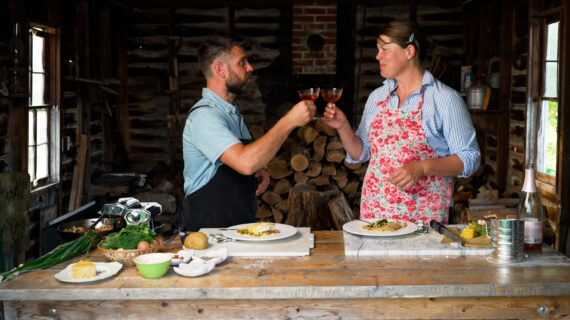
[groovy music] - Dave Kerr: Right now, we're working on raviolis.
So, we're working on the filling for those.
Some of that play off real traditional potato and leek type flavor, but we're using potatoes and ramps.
Utilize some of those forage ingredients that we're getting.
And then breaking down some oyster mushrooms for the filling of the ravioli that goes in there with the potatoes and the ramps, as well as in the sauce with that.
So, that's kind of what we're prepping now.
This is Justin.
Justin's been-- Justin started off as a dishwasher.
We had to kind of utilize him in the kitchen a little bit more, so he moved up right away from the dishwasher position.
He's been killing it for us.
This is Wyatt.
A little biased, proud dad moment.
But Wyatt's my son.
Couldn't do it without him.
He's been here, obviously, since day one.
Started professionally cooking at 14, and has really been doing it.
Again, he started off-- kind of a similar story.
Started off at a French restaurant in Minnesota on the other side of the river, and was down the dish pit a lot and watching the gentlemen make pasta.
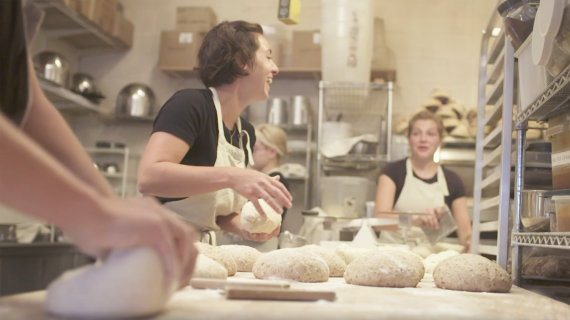
He's taken over here for us, you know, doing the pasta.
So, he's working on the on the ravioli right now.
It's been a lot-- It's always fun to work with your family, but to see him kind of to grow and excel has been a lot of fun for us.
We do things on a smaller scale.
Again, we're running a small dining room so we don't have to, you know, focus on efficiency sometimes.
– Arthur: How did you get into food and cooking?
– Dave: Grandma.
Grew up in a multi-generational home.
Grandma lived with us, so she was always around and cooking, do a sweet and sour cabbage that growing up as a kid, I just sort of thought was always kind of a farm recipe.
I grew up with a first-generation Sicilian woman who married, met a German guy after the war and ended up in the middle of Wisconsin.
And I just thought it was kind of a combination of those flavors.
And then you start to realize as you go through your career, that that sweet and sour cabbage is a real traditional Sicilian thing, you know?
I was really fortunate to grow up with a different, a little bit different influence.
But still, that connection to the local community and still have that farming feel to a lot of it.
One of my earliest memories that I have as a child was standing up on the counter and reaching up into the spice rack, so I must have been, you know, this tall, and reaching up and just going in the spice rack and pulling them all out, putting a little in my hand and smelling it and then tasting it.
And I still cook by-- a lot of it is smell to me.
You know, the aromas of things.
I can kind of taste them by scent and combine them in my head.
The beginning part of the season, it's so much fun with, you know, the morels pop out first.
The ramps kind of come up young and tender.
And then we're using a lot of the tops.
A lot of those smaller areas, especially along the trout streams, we kind of combine two for one.
We like to fish as well, so we're kind of looking for the morels in the same areas.
Then we get into the season where the oysters start coming out, and then fiddlehead ferns.
And that's sort of that transition period to morels and the smaller ramps go away.
And then before you get into the mushrooms, you have this little period with the fiddleheads.
So this is the filling that we're working with.
So, again, the potatoes, the ramps, the pheasant back and oyster mushrooms are in here.
So, a really cool dish for us.
Our ravioli, we do everything here in-house, obviously.
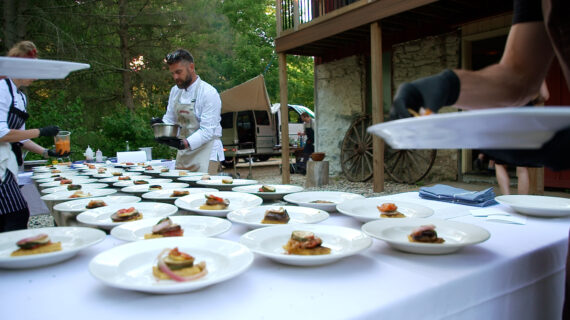
Just packed full of foraged ingredients that we've gone out as a staff, and with the help of the community as well, and gathered a lot of these ingredients.
Fiddlehead ferns in there, oyster mushrooms, pheasant back mushrooms, locally-raised pork with the bacon.
And also as a staff, kind of a fun one for us to do.
We just kind of had this assembly line process, you know?
Somebody's making the dough, somebody's working the filling, somebody's finishing the pasta.
So, a lot of fun, just again, all the flavors of the season, as much as we can do in there.
Kind of a finish with the orange zest, again bring our flavors that we really stayed true to with the citrus.
[gentle music] - Luke: Thank you.
[gentle music] This dish tastes like a walk in the forest.
- Yeah, it really does.
Really earthy.
The ferns, the mushrooms in there, again, ramps, and just finished with that smokiness with that Berkshire, that heritage pork.
– Luke: Yeah.
You know, the thing that I love about it, number one, it's beautiful.
You eat with your eyes first and, you know, to have a plate of ravioli, there's something so satisfying about that, I think, as a diner.
The earthiness of the mushrooms really, really balance well with, you know, the density of the pasta, the salt and black pepper.
And then when you think you've got it all figured out in your palate, you get a little bit of that, like, inherent green bitterness in that fiddlehead fern.
And it just gets kissed with that touch of orange.
Man, it just keeps going.
It's one of those flavor bombs.
– Dave: Thank you.
Yeah, the fiddleheads are just that sort of that, like you said, add a little bit of bitterness, a little bit of that acidity to there to kind of cut through all that earthiness.
– Luke: The thing that I love about this is it's so uniquely Midwestern.
I mean, it's of this place right here, right now.
Did you grow up eating like that?
I mean, where did you get the chops to put together a dish like this?
- I did, I had a really unique situation where I was able to grow up with a Sicilian grandmother that ended up in the Midwest.
So, a lot of our food is kind of a balance of the influences.
You know, growing up on a small farm in Wisconsin in the area, but having that influence of a mother-- of a grandmother that was from the Mediterranean.
So, we do combine them whenever we can, again, make the most of what's local and seasonal, but definitely that influence that my grandmother passed on to me.
You know, her flavors, her cooking, always try to pay respects to her as well.
– Luke: Yeah.
I think it's beautifully reflected in your food.
Like, this is-- It's a concoction of, like, divine inspiration and passion, right?
To take the care to put something together, like a handmade pasta, fill it with, you know, things that you've foraged, garnish it with things that you've foraged.
Highlight it with, like, a local farmer's, you know, bacon.
That is like telling the story of Plum City to people that maybe have never heard of this quaint village before.
But I'm telling you, this is going to knock people's socks off.
- Thank you.
- Honestly, I'm-- I could eat this all day, but I'm really looking forward to seeing what's next.
– Dave: Sounds good.
So, yeah, we have a seared duck breast coming up with, again, kind of a touchstone.
We prepared some things for you, again, seasonal.
And this is one that really hits close to home as well.
It's Grandma's sweet and sour cabbage, real traditional Sicilian dish.
So, we're starting off with the sauce for the sweet and sour cabbage.
Really don't change a bunch from the way Grandma did things with this one.
So, a lot of citrus juice that we're working with there.
And then, we'll get into some red wine there, but before we let the citrus juice reduce.
And then... Grape jelly.
So, we've been able to, again, work with some of the people in the community, the ladies next door that run little consignment shop, and they harvest wild grapes and make jelly for us.
Another one of those ingredients that comes right up Plum Creek behind the building, and someone local is making that for us.
So, we're just tweaking the recipe a little bit, but we're still staying true to what's in there.
You know, all that citrus juice and grape jelly, a little bit of red wine, and then, of course, a little garlic to make it a little more savory towards the end, so yeah.
[bright music] - Luke: Man, this dish is beautiful.
– Dave: Thank you.
- It obviously speaks to the bounty of the area.
And I wanna know just a little bit more about it.
Like, what makes this dish shine for you?
- So, what makes it shine to me, again, it means a lot, childhood recipe.
It's something my grandmother always did, the sweet and sour cabbage, very traditional, Sicilian preparation.
I just thought it was just cabbage as a kid, you know, and the sweet and sour, German grandfather and those influences as well, it just really worked.
So, that's been on the menu in different forms.
Lots of times, we pair it with a fish that's sort of that sweet and sour is a good counterpoint with it.
There's lots of citrus in it.
Here, we did it with a duck.
So, that sauce works well for the duck, works with the cabbage.
Yeah, it's an ingredient we like working with.
Again, some of the game meats where there's so many products around here, the beef, the pork, things like that, but just to kind of expand upon that a little bit, lamb, goat, duck, with rabbit occasionally as well.
Just the full range of the proteins.
[bright music] - That's so good.
The first thing that hits my palate is the sweetness on that, that cabbage agrodolce, like, the sweet and sour.
And then the richness of the duck.
Like, duck is one of those really delicious, delectable proteins.
Combine that with that saltiness, just a sharp saltiness, but it's been muted in the caper and the garden fresh of the tomato.
Did you ever get the chance to cook for your grandma?
– Dave: Oh, yeah.
– Luke: Yeah?
– Dave: No, it was definitely something that we did together.
You know, and she was able to see as I advanced in my culinary career, it was always fun to come back and cook with her.
You know, when she was here in Wisconsin, I was out on the West Coast, in California.
Definitely, whenever I came back, I would find time to cook with her, you know, and show her some of the things, again, the tweaks off of what she had taught me.
You know, you're always kind of learning things throughout your career, and it wasn't always her food, but kind of to combine them and to show her what I had done, it was always very rewarding for me and to, you know, to kind of show her what I was able to continue to do.
– Luke: Yeah.
- Continue that process.
- Tell me a little bit about the name.
- So, Nettie's Volta, Grandmother Nettie, Grandma Nettie, Antoinette.
Volta kind of has a two-part meaning in Italian.
So, it's vault, and it's sort of the centerpiece of our building as an old bank building, turn-of-the-century building.
And it also means kind of a turn or a turn of phrase in a song or a piece of music.
So, to me, it was kind of two parts.
The building is there, the vault is a noun, but also kind of, you know, the changing of hands or her turn and now into mine I think was-- it just made a lot of sense for us when we chose the name.
- Yeah.
I definitely feel the spirit of your grandma.
– Dave: Thank you.
- I definitely feel the warmth and the generosity and the love and the passion.
And I think she's here with you, living in these walls, man.
- Yeah, that means a lot.
- Yeah, it tastes like it.
I'm really proud of you.
Keep going, man.
This place is going to be amazing.
Man, this whole experience is absolutely fantastic.
Being in the restaurant, it feels like time slows down a little bit.
Getting to experience this food and the storylines behind it, it truly feels like I'm in Grandma's kitchen.
You've got this.
This is amazing.
Keep going.
- Awesome, thank you so much.
– Luke: Of course.
Thank you.
[playful music] - Cook: Tracy!
- Yep, for sure.
- Tracy, your ticket's up.
- Yeah, yeah, yeah.
[Luke laughs] - We're at Nettie's Volta, and I am so... - Arthur: Engorged.
[Luke laughs] - I know, it's always like, "You're not supposed to eat 'em raw."
- Oh, really?
- No.
Everything I read says not to, but how long have we been doing it?
– Wyatt: Ruh-ro.
– Dave: [laughs] Ruh-ro.
[gentle music] - Did you know Organic Valley protects over 400,000 acres of organic farmland?
So, are we an organic food cooperative that protects land, or land conservationists who make delicious food?
Yes; yes, we are.
Organic Valley.
- Other sausage makers use the AI-generated voice of their namesake and founder.
Our products are finely crafted, made from time-honored recipes with ingredients you can actually pronounce.
Jones: Making breakfast better since 1889.
- The Wisconsin potato and vegetable growers are proud underwriters of Wisconsin Foodie.
It takes love of the land and generations of farming know-how to nurture a quality potato crop.
Ask any potato farmer and they'll tell you, there's a lot of satisfaction in healthy-grown crops.
- Employee-owned New Glarus Brewing Company has been brewing and bottling beer for their friends, only in Wisconsin, since 1993.
Just a short drive from Madison, come visit Swissconsin and see where your beer's made.
- With additional support coming from The Conscious Carnivore.
From local animal sourcing to on-site, high quality butchering and packaging, The Conscious Carnivore can ensure organically raised, grass-fed, and healthy meats through its small group of local farmers.
The Conscious Carnivore: Know your farmer, love your butcher.
- Also, with the support of the Friends of PBS Wisconsin.
Search Episodes
Related Stories from PBS Wisconsin's Blog





Donate to sign up. Activate and sign in to Passport. It's that easy to help PBS Wisconsin serve your community through media that educates, inspires, and entertains.
Make your membership gift today
Only for new users: Activate Passport using your code or email address
Already a member?
Look up my account
Need some help? Go to FAQ or visit PBS Passport Help
Need help accessing PBS Wisconsin anywhere?

Online Access | Platform & Device Access | Cable or Satellite Access | Over-The-Air Access
Visit Access Guide
Need help accessing PBS Wisconsin anywhere?
Visit Our
Live TV Access Guide
Online AccessPlatform & Device Access
Cable or Satellite Access
Over-The-Air Access
Visit Access Guide




Follow Us