

 Passport




50 Years of Seed Savers, Owamni
04/16/26 | 26m 47s | Rating: TV-G
Luke travels to Decorah, Iowa, for Seed Savers Exchange's 50th anniversary, joining Alice Waters, Sean Sherman and Linda Black Elk for a community dinner built on heirloom vegetables, wild rice and foraged foods. Then he heads to Owamni in Minneapolis, where chef Lee Garman's bison ribeye embodies the depth of Indigenous pre-contact cooking.


Copy and Paste the Following Code to Embed this Video:
50 Years of Seed Savers, Owamni
– Luke Zahm: This week on Wisconsin Foodie: - Mike Bollinger: Our mission of the organization, founded in 1975, was to steward America's garden and food crop legacy for present generations and for the future generations.
Yeah, so this weekend is an incredible gathering here for us.
We're celebrating our 50th anniversary.
We have, you know, nearly 500 people from, you know, nearly 35 states from all over the country that are descending here.
– Lee Garman: Yeah, my name is Lee Garman.
I'm the executive chef here at Owamni.
We're a restaurant based in Minneapolis.
Here at Owamni, we make all pre-contact food.
So, that's food that was in North or South America before the Columbian Exchange, 1491.
– Luke: Who knew that learning could taste so good?
This food is powerful, man.
– Lee: Mm-hmm.
– Luke: It is so powerful.
– Luke: Wisconsin Foodie would like to thank the following underwriters.
[gentle music] - Did you know Organic Valley protects over 400,000 acres of organic farmland?
So, are we an organic food cooperative that protects land, or land conservationists who make delicious food?
Yes; yes, we are.
Organic Valley.
- Other sausage makers use the AI-generated voice of their namesake and founder.
Our products are finely crafted, made from time-honored recipes with ingredients you can actually pronounce.
Jones: Making breakfast better since 1889.
- The Wisconsin potato and vegetable growers are proud underwriters of Wisconsin Foodie.
It takes love of the land and generations of farming know-how to nurture a quality potato crop.
Ask any potato farmer and they'll tell you, there's a lot of satisfaction in healthy-grown crops.
- Employee-owned New Glarus Brewing Company has been brewing and bottling beer for their friends, only in Wisconsin, since 1993.
Just a short drive from Madison, come visit Swissconsin and see where your beer's made.
- With additional support coming from The Conscious Carnivore.
From local animal sourcing to on-site, high quality butchering and packaging, The Conscious Carnivore can ensure organically raised, grass-fed, and healthy meats through its small group of local farmers.
The Conscious Carnivore: Know your farmer, love your butcher.
- Also, with the support of the Friends of PBS Wisconsin.
[upbeat music] - Luke: We are a collection of the finest farmers, food producers, and chefs on the planet.
We are a merging of cultures and ideas, shaped by this land.
[brats sizzle] We are a gathering of the waters, and together, we shape a new identity to carry us into the future.
[glasses clink] We are storytellers.
We are Wisconsin Foodie.
[bright music] - Luke: Here's a day that I never really thought would happen.
I find myself at Seed Savers, the United States' largest non-governmental seed bank, just outside of Decorah, Iowa.
That's right.
We're in Iowa today.
And we are here to celebrate the 50th anniversary of this organization that takes saving seeds, preserving their cultural varieties and stories very seriously.
Good food is all around us, and the stories are usually lying just beneath the surface.
– Mike: I just want to give a huge shout-out and another round of applause for Sean and Linda.
Hi, my name is Mike Bollinger.
I'm the executive director of Seed Savers Exchange.
Our mission of the organization, founded in 1975, was to steward America's garden and food crop legacy for present generations and for the future generations.
We do that through collecting seed, regenerating seed, and sharing stories, and then all of the education and knowledge sharing that goes along with all of those layers of work.
You know, the uniqueness of, you know, this organization is that we kind of, you know, we ride this line between, you know, the seed work that we're doing and the value of that as food.
One of the places that we really see a through line with chefs is that they are able to just really translate that through the uniqueness of the flavors and the preparation of those foods.
Yeah, so this weekend is an incredible gathering here for us.
We're celebrating our 50th anniversary.
We have, you know, nearly 500 people from, you know, nearly 35 states from all over the country that are descending here, and enjoying that sense of community, sharing seeds, you know, listening to the presentations and the guest speakers that we have come in.
We're doing farm tours.
So, one of the guest speakers that we have this weekend is Alice Waters.
We feel really fortunate to be able to have Alice here.
She has been an incredible and inspiring advocate for food and quality food and supporting farmers.
– Alice Waters: And huge congratulations to Seed Savers.
– Mike: Alice being here not only inspired more people to come, but I think really bridges the gap between the seed work that we're doing and connects it to folks that may not be seed savers yet, but are food advocates, are food system advocates.
- Thank you for teaching us... [gentle music] - Luke: Oh, man.
So, we're here in the Iowa Food Hub kitchen located downtown Decorah.
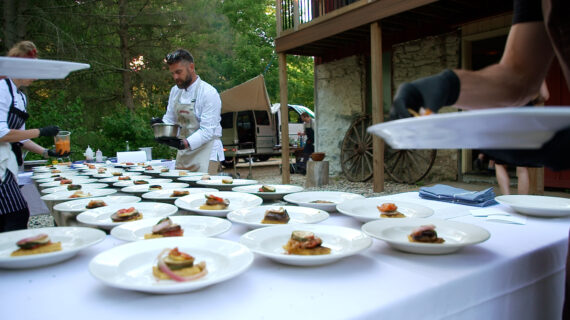
And what we're doing is we're putting together a dinner for about 350 folks as part of the 50-year celebration of Seed Savers.
I've got my buddy Cole Willbright behind me, Lucy Danforth, my ride or die.
We're going to go in a couple different directions, ones that allow us to use the bounty of the season and food that's ready right now.
One of the highlights of being at the Seed Savers' Heritage Garden is seeing this amazing bounty that's been raised up with a lot of uniquity to this place, and that's what we're trying to do is celebrate that uniquity, celebrate our gardeners, celebrate our farmers, and of course, celebrate flavor.
[gentle music] So, the menu for this event, I wanted it to be a showcase of, like, Midwestern foods.
I also wanted it to be accessible for people, but I also wanted it to showcase some the finest foods that our farmers and food producers in this region have to offer.
So, we're sharing this kitchen with some folks who are in the rare air of the culinary world.
The Driftless Caf is responsible for one of these meals.
Owamni in Minneapolis is also responsible.
So, behind me, these guys are putting together about 1,000 pounds of bison back ribs.
They also have a wild rice salad, greens, corn cookies.
These guys are the real deal.
Like, it's so fun, at least from my perspective, to see the changing progression of what food means in the Midwest.
– Sean Sherman: We've got these beautiful stuffed tomatoes.
They're green tomatoes, right?
– Lee: Green tomatoes.
– Sean: Yeah.
And then, it's kind of like a green mole.
– Lee: Yeah, green pipin mole.
– Sean: Yeah.
And then, we have a bunch of hand-harvested rice, wild rice from Minnesota, some braised greens.
- Yeah.
- We had some sunflower cookies and some crab apple sauce you made.
- Yeah.
- And some wild tea with a bunch of wild herbs, like Labrador.
– Lee: Bee balm.
– Sean: Bee balm, cedar.
Yeah, it's a bunch of foraged tea.
And we got T-minus one and a half hours.
– Arthur: And how you doing with all this?
– Sean: Well, our number's 500.
So, we're gonna see.
See how many people show up for it.
That's catering though.
– Luke: Wait, what have we got here, man?
- Smoked bison back ribs.
We do a, we call it birch rub.
It's, maple sugar, salt, and just brown chiles.
- Sure.
- Cured it overnight.
And then smoked it for three hours.
- That looks and smells gorgeous, dude.
Have you-- How many of those things have you hammered down yet?
- Three today.
- Three, okay, great, great, great, well, I'm on-- - Racks.
- Oh, three racks!
[both laugh] Oh, my God.
I feel, like, an obligation to share this with my coworkers, but I don't want to.
It's so flippin' good.
Try it.
That is legit.
Sweet, smoky, salty.
Rich, fatty, like, it coats my lips.
– Mike: Having an event here, like, our 50th anniversary celebration where we had, you know, Sean Sherman and Chef Lee, you know, from Owamni come and be able to use foods in preparation and feed all of the guests that we had here, you know, folks like Luke and Driftless Caf that are coming here and again, taking that food and translating it into something that, you know, that just puts smiles on their faces and, you know, fills their bellies and allows them the time to be able to just share around that space is really incredible for us.
– Lee: These are braised mustard greens with bison stock, smoked turkey legs, a lot of onions, and a lot of garlic.
These are our ribs.
So, this is hand-harvested wild rice from the White Earth Reservation.
And then, we mix that with carrots, tepary beans, and a little bit of spices.
[bright music] - Mike: Yeah, so the culmination of this event, you know, in relationship to the food is with a longtime friend of mine, Luke Zahm, and Driftless Caf.
– Luke: So, what we're doing is we're kicking out, like, our version of the Midwest bento box, right?
I have 350 cardboard pizza boxes.
And I wanted it to be cardboard 'cause it was more environmentally friendly than doing something all in plastic.
I got my guy, Mike, walking by there.
[bright music] Part of the joy of being at Seed Savers is just being outside in the world.
And I really think that by giving folks food that they can take with them and taste the notes of this place, taste the region in which we live and cook in, that's a gift unto itself.
So, I wanna put together these presents, and I've got an amazing crew of helpers here putting together the pizza boxes, helping me assemble the dishes.
It's gonna be awesome.
All right, how's that look?
Is that good, you like that?
Feels good?
Okay, great.
What we're gonna do is we're gonna set up all these courses and components in one box so people can have this kind of pseudo-picnic experience.
So, I'm doing one handful.
This is the panzanella.
I'm gonna take this caponata, and I'm gonna get this right on that sheet just like that.
It gets just a little bit of roasted garlic oil, okay?
And then we wanna come down here.
I have red lentil dahl.
Nice, big flavor pile right there.
This is a mlange of heirloom beans.
We're gonna hit it with a little bit of cilantro.
This wild rice comes from the Red Lake Nation in northern Minnesota.
So, we're gonna work as a system here really quick, and we are gonna knock out 350 dinners faster than Decorah has ever seen before.
[bright music] Getting flat sat 350 people, everybody lines up at once.
That's a crazy kind of pressure.
Like, these people showed out for Decorah and for Seed Savers.
We understand what community means.
And when you serve food that is sourced from your community, people resonate.
[gentle acoustic guitar music] It's literally one of the best parts of my job is being able to just stand up and be an ambassador.
Put these ingredients together in a way that makes people appreciate each other, because in the end, everybody eats.
- One more box?
– Worker: Yeah.
– Luke: Ladies and gentlemen, we just managed to feed 350 people locally sourced, sustainably grown, delicious, amazing food.
I'm so proud of all of us.
Thank you so much for showing up for your community, for Seed Savers, and making this thing possible.
Thank you.
[applause] This is a dream, but I am shot.
It's rad.
Seed Savers, man, what a gig!
[gentle music] Today, we're in downtown Minneapolis and we're standing at the base of Saint Anthony Falls.
Lots of folks, when they think about Midwestern cuisine, they think about it in its modern era.
But for Sean Sherman and Lee Garman and the folks at Owamni, this cuisine has been alive and well for over 20,000 years.
In fact, Owamni is the cultural mecca of Indigenous cuisine in the United States.
And I'm really excited to go inside and see my friend Lee Garman and hear about why these ingredients are important to him, and see what makes Owamni truly one of the best restaurants on Turtle Island.
- So, these are bison tongues.
We're actually-- We have an event in Chicago this weekend.
So, we're doing bison tongue and bison liver pat.
So, to get the skin off the tongue, we have to boil 'em for a few hours.
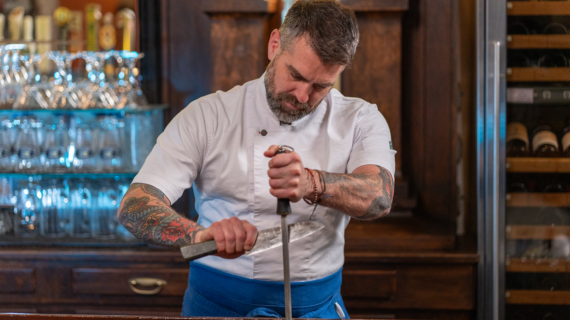
Yeah, my name is Lee Garman.
I'm the executive chef here at Owamni.
We're a restaurant based in Minneapolis.
Where Owamni is sitting is actually-- Owamni is named after the space that we're in on the Mississippi River.
The original name of this place was Owmniyomni.
And that means whirling, swirling waters.
So, right next to us is Saint Anthony's Falls, formerly known as Owmniyomni.
So, Sean named the restaurant after the spot that we're actually physically standing in.
[gentle music] Here at Owamni, we make all pre-contact food.
So, that's food that was in North or South America before the Columbian Exchange, 1491.
We don't use beef, chicken, pork, white flour, white sugar, dairy.
We don't use chicken eggs.
We don't use any of those items that kind of came over in that exchange.
What we do use is bison, elk, venison.
We use antelope.
We've done beaver.
We've done-- We do a lot of, like, local fresh fish.
We do do some seafood, but it has to, like, specifically be from, you know, Washington State or Canada or Mexico, the Gulf of Mexico.
We do a ton of research to actually source a lot of these items.
We also try to utilize, almost all Indigenous purveyors.
So, our bison comes from Native Wise in northern Minnesota.
We also use, you know, Red Lake Fishery.
We use Red Cliffs for some of their fish.
We have a pretty good now, like, list of purveyors set up.
But it did take a few years to kind of get 'em lined up and be able to use them, you know, for a restaurant this size.
[bright music] - Mm!
- What's up, Lee?
- Hey, how's it going?
- I'm great, how are you doing, man?
- Good to see you.
- It's good to see you.
- Yeah.
- It's good to be seen.
- Yeah.
- This is a gorgeous space.
– Lee: It's amazing, right?
Beautiful.
– Luke: Yeah, endless creativity.
– Lee: Yeah, yeah, absolutely.
It's not a bad thing to stare at every day.
– Luke: No, no, certainly beats a mirror.
Being here, obviously, Owamni is one of those restaurants that has, like, given so much depth and characterization to the Indigenous food movement in the United States of America.
And, you know, from my perspective, it's long overdue.
But I'm really excited to learn more about the ingredients, you know, that you guys lean into here.
And are there any particularly right now on the menu that are speaking to you?
- A big one is our bison ribeye.
We get all the time, like, from people, you know, "We've-- I've had bison before.
I didn't really like it or it wasn't very tender."
Or, you know, it wasn't all of those things that they expect beef to be.
But I think the way that we prepare it here, it's a thousand times better than any beef steak you're gonna find anywhere.
Yeah, and then we do a pre-contact mole.
It's one of those moles that was being made in Mexico before the Spanish ever got here.
So, epazote, hoja santa, sunflower seeds, pumpkin seeds.
You know, all the raisins and chocolate and all that stuff has been taken out.
Sesame seeds, all the stuff that wasn't here.
– Luke: You just wanna walk me through what we got going on?
– Lee: Yeah, absolutely, so we're heating up the pan.
And I'm bringing the bison steak to room temp.
You know, it's always best to do that with your steaks.
Especially any kind of game.
- Yeah.
- So, we actually cure all, every piece of game that we get for two days.
– Luke: Okay.
– Lee: We use maple sugar, salt, chilies.
And we do that with everything, and we find it makes absolutely everything insanely tender.
– Luke: Is it because it enzymatically breaks down?
– Lee: Yep, exactly, yeah.
– Luke: Okay, sure.
– Lee: So it's-- We call it dry cured, dry brine.
Like, whatever you wanna call it.
Because obviously, by the end of the two days, it's not looking very dry.
– Luke: Mm-hmm, yeah.
– Lee: And it looks like, when you cook it, too, because of that maple sugar, it looks like it burns a little bit, but it's all part of the experience.
– Luke: Awesome.
– Lee: I know.
- [Luke sings] Tong, t-tong, tong, tong Do you prefer tongs or tweezers?
[Lee laughs] - I mean, I... [Luke laughs] - That's a long-- I worked in, like, French fine dining.
- Yeah, so with spoons?
– Lee: Yeah, spoons and tweezers.
I've had chefs take tongs and... - Luke: Whip them?
- Yeah.
- Yeah.
- I gotta pop this in the oven.
– Luke: Hot corner.
Hot corner.
– Lee: Since we do, we dry brine 'em and let 'em sit for two days, you get a lot of that sugar, you know, you get a lot of the enzymes that kind of break down.
All that stuff kind of comes to the surface and sits.
It's not dry.
So, it kind of, you know, like, if you were to look at it like this and you set this down, someone might say, "Oh, that looks burnt," but it's actually just like, you know, that nice caramelization, the enzymes, all that.
And then we slice it for you.
So, you kind of see that, like, the difference between.
– Luke: The craftmanship, yeah.
– Lee: Yeah, exactly.
– Luke: Dude, that's amazing.
You know, I've never actually been in a restaurant, Lee, where they dry brine.
– Lee: Oh, really?
– Luke: Outside of, like, a barbecue joint, right?
– Lee: Yeah, yeah, yeah.
– Luke: Like, but this is-- This is really innovative, obviously.
And it's one of my favorite parts about what y'all do here at Owamni.
It's like, old school meets new school.
And it's a way that-- It's a way that, like, completely redefines what it means to live and eat in America.
- Right, exactly.
- Dude.
This is great.
I'm getting goosebumps.
– Lee: [laughs] Good.
[groovy music] Lee, man, this is incredible.
- Thank you.
- It's absolutely incredible.
All the pieces, the storylines.
So, we've got the sweet potatoes, we've got the bison.
Like, where do we start?
What do you wanna do?
- I mean, personally, I always just go right for the meat.
But if you wanna start with the sweet potatoes, we could.
– Luke: Okay, well, like, don't just stare at it, eat it!
[Lee laughs] Like, let's go.
– Lee: That's delicious.
– Luke: Yep.
- That's one of the original menu items.
- Okay.
- It hasn't come off the menu in five years.
- Sure.
- We change the menu every three months, but this one we always keep on as well as the bison.
- I mean, like, the thing about this and the thing that I love about Owamni's food is, like, I don't wanna say it like it's simple in the way that, like, anybody could do this.
- Yeah, yeah.
- But it is.
- Right.
- It's really straightforward.
- Yeah.
- And it's amazing when you give these ingredients the chance to, like, do what they do.
- Right.
- They sing.
- Well, so many chefs, like, you know, you get something like bison or sweet potatoes and you wanna just-- It just generally gets over-adulterated.
You just do too much and then you just-- It gets lost in all these other things.
But this is just so straightforward.
It's chilies and grilled sweet potato.
And it's-- I mean, it is simple, but it's just, yeah, you can't really beat it.
- And the smoke on it from the grill... - Yeah, yeah.
- [sing-song voice] It is sick.
Oh, my gosh.
– Lee: Dry-brined bison ribeye.
We have pre-contact pipin mole.
We have pickled fresnos and pea shoots.
– Luke: That sounds fantastic.
– Lee: So, bison is actually 40% higher in omega-3s and omega-6s.
– Luke: Sure.
– Lee: Yeah, than beef.
Beef has almost none.
So, even the fat on this is good for your heart.
- This is, uh... This is truly delightful.
And the thing that I'm noticing about it, like the chilies and the sugar, you know, and all that, like, char!
- Yeah.
- Char, that's the char!
- Yeah.
[laughs] - All that char, it lends itself to, like, this rich body.
And, you know, any experience that I've had with bison, usually it does.
You get the association of it being, like, kind of tough.
- Yeah, yeah, yeah.
- Maybe a little gamy.
You know, lots of folks aren't accustomed to eating it, but, like, you guys are doing this in a way that is truly incredible.
The dry brine, I mean, you get almost elements of that barbecue essence.
– Lee: Yeah.
– Luke: Like, old school southern smoke.
But like, this is truly unique and delicious in a way that's very, very pleasing.
My gosh, that's delicious.
[Lee laughs] [Luke laughs] It's almost-- It's breathtaking, man.
- Thank you.
- I mean, I'm a-- I'm a huge sucker for food with a story.
- Yeah.
- Right?
I believe that the things that we put in our body to feed us, they have, we have ancestral memory regarding them.
Who knew that learning could taste so good?
You come into this space with an open mind and, like, have the doors blown off with your perception of what it means to eat in America.
– Lee: Yeah.
- There's a lot of, like, street cred.
People say like, "Ah, it's New American cuisine," you know, all that.
But like, this is like a beautiful marriage between really old American, South American, North American cuisine, Turtle Island cuisine, and, like, some modern cooking techniques.
And it's just unparalleled.
You don't find this anywhere.
This food is powerful, man.
- Mm-hmm.
- It is so powerful.
To be here to share some bison, to share some sweet potatoes.
You know, these are things that people often take for granted.
- Yeah.
- You know?
Where does that food come from?
How does it get to your plate?
Who's making that food?
But the storyline here at Owamni is so central to who we are as humans, you know, in this place.
And I'm just, I'm humbled, I'm honored.
And, you know, I'm working on getting full.
- [laughs] Yeah, yeah.
- You're-- You're a great dude, man.
- Thank you.
This is-- The work you do here is hero stuff.
- Thank you so much.
– Luke: Yeah.
Whoo!
[bright music] It's like a kiss from Alice Waters.
It stays with ya.
[Luke sings] This is how we do it [laughs] I'm a-- I'm like a-- I'm like a goat in a garden.
This is wild.
My okra looks nothing like this.
Look at that okra.
Do you see these things?
That's bananas!
No, it's not; it's okra.
[laughs] [gentle music] - Did you know Organic Valley protects over 400,000 acres of organic farmland?
So, are we an organic food cooperative that protects land, or land conservationists who make delicious food?
Yes; yes, we are.
Organic Valley.
- Other sausage makers use the AI-generated voice of their namesake and founder.
Our products are finely crafted, made from time-honored recipes with ingredients you can actually pronounce.
Jones: Making breakfast better since 1889.
- The Wisconsin potato and vegetable growers are proud underwriters of Wisconsin Foodie.
It takes love of the land and generations of farming know-how to nurture a quality potato crop.
Ask any potato farmer and they'll tell you, there's a lot of satisfaction in healthy-grown crops.
- Employee-owned New Glarus Brewing Company has been brewing and bottling beer for their friends, only in Wisconsin, since 1993.
Just a short drive from Madison, come visit Swissconsin and see where your beer's made.
- With additional support coming from The Conscious Carnivore.
From local animal sourcing to on-site, high quality butchering and packaging, The Conscious Carnivore can ensure organically raised, grass-fed, and healthy meats through its small group of local farmers.
The Conscious Carnivore: Know your farmer, love your butcher.
- Also with the support of the Friends of PBS Wisconsin.
Search Episodes
Related Stories from PBS Wisconsin's Blog



Donate to sign up. Activate and sign in to Passport. It's that easy to help PBS Wisconsin serve your community through media that educates, inspires, and entertains.
Make your membership gift today
Only for new users: Activate Passport using your code or email address
Already a member?
Look up my account
Need some help? Go to FAQ or visit PBS Passport Help
Need help accessing PBS Wisconsin anywhere?

Online Access | Platform & Device Access | Cable or Satellite Access | Over-The-Air Access
Visit Access Guide
Need help accessing PBS Wisconsin anywhere?
Visit Our
Live TV Access Guide
Online AccessPlatform & Device Access
Cable or Satellite Access
Over-The-Air Access
Visit Access Guide




Follow Us