-
Voiceover
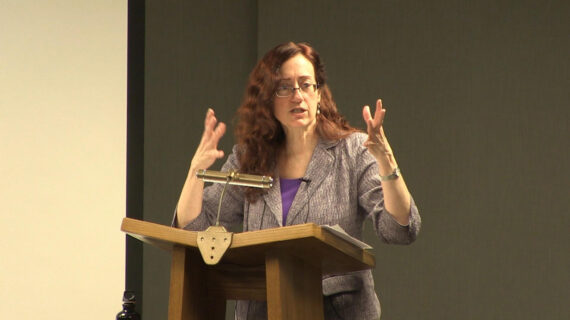
Our next two, we're going to have two speakers. We're going to start with Abigail Beaver, Dr. Abigail Beaver from Leading Edge Veterinary Services and then Ed Metcalf from Leading Edge Veterinary Services and they can explain to you what they do. So you may start. -
Abigail
So, I'll be talking, we'll both be talking about calving issues out on pasture. The things that can go wrong, the things that can go hopefully right, and then, kind of how to deal with those situations. And, I'll talk about the first half of this and I'm going to talk about what to look for, what's going on normally, how to address it and then Ed will come up and he'll talk mostly about facilities, pastures, when to move cattle around, and then I'll touch a little on the calves themselves. So, the issues mostly out on pasture are going to be a dystocia, or difficult calving. And the biggest thing is having a facility to safely and efficiently address the issue. If we have a cow that has been out there and she has been trying to have a calf for hours, within the normal range is one to two, possibly two to four hours. If we're getting outside of that, then that's where we would consider it a dystocia. And we run the risk of having our cows become exhausted and they can no longer try to push the calf out. The calves are just too big and the calves that become hypoxic or lack of oxygen, and then the calves can die. So we no longer have the calf and that dead calf is going to decompose rather quickly and then we're going to have a toxic cow. So we run the risk of losing the calf, losing the cow, and we're out both of those entities. So when it comes to having a dystocia, I consider that usually after four to six hours, especially if our cow is down. If she's bellowing and there's no progression of the calf. And we run the risk of having a dead calf when we're getting anywhere from that six to eight hours. Definitely after 12, the calf is likely going to be dead. Start decomposing, and we're going to have a very sick cow soon after that. If we have inability to access our cow or our calf, that's also going to be the biggest issue when calving out on pasture. If they're out in the woods, if they're in a swamp, if she's down in a swamp, and she can't get up, or she cast her withers, she has a prolapse, and she's out in an area where we can't get to her, that's going to be a big issue out on pasture. Excessively wet and muddy pastures, the cow goes down, she has her calf, everything is normal, but the calf is born in a rather dirty environment. Has a mouth full of manure, has a mouth full of mud. When the calf is first born. Or the calf can get up, but he keeps slipping and then can't find the cow can't get back up to the cow, becomes chilled rather quickly. That's going to be the other big issue when calving out on pasture. So in order to identify a problem, we need to know normal. And normal parturition or normal calving process, we're going to have the cow, or the calf presenting head first. We can also have it presenting hind end first, but this is head first and the front legs coming out. So with that presentation, the hooves of the calf are going to be facing down. They should be coming out roughly at the same time, slightly apart from each other and then you should see a nose and a head. And again, we should have a pretty consistent progression of that calf coming out of that cow, once you start seeing the feet. So in order to identify, we have front limbs coming out, they bend the same direction. That first joint is the fetlock joint, that's going to bend down, the next joint is the carpal joint, that knee joint, that's also going to bend down. We can have a calf that presents backward, that's also normal. This is also a normal presentation. The calf can be born without assistance this way as well. But the big thing is those hooves are going to be upside down compared to those front ones. They're going to be facing the sky. If we have front hooves, that are facing the sky, that's bad. That's very bad. But if we have hooves facing the sky and it's back hooves, that's okay. That's alright. To identify if we have hind limbs that are coming out first, one joint, that first joint, that fetlock again, it's going to bend one way, the hock joint, the next one up, that big knee joint, is going to bend the opposite direction. And again, when we have a coddle presentation, or the hind end coming first, you're going to have the legs, and then you're going to have a rump and a tail. If you have hind legs and a head coming at you, that's bad. That's very bad. So if we have front limbs coming out, or you know there's at least one front limb, we've had no progression, no consistent progression of a calf coming out, that's a problem, we need to go in, we need to address that and figure out what's going on with her. We want to be careful though, that we don't rip anything going in to her. Going in, vaginally, grabbing those front feet. Identifying we have two front feet, we have two joints that are bending in the same direction, and we have a nose. Getting those feet up and out of her uterus, cupping your hand around them, and then bringing it out. Because if you just reach in, and you grab, and you pull, potentially, the claws on that calf could catch the uterus and can tear and rip it. And again, that would be very bad. So when you go in, identify how the calf is presenting, and then, trying to protect the cow, protect the uterus as much as you can in getting it out in the correct presentation. When we have hind feet coming first, again, that's normal. That could happen naturally, she can still have a vaginal birth fine, but we have to make sure that everything is going to be coming out and that's usually the biggest thing with a hind end presentation is that the feet get caught. The feet aren't coming out the way that they should. The big trick with these is after you identify that's what it is, bringing those feet in towards her midline, pushing that big joint, that hock joint out sideways and then pushing, and then it's push and pull type of a motion. And again, the biggest thing is having your hand cupped around that claw of the calf to guide it up so it doesn't tear the uterus. When we have a coddle presentation like this, this is going to be the time when the uterus is torn up the most because imagine how the calf is coming out. Those hind feet are just gonna dig right in and just tear everything as it comes out. So if you go in, you make sure everything is cupped and protected and then guide it out that way, then everything should start to progress normally, in a consistent manner. When it comes to assisting with having her calves, we have a couple tools, hopefully, in our tool box. We have the chains, where you want to hook them around two joints so you have leverage but it's spread out over a surface area so you're not putting all the tension, and all the pressure just on one area. And then you can use things such as calf jacks. The big thing is using them appropriately. If we are hooking chains on to that calf but just around one joint, just around one leg, we're not trying to extend our surface area, you're going to break legs. You're going to cause a lot of damage to that calf. If we're putting on a calf jack and we're just trying to crank it out, and you could rip the cow, you could rip the calf in half. You can do a lot of damage if you aren't using these things appropriately. With the calf jack, the whole purpose of this is to try to pull, we put it on the cow and we have it pretty much flush with her hind end. Pull the calf out, jack it out a couple jacks, pull it down. Because think of how a cow naturally has a calf. She pushes it out and it's not shooting straight out. It goes down. It goes out and down. And that's what we're trying to facilitate with using the calf jack. Is pulling it out and pushing it down. If you have to use more force than what the calf jack is providing, then something is very wrong. And it's not okay to be hooking up other equipment, other guides. There's something wrong, the calf is too big, we're going to just tear the cow apart trying to get out the calf. It's time to think about other measures that we have to deal with the situation. And if you don't have these types of tools, if you aren't comfortable using these types of equipment, that's fine. That's okay, but have a plan. Who does have one? Who can you call that would have something. When is it going to be time to use these things? When is it going to be time to call people out to help you with these types of situations. Again, so it comes to being prepared. Having good records. Am I going to go out and is this cow having a calf and is she early? Is she really late? Were you not even expecting this? Those are all really helpful things that seem almost tedious but you'd be surprised with the number of calls we go out to where everything is just a train wreck and a lot of it comes down to just lack of good records and good knowledge of where things are at. A lot of things could have been caught sooner had we known the whole situation beforehand. Counting the cows as they're coming up. So feeding them, being around them consistently, knowing your cows, knowing the numbers, that way you can say, hey, there's one missing. If she's missing, what is she probably doing? She's out having a calf and then again, looking back at that time frame. So that we can keep track of the time frame so then you know when to call someone out to help so you know when to go out there to assist her. That way, you're not intervening too early and you're not getting there too late. With the plan, where can you move them? Who will help you? When do you need to intervene? And again, when do you need to intervene? After that four hours, especially, if it's a cow that's had multiple calves, something's not right. If we're not seeing progressive progression of this calf coming out, we have feet, but we're not getting anywhere else. The calf is going back in, back and forth, we're not progressively coming out of the cow, that's a problem, that's when we need to intervene. And then thinking about all these things, the presentations, we have maybe one leg out, one leg in, going in, protecting the uterus, bringing it out. So we should be thinking in our mind where can we be doing this? Because it is possible to do it out in the middle of a pasture. And we possibly all have done that, but it's not ideal. Especially if it's a first calf heifer being fractious, not knowing what's happening, and I've tried sedating them. If that's going to be your plan, that's not a good one. And that's my job, is sedating animals a lot of the time. And that's not a good plan. By that time, we're so wrapped up, we're so anxious, she's got so much adrenaline pumping through her, it takes a lot of drugs to get her knocked down and then we have this fine balance of having enough drugs to knock her down so I can work on her, and having enough drugs to knock her down, then she dies. Because she's so worked up. It's a very fine balance at that point. And it's dangerous for everyone. Dangerous for the cow, dangerous for the people around the cow, and then it's dangerous for the calf because I don't want to be pumping a lot of drugs in to her while leaving the calf in there. And you don't need to be big to do this type of a situation. I've pulled calves and in case you haven't noticed when Ed was up here, I'm not a big person. But if we have the appropriate facilities, we can certainly address the issues. We can come up with a solution. And even if that solution is having a C-section, which, again, most of that time having a veterinarian around, that may be a viable option. Especially if you're experienced and if you haven't been able to pull that calf, and I walk out there, most of the time, we're probably not going to be pulling that calf out vaginally. Then we're talking about a C-section. Where are we going to be doing that? Again, out in the pasture, out in the middle of the field is not ideal. We certainly can do it but then we run the likelihood of having problems with the cow, problems with the calf, and then we're losing those entities. And we simply don't need to if we're prepared, if we have appropriate facilities, we can recover both the cow and the calf, or at least the highest likelihood of having both of those things. So with that, we'll have Dr. Metcalf come up and talk about facilities. -
Ed
Alright, as many of you guys know, we show up and the producer looks at us and we say, looking around, where's the cow? Back there. How far back? We can't see the cow. So when Otto asked us to talk about calving issues on pasture, I told Dr. Beaver there really aren't any issues with calving on pasture, the issues come when there's a problem when you're calving on pasture. Because like she said, we have to pretty much be able to get our hands on the animal. So I start off by looking at the pasture where the people are gonna be like my cows calve out in the middle of a field and they're about a eight or 10 acre pasture. And as they get closer, I move them into a smaller pasture where there's just that cow and maybe a few other ones that are going to be calving. So, if you have a huge pasture, that's fine to have your cows out there, you know, all winter. Spring's coming, grass is coming, they can, it's all about pasture, and that's fine to do. But what you really need to realize is that the cow is more than likely going to go to the very back corner of the pasture. She's going to pretty much get away from the rest of the group. She's going to want to get away from the rest of the group. And it's going to be the back corner. I can almost tell when a cow is going to calve because I look out my window and there's a cow way in the back corner along the fence line. She's gotten as far away from everybody else as she can. Now, if they're in a pasture where there is a swamp, she's going to go to the swamp. And I used to do that, I used to go out and pull calves out of the swamp and I'm like, I'm not doing that anymore. Because first of all, you're trying to carry a calf that's crossed a swamp and the cow is right behind you and you're not sure if she's coming at you or if she's just following a calf. So, be aware of the pasture. There are going to be problems. The more cattle you have, the more times you're going to see problems. So start with an area where you decrease the number of hazards for yourself and for the cows and for the calves. Another thing we see is sometimes calves are born and especially if your pasture grazing, you've got an electric wire. Cow has a calf, she's out by the wire, because that's kind of as far away as she can get, so the calf is born, it gets up, it's on the wrong side of the fence, a lot of times. Even if the wire is low, if the calf is low, they'll usually fall through that electric fence and then they get up on the outside and they can't get back to the cow. So if the calf is born in the middle of the night, then you start to get into colostrum issues because if the calf can't get to the cow, then it hasn't nursed, it hasn't gotten colostrum and that can lead to some other problems which we're not really here to talk about today. But it is an issue if you're calving on pasture to make sure that you got kind of a safe area where they calve. So I don't like standing water. I've seen it where, for whatever reason, the cow decides it's a great place to have a calf right next to a pond of water. And there's the calf there. So we don't like standing water. Other hazards, just muddy areas. There's a lot of different ideas of what pasture is. My idea, of the ultimate calving pasture would be clean, grassy area that's relatively well drained. Obviously you're not going to have the perfect place. There's going to be some muddy areas, but try to minimize the areas where they get mud in. And that goes back to your stoking density on that calving pasture. If you end up with a lot of cows on a small area, even if it starts off nice and grassy, you leave them in there for a few weeks, and it's going to be nothing but mud. So those calves are going to be born into mud. Like Dr. Beaver said, they're going to end up with a mouthful of bad bugs or manure or whatever, and they're not going to get off to a good start. So I try to save an area that's relatively clean for the cows I know are going to be calving and relatively dry and hopefully, you've got a fence, a woven wire fence or something that goes all the way down so that the cows are in there and the calves can't get away from them. And it also decreases the likelihood that you're going to get predation by either wolves or coyotes. I'm sure anybody that's living in northern Wisconsin and you have beef cattle, you're aware of the wolf population up here and more than one farm we've been to where the cows have been calving, and she's down calving and the calf's partially eaten. She's been in dystocia, calf's partly hip locked or something. And coyotes have actually eaten on the calf while it was still being born. When you're calving and you've got large pasture areas, you need to be aware of the potential possibility for predation on your calves either as they're being born or soon after they're born. And if you've been calving in an area consistently, and there is a wolf population, or a coyote population there, they pretty well in tuned to what's going on and they know when calves start coming. So I guess that's kind of how the pasture issue should go. As far as facilities go, now we've identified that there's a cow that's having a problem, you need to be able to move her to a small pen. So you start with a big pasture, you come in to a catch pen area where you can actually get her in. And then you want to get her moved in to an area where you got some sort of a restraint facility. This you can see, can't move over there, but on the back side of that, there's actually a swing gate in there that swings out after the cow is in there, or before the cow is in there, you can position it. And then you move it around so she has to turn and come out through the head gate there. That's an ideal one. If everybody had one of these, our jobs would be a lot easier. Not everybody has that facility, even if you have a head lock, you know, an area where you can get them in. And it can be as simple as a wooden stanchion. I don't know how many of you are familiar with the old type wooden stanchions that were in barns. They were just made out of two by fours where the cow sticks her head in and the little board drops down and holds her there. We just need to have it so the cow cannot move away from us when we're working on her because as Dr. Beaver said, while you're trying to reach in there, you obviously can't be chasing the cow around the pasture. And a lot of people think that, well, my cows are tame. And you guys could probably walk up to half your cows and pet them. When I go on a farm, I can't get within 50 yards of them. Because I'm somebody different and they know that, and they know the smell and they're not sticking around. If they're to the point where they're already exhausted, we can obviously touch them, but by then, like Dr. Beaver said, it's probably too late. We're going to have a potentially poor outcome from those situations. So identifying them, get them moved in to a smaller pen, get them moved in to a place where there's some sort of catch facility. I think I probably covered a lot of these. I wasn't sure exactly how this was going to proceed. I think that's about-- What else do we need to do? I think that's about it. If you have questions. (applause)


 Passport


















Follow Us