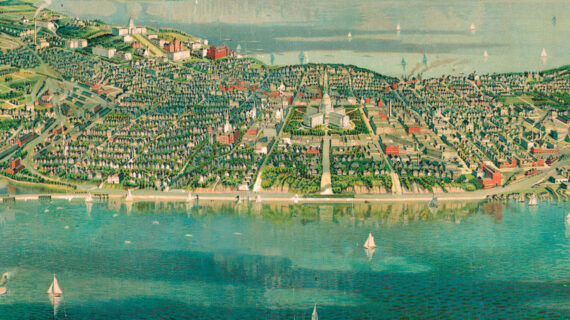
♪ ♪ The first photos of Oshkosh show a young and growing city, on the banks of the Fox River. We think of Oshkosh on the Fox. It is on the Fox, but more importantly for its birth as an industrial city, it's on the Wolf. The Wolf river and its tributaries form an immense watershed, draining thousands of square miles of land, all flowing toward Oshkosh.
Early lumbermen found that thick stands of giant white pine, covered much of the area. Joseph Schaefer, who was a Wisconsin historian from the 1900s, said of the place, where Oshkosh was located, "That there probably was no better place to site a lumber-industry city than where Oshkosh was." Its location was absolutely perfect. You couldn't ask for a better location. Log drivers found the lower Wolf to be an excellent driving stream, with few rapids or obstructions.
As the wolf flows toward Oshkosh, it empties into a series of broad lakes. All those logs could come down to those up-river lakes, and they could go into holding pens, where they would be sorted according to the company. You can imagine, looking at the map, at the size of those lakes, you can see how many tens of thousands of logs could be held. And those rafts of logs could be, from there, brought down by steamboats to the sawmills in Oshkosh.
♪ ♪ Mill owners in Oshkosh overcame a lack of water power by installing steam engines in all of their mills. They had a lemon site, in terms of water power, so they made lemonade with steam. And mill after mill after mill is able to be built there. Located at a water crossroads of the Wolf, the Fox, and Lake Winnebago, Oshkosh schooners and steamers could deliver wood products to other settlements in the area.
But what set Oshkosh apart, what really made Oshkosh the "Sawdust City of Wisconsin" is the fact that the railroad came early. And it was the railroad that transformed Oshkosh more than anything else because the railroad came to Oshkosh before the Civil War. That gives Oshkosh a head-start on other cities in the state, and opens it up to the huge lumber market centered in Chicago. Now connected to the largest lumber market in the world, Oshkosh's growth exploded during the Civil War.
Sawing railroad ties, bridge timbers, and other wood for the war effort, Oshkosh's mills also moved beyond rough cut lumber, and found a ready market for other kinds of building materials. So they were making windows, and they were making doors, and they were making shingles. One year, they made 80 million shingles. A match company set up shop, along with several furniture makers, and other wood products companies.
Just about everything that could be made of wood is made in Oshkosh. Wagon wheels, wagons themselves, buckets, tubs. They even ground the wood up for packing materials. And from Chicago, their goods went West, went East went everywhere lumber could be sold.
Where wood products could be sold, they went through Chicago and out. Altogether, they built over forty steamboats here, along with anything that could sail on the lake. Because they built boats, and because they had steam-powered mills, there was also a great population of skilled mechanics, People who were skilled at running milling machines and building boilers. So, there was a diversification of the economy pretty early on.
So the Oshkosh Logging Tool Company started. They made peaveys and axes, and all sorts of things. The hum of dozens of mills mixed with the clatter of the railroads running day and night, and everywhere, the air smelled of fresh-cut pine and wood smoke. Oshkosh grew economically.
It grew socially. Its political power was growing. Oshkosh quickly became the second largest city in Wisconsin, but time and again, catastrophic fires would devastate the city and test its spirit.
fire crackles


 Passport

























Follow Us