The Wisconsin Collection is a partnerhip of the Wisconsin Historical Society and Wisconsin Public Television. Are we all set? Yeah! On your mark, get set, go!
Narrator
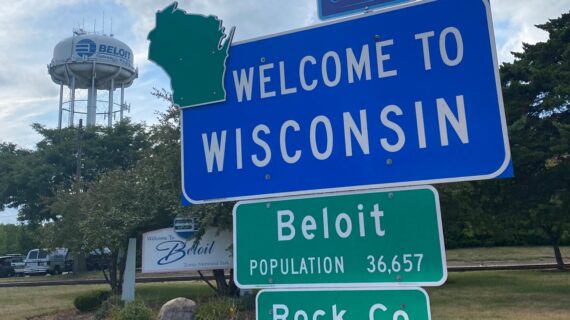
For more than 25 years thousands of school children from around Wisconsin have learned the rules and the fun of an old-fashioned game of hoops. A modern generation that has learned that shoes were once hand-made in a local shop. And once this is dry and you take all those nails out the leather will hold that shape wrapped around the last... You take the iron off, it's very hot. And others who gained new respect for their grandmothers and great-grandmothers and the job of ironing clothes. It's pretty heavy, isn't it? Yep. And of course, back then, they ironed everything. This is a world beyond modern imaginations because it is the old world but still accessible at Old World Wisconsin the unique historic site located near Eagle, Wisconsin. A place where visitors can step back in time and learn the crafts of Wisconsin's first pioneers. Now you choose your skirt... ( horse whinnies ) Or reminisce bout how life used to be or visit the actual homes of their ancestors buildings now part of the painstakingly researched and reassembled exhibits at Old World Wisconsin. Each of the buildings tells a story tales from Wisconsin's first century of immigration of the people who left other places to start a new life on what was once the western frontier. Their stories are Wisconsin's stories told and retold in an outdoor museum that brings history to life. Funding for Old World Stories is provided in part by the Halbert and Alice Kadish Foundation with support from the Bergee family; and by member contributions to the Wisconsin Program Fund. "As the farmer's son, Knudt Christiansen Fossebrekke "intends to leave his native village "and his fatherland, the Kingdom of Norway "in order to emigrate to North America. "He is hereby released from the congregation "with the best wishes for his future "and with assertion "that nothing but good is known to me about him. The Minister Johannes Reinhardt." This is our Fossebrekke cabin. We're taking you back to the year 1845. And at that time, Knudt and Gertrude Fossebrekke were living in this cabin down in Rock County near Beloit. Knudt Fossebrekke came to America in 1839. According to his travel documents he was at the time, single, age 25 a farmer, blonde, blue-eyed, slender and cross-eyed. No known pictures of him exist but his cabin does and everything it tells us about him.
Guide
He found the land he wanted, marked off 40 acres. He didn't have money to pay for it. He was a squatter. And he didn't have time to build a house that first winter so he lived in what we call a dugout where he lived in the side of a hill.
Narrator
The Fossebrekke cabin is the oldest of 69 historical buildings at Old World Wisconsin architectural artifacts relocated to almost 600 acres outside Eagle, Wisconsin where visitors can enter the museum's display.
Guide
Now, in the kitchen we do have many things here. Norwegian people made a lot of their own kitchen utensils. Why do you think they would do this rather thanbuying them? Yes? Because they didn't have a lot of money? That's true.
Narrator
The earliest immigrants often led secluded lives bent on mere survival. Among them were the Nattestad brothers who Knudt had met in Norway. "On July 1, 1838, I, Ole Nattestad arrived at the place I now live. Herds of deer and other wild animals were seen almost daily and the weird howl of the prairie wolf disturbed by sleep until habit armed my ears against it. The next summer, I built a cabin and received a group of emigrants from my home district who came with my brother Ansten from Norway. Ansten's group of more than 130 included none other than Knudt Fossebrekke who later returned the favor to others also looking for a home on the Wisconsin prairie.
Guide
Knudt supposedly housed17 people in this building one winter. Knudt probably never forgot his first winter in Wisconsin having to live in a dugout.
Narrator
There were so many new things to learn here even eating pigs was a new concept. But as winter came the Norwegians introduced a few new ideas of their own like skiing. "When the first snow had fallen that autumn "another Norwegian and I went on skis "over the prairie to Beloit to buy flour. "The Americans later saw our tracks in the snow "and the matter aroused much talk. "The most learned naturalist in town "finally delivered the verdict "that in the forests out west "there must be some unknown monstrosity. "But even he could not give any satisfactory information "as to whether this 'freak of nature' attacked and devoured human beings." Ansten Nattestad, 1841.
Jacob Conrad
When we walk into acabin like this today it looks very poor to us. But I often tell people that they can think of a house like this as a starter home.
Narrator
After five years the 31-year-old Fossebrekke took a wife. This is a later picture, as Gertrude Vikers was only 17 when Knudt added windows and a stove to the cabin as a welcome for his young bride. This particular trunk here has the name of a woman on it. The script is kind of hard to make out but it says "Grunild Knudsdatter Binstir" gives her date of birth and the date when she was married. She was born 1818, married 1836. So, she evidently got married when she was 18 years old. An immigrant's trunk held the few things a person could bring to America. Only the most important possessions took up such precious space.
Conrad
We know that people who lived in this cabin brought both Bible and a prayer book with them. This, of course, is a Lutheran Bible in the Norwegian language. A traditional curator looking at this object would probably disregard it. It's really quite commonplace. Here at Old World, we tend to focus more on what the object meant to the people who owned it.
Narrator
When he accepted the role as Director here Peter Arnold was impressed with the depth of research pursued at Old World Wisconsin. What struck me here was the degree of authenticity. They don't leave any stone unturned in terms of trying to replicate really, what life was like in the 19th century.
Guide
If you look where my thumbs are at you can see how it's twisting the fibers.
Arnold
You really are able to immerse yourself in that period whereas you can't when you're looking at a static exhibit no matter how good it is.
Guide
I'm going to pass come wool around so that you can feel how nice and soft it is and you can kind of feel the lanolin that's still in it. Now, the Kvaale's did very well during the time of the Civil War because they had sheep. What do you suppose they did with the wool during the war? What did they make out of it, then after they made it into cloth? The uniforms? Yes, the uniforms for the soldiers and also, the soldiers would need blankets.
Narrator
It's now 1865 20 years after Fossebrekke's arrival. And Anders Ellingson Kvaale, a well-to-do farmer who came here for a better life for his eight children has already fulfilled his dream. He bought 160 acres in Dane County stocked his pens with sheep built a home in the style of his homeland and started filling it.
Conrad
On the one hand, there is that desire to hold onto the old ways which is reflected in the traditional objects and in the traditional crafts. On the other hand, people also want to take advantage of the wonderful things the wonderful opportunities that the new world that's taking shape around them offers.
Narrator
Store-bought stoves machine-cut chairs, factory-made things now available in the growing towns. The Kvaale's probably traveled to the nearby town of Stoughton. "On the streets, a newcomer's ears "will easily recognize "the familiar sounds of his mother tongue. "On the store, signs are Norwegian "and at the merchant's desk, are customers who dicker "exactly as the custom was in Old Norway. "I do not believe there is in all America another town "with such clear-cut pure Norwegian characteristics as Stoughton." Sveim Nillson, 1870. This was a time of change, with new machines and products.


 Passport

















Follow Us