light piano music
Peter Shrake
The earliest known inhabitants of the Sauk Prairie would have been the Sauk Indians themselves. And hence the name Sauk Prairie, Prairie du Sac, Sauk City. And the earliest village as far as is known was a Sauk village that was established around 1740. Jonathan Carver, the British fur trader and explorer, was coming down through the area, and he provides a fairly detailed description of that village in his journals.
And he describes a community of about 90 buildings, of about 300 warriors, but well-laid-out streets, well-laid-out and constructed buildings. The buildings are of, as he describes it, hewn timber with very tightly fitted joints, covered with bark. He describes the prairie full of plantations, as he put it, very well-maintained of corn. The village lasts until sometime after the Revolutionary War, and the Sauk move out of the area.
Narrator
The Sauk Village, on the site of today's Sauk City, was located in the center of traditional Ho-Chunk territory. After ceding much of their land, the Ho-Chunk continued to control the area north of the Wisconsin River, until the Treaty of 1837.
Peter Shrake
In 1837, the Ho-Chunk were invited to send a delegation to Washington, D.C., to meet with the President of the United States. And after some very forceful negotiations-- the delegation was told they would not be allowed to return home if they did not sign the agreement-- the leaders did indeed sign the agreement under duress. And it was as a result of that treaty then that the Ho-Chunk lost all of their remaining lands in Wisconsin. And within a matter of a year, the earliest settlers crossed the Wisconsin River and start the settlement of what becomes Sauk County, but in the area of Sauk City.
Narrator
In 1840, Hungarian immigrant Agoston Haraszthy climbed a hill with an expansive view of the Sauk Prairie and the Wisconsin River Valley. "The view," he later wrote, "Was more beautiful than anything I had seen "in all my travels. "I was firmly convinced that nowhere in the world could there be a more enchanting place." And so, he saw potential here. He saw potential in that pioneer sense of, "How can I make a buck?
And how can I develop something?"
Paul Wolter
Well, he was known as The Count. We do know that he was of kind of middle-class nobility in Hungary. He kind of added the "Count" business when he got here to impress people, which it did work. He could say, "Well, I am of noble family, "and you don't know what that means in the United States, so, you know, it translates as Count." So, he's only, like, 27 when he hits the Sauk Prairie for the first time, apparently learning about Wisconsin on the trip over.
Philip Hasheider
So, in the fall of 1840, he went to Milwaukee to see if he could find anybody to invest in this new, grand area he was trying to open up. He met a man by the name of Robert Bryant, and Bryant came to this country with $90,000 to invest. So, the count, who apparently was quite charming, goes into partnership with Robert Bryant, gets him up here to Sauk Prairie, and they start developing things. One thing you have to say about Agoston Haraszthy is that he had plenty of energy.
And so, he comes here, and he files a plat for the village, names it, of course, Haraszthy.
Paul Wolter
And this is even before the land is federally for sale, but they lay out the village of Haraszthy, named after Haraszthy, but certainly financed by Bryant. Goes up to Baraboo, starts a store there. He gets into lumbering.
Philip Hasheider
And the Honey Creek had enough water where they could dam it up and then run a really primitive sawmill. They have the rights to the ferry crossing. He builds a home for his family, because he, of course, has gone back to Hungary and brought his wife and several children and his parents. And while he was there, in his spare time, he wrote the first guide to Wisconsin in Hungarian in order to stimulate more immigration.
Paul Wolter
He was definitely flamboyant, colorful, apparently had quite the charisma to get all of these German settlers to come. They start building buildings. They eventually open a brickyard.
Michael Goc
He also convinces the Catholic bishop to build St. Aloysius Church in Sauk City.
Julie Coquard
This cave is built out of sandstone, and it was carved out of the bedrock by Agoston Haraszthy, who founded Sauk City. And we think that he did this to use it as a wine cellar. He had planted grapevines here on the hillsides. And so, being right next to the vineyards is the perfect spot to age the wine.
Philip Hasheider
The last thing that Bryant invested in with Haraszthy was a steamboat. It was used to transport stuff all the way down to Prairie du Chien and back.
Narrator
Agoston Haraszthy left Sauk City during the California Gold Rush. He went on to establish a large winery north of San Francisco and become known as a founder of the California wine industry.
Peter Shrake
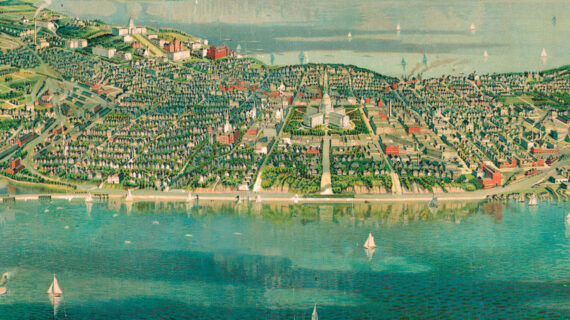
But it is the Great Sauk Prairie itself that is the biggest draw to the area. This large expanse of land, natural prairie land, exceptionally fertile ground, is perfect for farming.
Narrator
At the end of the last ice age, a melting glacier deposited thick layers of sand and gravel over a broad outwash plain. Layers of windblown soil created ideal conditions for the growth of the 14,000-acre Sauk Prairie.
Michael Goc
All of this stuff coming together to make that patch-- that 14,000-acre patch-- as fertile as it was.
Narrator
Using oxen, early settlers plowed up the prairie acre by acre and planted the pioneer crop of wheat.
water flowing
Narrator
The sawmill on Honey Creek soon became a flour mill.
Goc
To give you an idea of the quality of the farmland and the farmers, in 1859, flour ground at that mill won the championship at the Wisconsin State Fair.
Narrator
In Prairie du Sac, entrepreneur Miles Keysar built a 50,000-bushel grain elevator next to the Wisconsin River. There he could load his steamboat, the Ellen Hardy, to transport the grain to market.
steamboat paddle wheel churns
Narrator
These villages exist because of the prairie, because of that fertile farmland that was there, as farm service communities.


 Passport





















Follow Us