

 Passport




Maple Syrup and Microgreens
10/04/18 | 26m 47s | Rating: NR
Spring is about to arrive on the farm and Inga ventures out for the start of maple syrup season. She also gets an early taste of summer with microgreens. Rack of lamb and a fresh spring salad are on the menu.


Copy and Paste the Following Code to Embed this Video:
Maple Syrup and Microgreens
bright acoustic music
Welcome to the farm. Spring has finally sprung, and to celebrate, I've asked my nephew, Ashton, and my mother to come over for a simple but elegant spring supper. For the ingredients, I'm going to be going up to Whetstone Farm to get some lamb. And then, it's off to Morley's Maple Syrup for some fresh Wisconsin maple syrup. And finally, we'll be stopping at Morning Sun Farms for some nutritious and delicious microgreens. Gather with us Around the Farm Table. I'm your host, Inga Witscher. Good morning, girls! I'm Inga and I love everything about farming.
upbeat country music
Midwestern farms are a bounty of good food made by good people. I love being able to travel to search out good ingredients. Cooking is all about what's seasonal, what's fresh. Every day can be filled with good food, good friends, and a beautiful herd of cows. Welcome to the farm!
speaking affectionately to cow
Good girl!
Announcer
Around the Farm Table is funded in part by Wisconsin Farmers Union, united to grow family agriculture, Heartland Credit Union, and Friends of Wisconsin Public Television. Today, I'm going to teach my nephew, Ashton, how to sow seeds. He's five years old. I was five years old when my grandfather taught me. I think it's a fun way to get excited about gardening, about growing your own food. The first thing you want to do is find some good quality seed starting mix. Do you want to try to gently put some of that mixture in here? And these are our little seed cells that we're going to start with. There you go. And then I'll tap it down for you.
bright acoustic music
Announcer
We've picked out several seeds that Ashton's interested in growing in our garden. So I think today, looking through the variety we have here we're going to start with Brussels sprouts. Brussels sprouts need longer to mature. They need about 100 days to go from the seed to when you're going to harvest that plant so it's nice to start them in March when you can get a head start. Here in Wisconsin, you almost have to start a lot of those seeds indoors because we have a short growing season. Okay, Ashton. Now, you did a great job getting the soil in. Let's tap that down. Again, we want to kind of push it down so we're getting that good soil to seed contact. And now, are you ready to plant some seeds? Yeah. - Okay. My rule of thumb with planting the seeds how deep you go is just plant them about twice as far down as they are big. These seeds are really, really tiny. Right here. Aren't they tiny? And the plant is going to be almost as big as you are.
bright acoustic music
Announcer
You want to do me a favor? Can you go back and kind of push these seeds in a little bit?
bright acoustic music
Announcer
You got them all squished down? And then a little tip that I like to do is I like to cover the seed trays with a little bit of Saran Wrap for the first few days until you see germination. That acts like a little greenhouse. And then I just put it in the sunny window. I don't have any special lights or anything like that. I think a sunny window is just fine. Okay, now you got to water 'em. Now we just want to lightly water. And then you're just going to monitor those seeds to make sure that they're evenly moist at all times. We just started growing a plant! So then the next step is just you want to make sure that you label your plant so that you know in a few weeks of what it is that are actually coming out. Can I have our tags that we made? And on our tags, we just put what we're growing and the date that we sowed them. Ashton, I'm going to take these inside and put 'em in a sunny window. How about if I leave you here with grandma and I go pick up some ingredients and I treat you and grandma to an elegant springtime savory meal? Sound good? - Yeah. Okay.
bright acoustic music
Announcer
I'm here in Amery at Whetstone Farms. Let's go move the sheep with Emily and Klaus and then we're going to find out a little bit more about grass-fed sheep.
Klaus singing
bright acoustic music
Announcer
Why, it's a great day to be out here. The sunshine, it's warming up a little bit, and it's fun to see all the sheep on pasture right now. - Yeah. For those people that don't know exactly what's happening out here, can you explain to them what winter grazing is and what you're doing here? Yeah, so we are bale grazing our flock of sheep. That means that instead of bringing 'em into the barn in the winter, we place the bales on our own pasture at the beginning of the season and we let them eat all the hay in one paddock and then move them on to the next. That way, any hay that they waste and all the manure goes right back into the pasture, kind of gets composted right in place and you don't have to haul any manure. It's such a nice thing to do. Then you don't have to clean out your barns. I did this one year with some heifers and the pasture changed. From winter to spring, it was a different pasture than I had in the spring before with all the nutrients and everything that's just built right in there in the soil. It's really amazing. It's kind of just like composting right on top of your soil. Once the grass grows back in, it's just thicker and more lush, green, so we're really building our pasture back up this way. But don't you wish you were hauling manure every day and then your equipment was breaking down and it was--
Emily
No, not at all!
ladies laughing
Emily
Kind of takes the fun out of it, right? So what all do you have going on here at Whetstone Farm? So we raise 100% grass-fed sheep for lamb, mutton, and wool. We also grow a few acres of vegetables but yup, the sheep are dual-purpose for meat and wool. Can you explain the difference between mutton and lamb? Yup, so lamb is from a younger sheep, under a year or so, and mutton is just meat from an older sheep. So the lamb tends to be lighter in color, more tender, and a little more mild-flavored. The mutton is going to be a little stronger of that lamb-y flavor and not quite as tender. We love it for sausages, ground, use it anywhere you would ground beef so meatloaf, chili, stew. Yeah. Nice, and I'd noticed the dog. This is your guard dog. Yup, so we have two guard dogs. They protect the flock from coyotes, from any neighborhood dogs that might get out. They let us know when people or anyone's around, they also kind of let the flock know when there are deer or other animals moving around and keep the deer away from our fence. So they're born knowing how to protect the flock. Exactly, they have a really strong guarding instinct and he just lives outside with the flock year-round. We have to give them access to a shelter and we'll find the dogs just sleeping out with the sheep. Sometimes when I'm talking to people, they tell me they have a little bit of sticker shock when they're looking at the price of grass-fed beef, or I know lamb is, when you're looking at it, it's a little bit more expensive. Right, so part of the reason grass-fed meat is going to be more expensive than grain-finished product is that it takes a little longer to get our animals to market weight and we're also doing a lot of labor, moving them every one to three days from late April through early December, really. They always have access to fresh pasture and that means us walking around, moving fence. In terms of lamb being a little more expensive than grass-fed beef, part of that is just that the animal is much smaller so you have more bone compared to the amount of meat that you're getting, and also butchering a lamb is pretty expensive. A lot of butchers don't take lamb and they charge by the head instead of by the weight of your animal. - Oh, really? Okay. - So we just have a set price per lamb that we pay and that ends up costing us about $2 per pound just to get our lamb butchered. So that's a cost we kind of just have to pass on to the customer. How is it farming with kids? I noticed Aldo is on the back there. Yep, little Aldo is 4 1/2 months old and then we have a 3 1/2 year old, Sylvan. I think, folks. You're a farmer, you're a mother, you're taking care of a business. How do you operate all those different things? It's a juggling act, gets you in a lot of days. It takes a lot of flexibility and being willing to put my work aside sometimes and tell the kids that they have to wait sometimes. There's a lot of baby riding along. And Sylvan, our three-year-old's kind of learning the ropes by watching. We also have a really great community of other folks with kids around and we do some childcare sharing. So different people watch the kids different days of the week and allow others to work. But it's definitely a juggling act. I'm not really a full-time farmer or just a full-time mom, I'm kind of a work-at-home, farm all the time, mom all the time. Well, I'm going to let you get back to it but I'm just going to drop off some cash in the cash box and grab some a little rack of lamb if you don't mind and I'll let you get on with your day. Sounds great! Thanks, Inga. - Nice to see you.
bright acoustic music
Emily
Hey, John, I'm so excited to be up and what are these? Maple syrup! Hi, Inga! I want to go tap some maple tress but I need you to teach me how. Alright, let's go!
bright acoustic music
Emily
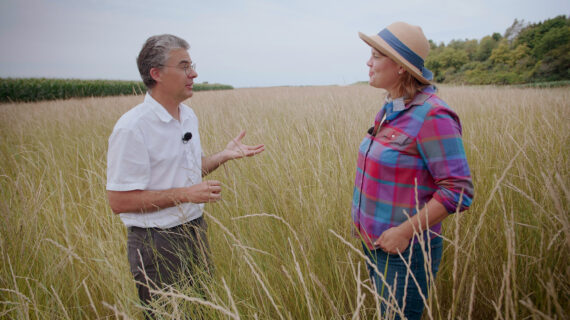
John, thanks for taking the time out of your busy spring schedule to teach me a little bit about maple trees. It's something I've been wanting to get into but I have no idea what I'm doing. Well, we are honored you're here. Maple syrup's always been a passion so I'd love to teach you a little bit. So once you've identified your tree, when you're looking to put in the tap, do I have to find a certain spot? Is it like a vein on a person? There's a couple old wise tales like that where you want to have a nice root system coming up. Really, a good clean soft area, no knots, a healthy spot to drill in. We're going to drill in at two inches and pull the material back out. You want good, nice, white wood. That means a healthy spot in the tree and that sap will go up and down during the season. And I know they talk about all the saps are running. What kind of temperature do you need for that? That's a great question. We need above 32 and it's kind of a tricky one 'cause everyone's excited and getting their yard trees, they'll tap a little bit early, the sun is very powerful in the spring so when it hits the bark, their sap held from the fall frozen, that's the first little bit of sap that comes out but once it roots and thaw when it gets above 32, then it'll pull a sap up and down and you'll get good runs and the sap is running. Technically, that is when sap is running when they're thawing through the roots and going to the top and down. So after these bags fill up, how much sap is it going to take me to make a gallon or something of syrup? Great question again! Every tree's going to be a little different. A nice yard tree, a fine yard tree with a great canopy is going to have higher sugar content. This tree here runs about 3% to 3 1/2% sugar so you're looking at 30 to one, 30 gallons of frost sap to make one gallon of syrup. Wow, okay. Boy, that's a lot! Yeah, yeah. And then when I get my sap off of here, so I take my bag, do I just take it inside and dump it in a big pot and start boiling? Yeah, well, pretty much, you'll take your sap once it's full or closed, you pour it into a five-gallon pail, you gather it. The hobbyists kind of start maybe with a turkey fryer or some sort of burner outside and they'll get it concentrated down to about 58% sugar content and then they'll bring it in the house and finish the final 'til you get to legal maple syrup and then you can can it and they get more control in the oven on the stove. So you say the hobbyists start with that. What do they end up with? Just 280 acres of trees like you here? Oh yeah. It's a hobby out of control. You got to be careful. It's just, I don't know, a lot of fun. Do you see more people getting interested in doing it? Oh, yes. The hobbyists, you're all natural, organic, just a natural beauty of a product coming out of your own yard tree and it's simple enough to do at this time of the year. Ice is not off lakes yet to get on your lake place or enjoy the water. And you're going crazy sitting inside. Right, camp beyond the trees, cross country skiing, or enjoying the woods so it's another way to enjoy the woods, the outdoors. Good, well I'm hooked on maple syrup and I think I'm going to try some when I get home. Alright! - Thanks for teaching me. Great, great!
bright acoustic music
Emily
I've made it up to Morning Sun Farms. Why don't we go say 'hi!' to Janet in the greenhouse? Hey, Janet! Nice to see you! Oh, hi, Inga! Thanks for letting me come visit today. It's nice to get out of winter and come into spring. Yeah, thanks for coming! What a great work environment to be in all day long. Don't you love seeing all this green when it's snowy outside? It's better than what I see most of the day.
ladies laughing
Emily
So these are microgreens you're growing here and for folks that don't know what microgreens are, 'cause they're not very common, really. No, they're not. Tell us a little bit about them. Well, microgreens are little plants that are between the stage of a sprout and a baby leaf. They're very, very high in nutrients. If you could imagine all the nutrition that's in a seed that will produce a huge plant and all the fruit on it, well all that is captured in these little greens. Then why are we eating mature plants? These are so good! Well, once you taste these, you might not want to eat the matured plant. What is this I'm eating right here? This is kale, this is a-- - No kidding! Kale microgreen, yes. Aren't they good? - I prefer it to the mature leaves. Yup, as you can tell, they're very tender, nice, mild flavor, but yet you get that huge nutritional boost. Yeah, it is a nice flavor. On my way in, I was grabbing a few of the other ones. I think I tasted a radish leaf and it tasted like you were biting into a radish. It was amazing! Yup, yup. We do Red Rambo radish, Daikon radish, we also do pea shoots, sunflower shoots, we do a mustard microgreen, we also do broccoli microgreens. Really? - Yeah, yeah. They're all just great. I think this is a great way to get my nephews to actually eat their vegetables! Absolutely! I don't think I could tell 'em they're going to have kale and broccoli, though.
ladies laughing
Emily
No, and you don't need to. You throw a little handful of this into a smoothie or sneak it in their sandwich and you've just given them a handful of vitamins and they won't even know it. How does one become a microgreen farmer? Was this something that you said, I want to grow up and grow microgreens? How did you figure this out? This is so cool! Well, we started off, we knew we wanted to do something here at home. We had always grown gardens for our family and so on so we started experimenting. We actually were planning to do tilapia and lettuce and do an Aquaponics system. That's how we started. Over the course of time, that changed. I had a friend that invited me to a wedding expo, I talked to a chef there, and he asked me about growing some products for him. And as I researched those products, I came across microgreens and we started growing some, took 'em to the farmer's market, people seemed to really love them so we did that again and it went really well so I thought, gosh, this really should be available to more people! So I started knocking on some store doors. I went down to Whole Foods and brought some samples and I just happened to hit a produce manager that was very passionate about local food and really excited about our product and he brought it into the store and helped me learn the process of getting into their store, went to some co-ops and they brought us in. That was about five years ago! You grow and grow and grow! Yeah, and I've grew from there. Just recently, we were able to get our product into the Whole Foods distribution center. Oh, my gosh, that's really nice! So that's going out regionally! Oh, congratulations! - Yeah, thank you! That is so huge! - We're excited! Yeah, it is huge! I think one thing a lot of folks don't realize about farmers is that we have to be our own marketing team. We have to go in and teach ourselves how to speak to those produce managers or the dairy case manager or whoever. There's a lot more to it than just growing things or milking cows. Absolutely, absolutely. There's a ton. There's a ton of work involved but we put in some long, long days but it's really paying off. - It's worth it. It is worth it and we feel so good about putting very, very nutritious food into people's hands and giving them the opportunity to enjoy such good, healthy food. Yeah, and it tastes great, too! I mean, the flavors are really there, too! So you don't even feel like you're getting healthy which is, I don't ever feel like I'm getting healthy but I need to get healthy. So now, I'm just going to start eating microgreens. We've got some for sale. Well, I have to tell you. I love visiting small towns like Frederic here and seeing these thriving farm businesses where you're employing local people, you're putting Frederic on the map. You're going to be the microgreen capital of America pretty soon, I'm sure. - Absolutely!
ladies laughing
Emily
Well, I know you're harvesting today so I'm going to give you a little hand at harvesting to hopefully take some home. And then why don't you meet me in the kitchen where we're going to cook up some microgreens and some lamb for my lovely little nephews.
bright acoustic music
Emily
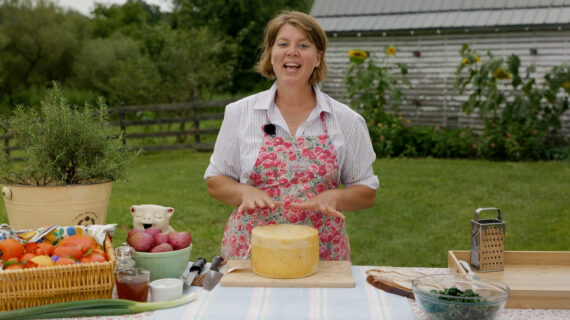
I'm so excited to finally say that we can celebrate the first day of spring. It's been an awfully long winter. I don't know if I'm just getting older or if the winters are getting colder, but I am done with it, I'm so ready for spring, I'm so ready to be out in the garden, even though it doesn't feel like spring outside, I want to make it feel like spring inside with a lovely spring menu of a maple-glazed lamb and then a beautiful microgreen salad. So for the maple glaze, I'm going to start with a little bit of some grainy mustard and then I'm going to put a little bit of maple syrup in. I like to use maple syrup in a savory way with the entree. It's kind of a different take on it and it's fun. And maple goes so well with everything. It's such a nice, you can use it in vinaigrettes, you can use it on pancakes, who would've thought? You can use it anywhere. Let's get that stirred up. And then a little salt and pepper. Fresh ground pepper. And I think a little bit of lemon zest would be nice in here just to add a little touch of acidity and brighten it up a bit. Give that a good stir, it smells good. One thing I love about cooking with lemons is using that zest and the kitchen just smells really bright and beautiful. Let's taste that. That's really good! Mm! Okay. I'll set this off to the side. I'm just going to let those flavors come together a little bit. So for the lamb, I want to add some rosemary to it. Rosemary is one of my favorite herbs to have around the house. Okay, now just chop up that rosemary. I want to get the rosemary really fine. The more you cut those herbs, the more the essential oils will come out of it and flavor that piece of lamb. Okay, now that rosemary is nice and fine, I'm going to move that to the side and do a few cloves of garlic. And just like with the rosemary, I want to mince my garlic up really fine. Okay, that's looking good. Then I'm going to mix these two together. With my lamb, I'm just going to put a little bit of olive oil and rub that in both sides. Look at this beautiful fat cap on it. That's going to add a lot of flavor when we're cooking. And then salt and pepper. Well, this is looking good. Now, let's put our rosemary and garlic mixture on here. And I'm not doing this gently. I really want to get it in there. On both sides here. Get a pan going over medium-high heat, I'd say. Put a little olive oil in there and get it cooking. We want to really sear the lamb when we put it in there to get that nice sort of crunch on the outside. And I'm going to do the fat side first and then here we go.
pan sizzling
Emily
When you're searing things, always be patient too. You don't want to move 'em too fast. You really want to just leave 'em, be patient. Let them get that crust before you flip it. So it's going to take a few minutes.
sizzling
Emily
That looks good. When you're cooking lamb, you don't want to overcook it. It's not something that you really want to get well done. So when I'm searing it, I just want to get that nice crust on the outside and then we're going to pop it in the oven.
sizzling
Emily
Alright, this lamb is looking really good. I'm loving lamb, I think lamb is great. I'm going to put some of my glaze in a different little bowl for glazing it when it comes out of the oven but before it goes in the oven, I'm just going to cover as much as I can with this beautiful maple glaze. And as it's cooked, it's just going to sink in to the flavors and caramelize and add a little bit more deliciousness to it. That's good on that side. Then I'm going to pop it over. Use the rest of my glaze here. I love it! Okay, this is smelling good with the rosemary and the garlic. There's nothing better. Now, it's ready to get popped in the oven. It's going to cook for about 10, 15 minutes, just to finish cooking it off. Don't overcook your lamb or else it's not going to taste as good. And then while this is cooking, I'm going to get this cleaned up and we'll start making our microgreen salad.
bright lively music
Emily
Let's get the salad ready for my mom. We're going to start with some pea shoots. I'm going to add in some of the sunflower microgreens here. And this is my favorite. This is the kale that I'm going to add here. You would never know that you're eating kale with these microgreens. I feel healthy already just working with these microgreens. Fluff this up. Maybe a few more of these. So my dressing is going to be very simple. I don't want to mask those flavors. Actually, I'm going to add a few radishes for color first before I dress it. And add a little crunch. Put those right on top. And since I'm not cooking for just myself today, I'm just going to add a few onions just to make me happy but I don't want to overwhelm anyone else. Now slice them very thin. And that should be good. So now, I'm just going to add some fresh cracked pepper and a little bit of salt to season it with. It looks beautiful! A little bit of olive oil, and I'm going to eyeball it here. What else is new? And then since I have the maple syrup, I thought the sweetness of the syrup would balance out nicely with the sort of more pronounced flavors of those radishes and the onions and everything else we've got in here. So I'm just going to drizzle this. And then a little bit of lemon juice again to add that nice acidity. And that's all she wrote. That's a really easy salad. And then you just give it a toss and it's as simple as that. And now folks, we're ready for a simple but elegant spring supper.
bright acoustic music
Emily
Well, thank you, Grandma and Ashton, for coming for a nice little supper here at the farm. Can you cheers me? Thanks, buddy.
bright acoustic music
Emily
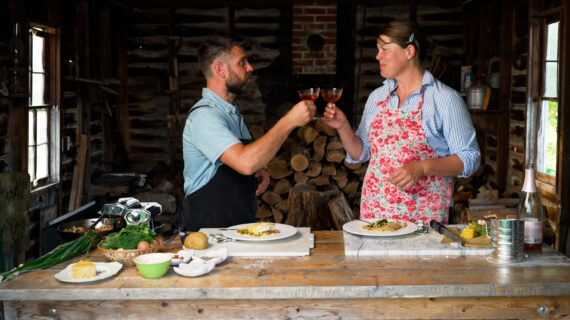
Celebrate the arrival of spring with a savory supper. Maple-glazed rack of lamb on a bed of garlic mashed potatoes and fresh spring microgreens with a maple vinaigrette. It's okay to help the budding gourmet learn how to use his knife. Grandma's maple butter cookies are the perfect topper for Ashton's special chocolate sundae. Ashton, what was your favorite part of dinner? Um-- The microgreens? That's what I thought. Grandma, would you like to have another dinner like this again sometime soon? Yes! If you're cooking, I'm coming. That was really good meat. Thank you! Thank you guys for coming! And I hope this has inspired you to have your family over for your own spring supper and I hope you'll gather with us next time.
Both
Around the Farm Table. I'm your host, Inga Witscher. Cheers! Cheers! More tea?
bright acoustic music
Announcer
Around the Farm Table is funded in part by Wisconsin Farmers Union, united to grow family agriculture, Heartland Credit union, and Friends of Wisconsin Public Television.
Search Episodes
Related Stories from PBS Wisconsin's Blog


Donate to sign up. Activate and sign in to Passport. It's that easy to help PBS Wisconsin serve your community through media that educates, inspires, and entertains.
Make your membership gift today
Only for new users: Activate Passport using your code or email address
Already a member?
Look up my account
Need some help? Go to FAQ or visit PBS Passport Help
Need help accessing PBS Wisconsin anywhere?

Online Access | Platform & Device Access | Cable or Satellite Access | Over-The-Air Access
Visit Access Guide
Need help accessing PBS Wisconsin anywhere?
Visit Our
Live TV Access Guide
Online AccessPlatform & Device Access
Cable or Satellite Access
Over-The-Air Access
Visit Access Guide




Follow Us