

 Passport






Lavender Ladies
10/19/16 | 26m 47s | Rating: NR
Inga takes a mini-vacation. After visiting a robotic dairy farm, she meets up with her cousin CeCe on Washington Island. Amidst a lavender field, they cook the catch of the day and make a panna cotta dessert.?


Copy and Paste the Following Code to Embed this Video:
Lavender Ladies
(upbeat music) It's summertime in Wisconsin, which is the perfect time for a little R & R with my cousin Cece. Once I finish milking the cows, I'm taking off for a little vacation in Door County where I'll do some bass fishing, and learn about culinary lavender. But first I wanted to stop off along the way and find out about robotic milking. Gather with us Around the Farm Table. I'm your host, Inga Witscher. -
Group
Gather with us Around the Farm Table. -
Inga
A few years ago, I moved up to Wisconsin. I started an organic dairy farm at St. Isidore's Mead. That's when I discovered the abundance of Midwestern local food and small-scale farmers growing everything from green zebra tomatoes to pasture pork. I'm taking a break from the cows, hitting the road and seeing if I can satisfy my epicurious appetite. That's great. This is amazing. Around the Farm Table is funded in part by Wisconsin Farmers Union, Heartland Credit Union, and Friends of Wisconsin Public Television. (folksy music) There's a few different ways to milk cows. A lot of farmers around here milk in milking parlors. You can also use a pipeline. A few years ago, I went to the bucket milking system, and, boy, do I wish I had a pipeline still. Well, let me finish milking the cows and then I'll pack my bags and then, why don't you meet me at the Wichman's where we'll find out about robotic milking. Hello, Wichmans. -
Group
Hi, Inga. Welcome to our farm. We'd like to show you the robots. I would love to see one, who's gonna show me? Bradley. Okay, Brad, I'm gonna follow you. Brad, tell me a little bit about your family's farm. I am a fourth generation farmer on this farm. My dad farmed, so did my uncle, my grandpa farmed here, and then, it would be my great-grandpa. How wonderful! How has the technology of your family farm changed in four generations? I think they had buckets at the time, went to pipeline, then we went to freestyle barn, with milking parlor and now we got robots doing the milking. And why did you choose to go with the robot milking system? One of the biggest reasons is because it was mainly family what did it. Most of the labor, we hardly had any hired help and we wanted to try and keep it that way. And it's hard to get away when you're milking twice a day. And this way, we can go to three times a day and try and get more milk out of our cows. Other area farmers are trying to find high school kids to do work and labor. It seems like now we're getting-- The kids are getting so far removed from dairy farms, especially, that it's hard to find help to bring onto the farm that you can trust with running your business while you take a few hours off or a weekend off. Tell me a little bit about how the robotic milkers work. -
Brad
When a cow walks into the stall here, she gets milk access. And while she's standing here getting milked, she's actually getting a pellet. -
Inga
They're enticed to come in with the food. The more milk she gives, the more pellets they'll give it. We call it "cow candy." (Inga laughs) When she comes in here, the arm comes underneath the cow. It brushes her teats, and then it goes out, washes the brushes, comes back in, brushes the teats again, and blows a little puff air on them to try and dry 'em. And then it attaches. The unit, itself, remembers about the last thirty milkings. So, it knows about where her teats coordinates are from how much milk she's got in her udder. And so, then, it shoots two lasers up to get her attachment on so much faster. That's nice and it's-- Everything stays really clean. Yep - Which is important when you're handling milk. Have you seen a difference in your milk production since you've put in, or lower cell counts, or anything like that? Our production went up and our cell count has dropped. So it's paid for itself, yeah. The cows seem to love it. And how often do they come through? Just as often as they want really? Yeah, so we got some cows that actually, they go through-- They could get milked up to-- Some get milk access up to six times a day. We got some getting milked about five times. And then, if a cow comes walking in and she doesn't have milk access, we call that a "refusal" and some days we got-- We average between three times a day for milkings and one "refusal" for the whole herd, but we got some cows that will go through 24 other times a day, just to try and get their cow candy. Sometimes, I just flat out refuse to go out and milk. (Brad laughs) Tell me about the-- Everything's red 'cause they're all wearing necklaces. Yep. So you can ID the cows, and what other things you can tell? Each girls got one of these on and we're doing a couple different things with this. Each ones got their own number so we know from the people who walk out in the barn they can visual ID that cow. And then, this box right here is doing a couple of different things. We're doing identification for the robot. There's a chip in here to read her. And then, it's doing activity so if the cow is real active, that she's in heat, that she needs to be bred, she'll come up on the computer. While I was walking around, I noticed some other technology that you have here, which is the robot that's pushing up feed. Tell me about that. How does it work? His name's "Juno" and his specific job is to push the feed up for the cows. He's got a route he's gotta do. He runs every other hour. so he starts at nine o'clock in the morning and goes until ten o'clock at night. And then he goes every hour after that until six o'clock in the morning. So he's running over 18 times a day. Gosh, he works harder than any hired men I've ever had. That's for sure. - Yeah. Well, that's wonderful. I have a rare day off from my farm today and I'm heading up to Door County to go see my cousin. So, why don't y'all come with me and we'll head out and do some fishing? (folksy music) Well, I've made it to Washington Island. It's so exciting. It's my first visit here. And now I've gotta find my cousin Cece so we can get our vacation started.
in unison
Hey, little lady! How are you? You look cute! - Thanks, yeah. Hey, are you ready to start our little vacation. Yes, where we going? Well, the first thing we're gonna do is go fishing so I've chartered us a little boat so we can, hopefully, catch some big fish. And then take you out to a lavender farm. Yes, love it. But I gotta figure out where this fishing place is. Excuse me, sir, do you know Jimmy, the fisherman? Yes.
I know
Why don't you climb aboard on the rumble seat and we'll take you for a ride? Oh fantastic.
truck engine rumbles
honks old fashioned horn
I know
Hello, ladies. Hey, captain Jimmy, good to see you. Nice to see you. -I'm excited to get on the water and hopefully catch some fish, and find out more about what kind of fish you have here on Washington Island. Well, absolutely, let's get out there. Okay, Cece's gonna stay and fish off the dock. Okay, sounds good. Okay, good luck guys. (folksy music) It's nice to be up here and kind of experiencing a whole different part of our state. I'm from five hours away. It's so quiet on this lake. This is such a beautiful island. I thought it would be packed with people out here. Yeah, no, it's usually pretty quiet. We like to keep it that way. I mean, I don't think there's many other boats out here today fishing, you know, that really helps the fishing be good. Now, do you take a lot of fish home to eat? I personally don't, no. I let them go, I let them grow. If I wanna eat, I'll go buy some fish at the store. That's nice. So, we're gonna be doing a little catch and release today? Is that what you're thinking? We are, yep. - Okay, let's get started. - Alright. (upbeat music) -
Inga
I know
Hey, Cece, you got one. (Cece screams) Try to grab it. -
Jimmy
I know
Did you want some help? -
Inga
I know
Here, net it. (Cece cheers) - Yay, I got one. Nice job. (Inga laughs) More than we caught. Well, I'm gonna leave Cece here to keep fishing, but why don't you come with me to the lavender farm here on Washington Island? (water splashes and gurgles) (bees buzz loudly) While Cece finishes up fishing, I'm gonna meet with Martine and find out about growing lavender here in Wisconsin. And then, Cece and I are gonna whip up a feast. Hey, hi, nice to see you. Nice to see you, too. - I was expecting you. What's happening in this building? Well we just finished distilling with the machine you have behind you. We actually put on 40 pound of cut lavender, and then, this is the result. You have 16 ounce of essential oil. -
Inga
I know
From 40 pounds of lavender? 40 pounds of lavender, and that's why, I think, lavender, or any essential oil, is quite expensive is because of what is left after all the distilling. So, you'll keep the essential oil and will you just get rid of what's on the bottom? No, we actually use the hydrosol for body mist, for linen spray because it has quite a lot of lavender on it. It smells amazing in this building. Yes it is, so we use it for all kinds......even soap making, so nothing is waste in the lavender you can do quite a lot of it with it. I use a lot of lavender essential oils. My dairy farm is organic so we do fly sprays and things with the lavender oils and a lot of essential oils. Sure. I think it's wonderful to see different uses for plants. Absolutely, with lavender, again, you have so many utility with it, both medical and relaxing, and I'm sure you have the same thing on your farm. Just being in this building, with the smell of lavender, I already feel just calmer. Just relax. Actually, we have to be careful because we could stop, really, during the day. We have guys who tell us, "We need to go and rest." It's happening. (both laugh) Well, I never thought that I could grow lavender here in Wisconsin, and so I'd love to pick your brain and find out a little bit more about what you do here and how I could be a successful home lavender gardener. Sure, well, you have to be a little bit more careful with lavender because it's not a native plant, obviously, but if you cover your plant-- If the base of your plant, the water go very fast through it. They don't like wet feet so that's the thing you have to watch. And then you have to, a little bit of care, you cut them and bring them in during the months of October, November. And every year, your plant are going to come back. It's just put full sun and cover them in the Midwest for the wind; the dark, cold wind. Can we go have a look? (upbeat music) Martine, what kinds of things do I need to be thinking about if I wanted to grow lavender here in Wisconsin? Well, you will have to find out what your pH is of your soil. Basically, the lavender will not like to have any feet wet, so it has to be a very porous soil, sandy preferably. And then after that, you have to watch them, full sun for sure, and depending where you are in Wisconsin or in the Midwest, you will have to cover them during the winter. And is there a different variety that you use for cooking with, or that you use for decorative purposes, or your oils? Well, you have two type. What we plant here is English lavender because it's basically hardy to the Midwest. And we can, and most of it is culinary, so you can actually use it for product, or cook and eat with it. And we grow another type which is a hybrid, which is way more difficult to grow, but the plant are way bigger actually, and the stem are longer, and that has more camphor on it and you don't wanna eat it. You won't die, but that won't be very-- But so that's basically it. You have 48 different variety under English lavender. So when you're cooking with lavender, what do you usually do? Well, I am pretty-- I have done cooking with lavender since I was a child and so I am a little bit more... I take more risk, I think, than most people will do. If I cook a tenderloin, I am going to put olive oil, salt and pepper, or little bit of garlic, and I coat it with culinary buds. And I put it at 425 degree. And it is unbelievable. So, I take more risk. I won't recommend it though. You have to learn to cook with lavender. Do you use it in just everything? I do, yeah, because if you use it right, you really don't know what the secret ingredient is. And it just gives kind of a nice floral note, right? Exactly, and it should be on the back of your pallet, not on the front. You don't want to taste the lavender when you eat your bite, you bite on anything. It has to be subtle. It has to come on the back. Now when you moved to Door County, was lavender just something that you said, "Oh, well, this is--" I'm French, of course, lavender, how did you come across? No, actually. Not immediately. I-- We bought a property when we retire here and I planted lavender because I use to live in the south of France for a quite a long time and loved it. But, so my plan goes so fast that when we start thinking of doing some kind of business here I told my husband, jokingly, "What about lavender?" And, actually, his first phrase was, "Are you crazy?" (Inga laughs) And after that, he did his research for a year, and that's what it is. It's beautiful here. It's also fun to be able to stand out in this field because you can hear the buzzing of the bees. They're just covering... They must be having a heyday with all this lavender? It is, and you hear them more at night, or in the morning, actually. It's kind of interesting. They are more active during the day. I think they go-- They are completely drunk on the nectar and kind of mellow down, but, no, you can hear it. It's that wonderful song. It's great. Yes, Martine, one thing I was surprised about when I came on this vacation is I always thought of Door County as a very tourist destination. And coming onto the island, and being around... There is so much agriculture happening! Just in our conversation here, I see somebody pulling hay home, and it's a thriving community. I think that's the surprise of Door County. I think that's part of its charm, too, I think. A lot of people have enterprise, smaller, larger, and you can see that when you start driving up the county for sure. And the island is a perfect place for that. Is that one of the reasons that drew you and your husband here? Yes and no, we fell in love with the blue sky, and the pristine, the cedar tree... The lilac here is unbelievable. And then after that, when we discover that we could grow lavender, yes, we certainly stayed. Well, I'm not sure if I'm going to be able to leave now after having this beautiful experience. Well, you'll have to come back then. - Absolutely. Well, I was hoping to cook with some today with my cousin Cece, so would you mind if I harvested a little bit? You have 14,000 plants to choose from. Thank you so much. You're welcome. When Cece and I were little kids, she used to come out to the farm for about a month every summer. And since we've grown up and moved onto our own places, it seems like we never really get to have time to hang out in the summer like we used to. I know. - So I think it's nice that she joined me here in Door County. We can cook together, hang out, and it's like the old days. I know, I know. But Cece is a trained pastry chef and so I'm gonna let her take care of the dessert portion of our meal. Yeah, we're gonna make panna cotta today 'cause I love a nice cold dairy dessert. When I do a dish like this that's gonna have something like coffee or a lavender in it, that's a stronger flavor, I like to cold-seep it overnight.
So what I do is
I'll take my lavender in my fingers, break it up a bit, and then you put it into your container and you let it sit overnight. So the next day we come in, and then we'll strain it out, and use that 'cause you know, when you cook with lavender, sometimes it becomes astringent, if you're cooking it for too long at too high of a temperature. One of the reasons why you wanna break those herbs up with your hands-- whether it's rosemary, or thyme, or lavender-- is you're releasing the essential oils and that's what helps the flavor come through. Alright, what's the first thing we wanna do? The first thing we're gonna do is we're gonna add a cup and a half of milk to the cream. And this, I brought with me. This is my great-grandfather's farm so I'm a-- I wanted to prove that I'm a fourth generation dairy farmer. I know it. I'm pretty excited about it. So, but I think, I just like having these little bits of history around. I know, it's very sweet. - Yeah, I never keep anything. It's nostalgic, very sweet. Okay, so a cup and a half, okay. And then we're gonna strain everything into the pot. Once it's in there, you're gonna mash the lavender up with the back of the spoon into the strainer. Okay, it smells good. So yeah, just smash 'em around a little bit, give it another little dunk at the bottom, there 'ya go. Sugar? So now we're gonna add the sugar to this. So then we're just gonna cook it until we bring it up to a scald so that means-- I call it "sc-AWL-d." I call it "sc-ALE-d" 'cause I'm from Chicago. So we have, we're gonna bring it up so there's little tiny bubbles all along the side, just before it comes to a boil. Cause I'm sure, it's happened to you... Oh, a million times. Where the minute you turn your back it's gonna boil over. And it's gonna ruin your stovetop. And you're kitchen smells like burnt milk forever. It's the worst. So, we're just gonna pay attention a little bit and we're gonna wait 'till you start seeing the little bubbles on the side and it's just gonna be right there. So, Cec, now there's bubbles. Are we scalding? I think we're-- - Are we scalding? I think we're scalding, I think we're good. - Go Bears! Okay, and what do I do now? Just take it off, I'm gonna take it off the heat. Take it off the heat. - I need your direction. Over here, so I'm gonna add the crme frache to it because you want to cool it down just slightly before you add in the gelatin. The crme frache will add a little bit of a bite to it, too. Right, yeah, kind of. - Zing, a zinger. So we're gonna add the gelatin after the crme frache because if you don't, what happens is the gelatin will separate a little bit and you'll get this gummy film at the bottom, and you don't want that. If you wouldn't mind squeezing a couple of lemons there. Thank you. And then lastly, we're gonna add a little vanilla bean paste. Now we're gonna add this back into our original dish because it'll be easier to pour, so we're just-- Are we doing a little filling this with water, or this is just--? No, because we're going right into the fridge so we don't even need to. We're not cooking it? - No, it's not like a custard. You'd normally would thicken it with eggs yolks and maybe some butter. - Right. But you don't need to do that with this because it's thickened with gelatin so it's gonna go right into the fridge and the gelatin's gonna set and then, we're gonna be ready to unload it and eat it. Alrighty, well, I'm gonna pop these in the fridge and then Cece and I will get started on the main course. Since it's summertime and we're on this beautiful island, I thought it's only appropriate that we have fish for dinner. Yes. And we're gonna do it in a little, slightly different way. And it's called-- I can't pronounce it. En papillote. En papillote, which basically means we're gonna cook it in parchment paper and that's gonna allow the fish to steam. So, the first part and maybe the trickiest part is just gonna be making the little pouch that we're gonna cook in. So what we did is, I brought with me some parchment paper that's in individual sheets. And then, I just fold it in half, get a good crease on the outside and then you're gonna cut this into a heart shape. Alright. - There we go. I've got a little heart. When you're making your little pouches make sure that everything's gonna be cooking at the same time-frame. So, we're cooking the zucchinis with the fish 'cause they're all gonna cook at the same time so they're all gonna be done in 15 minutes. Like, if we were gonna use potatoes, we would have to parbake the potatoes beforehand 'cause they don't cook at the same rate as a fish does. So you're doing a shallot? Yeah, I'm gonna do a garlic and a shallot. We'll just put them together 'cause it's kind of, you know... Oh, I have that garlic at every meal. Like, I would eat it at breakfast. Me too. - I wouldn't even mind. I love this time of year, too, 'cause there's just so many options for doing your side dishes. In the wintertime, you could always do the same method and use wild rice, or something. - Right, yeah, yeah. Kind of like that. You can cook the starch with whatever with the fish. And I'm gonna start layering it on one side 'cause we're gonna have to fold this all up. And I'm gonna give us a lot of vegetables 'cause it's kind of nice to have them. And we're layering these. Okay, then, I'm just gonna sprinkle a little shallot on here and a little garlic. It looks like summer. - It does. Put a little pepper on there. Alright, toss those guys in there. Nice and colorful... And now, I'm gonna put the fish on top. And the fish is just gonna sit right on top of those vegetables. Beautiful. Yeah, this is a nice healthy way of cooking so I'm just gonna do a splash of olive oil. Perfect. Alrighty, layer the lemon on top. Fish and lemon, it's the perfect match. - Oh yeah. And then now, we're gonna put our herbs on so I'm just going to layer a little bit of rosemary right on top, a little bit of thyme, and one of the main ingredients in the herbs de Provence is lavender. Remember that when you're cooking with lavender, a little goes a long way. You really don't wanna overdo it, or else you're gonna maybe have a fish that tastes like a bar of soap, right? Right, right. So just a few pieces here, and we're just gonna put them right on top. This is looking beautiful. -
Cece
So what I do is
What a nice, tasty summertime meal. Yeah, you know, I'm gonna put a little splash of wine in, actually, before I seal it up to give it a little bit of flavor, and that's gonna help it steam. And a white wine-- Like, I wouldn't wanna put a red wine in here. Now, I can just fold it up. You really just gotta seal it really well. You don't want it falling apart or the steam coming out when you're cooking it. So you're just gonna kind of make little corners and we're still sealing, pushing that fish in. Don't put too much stuff in is what I'm finding out right now. Probably put in a little bit too much vegetables so don't put too many vegetables in yours. And then, at the end here, with the tail, we are just gonna wrap it right on up. And that is gonna seal that little pouch. -
Cece
So what I do is
I love it. You can also do a little staple. Will you hand me that staple? I learned this from Martha Stewart. It's an insurance policy. -
Cece
So what I do is
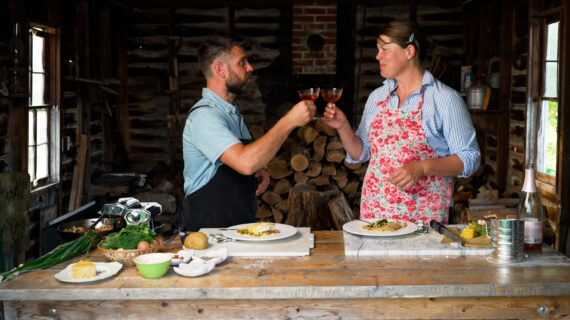
Extra insurance, yeah. Insurance policy for me. Staple this and then now you have your little pouch. And I can just put this in the oven, and have that be nice and steamy. It's a nice way to be able to cook, if you wanna cook outside, or if you just wanna cook something simple without a ton of dishes, this is the recipe for you. When Cece gets finished up with her pouch, we're gonna pop 'em in the oven for about 15 minutes, and then, dinner is served. (cork pops, both cheer) Yay! Toast the island sunset with a crisp, bubbly Wisconsin hard cider. Lavender, local veggies, and the catch of the day steamed to perfection in a parchment pouch. A lavender-infused panna cotta. It's quick, and easy to make. The perfect dessert to enjoy in the middle of a lavender field. Well, I hope this has inspired you to get out and enjoy Wisconsin with your cousin. And I hope you'll gather with us next time -
Both
So what I do is
Around the Farm Table. I'm your host, Inga Witscher. Cheers! - Cheers! Thanks again. Around the Farm Table is funded in part by Wisconsin Farmers Union, Heartland Credit Union, and Friends of Wisconsin Public Television.
Search Episodes
Related Stories from PBS Wisconsin's Blog



Donate to sign up. Activate and sign in to Passport. It's that easy to help PBS Wisconsin serve your community through media that educates, inspires, and entertains.
Make your membership gift today
Only for new users: Activate Passport using your code or email address
Already a member?
Look up my account
Need some help? Go to FAQ or visit PBS Passport Help
Need help accessing PBS Wisconsin anywhere?

Online Access | Platform & Device Access | Cable or Satellite Access | Over-The-Air Access
Visit Access Guide
Need help accessing PBS Wisconsin anywhere?
Visit Our
Live TV Access Guide
Online AccessPlatform & Device Access
Cable or Satellite Access
Over-The-Air Access
Visit Access Guide




Follow Us