

 Passport







Representing Shakespeare's Kate
I am Kari Borne. I'm from the Office of Continuing Education at UW Whitewater, and each semester we host the Fairhaven Lecture Series. We host the series that focuses on a theme, and this semester we're talking about remarkable women, and we're happy to have you with us. I'd like to introduce today's presenter.
Donald Jellerson studied at Vanderbilt University where he received his PhD in English Literature with concentrations in Shakespeare, film studies, and gender studies. He taught in the Women's and Gender Studies program at Vanderbilt and then at Rhodes College before coming to UW Whitewater, where he teaches courses in the English program. In addition to teaching Shakespeare and other courses, Donald runs the Film Studies program at UW Whitewater. In the Film Studies program, he teaches courses such as Gender and Film, Shakespeare on Film, and Literature and Film.
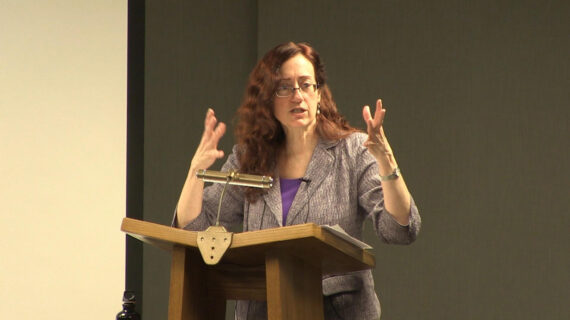
Welcome Donald Jellerson. (audience applause) Thank you. Thank you, Kari. And thanks to all of you for being here on such a lovely day.
And it is such a lovely day, and I am dealing with Shakespearean comedy, so I'm going to try to keep it light today. So it's okay to chuckle, or laugh, or interrupt me or anything like that. I'm going to talk about William Shakespeare's play, "The Taming of the Shrew," and about the character of Katherine, or Kate, in particular. Kate is the shrew in the play's title.
As those of you who have seen or read this play already know, and I'm assuming most of you have at some point seen or read this play. The Taming of the Shrew is about a macho dude named Petruchio who sets himself the task of taming a lovely but quarrelsome Kate. He wants to turn her into a proper wife. Kate needs taming because she is a cursed shrew.
She talks too much. She does not subscribe to the social norms for women in renaissance England. She is neither quiet nor obedient. She is loud, rebellious, and even pugnacious.
Mostly, she talks too much. Today, we'll look at a few 20th century film versions of Taming of the Shrew as well as the text as it may have been performed in Shakespeare's lifetime. But before we get too deep into that project, I want to acknowledge that my standing here in front of you today may seem a bit counterintuitive. This lecture series is called Remarkable Women.
(audience laughs) And it is described, as you see here. What can we learn about the leadership of women in business, education, literature, science, and politics, and how their accomplishments have shaped who we are today? The stories of these women across the world intrigue us, inspire us, and they remind us how their creativity and perseverance continue to impact our lives. The speakers in the series all talk of real remarkable women, and from what I can tell, these speakers are remarkable real women themselves, (audience laughs) among whom I am proud to appear as unwomanly as my appearance may be.
(audience laughs) So, what am I doing here, and why I am talking about Shakespeare's Kate, who, one might argue, is a fictional creation and not a real woman at all? We might say that the role of Kate has been performed by remarkable real women, Elizabeth Taylor among them. But then we would have to turn around and say that in the earliest performances of Taming of the Shrew, Kate was performed by a boy. Since women were not allowed onstage in Shakespeare's lifetime, his theater troupe used boy actors for the female roles.
I could go on, articulating the problems inherent in understanding Kate as a remarkable woman, real or not, or about the problems inherent in understanding gender and sexuality themselves as real. And believe me, you don't want to get a literary critic started on what's real. (audience laughs)
But I want to pick up on a word here
stories. Perhaps you'll agree with me that sometimes the stories we tell about people can become as influential as the people themselves. And if that's true, perhaps you'll even agree with me that remarkable women are sometimes not real at all, but the products of powerful fictions. That is, some of the most influential women, the ones who get into our minds and hearts and stick there, are characters in stories.
Like Anna Karenina, Elizabeth Bennet, Clarissa Dalloway, Blanche DuBois, Holly Golightly, or the Disney princesses. (audience laughs) Or they're real women who become influential because of the fictions they create or inspire, like Cleopatra, Joan of Arc, or Marilyn Monroe. Fictional or fictionalized, these are all remarkable women who have exerted tremendous influence on our understandings of the interactions among gender, sexuality, and culture here in the real world. And if we're making a list like this one, Kate from Taming of the Shrew might well appear on it.
Perhaps somewhere near the top. Shakespeare's creations have a special claim to this kind of list of influential characters, since his work has been shaping our understanding of what it means to be human for over 400 years now. As the renowned critic Marjorie Garber notes, "Shakespeare makes modern culture, "and modern culture makes Shakespeare." By this, she means that Shakespeare has scripted many of the ideas we think of as naturally our own and even as naturally true. Ideas about human character, about individuality and selfhood, about government, about men and women.
The ideas in Shakespeare's plays have seeped into our culture, and some of Shakespeare's characters are so influential that they have become stereotypes. There are those, for instance, who used to say that Hillary Clinton is a Lady Macbeth. Do you remember that? (audience murmurs) And we all know what a Romeo is, right?
What that refers to. But for all the staying power of Shakespeare's ideas and characters, it is perhaps the interpretability of his plays that give them the most power. That is, while Shakespeare has been making us, we have been making Shakespeare. Performing his plays, interpreting them, and reinterpreting them for the stage.
Reading them in school, reading them for pleasure without interruption, for centuries. Now we see them on film. In every new iteration, we remake the plays. We read them for different reasons, and adapt them to different audiences.
This is the effect I want to speak about today, and this is the effect that makes The Taming of the Shrew and Kate so interesting. Because, as odd as it may be to consider, Kate has become something of a feminist character. Or perhaps more precisely, she has become a way to make a statement about women's social roles. And in that sense, she's become a sort of bellwether for feminism.
Now, again, that may seem counterintuitive since we're talking about a play in which an outspoken woman is tamed by a domineering man, but a glance at the history of the play's performances tells us that whatever it was in Shakespeare's day, The Taming of the Shrew has become about the resistance to the idea of male supremacy more than it is about the right of men to rule over women. Let's look at the film versions, and I'll show you what I mean. I'm just going to flip... out of this...
and into this. That look good? Okay. So I've cut this up in some little pieces for you.
We're gonna see some clips. The first film I'm going to show you is from 1929. It's directed by Sam Taylor and stars Mary Pickford and Douglas Fairbanks. -
Audience
But I want to pick up on a word here
Oh, oh. Yeah. (laughs) This is at the very, very beginning of the talkies, right? Just in this year or the year before, cinema acquired the ability to have sound attached.
(thud) (tearing) (yelling) (smash) (shattering) But, wait. It's not fair. (yelling) (playful music) (thud) (suspenseful music) -
audience
But I want to pick up on a word here
Pretty scary. (laughing) Yeah, scary. I like that. Yes.
So, as you see, we have the physical comedy typical of this play, and we have Kate costumed in the fashion of the times. We might call this a kind of flapper outfit. In fact, with the feather hat and the boa. In fact, she sports these kind of flapper outfits throughout the entire film.
She also has a lion taming whip. (audience laughs) Oh, and we'll come back to that. (laughs) So already we begin to see that the film wants to give us a specific cultural point of reference in the Roaring '20s, even though many of the other costumes in the film don't seem to belong in the 1920s at all. I'm going to suggest that this image is a relatively straightforward reference to 1920s feminism.
We might remember that to be a flapper in this period often went beyond fashion choices. Suffragettes had successfully argued for voting rights. The 19th Amendment was enacted in 1920, and for many, the next step after a greater political equality was greater social equality. Flappers kind of signify that for us here.
I'm gonna give you the next clip. (light instrumental music) (grunts) (footsteps) (whip cracks) (laughs) (whip cracks) (laughs) Okay, so here we have a bit of a contest over who's got the bigger whip. And here's a hint about interpreting any film made before 1960. If you think it might be a phallic symbol, it probably is.
(audience laughs) But I want to notice two things here in addition to the phallic contest. First, Douglas Fairbanks here, as Petruchio, is wearing some kind of pirate costume, perhaps a nod to the swashbuckler films that made him famous. But for whatever reason, he is weirdly out of fashion for 1929, where Kate, again, is very much of the sartorial moment. Second, we should notice the stairs, which are absurdly oversized to give Kate the power of relative position in the scene.
This is obviously a constructed set rather than a location shot. Even with this power, however, Petruchio proceeds to overwhelm her with brute force, which is, of course, foreshadowed by the contest with the whip from which Kate withdraws. The ending scene of, the ending of this particular scene, the wooing scene, looks like this. -
Petruchio
But I want to pick up on a word here
Kiss me. (slapping) (footsteps) Out to my country house to prepare our coming. We'll have rings and things and fine array, for Sunday is our wedding day! Kate, father, adieu!
(laughs) Good Katherine. Sweet daughter. You! (whip cracking) (yelling and whip cracking) Petruchio!
Petruchio! Petruchio! Help! (whip cracking) Help!
Petruchio! Oh, master! Master, master! Petruchio!
(galloping) -
Petruchio
But I want to pick up on a word here
On Sunday, Kate! Look to your seat, Petruchio, or I'll throw you. Katherine shall tame this haggard. Or if she fails, I'll tie up her tongue and pare down her nails.
Okay, so Kate gets her whip back and makes use of it. But what's most interesting about this scene is Kate's speech. It's not in the text. "Look to your seat, Petruchio," she says, "or I'll throw you," which metaphor makes her the untamable wild horse.
"Katherine shall tame this haggard," she continues. "Or if she fails, I'll tie up her tongue "and pare down her nails." A haggard is a wild hawk, so in this metaphor, Petruchio is the wild animal to be tamed. For those of you who know this play, some of Petruchio's favorite metaphors for Kate have to do with animals. In the text, Kate is the haggard, among other things.
Petruchio has a long speech in which he compares her to a hawk that needs taming. And in another memorable speech, Petruchio says, "She is my goods, my chattels, my horse, "my ox, my ass, my anything." In this version, however, we are meant to understand that Kate will tame Petruchio despite his attempts to tame her. Now I'm going to skip over most of the film, in fact, and show the few bits from the scene in which Kate finally succeeds in taming her suitor. (humming) (thud) (crash) Oh.
Oh. (gasps) Oh, ow. Oh! Oh, Petruchio!
Petruchio! Ooh! Oh, beloved. Oh.
Oh. There. Oh. -
Katherine
But I want to pick up on a word here
There. -
Petruchio
But I want to pick up on a word here
Oh. Oh. Ooh. Oh.
Oh, oh, oh, oh, oh, oh, oh. Oh, oh. Huh, heh. (Petruchio sobs) (thud) There.
Oh. Ah. (audience laughs) So, in this scene, the violence reaches excessive levels when Kate actually hurts Petruchio, which is amazing, since they beat each other up through the entire film. It's the first time anybody gets hurt.
(laughs) And the two combatants reach a kind of accord in which Kate apparently becomes a kind of mother figure to the childish Petruchio. This apparently does the trick for both of them, and Kate can finally relinquish her phallus, I mean her whip. Finally, here's how the movie handles Kate's famous last speech, which is, as you might remember, all about the duties that a wife owes a husband. Oh, I am ashamed that women are so simple.
To offer war where they should kneel for peace, or seek for rule, supremacy, and sway where they are bound to serve, love, and obey. (laughs) So, obviously, the broad wink here suggests that this speech is about-- The speech about the obedience of women is meant as irony. A mere performance of obedience. And the fact that Kate winks to her sister while Petruchio revels in what he falsely assumes to be a successful taming suggests that men are childish, happiest when women control them with the illusion that they are in control of women.
So this is a kind of feminist statement, but we might remain a bit suspicious of how the film accomplishes it. As the final title card illustrates for us, which is, again, this picture of this little embrace, we might suspect that the films wants to tell us that feminine power lies, finally, in mothering. If we are post-modern feminists, we might well be a bit uncomfortable with that thought. Now let's look at the 1967 film, and we'll do a little compare and contrast.
So this is a version directed by Franco Zeffirelli, starring Elizabeth Taylor and Richard Burton. And this is just the introduction to Kate the first time we see her. Bianca. Bianca!
(dog barking) (shutters slam) Bianca, Bianca! Bianca! Okay, I wanted to that clip because Kate is introduced as something of a monster out of a horror film. Her predatory eye appearing behind the window shutters.
And she appears in direct contrast to her sister, the sweet, innocent Bianca. But here's the next clip, the wooing scene. (mumbles) (woman screams) (thud) (woman screams) (knocking and crashing) (grunts) (woman screams and grunts) (woman screams) (crashing) Ooh! (grunts) (crash) Ah!
(wood splinters) (screams) Good morrow, Kate. (wood falls to the ground) (panting) (romantic music) (laughs) That's your name, I hear. Okay, I'm fascinated by this, mostly because it's done up as a love at first sight moment. We get what's called a shot reverse shot sequence.
From a shot of Petruchio to one of Kate and back and forth several times. The dialog pauses. The music strikes up. Petruchio is haloed with backlight, and Kate tugs at a strand of hair as if she half desires for a moment to appear more put together than she does.
The attraction of one to the other registers on each of their faces. It's really actually quite artfully done. It's worth seeing again just very quickly so we can note the cinematic effects. The halo.
(romantic music) The music. The shot reverse shot. That's your name, I hear. (laughs) Okay, so after some of the famous verbal sparring written into the scene, Kate runs away and Petruchio follows.
So this is the same scene, just a little further on when Kate is running through the house and Petruchio is chasing after her. (woman shouting in Italian) (laughs) (dramatic, happy music) (screams) (laughs) Whoo! (laughs) (dramatic music) Okay, there's no reason for that shot to be in the film. (laughter) So why is it there?
What is it doing? I think what we're treated to here is some sort of cinematic characterization. There's no dialog, but the images of Kate rolling around in a pile of wood, of wool, sorry, with an apple combined with a triumphant score seem to be telling us that Kate is an innocent free spirit, and perhaps a bit weirdly alluding to Eve from The Bible with the whole apple thing. A few things might be going on here.
We should remember that in 1967, when this film was made, we're on the verge of the sexual revolution and in the midst of second wave feminism. This brand of feminism revolted against 1950s ideals of domestic femininity. It was the era of women's lib. Women wanted to liberate themselves.
And this image of Kate seems to reference that call to freedom. At the same time, there's that apple. I don't know what to do with the apple. (audience laughs) But it's worth keeping in mind because Zeffirelli does these things.
He puts these little symbols in there for you. Teases you. Little Easter eggs they call them. But let's just keep this in mind and move onto the next scene, which is the one that seems to mark-- Again, we're going to skip most of the film and go to the one that marks Kate's capitulation to Petruchio and to masculine supremacy, if you like.
And now, my honey love, we will return unto your father's house, and revel it as bravely as the best, with silken coats and caps, and golden rings and ruffs, and cuffs and fardingals and things. With amber bracelets, beads, and scarves and fans. When shall we leave? Why, now.
What is o'clock? 'Tis day. 'Tis night! 'Tis seven.
'Tis two at most! It shall be seven or I will not ride. Look, when I speak or do or think to do, you are still crossing of it. Nay.
Let it alone. I will not go today or ere I do it shall be what o'clock I say it is. 'Tis seven. (soft music) Okay.
Here, Kate is lured by Petruchio with promises of parties, pretty clothes, and jewelry. Like a child, she rises to the bait. Even though this is a bedroom scene, there is no suggestion that a sexual relationship is what's on offer here. She gives over to his will as a child does to a father.
Here's the last clip. The final speech. But now I see our lances are but straws. Come and place your hands below your husband's foot, in token of which duty, if he please.
My hand is ready. May it do him ease. (applause) Why, there's a wench. Come on and kiss me, Kate.
(audience cheers and applauds) (dramatic music) I won the battle you have yet to fight. And being a winner, God give you goodnight. (laughter and applause) (women screaming) Now, some critics read irony in Kate's final speech here in this film version, but I find that a little difficult to support. To my mind, the film suggests that Kate is perfectly sincere about putting her hand below her husband's foot, which is indeed the last line of that speech.
If there's resistance to be had in this scene, it's after the speech when Kate appears to collaborate with her sister and the widow to block Petruchio's path as she once again leads him on a merry chase. Now, we could perform a much more robust reading of Zeffirelli's film, but it's more important for my purposes to compare it to the 1929 version. Both of these films, it seems to me, have feminist impulses. Certainly, each of them updates the play in a different way to valorize Kate's resistance, at least some of the time.
But from a feminist perspective, there are problems with each of the accommodations. The 1929 film seems to align femininity with motherhood, and the 1967 film seems to align femininity with childishness. We might well remain a bit dissatisfied when considering either of these approaches. All in all, however, I find the 1929 version more feminist, personally.
More liberatory than the 1967 version. Now, this conclusion may be counterintuitive. Aren't things supposed to be getting better and better for women? Shouldn't a 1960s Kate be more liberated than a 1929 Kate?
Sure. But these are only two versions of the play out of thousands, if we take account of stage productions. Perhaps all these two films tell us is that the battle for equality is ongoing, that the pendulum will keep swinging until we get it right, and that Shakespeare's plays are an interesting measure of where the pendulum is at any given moment. Now, here's the kicker.
I find the original text, Shakespeare's text, to be more feminist than either of these films. This is because Shakespeare's early version contains parts that almost every production, and every film certainly I've ever seen of the play, leave out. The Taming of the Shrew in the original has a frame tale, and the Kate/Petruchio narrative is a play within that larger frame tale. Taming of the Shrew actually begins with a character named Sly.
This is a picture of the first folio in PDF. As the play opens, we see Sly, a drunken tinker, getting kicked out of a tavern by the bartender or hostess. Sly yells at the hostess, "I'll fix you, in faith!" And the scene goes like this. I know it's hard to read in early modern English, but I'll read it for you.
Hostess
A pair of stocks, you rogue!
Sly
You're a baggage. The Slys are no rogues. Look in the chronicles. We came in with Richard Conqueror.
Therefore paucas pallabris, let the world slide. Sessa!
Hostess
You will not pay for the glasses you have burst?
Sly
No, not a denier. Go by, Jeronimy, go to thy cold bed and warm thee.
Hostess
I know my remedy. I must go fetch the head-borough.
Sly
Third or fourth or fifth borough, I'll answer him by law. I'll not budge an inch, boy. Let him come, and kindly. Then Sly falls into a drunken sleep right there on the curb. So this is a scene in which a woman kicks a man out of a bar and threatens to call the sheriff on him.
That's the way the real Taming of the Shrew opens. While Sly is sleeping, a rich lord comes along and decides to play a joke on this drunken bum. So the lord dresses him up in fancy clothes and tells him that he's actually a nobleman who's been sleeping for 15 years and only dreaming that he's a drunken tinker. (audience laughs) Sly buys it, and part of the joke is that as a nobleman, he is to be entertained by a troupe of actors.
The actors arrive, and they perform the story of Kate and Petruchio. By the end of that play, the inset play, which is specifically a play within the play, Sly has fallen asleep again. So the lord and his servants put him back in his old clothes and set him in front of the bar where they found him. Now, as one version of the text has it, Sly wakes up again at the end, believing that the Kate and Petruchio story have been a dream.
He's confronted once again by the bartender, a tapster in this version, and this is how that scene goes.
The tapster
What hoe, Sly, awake! For shame.
Sly
Who's this? Tapster? Oh, lord, sirrah, I have had the bravest dream tonight that ever thou heard'st in all thy life.
Tapster
Ay, marry, but you had best get you home, for your wife will course you for dreaming here tonight.
Sly
Will she? I know now how to tame a shrew. I dreamt upon it all this night till now, and thou hast waked me out of the best dream that ever I had in my life. But I'll to my wife presently and tame her too and if she anger me.
Tapster
Nay tarry, Sly, for I'll go home with thee, and hear the rest that thou hast dreamt tonight. Now, the important thing to draw from this is that the taming plot is set up as merely a fantastical play, a dream. In the real world, the play begins with a drunken man getting kicked out of a bar by a woman, and it ends with that drunken bum, emboldened by a dream, imagining that he's going to go home and tame his wife. But as the tapster says, his wife is likely to course him.
That is, to beat him up. And the final word is the tapster's, who seems amused enough by the situation to follow Sly home and watch him get beaten by his wife. (audience laughs) Through the ironic contrast of the play within the play in the frame tale, Petruchio, the macho tamer, and Sly, the drunk, men don't tame women. (audience laughs) That's a fantasy.
In the real world, at least as presented by the original Taming of the Shrew, men malinger, and women beat them up and call the cops on them. (audience laughs) So I ask you, of the 1967 film, the 1929 film, or the original text, which is more feminist? Thank you very much. (audience applauds)
Search University Place Episodes
Related Stories from PBS Wisconsin's Blog





Donate to sign up. Activate and sign in to Passport. It's that easy to help PBS Wisconsin serve your community through media that educates, inspires, and entertains.
Make your membership gift today
Only for new users: Activate Passport using your code or email address
Already a member?
Look up my account
Need some help? Go to FAQ or visit PBS Passport Help
Need help accessing PBS Wisconsin anywhere?

Online Access | Platform & Device Access | Cable or Satellite Access | Over-The-Air Access
Visit Access Guide
Need help accessing PBS Wisconsin anywhere?
Visit Our
Live TV Access Guide
Online AccessPlatform & Device Access
Cable or Satellite Access
Over-The-Air Access
Visit Access Guide




Follow Us