

 Passport






Neuroscience of the Spirit
12/11/07 | 1h 54m 50s | Rating: TV-G
Nancey Murphy , Professor of Christian Philosophy, Fuller Theological Seminary and Richard Davidson, Vilas Professor of Psychology and Psychiatry, UW-Madison Explore the connection between science and religion. Look at how neuroscience effects our idea of the soul with Dr. Nancey Murphy. Then analyze research of the changing states of brain functioning with Dr. Richard Davidson.


Copy and Paste the Following Code to Embed this Video:
Neuroscience of the Spirit
cc Well, welcome everyone. My name is Jeff Hardin. I'm a professor in the Zoology Department and Religious Studies. I'm also the faculty director for the Biology core curriculum here on the UW-Madison Campus.
On behalf of my Co-director, Ron Numbers and Executive Director, Ron Binsley, I'd like to welcome you to our fall semester presentation of the Isthmus Society, entitled Neuroscience of the Spirit. The Isthmus Society was founded as a Metanexus local initiative, dedicated to promoting dialogue between the sciences and religion on the UW-Madison campus and within the Madison community. And we gratefully acknowledge the support of several sponsors. First, the Metanexus Institute; second, the Lubar Institute for the Study of the Abrahamic Religions; and third, New College Madison.
We're very grateful for their support, which makes all this possible. We're also grateful to you for braving the elements to be with us today. I think you're in for a real treat. Before we begin, just one brief reminder.
If you'd like to receive email notifications of upcoming Isthmus Society events, we would like to get your email, so that we can send those to you. We have a sign up here in front which we would appreciate you adding your email address to on your way out this evening. In addition you can go to the Isthmus Society Web site, which is isthmussociety.org where you can find information about the Isthmus Society, its board members and upcoming events. Including some materials that will be helpful for today's presentation, which you can download afterwards.
The last century has witnessed an explosion in our understanding of how the brain functions. From work done towards the end of the 19th and beginning of the 20th century on synaptic connections in the brain, to Roger Sperry's pioneering work on interactions between various portions of the brain in the mid-20th century. to modern techniques such as single neuron recordings, PET scanning, functional MRI imaging of the brain while it is active. These kinds of approaches have revolutionized our understanding of how the brain works.
And the question that we present ourselves, that presents itself to us because of all of these enhancements in our understanding of brain function is what is the significance of our understanding of brain function in a modern scientific sense, for our understanding of religious perspectives on the human person, and for our understanding of what people are doing when they engage in what we traditionally consider to be religious activities. So, that's what we want to address today. We have some outstanding plenary speakers to help us address that. Our two plenary speakers will each speak for approximately 45 minutes.
And our first plenary talk, Dr. Nancey Murphy, a Christian philosopher from Fuller Theological Seminary in Pasadena, will talk to us about how our modern understanding of neuroscience might affect historical conceptions of the human person, including such things as our idea of the soul. In our second plenary talk, Dr. Richard Davidson from the UW-Madison Psychology Department will talk about some of his work in analyzing functional states of the brain when it is engaging in certain kinds of activities, which at least some people have considered to be part of the religious dimension of the human person.
And then following our two plenary session talks, we'll have a response by Steve Wald from the UW History of Science Department. And he'll provide some reflections on what we've heard this afternoon. And following that, we'll open it up for general questions, which can be posed to any of our panel participants. So that's the rough schedule for today.
And let me begin then, by introducing our first speaker, Dr. Nancey Murphy. A native of Nebraska, Nancey received her bachelor's from Creighton University and then went on to do PhD work in philosophy at the University of California Berkeley, and received her PhD in 1980. Then, apparently a glutton for punishment, she went on for a second doctorate, a Doctorate of Theology at the Graduate Theological Union, also at Berkeley, which she completed in 1987.
Since 1989, Nancy has been a professor of Christian Philosophy at Fuller Theological Seminary at Pasadena. And Nancey's first book, "Theology in an Age of Scientific Reasoning" received awards from the Templeton Foundation, the American Academy of Religion and I think really established her reputation as someone who speaks to philosophical issues at the interface between religion and science. Nancey currently serves on the board of the Center for Theology and the Natural Sciences in Berkeley. She's a member of the planning committee for conferences on Science and Theology sponsored by the Vatican Observatory.
She's also an ordained minister in the Church of the Brethren. Some of Nancey's recent publications include, "Bodies and Souls or Spirited Bodies," by Cambridge University Press; a Co-edited volume entitled, "Evolution
and Emergence
Systems, Organisms, Persons," from Oxford University Press; and "Did My Neurons Make Me Do It? A Philosophical and Neurobiological Perspective on Moral Responsibility and Free Will," from Oxford University Press. That last work was Co-authored by a neuroscientist, Warren Brown. So it is our great privilege to have Nancey brave the weather from Pasadena to be with us.
Nancy. ( applause ) Well, since I'm not going to have a white Christmas, I'll thank you for this Advent Christmas present. Thanks so much to the Isthmus Society for the invitation to be here, and your co-sponsors. Thanks also to Jeff, and especially to Ron Binsley, who had the miserable job of trying to find a time that Professor Davidson and I could be together on the same day.
And I think we found one day in a whole calendar year, or something like that. And I want to thank Steve in advance, assuming that you're going to say very nice things about my paper. ( laughter ) How's that for a set up? Well, I titled my talk "Science and the Soul." And I begin with a question.
What are human beings made of? I know, muscle, bones, fat, all that stuff you study in biology class. But is that all? Most Christians, throughout most of their history have believed that there is another part, generally called the soul.
This second part has been considered quite important. It is often thought of that which is saved for eternal life. It is thought to account for the capacity in this life to be in relationship with God. Other religions have similar concepts.
The doctrine of reincarnation in eastern religions presupposes the existence of an immortal soul that lives a number of lives in a series of different bodies. Increasingly though, our culture is developing an understanding of the human person that sees us as purely physical. Contributions to this view come from sciences such as biology. The theory of evolution already pointed many in this direction over 100 years ago.
Philosophers are increasingly arguing such a view. The most dramatic evidence now comes from the neurosciences. It seems to be the brain that does most if not all of what was once attributed to the mind or soul. So, we're heading for a major conflict between science and religion, huh?
Well, not. My goal in this lecture to convince you that there is another option for Christians. I will argue that a physicalist account of the human person is compatible with Christian teaching. In fact, more compatible with original Christian teaching than dualism.
Note that I can only speak for one tradition, my own Christian tradition. With some adjustments, what I say here will be relevant to Jewish thought. Also, I had a chance to lecture on this same topic in Iran recently. And although all of the Muslims in the audience were dualists, my research had shown that there are actually a lot of precedence in Islamic thought for physicalism.
My lecture will have four parts. First, I'll say a few words about the historical background that makes it appear that a conflict is brewing here between neuroscience and Christianity. Second, I'll take a brief look at the Bible and consider what it does, and more importantly does not say on this issue. Third, I'll comment on one major
theological problem
What about life after death if there is no soul? And finally, I'll reflect on human distinctiveness in light of both science and Christian teaching. So, section one, how history has set us up for conflict. First, we do have to recognize the fact, which I mentioned at the beginning, that most Christians throughout most of their history, have held some form of body-soul dualism.
This has been the case, at least from the 5th through the 19th centuries. This view has had repercussions throughout Christian theology, but it shows up most clearly in the expectation held by theologians and ordinary believers alike, that we humans come apart at death. The soul departs to be with God. The body molders in the grave until the resurrection of the dead, at which time body and soul are to be reunited.
This fact about the mainstream of Christian thought would be enough to raise the specter of conflict. But one particular strategy for reconciling Christianity with Darwin's theories has made things worse for some. It has sometimes been said that it is okay to believe that the human body evolved from lower life forms, so long as one maintains that the soul did not. And in fact, the soul is often said to be a special creation of God.
Pope John Paul II in an address to Pontifical Academy of Science presented to views of one of his predecessors. He said, "Pius XII stressed this essential point. 'If the human body takes its origin from pre-existent living matter, the spiritual soul is immediately created by God. Theories of evolution which consider the mind as emerging from the forces of living matter are incompatible with the truth about man.'" End of Pius XII.
Many Evangelical Protestants have made the same move. Anyone who has adopted this strategy to reconcile scientific and theological accounts of human origins ought to be very nervous about current developments in neuroscience. To show you why, I need to insert here a note about terminology. Contemporary scientists and philosophers talk about the mind and its relation to the brain.
Religious folk generally talk about the soul. In my introduction, I was supposing that these are the same. As a matter of fact, although we have two different words in English, they could be used interchangeable at the beginning of the modern period. I've just found that if you ask contemporary believers, though, what the soul is, they will not have very definite replies.
Therefore, it's helpful to look back at earlier writers who did have a definite idea. My favorite is the Medieval Theologian Thomas Aquinas. He produced a list of the higher capacities, or faculties of the soul, that closely match what contemporary cognitive scientists and philosophers would describe as mental capacities or operations. Thomas' list includes the five senses, four of what he called internal senses, and I'll come back to these in a moment.
As well as emotion, the appetites, intellect and will. It's enlightening to look at contemporary neuroscience to see just how many of these capacities, which Thomas attributed to the soul are now being studied by neurobiologists. Most significant in my view are localization studies, that is, research indicating not only that the brain is involved in specific mental operations, but that very specific regions or systems correlate with very specific cognitive abilities. Here is just a small sample of some of the results.
Vision depends on the transmission of signals from the retina to the visual cortex, back of the head. Smell involves transmitting signals from six kinds of receptors to the olfactory lobes. Some of the most intriguing pieces of research involve Thomas' interior senses. Here are just a couple of examples.
One of the interior senses in Latin is called the sensus communis, which is the ability to collate the deliverances of the five external senses in order to recognize a single object. This sounds remarkably like the neuroscientist's so-called binding problem. Another interior sense is called the vis estimativa, which is the ability to recognize something as useful, for example, straw for building nests, or friendly or dangerous. Joseph LeDeaux is well known for his investigations of emotion.
What he writes about emotional appraisal is relevant to distinguishing this estimative of power from the sensus communis. "When a certain region of the brain is damaged, namely the temporal lobe, animals or humans lose the capacity to appraise the emotional significance of certain stimuli, but without any loss in the capacity to perceive the stimuli as objects. The perceptual representation of an object, and the evaluation of the significance of an object are separately processed in the brain. In fact, the emotional meaning of a stimulus can begin to be appraised before the perceptual systems have fully processed the stimulus.
It is indeed possible for your brain to know that something is good or bad before it knows exactly what it is." So, in Thomas' terms, the vis estimativa is a separate faculty from the sensus communis and it works faster. Memory has been much researched. Long-term memory is conceived of as the result of patterns of connections within neural networks. Short-term memory is believed to be enabled by a system of recurrent pathways, such that information is processed then recycled and fed into the process again.
The hippocampus is known to be involved in converting short-term to long-term memory. Language abilities are associated with two regions of the neocortex called Broca's Area and Wernikee's area. Recall of words is even more precisely located. Different regions seem to be involved for verbs, proper names, common nouns, and even color terms.
The parietal lobes are involved in memory of faces. The ability to recognize other people's emotions can be lost as a result of brain damage, although there does not seem to be a specific region responsible for this capacity. Antonio Demasio has recently reported on victims of localized brain damage, whose injuries or illnesses have resulted in the specific loss of moral character. That is, their intellectual capacities remain unaffected, but they are unable to act in accord with what reason tells them.
This is particularly important from a theological point of view. For Thomas, it was the will, the ability to be attracted to the good that accounted for human ability to be in relationship with God. Note that none of this research disproves mind body dualism or body soul dualism. One can still argue that it is the non-material mind or soul that is responsible for these functions, and that for some reason, they are simply well-correlated with brain activity.
However, it is clear that the burden of proof has shifted to the dualists to explain why we need to postulate an additional entity, the mind, when accounts in terms of brain activity are becoming increasingly more powerful. Section two, what the Bible says and doesn't say about the person. The issue at hand has been an important one in biblical studies in the 20th Century. By the middle of the century, there was considerable agreement among Christian scholars on the importance of distinguishing in theology between the original Hebraic views and later, Greek or Hellenistic views.
One instance of such a difference was a contrast between Greek dualism and a Hebraic conception of the person that is much more holistic and physicalistic. Scholars no longer draw the distinction so sharply between Greek and Hebrew thought, but nonetheless, there remains a near consensus that the Hebrew scriptures do not promote dualism. Now, if this is true, how could people have been so mistaken for so long, for over 14 centuries. One answer is translation.
Early Christian's access to the Hebrew bible was primarily through a Greek translation called the Septuagint. It was very easy to impose Hellenistic ideas on Hebrew texts simply by the choice of translations. Then, the Greek was translated into English, with the same meanings that Greek philosophers would have given to those terms. To illustrate, let me read you a few lines from the Psalms, as they were translated
in the old King James Version. Psalm 16
"For thou wilt not leave my soul in hell."
Psalm 25
"Oh, keep my soul and deliver me, let me not be ashamed."
Psalm 49
"They that trust in their wealth like sheep, they are laid in their grave, death shall feed on them, but God will redeem my soul from the power of the grave." So these passages fit quite nicely with the view that while the body may decay in the grave, God saves souls. It sounds exactly like body soul dualism. However, there are a lot of other references to the soul in the Hebrew scriptures that don't fit the dualist picture at all.
Psalm 7
"Oh Lord my God, in Thee do I put my trust. Save me from all them that persecute me, lest he tear my soul like a lion, rendering it in pieces."
Psalm 22
"Deliver my soul from the sword."
Psalm 35
"Without cause, they have hid for me their net in a pit, which without cause they have digged for my soul." So this doesn't sound right. Souls are not capable of being torn or stabbed. And it is bodies that people throw in pits. Even stranger, a passage
from Leviticus
"And if any of the flesh of the sacrifice of his peace offering is eaten at all on the third day, it shall not be accepted. It shall be an abomination, and the soul that eateth of it shall bear his iniquity." Souls eating meat? What is going on here? Well, it's widely agreed now, that the Hebrew word translated soul in all of these cases, "Nephesh," didn't really mean what later Christians had meant by soul.
In most cases, it's simply a way of referring to the whole living person. Here is how a more recent version translates some of these same passages.
Here is the King James
"For though wilt not leave my soul in hell."
New International Version
"Because you will not abandon me to the grave."
King James
"Oh keep my soul and deliver me, let me not be ashamed."
New International
"Guard my life and rescue me. Let me not be put to shame." And finally, that strange Leviticus passage.
King James
"The soul that eateth of it shall bear his iniquity."
New International
"The person who eats of it will be held responsible." So the Hebrew word Nephesh is translated as person, life, or just used as a way for a person to refer to him or herself. It's also used of animals. And here it's best translated as living being. So those who have seen body soul dualism in the Old Testament, including many early translators have been reading it back into the texts, not getting it out of the texts.
The next question is, what does the New Testament teach about body soul dualism? This is a more difficult question, but the best answer I have concluded is, nothing. Let me explain. There are a number of issues on which the Bible has clear teachings.
There are other things that the bible says in order to put forward those teachings. For example, when Isaiah says that God will gather Israel and Judah from the four corners of the earth, he doesn't mean to teach that the earth has four corners. That's a conception of geography and geology that he simply assumed in making his prophecy. I believe that the New Testament has a lot to teach about what it means to be human, but does not mean to teach specific details about
how many parts we're made of
body and soul, body, soul and spirit, or just one. Just as in our own day, there were, in New Testament times, a variety of ideas about the make-up of the person. The various New Testament authors used different ideas in order to make clear their teachings in other matters. So if we try to go through the New Testament to see what it teaches on this subject, we'll end up frustrated and confused.
Helpful support for this conclusion comes from New Testament scholar James Dunn. Dunn distinguished between what he calls aspective and partitive accounts of human nature. Dunn writes, "In simplified terms, while Greek thought tended to regard the human being as made up of distinct parts, Hebraic thought saw the human being more as a whole person, existing on different dimensions. As we might say, it was more characteristically Greek to conceive of the person partitively; whereas it's more characteristically Hebrew to conceive of the person aspectively.
This is to say, we speak of a school having a gym. The gym is a part of the school. But we say I am a Scott, my Scottish-ness is an aspect of my whole being." So, the Greek philosophers were interested in the question, what are the essential parts that make up a human being? In contrast, for the biblical authors, each "part" stands for the whole person, thought of from a certain angle.
For example, spirit stands for the whole person in relation to God. What the New Testament authors are concerned with then is human beings in relationship to the natural world, to the community, and to God. Paul's distinction between spirit and flesh is not our later distinction between soul and body. Paul is concerned with two ways of living.
One in conformity with the spirit of God, and the other in conformity to the old eon before Christ. So, it's better to say that we have a spiritual dimension to our lives and a fleshly dimension. We're not composed of flesh and spirit. So, my conclusion is that a holistic, physicalist account of the person, drawn from contemporary science is not at all incompatible with the picture we see of the nature of the human person in the Bible.
Section three, what about life after death? Here is where the difference between physicalism and dualism will have a big impact. It's one thing to read the scholars' commentaries on the history. It's quite another to talk about these things at a funeral.
I mentioned a minute ago that one of the clearest places dualism has had an impact is on what Christians think will happen at death. This was brought home to me very personally when mother and I went to my father's grave for the first time. "He's not really here," she said. "Oh, yes he is," I thought.
But fortunately, I kept my thoughts to myself. I recognize the comfort it brings to imagine that loved ones are really not dead but just gone. However, I stand with the majority of contemporary scholars in saying that such a view is not part of original Christian teaching about life after death. The original view was that the whole person dies, but that the whole person will later, at the end of history, be raised from death.
The model of this death and resurrection, of course, is that of Jesus. Paul writes to the church of Corinth that if Christ has not been raised, your faith is futile, and those who have died in Christ have perished. But in fact, Christ has been raised from the dead, the first fruits of those who have died. In our day, it is difficult to talk about resurrection.
This has to do with the question of how there could ever be historical evidence for such a strange thing. If we find resurrection unimaginable, that's just about right, because we can't have any clear idea of something beyond the life of the present age. We get only a variety of suggestive pictures from scripture. The problem was difficult in Paul's day, too, but for different reasons.
The idea of resurrection of the body was already available at the time in some Jewish circles, so this was a conceivable prospect for Jews, but simply disbelieved by many. However, it must have appeared positively ridiculous to many of the Gentile Christians whose exposure to Greek philosophies and other Mediterranean religions had led them to believe that they already had a soul, destined for immortality. And that the religious quest was to liberate the soul from the encumbrances of the body. Why then should one hope to have the body restored after the liberation that comes with death?
So, we can see that there are two different accounts of life after death available in Western philosophies and religions. One is the more common notion that humans possess an immortal soul, which will survive death. The other is the now strange expectation that the entire person will be raised, or one might say re-created at the end of history. Many Christians have worked out a hybrid in which the soul survives in an intermediate state, awaiting the return of it's body at the end.
I'm claiming though, that the original Christian view was simply death followed by bodily resurrection. On this view, nothing of value is lost if one adopts a physicalistic account of the person, and such an account appears to be closer to original Christian teaching. Section Four, human distinctiveness. I now turn to my final topic.
This is a reply to the question, if humans are, as evolutionists tell us, closely related to other animals, and if as contemporary neuroscience suggests, we have no immortal soul distinguishing us from the animals, then what makes us distinctively human? The way to put this question is not in terms of special parts, but in terms of special capacities. Let me go back to Pope John Paul's address to the Pontifical Academy of Science. He spoke not of the creation of the soul as did Pius XII, but of "The moment of transition to the spiritual." Science cannot determine this point, he says, but it can determine, at the experimental level, a series of valuable signs indicating what is specific to the human being.
In addition, philosophical analysis can reflect on what is distinctively human. The Pope lists metaphysical knowledge, self-awareness and self reflection, moral conscience, freedom, aesthetic experience, and religious experiences. But only theology, he says, can bring out the ultimate meaning of these characteristics according to the creator's plan. What then are the capacities that are most distinctive of our humanness?
What does it look like to reflect scientifically on this question? And what does it look like to reflect theologically? A number of scientists studied the higher primates, and from these studies, we could construct lists of things we can do and they cannot. As it turns out, most of the differences are matters of degree, rather than the presence and total absence of certain characteristics.
However, small differences in basic capacities interact to produce huge differences in final outcome. For example, apes can be taught rudimentary forms of language. There's a debate over the question whether chimpanzees possess self-awareness, one of the distinctives listed by the Pope. Do chimps recognize themselves in a mirror?
Do they recognize themselves in a mirror? Higher animals have emotions, but ours are more finely modulated. Animals can be angry, but they can't experience righteous indignation. So here are some features that are associated with our sense of what it means to be human, and animals share rudimentary forms of them.
What matters is the way that these enhanced capacities interact in human life. For example, put together our clear sense of self with finely tuned emotions and subtle linguistic abilities and we have immensely different capacities for inter-personal relationships. Now what does theology have to say about human distinctiveness? Here, the question is not so much what it is that makes us different from animals, although differences have to be presupposed.
The question is rather what is it about us that makes us important to God? I would list pretty much the same qualities that the Pope did, but here I'll focus on just one, our capacity to be in relationship with God. A number of neuroscientists have began to study the role of the brain in religious experience, and that's what you'll hear about next, I understand. What are we to make of this?
Does this mean that God affects people's brains? I've been surprised by the number of my students who object that without a soul there would be no way for God to relate to us. It is true that Christians have for centuries believed that their relationship with God takes place within their souls. This is an inheritance from Augustine.
It's a common notion found across cultures that humans have both and outer and an inner self. What Augustine added was to describe the soul as an inner space, and most peculiarly, that he created the image of one's true self being able to enter into that inner space. The metaphor of entering into one's own self or soul, in order to find God, has shaped the whole of Western spirituality from that point onward. But notice how strange it is, I, the real I, am somehow inside of myself, not just that I am my soul and my soul is inside my body, rather, the real I is inside my soul.
So, let us grant that this has been a typical way of envisioning our relationship with God, but it is clearly only a picture or metaphor. How does a physicalist envision the interaction between God and humankind? And here I have to say that the brain imaging studies of people at prayer is not entirely wrong-headed. If one is a physicalist, as I am, it's not surprising that brain regions are involved in religious experience.
In fact, some regions would have to be. My objection to some of the earlier studies though, is that they usually don't begin with very comprehensive understandings of religious experience itself. St. Ignacius Loyola, who founded the Jesuit order in the 16th Century, was one of the most sensitive observers of the ways in which God interacts with humans.
Using typical dualist imagery, he wrote on rules for perceiving and knowing in some manner the different movements which are caused in the soul. Putting aside the imagery, contemporary commentators speak of movements of one's heart, motions affecting one's interior life, a certain impetus in one's life, or a feeling for or against some course of action. Some of these are to be attributed to the Holy Spirit. Those that "inflame the person with love for God, or with sorrow for sin, that increase faith, hope, and charity and produce an inner, interior joy that attracts to heavenly things." Another set of movements which Ignatius calls desolation are "movements towards things low and earthly.
The unquiet of different agitations and temptations, lack of confidence, hope and love, and when one finds oneself all lazy, tepid, sad, and as if separated from one's creator and Lord." Now it just happens that I was preparing a lecture on Ignacius' account of religious experience, and in that morning's New York Times, there was a long article on a small part of the brain called the Insulae. All mammals have these brain structures. They collect information on bodily conditions, such as hunger, cold, injury and produce motivations such as finding food or seeking shelter. Damage to the Insulae can lead to apathy, loss of libido, and even of the ability to tell fresh food from rotten.
Now, humans have evolved two innovations that take this system of reading bodily states to a new level. For one, humans have a hugely expanded area in the front. It is here scientists say that simple bodily states are recast as social emotions. A bad taste or smell is sensed in the Insulae as disgust.
A sensual touch from a loved one is transformed into delight. The frontal insulae is involved in love and hate, gratitude and resentment, self confidence and embarrassment, trust and distrust, empathy and contempt, approval and disdain, pride and humiliation, truthfulness and deception, guilt and atonement. Second, human insulae's have a large number of a special kind of neuron called von-economo neurons that appear to be crucial for turning feelings and emotions into actions and intentions. So here is a small prune-sized brain structure that is essentially involved in what Ignacius would call movements within the soul.
On the one hand, repentance for sin, impulses toward what is perceived as good. On the other hand, temptations to fulfill bodily cravings, lack of confidence, and feeling lazy, tepid and sad. If the physicalist hypothesis is that God affects us by affecting our brains, then this is the location or structure where God is very likely to be active. Contemporary spiritual writer Maurine Conroy, after describing Ignacius' own conversion writes, "All this occurred from the inside out.
God moving deep within him produced differences in affective responses, changes in deep seeded attitudes, thoughts, and feelings and a shift in behavior." Notice that she says "deep within." So the physicalist question is was it deep within his soul, or deep within his brain. Some interpreters of the neuroscientific study of religion take it to show that religious experience is nothing but a brain event. I'm often asked by media people to comment, and I always point out that these studies say nothing about the existence or non-existence of God. But I've never found a better way to put it than neuropsychologist Malcolm Geeves.
Making inferences from brain states could become risky business. Consider for example the likely state of the brain of Sir Henry Watton. Watton describes fishing as a rest to his mind, a cheerer of his spirits, a diverter of sadness, a calmer of unquiet thoughts, a moderator or passions, a procurer of contentedness. Geeves responds, "Such a description might suggest a brain state similar to some forms of religious meditation.
However, it would be hazardous to suggest that because Sir Harry Watton's selective brain activity resulted from his focus on fish, therefore it proved the existence of fish." So, neither is brain imaging going to provide evidence for or against the existence or action of God. So what are we to make of all of this? My claim in this lecture is that biblical studies, philosophy, and neuro-science are all pointing in the same direction, towards a physicalist account of the person. Humans are not hybrids of matter and something else.
They are purely physical organisms. As I noted, it would be easy at this point to fall into the reductionist's era of claiming that religious experience is nothing but a brain process. Instead, we should say that it is our complex physical organization, along with our social relations, that enable our morality, rationality, and even our religious awareness. Neuroscience will help to explain these capacities, but it cannot explain them away.
James Dunn's account of Paul's conception of human nature makes a fitting conclusion. He says, Paul's conception of the human person is of a being who functions within several dimensions. As embodied beings we are social, defined in part by our need for and ability to enter into relationships, not as an optional extra, but as a dimension of our very existence. Our 'flesh-ness' attests to our frailty and weakness as mere humans.
The inescapable-ness of our death, or dependence on satisfaction of appetite and desire, our vulnerability to manipulation of these appetites and desires. At the same time, as rational beings, we are capable of soaring to the highest heights of reflective thought. And as experiencing beings, we are capable of the deepest emotions and the most sustained motivation. We are living beings, animated by the mystery of life as a gift, and there is a dimension of our being at which we are directly touched by the profoundest reality within and behind the universe.
Paul would no doubt say in thankful acknowledgement with the Psalmist, I praise you, for I am fearfully and wonderfully made. Thank you. ( applause ) Thank you, Nancey. Our second plenary speaker is Dr.
Richard Davidson. A native of Brooklyn, Ritchie received his undergraduate degree from New York University, and in 1976 he received his PhD from Harvard University in Psychology. Since 1984, he's been on the faculty here at UW-Madison in the Psychology and Psychiatry departments, where is he currently Vilas Research Professor of Psychology and Psychiatry and director of the Laboratories of Effective Neuroscience and the Waisman Laboratory for Brain Imaging and Behavior. Ritchie's lab specializes in brain function as it relates to emotion.
And you will no doubt hear that in his talk. His lab uses modern quantitative electro-physiology, Positron Emission Tomography or PET scanning, and functional Magnetic Resonance Imaging, or MRI, to monitor brain states as part of his research. In the early 1990s, Ritchie made headlines when at the personal request of the Dalai Lama, he conducted research on the effects of meditation on the brain in Tibetan Monks. Ritchie has won numerous awards.
These include The American Psychological Association Scientific Contribution Award in 2000. In 2006 Time Magazine named him as one of its 100 Most Influential People for that year. And in November of this year, Ritchie was named Person of the Year by Madison Magazine. You may have seen him in the Lotus position at the local bookstore near you.
( laughter ) It's my great pleasure to introduce Dr. Richard Davidson. ( applause ) Thank you very much. Thank you all very much.
It's a pleasure to be here and to talk a little bit about our work which is relevant to this general theme. I want to thank the organizers of the Isthmus Society for making this event possible. I'll think we'll have some interesting discussion. I know that my friends in the animal rights movement have handed out a leaflet, which I will address in the questions and answers period.
They have been following me around very persistently. And I welcome the opportunity to address the issues, the important issues which they raise, but I'll do that later. What I'd like to do today is to give you a feel for this area which I actually don't conceptualize as the interface between science and religion, because what this focus of mine is really about, is the cultivation of certain virtues of mind that have been important in many of the traditions. And the study of how strategies and methods in those contemplative traditions can actually cultivate some of these qualities like genuine happiness.
This is the cover of a Time magazine that featured some of our work on this topic. And this is the cover of the National Geographic. This was a photograph taken in our lab, and as was mentioned in the introduction, we have had a remarkable project ongoing in our lab, that is directly stimulated by conversations with the Dalai Lama to investigate the brain function of meditating Monks who have spent years training their mind. So what is of great interest to us is that these are contemplative traditions, which have developed specific methods for training the mind to cultivate virtuous qualities like happiness, like compassion, kindness and altruism.
And the basic import of my talk is to suggest that based on these contemplative traditions, these are qualities which are best regarded as skills which can be trained, and they can be trained because of the very fact of neuroplasticity. That is, the brain is the organ that is built to change in response to experience, and there are particular practices which will stimulate the brain to change in specific ways, including in the insulae that Nancey beautifully set up for me. So, this is the cover of a program that was a small meeting that was held in Darsala, India, that the Dalai Lama asked me to organize on the topic of neuroplasticity, where we brought the world's leaders in this area, a small number of them together with the Dalai Lama to talk about the issues that are arising from this area of neuroscience, which is really probably the most compelling insight I would say of all of neuroscience in the last decade. The study of the mechanisms by which the brain can change in response to experiencing and in response to training.
These are just some pictures from that meeting. It is very unusual. This is unlike any other scientific meeting when you're sitting next to the Dalai Lama. It's a lot more intense than being grilled at your doctoral orals.
This is just a shot of the setting itself. So, what I want to do today is to make two big points. I'm just going to put this up here so I can see it. The first is that people differ in the extent to which they express many of these virtuous qualities like happiness, loving kindness, compassion, clarity of attention.
And these differences, as I'll show you, are associated with different underlying biological characteristics. The second point is that these qualities can all be regarded as the products of skills that can be enhanced through mental training. And the contemplative practices, and particularly the ones I've studied that are derived from Buddhism, provide very specific, highly detailed instructions for how to transform the mind and thereby change the brain. And these are training procedures which we believe and we have shown now induce plastic changes in the brain which can be tracked with modern science.
And there is no appeal to anything outside of mainstream science to understand how this happens, and I certainly believe that this information enriches the experience of practitioners. And it's been our experience in the study of these practitioners that they are deeply interested in how their brains have changed as a consequence of this kind of training. So, the rest of my talk is mostly going to be focused on these issues. But before I introduce them, I just want to talk a little bit about happiness in particular since it is a topic that has been central to a number of recent popular books.
And also because in our country, happiness is also an unalienable right. So just to remind all of you of these words that were penned in 1776, it's a little hard to imagine with the current administration, but in fact, happiness is in fact, or the pursuit of happiness is something that is very much a part of our country. Happiness also can be a matter of life and death. These are actually data from a longitudinal epidemiological study that was conducted in Finland with approximately 30,000 individuals who were studied over a 20 year period.
And what these findings simply show, if you look in the column all the way over to the right is that if you just ask people how happy or unhappy they are and follow them over a 20-year span, the individuals who report themselves to be very unhappy, what this 10.8 means is they have a more than 10-fold risk of committing suicide within that 20-year period compared to those who reported themselves to be very happy. And so these are qualities which make a difference in a very real way in the lives of people. Happiness is also associated with a biological profile that is health enhancing. These are findings from a British study that appeared in the of the National Academy of Science in 2005.
And what is shows is that on a number of major systemic biological systems, including neuro-endocrine, cardiovascular and immune processes, that those individuals who report themselves to be very happy have a profile on these biological indices that is health promoting, and that will confer resilience in the face of certain biological challenges. So these are not ephemeral subjective states. They are biological states which have consequences for illness and health. One of the questions which is frequently asked is how malleable is happiness.
And there is a whole tradition of research, which basically argues that we're all born with specific set points for these qualities, and that there is nothing much we can do about it. Some people are kind of grumpy, and other people are really glowing, and that's just who we are, and you can't really do much to change these traits. And there is some evidence that is consistent with these ideas. I'll show you in the next three slides, evidence which is used to support these kinds of conjectures.
This is not brain data that I'm going to show you, but I promise you it's real data. And it's based on tens of thousands of individuals who are looked at aggregated together. In the first question that we asked is whether marriage can buy you happiness, and here is the answer. ( laughter ) So, at ".0" here, is where people actually get married, and this is a proxy for happiness on the y-axis, a measure of life satisfaction.
And what the data show is that on average, if you average over tens of thousands of people, you actually do get a bump in your happiness at the point which you're married. But look what happens as you go progressively further away. And five years post-marriage, you're actually doing worse than when you began. ( laughter ) Now, you know there are lots of counter examples.
I recently celebrated my 31st wedding anniversary, so there are clear exceptions, but these are what the average data show if you aggregate across tens of thousands of people. So, what about the flip side? Does widowhood produce unhappiness, and here is the answer. What you see is that you take a big hit, but remarkably, people bounce back, and they pretty much get to their "set point" after a couple of years.
And of course the question that we are most obsessed with in our culture is this question. Whether money can buy you happiness, and here are what the data show. At least in the United States. If you do cross-national comparisons, the data are more complicated.
And I don't want to mislead you, individuals who reside in countries that are extremely poor, are in fact less happy than, on the average, than people in the United States. But if you just look within the United States, this is what you see. So these are data plotted from 1945 to 2000. And if you plot the real income per head, that's this line that's going up, and that's just a testament to economic success in our country.
If you superimpose on that any kind of measure you want, this is the percentage of people who report themselves to be very happy. It's totally flat. It does not track the economic success of our nation at all. These are orthogonal when you look at it within this culture.
And so many people, when they see data of this sort say, okay, these are major social and economic kinds of factors. Does this mean that we're all stuck at our respective set points, or can happiness, compassion, and loving kindness be enhanced? And what I'll suggest to you today is that because of neuroplasticity, all of these qualities are best regarded as skills which can in fact be enhanced. And the data that I've shown you are interesting, and they certainly represent what the average is, but if we took the cultivation of happiness and the cultivation of qualities like compassion and kindness as seriously as we take the cultivation of certain cognitive skills in this country.
Or, if we took the cultivation of these virtuous qualities even as seriously as most middle class Americans now regard physical exercise. If we practiced the cultivation of these mental qualities even a few times a week, because of plasticity in the brain, it is my firm contention that these are qualities which will be enhanced, and will have rippling effects throughout our culture, and will make a real difference. So what's the evidence for this? Well there is a lot of data now on neuroplasticity which underscores that the brain can change in response to experience.
And this evidence is present in many different domains. Time does not permit me to detail this evidence. I just will mention a couple of these domains. Musical training is one case.
It's obvious to anybody that if you pick up a violin and have never played, you're not going to be able to play it well. It requires practice. Practice in playing the musical instrument we now know induces discernable plastic changes in the brain. These are both functional changes, as well as actual structural changes.
The anatomy of the brain changes in response to musical training. We also know that this occurs in motor skills, in any kind of complex sport. You can't expect to play golf, or to play tennis, and do it reasonably if you're doing it for the first time. We all know that it requires practice to cultivate these kinds of skills.
That kind practice induces discernable, objective, plastic changes in the brain. We know that maternal behavior toward offspring will induce plastic changes in the brain in those offspring. In fact, in studies that have been done at the animal level, we know that the way a mother behaves toward it's offspring will actually affect the expression of genes in the brain of those offspring. And those gene expression changes persist for the entire life of the organism.
So, a mother, by her behavior toward her offspring will literally change the gene expression, wittingly or unwittingly in her infant. And it's my contention that if we are doing this mindfully and intentionally with the goal of enhancing these positive qualities, we will change gene expression for the better and not for the worse. We also know that things like stress impairs one of the most important mechanisms of plasticity, and that is neurogenesis. Neurogenesis is the growth of new brain cells.
This is a fact that was once considered pure fiction. When I was a student, we were taught that the brain was different from other organs in the body. We all know that if we injure our skin, it heals and new cells form. We're all taught that the brain is different, that cells in the brain are on a program of irrevocable cell death, and development is a process of cell death.
We're born with a fixed complement of neurons, this dogma held. And there were no new neurons that were formed. We now know that that is definitively wrong. It is a fact that there are new brain cells that are grown every day in a normal human adult brain.
And that's called neurogenesis, and that process occurs the entire life of a person. Neurogenesis occurs throughout life. Now we know that stress, mental stress, can impair neurogenesis. And the flip side of that, which has not been systematically studied, but which clearly is an implication, is that if you reduce stress and you cultivate calmness, you will actually facilitate neurogenesis.
Exercise, physical exercise in animal models has been found to actually promote neurogenesis. So, these are all ways in which plasticity has been studied in the recent past. One of the important things that we've been interested in is the extent to which people can learn to better regulate their emotions through contemplative practices. And what I show you here is just a hypothetical figure of two individuals, person A and person B.
And imagine that there is some stressful life event which occurs around this point here, and the way I've drawn this, person B recovers much more quickly compared to person A. And you can plot different physiological measures on the Y-axis and you see very similar kinds of trends. They may be on different time scales. But what this kind of figure depicts are differences among people in how rapidly they may settle, if you will, following a stressful event.
And clearly, the pattern depicted for person B is a pattern that we would consider to be one associated with more resilience. And what I would suggest to you is that this is a pattern which can be learned. So, if I show you a picture like this, most American college students cringe with disgust when they're shown this picture. If I instead gave you a simple contemplative practice, which cultivated compassion for those who are suffering, and where you were trained instead of withdrawing from an image like this, you would want to approach an image like this, and have an immediate disposition to want to do everything you could to help.
It totally changes the way the brain responds to a picture like that. So these are data just showing that the response in an important brain area for emotion called the amygdala can be dramatically modulated by one hour of training, one hour, based upon this kind of very simple reframing of this kind of image. So, I want to now turn to the impact of more systematic training of the mind on brain signals that are associated with emotion, as well as tension that I'll talk about. And these are just some pictures from our lab of some remarkable human beings who have spent at least 10,000 hours of their adult life in formal meditation, training their mind.
All of these people have done a minimum of one three-year retreat, where they spent three continuous years, every single day, seven days a week, for a minimum of eight hours a day, often much more, in systematic training of the mind. Many of these individuals have spent much more time than that. So the range in our actual study went from 12,000 to about 62,000 hours of formal practice. Another one of these individuals.
We spent a lot of time talking to these people. And this person who is sitting next to me here, is a particularly unusual monk. He has been a Tibetan Buddhist Monk since 1967. He also holds a PhD in Molecular Biology from the Pasteur Institute, where he worked with the Nobel Laureate.
And so he comes with very unusual credentials, and has been a very important bridge between the world of science and the world of contemplative practice. This is us in the lab, as I'm about to give him some instructions for a meditation period. And one of the really wonderful things about working with these experts is that they are so highly trained, that the unusual and often not so conducive environment in the laboratory for meditating is really something that they don't mind at all. It's pretty irrelevant to them.
They can meditate in the most difficult of circumstances, including in an MRI scanner. So, this is just after he came out of an MRI scanner. He was in there for more than three hours, and most people don't look like this when they just first come out. ( laughter ) And so he is really, he's been one of our star subjects so to speak, and he has been in the scanner probably five or six times now, maybe even more, sometimes for four to five hours at a time.
And he really doesn't find that environment to be particularly aversive. This is just another shot of monks who helped us actually run our experiments. Now, I'm just going to share with you a little bit of these data, and many of our early findings have already been published. There's still a lot that is in the works, but we began with very simple paradigms, where we had practitioners meditate and alternate those periods of meditation with a neutral resting period.
We probed those periods with the presentation of very strong emotional sounds, in certain cases, for example sounds of a bloodcurdling scream. And when most people hear sounds like this they get jangled, their brain gets high jacked, if you will, by the strong emotional stimuli. And this is kind of analogous to what you might think of as this is the brain equivalent of a cardiac stress test. You know, when you go to a cardiologist and he or she will challenge your heart by going on a treadmill or on an exercise bike to look at cardiovascular function.
Here, we are challenging the brain with strong emotional stimuli in a way that's analogous to a physical stress. So, one of the things that has been very important in our work is to study compassion and the voluntary generation of compassion. This is so central to the Dalai Lama's message. And compassion is a quality which we believe can be enhanced through mental training.
And it gets enhanced through mental training by changing certain circuits in the brain. The Dalai Lama, since about age four, has been doing very specific mental exercises every single day that are designed to enhance compassion. These are very simple exercises. They don't require that you that you have any specific religious belief.
They will work in an atheist and they will work in a Christian. And so, they are specific tools for training the mind to cultivate these qualities. And in the words of Matthieu Ricard, this is what he said that they were doing in this experiment, "...is to generate the state in which love and compassion permeate the whole mind, with no other consideration, reasoning or discursive thoughts. This is sometimes called 'pure compassion.'" Now, you've seen those commercials on television where they warn kids "don't try this at home." Well, it's not that you shouldn't try this at home, by all means try it at home.
The likelihood of actually being able to do this is not very good, unless you have a lot of training. It's hard to hold the mind in such a state without distraction, and a lot of the mental training that these individuals do is preparatory to enable them to hold such a state for such a long period of time. Now these are just raw brain signals that show changes in the brain during this particular kind of meditation. This is a resting state and this is a meditation period.
You don't need even any fancy computer analysis to see that there is a big difference, this is brain electrical signals and when the practitioner begins to start meditating. There is a dramatic discernable, robust, highly consistent and highly replicable change in these brain signals that we see. This has now been replicated in two other independent laboratories, and it's an extremely robust finding. And it shows changes in the gamma frequency band of the EEG, which is a very high frequency band that is associated with, in previous work, with states of focused attention, with binding of perceptual input.
But typically, when gamma has been seen in the human brain signal, recorded from the scalp in previous experiments, it only is observed for a very, very brief period of time. These observations that we made in these long-term practitioners have never before been seen in the human brain. And that is, for this kind of duration. This just quantitates some of these parameters.
I won't go into the details, but I'd be happy to talk about that in questions and answer periods. One of the things we did is find that the length of training over a practitioner's lifetime strongly correlates with the magnitude of these signals. So, this just shows that those practitioners who have had more lifetime hours of training, this number here is 60,000 this is our practitioner with 62,000 hours of practice. They show a much more dramatic enhancement of these gamma signals.
Relevant to Nancey's comments, we see big time changes in the insulae when we look with functional Magnetic Resonance Imaging in response to these emotional stimuli that we probe the meditation periods with. The solid red line is the meditation practitioners, the longtime practitioners, while they're meditating. The dotted red line is the longtime practitioners when they are not meditating. And the solid blue line is a group of control participants, age-matched controls who were taught the same meditation.
They've been meditating for two weeks. They show a little change compared to their baseline state. So even after two weeks of practice, there is some change, but it is not nearly as robust a change as we see in the long-term practitioners. There are other parts of the brain that change as well.
This is a very interesting area of the brain called the temporal-parietal junction. It has been linked very, very strongly in previous studies to empathy, and taking the perspective of another. There is a dramatic enhancement of activity in this region of the brain when the practitioners are doing compassion. Now, one of the questions which we're frequently asked is can ordinary people do this?
We're now in the middle of a study. We have initial data from one set of participants that we've tested, where we've looked at two weeks of compassion training, just two weeks where we've had people practice daily in an intervention that we delivered over the Internet. And the comparison group was taught cognitive reappraisal. This is derived from cognitive therapy.
They had the same length of training. They had the same contact. It was delivered over the Internet. And so, there were two active groups, and we're interested in changes in the brain that may be produced by just this two weeks of training.
The elements of this compassion training for these novice practitioners were these. They were asked to contemplate and visualize in the suffering and in wishing the freedom from suffering for a loved one, for themselves, for a stranger, for a person with whom they've had some difficulty, and for all beings. They repeated phrases to themselves. The most common phrase used is, "May you be free from suffering.
May you experience joy and ease." These are said silently. They are instructed to notice the visceral sensations, particularly in the area of the heart when these phrases are repeated. And they're specifically instructed to feel the compassion emotionally and not simply to repeat the phrases cognitively. And this is basically the design of this study.
I won't go into these details, but we challenged them with pictures of human suffering of the sort that I showed you, when they're in the brain scanner. We also gave them a number of questionnaires that were designed to get at aspects of compassion. So this is one example. This is a self-compassion scale.
"I try to see my failings as part of the human condition." "When I'm feeling down, I try to approach my feelings with curiosity and openness." And what we see is systematic changes on some of those scales, where the group that received just two weeks of compassion training shows significantly greater increases in these scales, compared to the practitioners who are trained in cognitive reappraisal. We also asked them a question about the extent to which they want to approach the individuals who they are shown who are suffering. And the individuals who receive the compassion training show, report a much greater willingness and interest in approaching those individuals. And finally, here comes the insulae again.
The compassion group shows increased activation of the insulae, compared with the cognitive training group, dramatic difference between these groups in the magnitude of insulae activation. Another scale that we used comes from a colleague of mine here at Wisconsin, Carol Riff who developed scales of well being. This is from one of her scales. "When I look at the story of my life, I am pleased with how things have turned out." "In general, I feel confident and positive about myself." And it turns out that among those in the compassion training group, the greater the activation in the insulae, the more they report well-being on these scales.
This is what these findings show. So the greater the signal in the insulae, the higher the levels of well-being on the scale. Now, one of the unusual things we did in this study, this was a study done on University of Wisconsin undergraduates. And we paid them a substantial chunk of money for participating in this study, because it involved multiple sessions.
They had to log on every day to do the training. We paid them $165.00 to participate in this study. And we told them at the end of the study that they have an opportunity to donate some percentage of the earnings that they will receive, somewhere between zero and $165 to a charitable cause of your choosing. And this was not any kind of deception.
This was real. And we actually had them execute the transaction online. And what you can see here is that the greater the activation in the insulae among the compassion group, the more they donated. The more actual money they donated.
This is an astoundingly high correlation. And so, it turns out that just two weeks of compassion training affect the brain in this way and produce changes in the real behavior that may make a difference. Now I'm not going to take time to talk about attention other than to just read this one quote from William James. And then I'm going to skip over this section on attention in the interest of time.
I want to make sure there's plenty of time for discussion. But in the contemplative traditions, particularly those derived from Buddhism, there is a strong emphasis on training attention, which is really the foundational skill that enables everything else to happen. To stabilize attention, to develop a clarity of awareness. And William James, in his remarkable chapter on attention in The Principles of Psychology, had a very clear insight about the potential utility of training attention.
He said, "...the faculty of voluntarily bringing back a wandering attention, over and over again, is the very root of judgment, character, and will. No one is compos sui if he have it not. An education which should improve this faculty would be the education par excellence." The italics are in the original. They are not mine.
"But it is easier to define this ideal than to give practical directions for bringing it about." William James clearly recognized that potential training was so important for the cultivation of virtue. He didn't know how to do it. The contemplative traditions really offer us prescription for exactly how to do it. And there's a host of evidence to indicate that these practices work.
They change the brain, and they change behavior. And there's a whole bunch of data, all of which is published if you log onto our Web site. You can download these articles. You can just Google me, and you'll find it.
And there are dramatic changes in attention that can be produced. And I'll just mention one other finding I started earlier on by suggesting that happiness and the cultivation of these virtuous qualities may actually have beneficial effects on your health. And in one study that we did, we gave people an influenza vaccine, and we looked at antibody titers mounted in response to the vaccine, which gives you a good index of the extent to which the vaccine is working. And this is a study that we did in novice practitioners, eight weeks of training.
We administered the flu shot to the meditators and to a control group at the end of the study. And this is what the data show. The subjects in the meditation group actually show significantly greater antibody titers mounted in response to the vaccine, compared to a carefully matched control group. And we further found that changes that were produced in the brain strongly predicted the magnitude of changes that were seen in the immune system, suggesting that there were beneficial consequences in systemic biology that may be associated with the cultivation of these virtuous qualities.
So, let me just end with some final reflections and conclusions. I've suggested to you that compassion, loving kindness and other related characteristics are best regarded as trainable skills. Mental training to enhance these skills changes both the brain and the body. And this growing body of evidence provides a scientific underpinning for the contemplative practices of many of the great spiritual traditions, and can lead to a more widespread incorporation of these practices into the major institutions of our culture, including education, and medicine, and other major societal venues.
And let me end with one of my favorite quotes. This is a quote from Albert Einstein, who wrote this in a letter offering some advice to a friend where he said, "A human being is part of a whole, called by us the Universe, a part limited in time and space. He experiences himself, his thoughts and feelings, as something separated from the rest, a kind of optical delusion of his consciousness. This delusion is a kind of prison for us, restricting us to our personal desires and to affection for a few persons nearest us.
Our task must be to free ourselves from this prison by widening our circles of compassion to embrace all living creatures and the whole of nature in its beauty." And let me end by just expressing my gratitude to the many people in my lab. I just sort of stay out of the way these days. These are the people who really do the work. And also to His Holiness, the Dalai Lama.
Thank you. ( applause ) Thank you very much, Ritchie. We'd like now to open it up for some questions from the audience. And Ron, I'm not sure exactly how we ought to do this.
Should we bring some chairs up front, I suppose, so that the speakers don't have to stand during all of this. You can stand to stand? Okay, Nancey can stand and Ritchie is mic'ed. And it would be very helpful to use the mic, yeah.
And actually if people could repeat the question, as I understand it after hearing it, that would be helpful to everyone. Just a comment or question for Dr. Davidson. Surely training and skills are very important.
You demonstrated that beautifully, but I don't know if you want to suggest that that's all there is to these great traditions. I would think that there's no Buddhist Monk that's meditated 10,000 hours that doesn't have core beliefs in certain truths of Buddhism, or a nun who has prayed for 10,000 hours that doesn't believe certain Christian beliefs, or somebody works in a lab for 10,000 hours, unless you believe something about science. The best example of this, I think, is the life of the Buddha who after years of meditation, reached a dead end. He's going to die under the Bode tree.
And enlightenment for him was four noble truths, not of healing, not of meditation, but thoughts about this is the way that reality is. So, I'd just say, maybe you didn't mean to suggest this, but that would be something that couldn't be left out. And probably at some point, you reach a dead end. You won't reach the 10,000 hours unless you do have some core beliefs.
I think it's a very good point, and I appreciate you raising it. I certainly didn't mean to suggest that these kinds of training practices are all there is to these traditions. And I think the belief systems to which you refer may be very, very important. From a scientific perspective, it's still an open question as to how important they are for the production of certain kinds of changes of the sort that I'm describing.
That is, the enhancement for these kinds of virtuous qualities. The Dalai Lama himself, in his book on secular ethics, has argued that you can take these practices and take them from their religious context, and give them to all people, and they will have beneficial effects irrespective of their beliefs. Now, that has not been studied scientifically. We don't really know the extent to which that is true, but that is something that he has staked out a very strong claim about.
And so, I certainly share your view that these beliefs are extremely central to these traditions. How important they are for the production of these kinds of changes we just don't know. Two more questions to raised. Compassion-- Compassionate.
It seems also possible to say something like, perhaps, hatred is a good thing in some contexts. And perhaps even other-- would be able to-- these particular emotions? Well, I think that actually that these two questions are importantly related. These practices are embedded within an ethical framework.
And there is a belief system associated with that ethical framework that holds that emotions like hatred are destructive. And that's not something that should be cultivated. From the perspective of neuroplasticity though, it certainly, I think, is possible to cultivate emotions like hatred, and certainly I think the republicans have been masters of cultivating fear. ( laughter ) And so I think that we've seen, I think, unfortunate examples of how destructive emotions have been cultivated in our culture.
And so, I completely agree with you. But I also think that it is why when these practices are taught, even if they're taught in a religious framework, they are typically taught and I certainly believe they should be taught within an ethical framework that places certain values on these qualities that I described. I have a question for Nancey. I've never thought very highly of the soul, so I'm not too sad that it doesn't exist.
( laughter ) But I am concerned a little bit about the reaction to this notion. Are there traditions within Christianity that you think would be the most receptive to this physicalist approach, or do you think that this idea of needing, especially at the time of death, some notion that consciousness continues is so powerful and so strong that despite your biblical and philosophical evidence, and scientific evidence, that you're going to lose big time. Well, to a great extent, there's just a range among people, pretty much across the board in religions, as to how anxious they are about holding on to whatever they've been taught at the beginning. But I do find that the Seventh Day Adventists, as you well know, are very open to these ideas, because they have taught conditional immortality throughout their history.
That's one small cult. That's not a cult. Those are some of my favorite people to speak to. Other people that I also find easy to talk to about these issues are Catholics, because if you've got a background in official Catholicism, and you talk about the soul, not as a separable entity, but as a form of the body you can kind of start working toward a physicalist position from there, because it's not a radical dualism.
Other groups that I find very open to what I have to say are my own radical reformation traditions, the Mennonites, the Quakers, the Brethren, because when you tie the contrast of emphasis on the soul and saving the soul for another realm to a neglect of the physical world that we're living in now, and tie physicalism to an appreciation for our own physicality, which means our own relatedness to other people, which means our relatedness to the physical earth. There is a lot of hope that recovering a physicalist anthropology will help us recover a more full-scale ethic than has been exhibited in many of the centuries of Christianity where the emphasis was so much on saving souls for another world, instead of saving this world. If the soul or the mind is really just a manifestation of the body, what happens to free will? Well, you'll just have to buy my most recent book, it's called...
( laughter ) Thank you for the opportunity for the commercial. That is a huge issue. I started working with my colleague in neuro-psychology, Warren Brown, on these issues about 15 years ago. And we got together a group, and we put out a little book called, "Whatever Happened to the Soul?" And we all claimed that we were non-reductive physicalists.
But I'm a philosopher, and I knew that we really didn't have the answer to the question of how you can avoid reductionism. And so, Warren and I decided that we would work on a serious book on neuro-psychology and philosophy of mind, particularly aiming to answer the questions of moral responsibility and free will. And what we concluded is, it's not so much an issue of determinism, it's an issue of whether you're a neurobiological reductionist, and so that's exactly what we focused on. And I do think that not so much because of our own work, but because there were so many resources being developed over the last 7-10 years that are calling reductionism into question.
I believe that we've been able to gather enough resources there to answer the charge that physicalism equals reductionism equals no human freedom. It's called, "Did My Neurons Make Me Do It?" Just to quickly follow up, do you address the work of Benjamin Libet? No, we don't do that, because my impression is that there were a number of other neuroscientists and philosophers who had treated that adequately. I would like to address my question to you, Richard.
Respected geneticists that I know have estimated for me that perhaps 80% of our behavior is coming from our genotype and some minor portion, 20% is from our environment. And you're discussing environmental practices that can alter our behavior, compassion, loving kindness. Do you think there are genes that govern these behaviors? In the mouse, a gene was described that controlled maternal nurturing.
Are there genes that impose a basic nature on us, and are you modifying them? Are there people for whom compassionate training is impossible? So, just to repeat the elements of the question, you began by suggesting that some have argued that 80% of our behavior is controlled by our genotype, and so how can environmental influences of the sort that I'm describing play such an important role. And the second part of the question was directed toward the issue of genes for pro-social behavior.
An example was given of genes that appear to be important to maternal behavior, and does that have anything to do with the kind of work that I was describing. And finally, the last part of the question was, are there individuals for whom compassion training just won't work? So, those are all wonderful questions. Let me just begin with the first question.
I think that assigning a number to the percentage of our behavior that is "genetic" is frankly, rubbish. Just pure rubbish. It is inconsistent with what we now understand in molecular genetics. The reason I say that is because there is a whole burgeoning field of epi-genetics.
Epi-genetics is the study of modulation of gene expression. And we know that you can take, I mean, for example at the animal level, if you take a rat that's been genetically bread to be high anxious, and you cross-foster it, you raise it with a mother who exhibits a lot of nurturance. And in the rodent world, it's expressed as high levels of licking and grooming, probably something that wouldn't be bad for humans to do, either. ( laughter ) So, if you do that, it changes the gene expression of the specific gene that codes for the gluco-corticoid receptor which is a very important part of stress neurobiology.
And so it basically doesn't matter that that rat has a genetic propensity for high anxiety. You have literally changed the expression of the very genes that the genotype is specifying for this trait of anxiety. Now, it's not to say that-- I don't want to leave you with the misleading impression that genotype doesn't matter. I think it does matter.
It sets initial propensities. But I also very fervently believe that we have just not undertaken the right kinds of experiments to know what the further reaches of human plasticity are, and the extent to which gene expression can be altered in the brain. I just don't think we know the answers to that at this point in time. So, I think the healthy response would be to be agnostic.
There is a recent major behavior genetic study, which just came out of the UK. It was just published a couple of weeks ago. And it was a very large-scale longitudinal study with monozygotic and dizygotic twins to look at issues of inheritability. And one of the major insights from that study is that the stability of behavior from one age to the next appears to be more under genetic control, but the change in behavior from one age to the next appears to be strongly environmentally influence.
Not surprising, but there's very compelling evidence to indicate that. And so, you know I think that we need to do the right kind of training, and intensive training, I think, has a very important role. Another question that you asked, are there some people for whom compassion training may not work? I don't really think we know the answer to that.
There may be a group of people who, in psychiatric jargon, would be called psychopaths, for whom compassion training may not be helpful. But these are individuals who have documented abnormalities in certain brain circuits that in part underlay empathy and other such qualities, and so it may be that this kind of training wouldn't be particularly effective in those individuals. Although it hasn't been tried, so I don't think we can say with any certainty. I'm not quite sure how to this.
It's not a question, but what is the nature of identity then, and the continuity of one's existence, in the case where we reduce things without being reductionistic to physicality. Because, then you have people say, well I'm the same person although I lost my arm, I lost my leg, I lost my frontal lobe, whatever part. And yet, things are different, if it's physical. And so, it seems like this issue kind of overlaps all of the comments that you've made today, perhaps the three of you.
Well, philosophers have debated the criterion for personal identity for years. And they're talking about the simpler question of just what counts as you being you over the course of your lifetime. For Christians like me, you've got the more complicated question of what would constitute me being me after the resurrection, when I'm decidedly going to be different, at least I hope. What it turns out to be is that there isn't any single criterion.
Our bodies obviously change immensely from birth, to full maturity, to death. And so you've got, in a sense, a continuous spacio-temporal physical object. But we know that the actual materials of it are almost all replaced within a seven-year cycle, so it can't just be the same criteria as for a physical object. The other major criterion is the memory criterion.
But when we find an amnesiac who happens to wander home after five years, and doesn't have a scrap of memory will still recognize, this is Uncle Joe. So, the bodily criterion is what we use to fill in when the memory criterion doesn't work anymore. So actually, we're always using a combination of these, all the time, but it doesn't matter, because they tend to be identical. They tend to correlate.
When we've got peculiar thought experiments, well, what if we switch my brain with my sister's, which is me from then on? There aren't any answers to that question, because it's just a thought experiment. But when I talk about what will constitute me being myself after the resurrection, that's a very serious question. And I think that we all know what we mean when we talk about people having pretty stable personalities over time.
I always joked that if my late husband came back in a woman's body, I would still know from all of the personality traits that it's Jim, you know, people just are like that. So you know, character, also our personal relationships with others constitutes as who we are. And if you believe in God, if you believe in resurrection, then God's relationship to me is the primary thing that would constitute me as who I am. But then there is also simply the continuity of consciousness.
When you wake up in the morning you don't have to go and look in your appointment book and look up your business card to find out who you are. So I'm assuming that after resurrection, we'll just know that I am I. Dr. Davidson, you've spoken very frequently on the benefits of decreasing personal suffering within the self, and increasing compassion, but I can see potential for increasing personal suffering if one cannot respond constructively to the object of great suffering.
And so I wonder to what end is all of this? Is is simply to make ourselves more comfortable, or is there some larger, activist moral framework in which we're called to reduce some sort of quotient of suffering by some sort of means of counting. Wonderful question. I think most people heard it, but let me just repeat the essence of it.
And the question was being asked whether, initially, the first part of the question had to do with the potential negative impact of this kind of training of being overwhelmed with the suffering of others, and not being able to appropriately act. And the second part, related part, is this kind of training embedded in a framework of relieving the suffering of others, and sort of a call to action. Let me just first begin to answer that with an empirical finding. And that is that one of the surprising parts of the brain which is strongly activated by compassion training of the sort that I described, which I didn't have time to go into, are the motor areas of the brain.
Despite the fact that the practitioners are perfectly still. And this was a real anomaly when we first observed it. And we've observed it repeatedly when we have discussed this with the long-term practitioners. According to their view, this makes complete sense because they understand the practice to be one of action preparation.
So that they are utterly prepared to act as soon as suffering is encountered. And so, the purpose of these practices is not at all to make one feel better, but it is explicitly to relieve the suffering of others. That's a central motivation, so it very much is a call to action, and the changes that are observed in these motor regions of the brain, I think, is a very interesting neural-- that may be associated with the disposition to approach and engage rather than to simply withdraw. And I also want to just say that I think compassion is very different than empathy, the way empathy has been defined in the psychological literature, it is the experience of the same emotion that another is experiencing.
If you are with someone who is in pain, and you are experiencing the same pain, it may not be the most adaptive emotional state for you to actually help that other individual to relieve their suffering. And so, we think that compassion is probably very different than empathy, although the cultivation of empathy may be a very important developmental stage in the accentuation of compassion. My question and comments is directed to Mr. Davidson.
I'm one of those animal rights people you mentioned earlier. But don't worry, I'm not stalking you, and I don't know where you live. You don't have to call the cops on me. But during your presentation, like all those slides that you were showing, they were all, I'm assuming, based on human studies.
I didn't see anything that was obvious, that was being done on human primates, so I really, and other people, medical experts, etc., also share the same viewpoints, who really fail to see any kind of a direct link between studying non-human primates and human beings, as well. I really seriously doubt that if you stop studying the primates-- If you stop studying the primates, you really won't have anything to lose. I mean, you've made a lot of great strides, and you've gotten a lot of great results by just studying the humans. So why continue?
I mean, there's a lot of money that is involved with primate experiments, etc. I appreciate the opportunity to respond to this question. And it's a question which will inevitably persist. And I really welcome the opportunity to address it directly.
Let me just first say that 99% of the research that we do is with humans. The work that we do with non-human primates is really a tiny slice of what we do. But I feel that it is a very important slice. It's a slice that I'm proud of.
It's a slice that I will defend. And it's a slice that I think is crucial. And I say that because in addition to the kind of work that I describe, we also are working on some devastating human diseases. One of the diseases that we study is depression.
Depression is the second most common cause of morbidity and mortality worldwide. We also study other disorders, like Autism. These are very costly, devastating disorders that are responsible for massive amounts of human suffering. We have made a decision, and I've made a personal decision that and when I study those disorders, will do everything I can in ways that I think are the most beneficial to help promote new knowledge, to develop better treatments with the aim of reducing the suffering of these individuals.
In my best judgment, there are certain kinds of studies in non-human primates that are crucial in order to advance this science. I don't do these kinds of studies routinely. I do them extremely selectively. But when they are done, I do them with as much awareness as I can muster, and with as much intelligence in terms of making these decisions.
And also with as much gratitude and compassion for the beings that we are working with who are dedicating their time to help us better understand these issues. I should also say that the work that we do with non-human primates has pioneered the development of methods that are, for the most part, non-invasive methods. Now I know that you've been-- That in the literature you received, there are studies that we do that involve lesions of the brain. I can tell you that there are now treatments for depression that are being based directly on these studies that actually involve surgery to the brain for patients who have intractable mood disorders, whose lives have been devastated by these conditions.
And so I am proud of this work. I feel it really does importantly contribute to the alleviation of suffering. I do it extremely judiciously, and I try to do it with an attitude of gratitude and awareness. I think that a lot of animal research that's done is done in a more cavalier way.
I have spoken out in many forums to help reform the way animals are treated in research. I think that we could, in general, be doing a much better job than we're currently doing. And so my use of these animals in no way condones treatment as usual. But, I think it's necessary.
And in fact, I would say that those who advocate the cessation of animal research are irresponsible. The elimination of research in animals are irresponsible. With that, let me thank all of our speakers for an outstanding session. Thank you all for coming.
( applause )
Search University Place Episodes
Related Stories from PBS Wisconsin's Blog





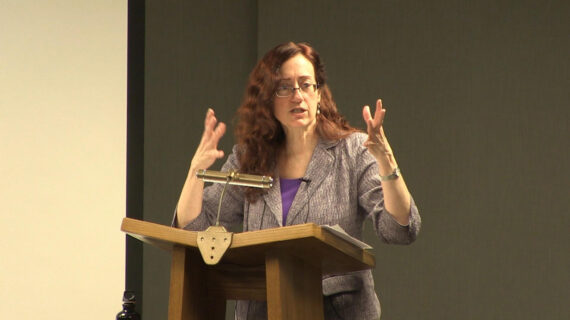





Donate to sign up. Activate and sign in to Passport. It's that easy to help PBS Wisconsin serve your community through media that educates, inspires, and entertains.
Make your membership gift today
Only for new users: Activate Passport using your code or email address
Already a member?
Look up my account
Need some help? Go to FAQ or visit PBS Passport Help
Need help accessing PBS Wisconsin anywhere?

Online Access | Platform & Device Access | Cable or Satellite Access | Over-The-Air Access
Visit Access Guide
Need help accessing PBS Wisconsin anywhere?
Visit Our
Live TV Access Guide
Online AccessPlatform & Device Access
Cable or Satellite Access
Over-The-Air Access
Visit Access Guide




Follow Us