gentle guitar
William Frost Jenkins
I remember going fishing with my dad on the Tomorrow River, which is one of the premier fishing streams in the area. Fly-fishing in Central Wisconsin is wonderful.
fishing rod winds
Chris Slusar
The same waters that were around a hundred years ago are around today.
Jen Ripple
What I look for in a good fly-fishing area is good, clean, cold water, especially when you're fishing for trout. And, you know, Wisconsin is one of the perfect places for it.
Narrator
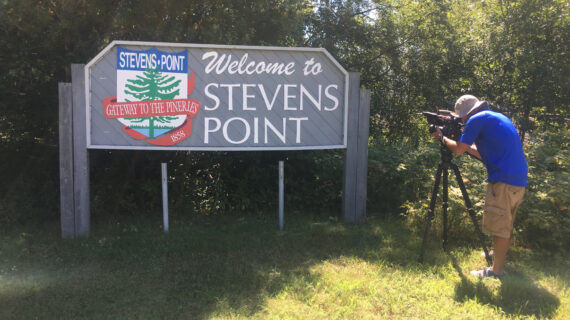
The abundance of cold water streams makes Stevens Point a perfect destination for fly-fishing. In the early 20th-century, it was also renowned for the quality fishing flies being made there. It all started when schoolteacher, Carrie Frost, took a job in Stevens Point to move closer to family, especially her father, with whom she shared a special bond.
William Frost Jenkins
Her father, John Clark, was also an avid hunter and fisherman. And he taught her to fly-fish early in her life.
Jen Ripple
It was not common in those days for women to fish, especially young girls. And so it's interesting that Carrie Frost's dad took her fishing.
Chris Slusar
Carrie was an expert fly-fisherwoman. Some say that Carrie could lay a fly in a calm pond without causing a ripple.
Jen Ripple
The flies that were around in the late 1800s all came from Great Britain or from Europe. The problem with them was that they were not on time. When they finally showed up, they were sloppily made.
Chris Slusar
In May of 1896, after missing a shipment of flies, her father asked her to tie some flies for the coming fishing season.
Jen Ripple
The locals saw that Carrie and her dad caught the most fish. They went over and said, "What are you catching those fish on?" And so, Carrie started out by tying flies on a small scale for the people in her neighborhood.
William Frost Jenkins
She started tying flies that matched more the insects in this area. So, she essentially filled a niche.
Jen Ripple
The fly-tying business became so busy that she left teaching in order to start the fly-tying business.
Narrator
Carrie formed the C.J. Frost Fishing Tackle Manufacturing Company in 1896. The business began operations out of the family home, but soon more space and more workers were needed.
William Frost Jenkins
In five years, she had expanded the number of employees to 45. Ten years after starting, she's now employing nearly a hundred women. And in that year, she had a new brick building built, C.J. Frost across the top.
Newsreel
Now, for the first time, Americans were able to travel inexpensively across their own country in their own cars and see the grandeur of...
Narrator
As more people could afford to own automobiles and had more leisure time to hit the road, Carrie's company supplied the needs of a growing fishing industry.
William Frost Jenkins
A typical employee could tie one gross a day. One hundred and forty-four flies per day. So, when you add up all those numbers, you come up with about four and a half million pieces per year put out by the company at its peak.
Jen Ripley
Carrie's business was actually the first of its kind in the United States. No one had thought to tie flies on a commercial level. She broke so many barriers at that time.
Narrator
As the company grew, Carrie's father, John, and brother, George, came to work for her, becoming the few men working at the company.
Chris Slusar
Carrie's employees were women at the time for a couple of key reasons. One was she offered a very kind of unique opportunity for ladies at the time to stay local and earn a pretty decent salary. They were actually recruiting the young gals right out of high school to participate in fly-tying. I think she also, as a feminist at the time, wanted to encourage opportunities for ladies.
But in addition to that, the ladies were great fly-tyers.
Narrator
Carrie's flies were mostly sold in hardware stores and would be branded with the store's name. Unlike her competitors, she would also put her company's name on these products as the manufacturer, often including "Miss" before the name of her company.
Chris Slusar
I believe that Carrie was selective in when she chose to point out that she was a female. I think she was, at times, had to maybe be cautious for business reasons to leave the Miss off, but when she wanted to put the pedal to the metal and make it clear that, "Hey, I'm a female, and I'm running this outfit," she was not afraid to use the term, Miss.
Jen Ripple
Her name started to carry so much weight. She would put her name on the flies because that was a way to show people that yes, women can put out quality products in the fly-fishing world, and we can make a superior product.
Narrator
In 1920, at the height of the company's size and production, Carrie sold her business. At that time, the company had around 150 employees and was the largest producer of flies in the country. Carrie's company was only the beginning of what would become a fly-tying empire in Stevens Point. Her brother George would even start his own company, G.W.
Frost and Sons. The strength of the family name
was reflected in his company's slogan
"Fish Fight for Frost Flies."
Chris Slusar
Stevens Point was home to many fly-tying companies. C.J. Frost, subsequently the Frost Fishing Tackle Company, Weber Lifelike Fly, G.W. Frost and Sons, and even smaller organizations, like A.J.
Koshollek, William Plantico and Sons. Joe Worth originated the Worth Company in 1940 in Stevens Point. Worth was also tying flies at the time, so Stevens Point has a rich history of fly-tying and fly-tying companies.
Narrator
With so many fly-tying companies in one city, there was competition for the best tyers. Businesses would install air conditioners, upgrade their bathrooms, and provide other amenities to keep the best fly-tyers.
Chris Slusar
The fly-tying in Stevens Point is said to have had its peak in early 1940s. It's thought that there were five to six hundred fly-tyers in the area tying some 10 million flies annually, so a really remarkable number.
Jen Ripple
So, the Stevens Point area was the perfect place for Carrie Frost to start her business because fly-fishing was very prominent in that area. And so, having the business right there was just a natural place. Stevens Point is known as the Fly-Tying Capital of the World, and it's all because of what Carrie had done. She's the one who put it on the map.


 Passport














Follow Us