uplifting acoustic guitar music
Narrator
The majestic white pine trees, which brought the lumbermen to Stevens Point, still tower above the city's many parks and green spaces. To encourage the use and enjoyment of these treasured places, a group of civic-minded residents pursued a new idea in 1989.
Christine Thomas
The trail was a relatively new idea in its day. The idea was to take the wonderful parks we have in Stevens Point and to connect them so that folks could walk, bike, take their dogs, push their strollers over the entire greater Stevens Point, Plover, Whiting area.
acoustic guitar music
Narrator
The Green Circle Trail would string together the jewels of the city's park system, a system that began when people complained about the quality of the drinking water drawn from the Wisconsin River.
Tim Siebert
The water tended to be murky, not necessarily bad health-wise, but it was not pleasant. It kind of smelled. Then the city discovered the aquifer to the east of the city and began to pump that water. And just kinda took on the name "The City of Wonderful Water" because of the clarity.
Narrator
To protect the underground aquifer. The city purchased the land around the wells, including a section of the Plover River with a popular swimming hole. This ready-made recreation area soon became a city park. In 1935, a generous gift more than doubled the size of the park.
Ron Zimmerman
Jules Iverson, a local businessman in town, purchased it with the idea that it was for the children of Portage County. That park today bears his name.
Narrator
As Iverson Park grew on the city's east side, changes to the west side were occurring along the Wisconsin River front.
Tim Siebert
There were lumber mills all along the river. Once those began to disappear, then the idea began to develop of, you know, maybe this would be good parkland.
Ron Zimmerman
That water crisis that created Iverson Park also created Bukolt Park because the old water plant in what became Bukolt Park was abandoned. So, it was excellent land right on the Wisconsin River. It was just a natural to become a park.
playful instrumental music
Narrator
Improvements to the swimming beaches of both parks proved to be highly popular with the children of Stevens point.
Siebert
Swimming was pretty important back in the day. They didn't have air conditioning.
Dorothy Zmuda
We had lot of fun there. We just wanted to swim. You could go up on the dock, and there was a 15-foot scaffold where the brave people dived off. Not me;
chuckling
Dorothy Zmuda
I climbed up, but I climbed off, too.
laughs
playful instrumental music
Narrator
The Green Circle Trail provides a journey through history, passing by a collection of park buildings built during the Great Depression. The Works Progress Administration, or WPA, employed local people and used local materials for the construction.
Ron Zimmerman
They used local sandstone to create some of those beautiful buildings that are still in use today in those parks. Gives 'em a very timeless look.
playful instrumental music
Narrator
Through the years, more recreational opportunities were added at Iverson Park, including a ski jump and toboggan slide.
children laughing and screaming
toboggan sliding
happy laughter
Narrator
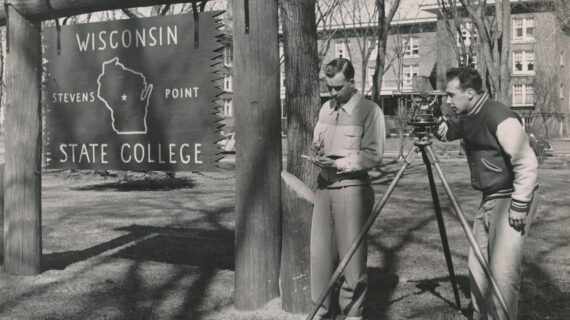
The anchor point of the Green Circle Trail is the Schmeeckle Reserve, a 280-acre conservancy on the UW-Stevens Point campus named for Fred Schmeeckle, a professor who came to teach in 1923.
instrumental guitar music
Christine Thomas
Fred Schmeeckle was hired to teach agriculture and science. He decided that conservation was a really important thing and that teachers also needed to know about that.
Male Narrator
"Soil erosion, destruction of forests, "pollution of water, and misuse of wildlife, "were factors that started me thinking "that something should be done to educate people in the wise use of resources."
Ron Zimmerman
He started teaching a few conservation courses, and in 1946, it became the first conservation education major in the United States. He's called "the father of conservation" here at Stevens Point. He really was ahead of his time. He was really a pioneer.
instrumental guitar music
Christine Thomas
The late 1960s is really the start of the environmental movement. And natural resources, in general, has always been very popular in Wisconsin. This was sort of a natural place in a natural time. In the 1970s, the conservation major became the College of Natural Resources.
And so, this grew into the largest natural resources-based undergraduate program in the country.
Ron Zimmerman
You can find majors not only in the United States but all over the world.
Christine Thomas
One thing that sets our students apart is the hands-on nature of our program. And that really started with Fred Schmeeckle. He was a hands-on guy, and the university had a parcel of land just to the north of campus that they purchased, with the idea of potentially expanding there. But Schmeeckle used it as an outdoor classroom.
acoustic guitar music
Narrator
The land used by Schmeeckle would officially become a conservancy in 1977 and named in his honor. Today, the university continues to use the land as an outdoor laboratory and training ground for natural restoration.
starting chainsaw engine
Christine Thomas
It also is a community resource. It's a quiet, wonderful place to come, and the community takes advantage of that.
Ron Zimmerman
Today, people look at the reserve as a place to get back to a more natural rhythm.
Christine Thomas
This is also the trailhead for the 27-mile Green Circle Trail.
Ron Zimmerman
The trail was an inherent problem to create because they didn't have natural public lands that connected all of these neat parks and all these points of interests. And they needed to win over private landowners because they had no money to rent land or anything. And many, many people signed off.
tires crunch on gravel
Ron Zimmerman
You get these corridors of green to connect the whole area. There's been a lot of, a lot of unity, a lotta cooperation.
Christine Thomas
Community-minded people who got together and found ways to make the world a better place.
piano music
Narrator
The city's dedication to improving their community is evident in the Sculpture Garden located along the Green Circle Trail. Created in 2009, the 20-acre park features the work of local and national artists in a setting that connects nature and art. The city's commitment to the arts is also seen in the murals in the downtown area. Many depict the city's history and important residents.
fountain splashing
Narrator
The Stevens Point square continues to serve as an anchor for the community, providing a place to gather and find refreshment on warm summer days. The farmers' market still draws crowds in search of local produce. As legacy businesses thrive and grow, Stevens Point welcomes new industries, creating a diverse local economy poised for future growth.
Ray Reser
Stevens Point is culturally and ecologically the center of the state. This has been a mecca for people to come to for the last 12,000 years, and I think that just speaks well to our shared history in the state and what an amazing place this is.


 Passport
















Follow Us