instrumental music
Narrator
The city of Stevens Point lies in the middle of two ecological regions. To the north, a towering pine forest. To the south, a hardwood forest mixed with prairie. In this area of overlap called the Tension Zone, live an especially wide variety of plants and animals which have drawn people to the area for thousands of years.
Native American music
Narrator
An early map shows a network of well-worn Native American trails running through the Tension Zone, and the Stevens Point area became an early crossroads of activity.
David Grignon
The Menominee people were in the Stevens Point area. Historically, was part of our ancestral territory, and we had a historic village site at Stevens Point. We called it "Pasipahkihnen." What that means is "the land that jets out into the waters." We made use of Stevens Point, too. Just an area that was rich in resources.
It was here that our people harvested wild rice along the Wisconsin River. We made maple sugar in the maple groves, and fished, and hunted, and were just a good area for us. The Wisconsin River was useful to not only the Menominees, but other tribes, too. Using the river as a historic highway.
Using it for transportation, for fishing, wild rice, trapping.
Narrator
Trails also connected Native Americans to resources throughout the region. The trails through Stevens Point formed the groundwork for many of today's roads and highways.
Ray Reser
Trail systems were kind of the equivalent to a water system. You know, if you couldn't travel by water or if you needed to portage somewhere or get to a specific resource, you used the trail system. They might be a modern highway today, but they could go back thousands of years. People have been traversing that track for a very long time.
Narrator
As Europeans began exploring the area, word spread of immense stands of white pine that would soon be cut along the Wisconsin River.
Tim Siebert
It's relatively light, so easy to transport. Cities needed volumes of the stuff to build. So it was just the perfect timing for the Great Northwoods.
Ray Reser
In 1836, the Treaty of the Cedars happened. The Menominee negotiated with the federal government and then Governor Dodge of Wisconsin.
Grignon
Chief Oshkosh was the head negotiator for our tribe. Although he didn't want to give up land, he thought he had to because he didn't want an army of soldiers coming on our villages to bring harm to us, so he and other chiefs agreed to the Treaty of the Cedars.
Narrator
It would become known as The Lumberman's Treaty because it included a six-mile-wide strip of pine along the Wisconsin River. In the middle on a point of land, with rapids just downstream to provide water power was the future site of Stevens Point.
Tim Siebert
It became the perfect place to store stuff 'cause you were just around the rapids, and the river from here north for several miles was very calm, and you could use boats much more easily transported the stuff.
rushing currents
Narrator
By the time the government hired Joshua Hathaway to survey the land for settlement, many of the water power sites in the area were already occupied.
Gene Kemmeter
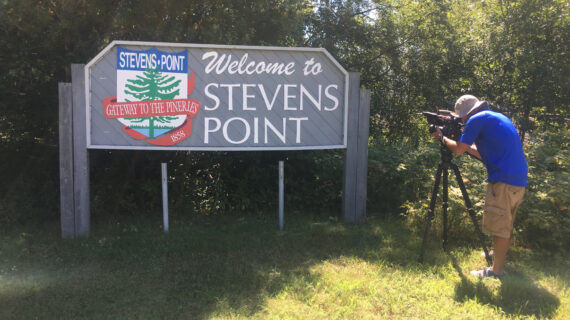
He recorded the names given by early settlers of locations. The locals had told him that this point jetting out into the river was known as "Stevens Point" because he owned the cabin that was there. George Stevens was a lumberman from Almond, New York. He heard about Northern Wisconsin, so he made an expeditionary trip up in 1838 to see where these large lumber domains were.
Narrator
Stevens used "the point" to store materials for a mill he was building at Big Bull Falls, the future site of Wausau. Despite his brief stay in the area, Stevens connection to the point stuck.
Tim Siebert
Stevens Point is the gateway to the pineries, the Great Northern Pinewoods. They begin a little further north.
Gene Kemmeter
Towards the 1850s, 1860s, Stevens Point area became a good place to locate sawmills. The railroad hadn't come here yet, and the river was the means to transport all those logs.
Tim Siebert
They would cut the logs into rough cut lumber and then organize them into these giant rafts that then could be floated down river and get it on down to oh, say, St. Louis, where it would be planed and made into fine lumber. And Point became important because you had to stop here and hire what became known as a river pilot, people around here who knew the river. They were probably the most highly paid men in the Northwoods because their life expectancy was fairly short, and that's why the town began to grow, is because these loggers would stop here and have to wait until the river pilot was available.
Narrator
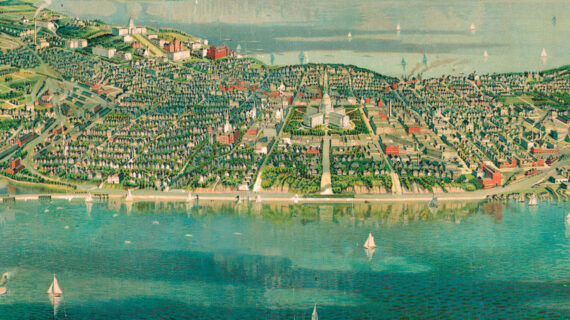
Men poured into Stevens Point looking for jobs in the lumber mills and on the river. As it grew, the lumber town was able to incorporate as a city and officially took the name "Stevens Point" in 1858. The new city already featured six hotels, ten saloons, and three school houses. With a growing population, the city began to expand east of the river, and as people bought up land, the layout of the city took shape, including a key feature.
Tim Siebert
Mathias Mitchell, who we really don't know anything about,
laughs
Tim Siebert
came into the area and purchased a lot of this surveyed land and platted out a lot of what is now downtown Stevens Point. At some point, he then donates a fairly significant chunk of land to the city as a square, or what, in Europe, would have been the village green.
Narrator
Mathias Mitchell's generous donation would live on as the public square would become the region's commercial center and a focal point of the city's history for generations to come.
band fanfare


 Passport














Follow Us