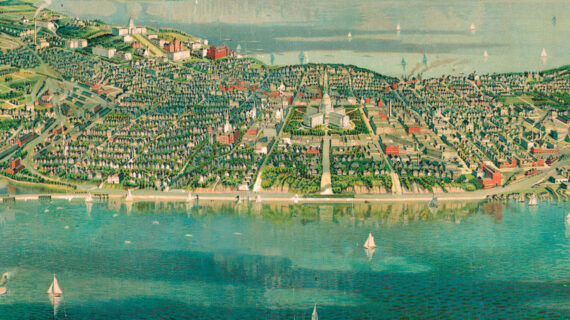
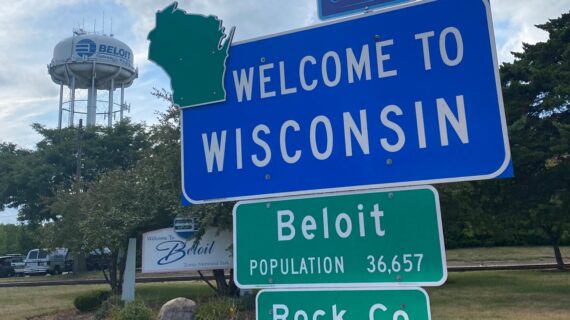
[wistful, nostalgic piano] - Narrator: In southern Wisconsin, along the Illinois state line, just north of the confluence of the Rock River and Turtle Creek, sits the city of Beloit.
The area's flat landscape was created during the last glacial period, peaking more than 15,000 years ago.
The outwash from the melting glacier filled in the once hilly landscape and deep valley, creating a slower and rocky river.
Named the Rock River, it originates in the Horicon Marsh area and empties into the Mississippi River.
As a tributary to the Mississippi, the Rock River was a key waterway for the Ho-Chunk people, particularly to reach one of their largest villages at the junction of the Rock River and Turtle Creek.
– Bill Quackenbush: Beloit sits within the central area of our ancestral homelands.
The Ho-Chunk, we hold the Beloit area near and dear to our heart.
Much like many of our large city or council areas, there's the utilization of our traditional names for those sites, and Beloit being referred to as "Ke-Chunk," the Turtle.
[traditional Ho-Chunk flute] In our oral history... that talks about when the Turtle came across and wanted to reside down into the Rock River.
This is where he drug his tail.
And that's where the confluence is.
- Ke-Chunk, also called "Turtle Village," thrived.
When Indian Agent John Kinzie visited the village in the 1820s, he conducted a census and reported almost 700 Ho-Chunk people living at Turtle Village.
Kinzie noted the village growing vegetables and tapping trees for syrup.
– Bill Quackenbush: Beloit is unique.
It had its own resources, and this was something that they would supply in abundance and trade to other resources throughout our network.
So, Beloit played a very important role of a place where people would come to enter into that trade process.
[cheerful old-timey music] - These trading opportunities eventually attracted non-native people to the Ke-Chunk area.
– Fred Burwell: Joseph Thibault was a French-Canadian trapper and trader who had been out in this region for quite a few years, had made a lot of inroads with the native population, got to know them well, traded with them.
Thibault claimed a lot of land.
- In the early 1800s, the Ho-Chunk Nation fled Ke-Chunk as the Blackhawk War came into the area, and the government forced them to move west.
– Fred Burwell: Because the Native Americans had mostly moved on, trading was not good for him anymore.
He was looking to move on.
And when Caleb Blodgett from Vermont came out here, he made a deal with Thibault.
– Beatrice McKenzie: Caleb Blodgett was a land speculator and the first settler in Beloit.
In May 1836, he purchased the claim that Joseph Thibault had made for a disputed amount, something between $200 and $500.
- Blodgett bought Thibault's land claim, which amounted to what they called three "looks," an estimated 7,000 acres.
As word began to spread out east of available land in the territories, other people started to organize and look west for new opportunities.
– Fred Burwell: The New England Emigrating Company was formed in Colebrook, New Hampshire.
Many of the citizens there were looking for a new place where they could grow better crops and found a community.
– Beatrice McKenzie: So, they sent their most enterprising young member, Dr. Horace White, who was 27 years old, west to look at various potential sites.
Colebrook has a confluence of two rivers that's very similar to the confluence here.
And so, when they got here and saw the stream and the Rock River, they thought, "Wow, this looks actually quite a bit like Colebrook."
The New England Emigrating Company decided together to purchase a piece of Blodgett's claim.
They purchased it for $2,500.
- As members of the New England Emigrating Company and settlers started to stream into the area, a village was soon established, 12 years before Wisconsin was even a state.
– Beatrice McKenzie: It was established as a village in 1836.
[horse neighs, fiddle music] The first European-American settlers were Yankees, were East Coast people from New Hampshire, from New York, quite a number from Canada, French Canadians and English Canadians.
Norwegians came in 1840 to start farms outside of Beloit.
But the largest groups of immigrants in this early period were Germans and Irish.
- Along with these European-American settlers came Beloit's earliest Black residents, often as domestic workers to escape enslavement in the South.
– Fred Burwell: In the early years of Beloit, there were some Black residents here.
Never a huge number, but more than in most communities in Wisconsin.
And I think some of that has to do with opportunity, again, and some of it has to do with pretty good abolitionist sentiment overall.
- With a growing village and an established community, the New England Emigrating Company began planning the city.
Originally called Turtle, the settlers named their new community Beloit.
– Fred Burwell: In 1837, they hired a man named Kelsou to do this survey.
They wanted to create kind of a planning document-- not as Beloit was, but as they wished Beloit would be.
And they included things like a Canal Street, a Hydraulic Street, and a College Street ten years before Beloit College actually opened its doors.
- Originally, the plans for Beloit expanded only as far as the northern border of Illinois allowed.
Before Illinois became a state in 1818, its border was south of Lake Michigan, but population requirements to become a state pushed the border further north-- allowing Illinois to have a port on the Great Lakes.
This placement of the state line put the future home of Beloit right on the edge of Wisconsin.
As the city continued to grow, it pushed further south, past the state boundaries.
In 1917, this community was officially incorporated as South Beloit.
Sitting on the state line, Beloit was in a key location to receive the first interstate railroad in 1853, even before Milwaukee.
Access to the new rail established Beloit as an early industrial center in the Midwest.
– Fred Burwell: The coming of the railroad to Beloit, super important for the community-- not only to connect, in terms of being able to travel to these places, but all of a sudden, you have easier ways of exporting farm produce, animals, and its industry.
- Beloit quickly became a crossroads amidst major developing cities in America's new frontier.
The city's position on the state line soon earned Beloit the title "the Gateway to Wisconsin."
[upbeat fiddle]


 Passport




















Follow Us