

 Passport





Preserving the Summer
10/10/19 | 26m 47s | Rating: NR
Inga explores different ways to preserve the summer’s bounty. She visits fruit farmers in LaValle and Menomonie who are using different methods to grow fruit orchards, then passes by Gilmantown to meet a man who is growing herbs and flowers for a boutique line of herbal teas. Inga’s cousin Cece visits the farm and they make currant jam.


Copy and Paste the Following Code to Embed this Video:
Preserving the Summer
soft music
upbeat folksy music
Hey, girls. Hi, babies. Welcome to the farm. Summertime is all about preserving the season, and that's what I plan on doing today.
Cousin Cece's coming over and we're gonna be making some jam. For the ingredients, I'm heading out to Hilltop Community Farm to get some currants. And then it's off to Sacred Blossom Farm for some tea. And finally, I'll end up at Mary Dirty Face Farm and see what's growing in their orchard.
Gather with us Around the Farm Table. I'm your host, Inga Witscher.
upbeat folksy music
Good morning, girls! I'm Inga, and I love everything about farming. Midwestern farms are a bounty of good food made by good people. I love being able to travel, to search out good ingredients.
Cooking is all about what's seasonal, what's fresh. Every day can be filled with good food, good friends, and a beautiful herd of cows. Welcome to the farm!
Affectionately to cow
Good girl.
Announcer
Around the Farm Table is funded in part by
Wisconsin Farmers Union
United to Grow Family Agriculture, Heartland Credit Union, Focus Fund for Wisconsin Programming, and Friends of Wisconsin Public Television. Summer is all about preserving the season. We have such a short summer here in Wisconsin that I like to do everything I can to make sure that I can have those wonderful flavors of summer during the wintertime. Especially being a farmer, I'm constantly thinking about collecting what we can during the summer for the winter.
And elderflowers are one of those things that I really loved getting in the summertime. In late spring, early summer, you can find elderflowers out in your pasture, alongside the road, and there's these-- They're beautiful delicate flowers. And when I pick them, I wanna pick them after the dew's off, so later on in the morning, maybe before lunchtime I'll pick all my elderflowers, and then I'll just put them in my basket and later on, I'm gonna turn them into a cordial. A cordial is a beautiful syrupy, sugary, elderflowery flavor that I can add to sparkling water or top off on champagne.
If you've ever had St. Germain, it's basically elderflower cordial. So, remember to look out for the elderflowers and then also leave some of the elderflowers on the bush, and then you'll be rewarded with elderberries later on. Speaking of berries, I'm excited to head down to Hilltop Community Farm and visit with my friend Erin to see what she's growing in her orchard.
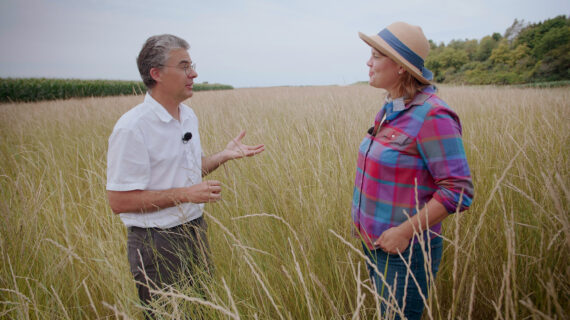
Let's have a look. Just outside of La Valle sits Hilltop Community Farm, a small-scale, diversified farm growing wedding flowers, vegetables, and some unique varieties of fruit. I first visited Hilltop seven years ago, and I met Erin and her husband, Rob, when they were first developing their orchard. I was excited to come back and see how things have grown.
Hey, Erin! - Hey, Inga, welcome. Thank you, good to see you. Yeah, welcome to the potatoes.
It's been years since I've, it's been almost seven years since I've been here. Oh, welcome back. It looks even more beautiful than the last time. Can we take a little tour, just so I can see how things have grown up?
I'd love to show you around, yeah.
gentle folksy music
Wisconsin Farmers Union
Yeah, so we are like, right outside of La Valle, Wisconsin, and it's right on the eastern edge of the Driftless Region, so about the last glaciation missed this area. Uh-huh. So, you have a lot more rolling hills, a lot more rivers instead of lakes, and the soils are older. It's pretty cool, as you continue north up back toward your place, you'll drop down into old Glacial Lake Wisconsin lakebeds.
So, it's really-- we love it here, but old soil, sloping lands. We have about just under 60 acres, and so you're looking right back here at prairie, so, native prairie. Wow. About 24 acres, and we used to rent this out to a neighbor and it was a corn/soy rotation, and you know, we just heard about the conservation reserve program, and it just kinda made sense to transition that to prairie habitat because of just, slope and I think especially now with more intense and frequent rains, the more we can keep the soil covered continuously, I think the better off we are, especially on sloping lands, and so perennials have been a really good fit for us.
I think it's been really fun to just try to experiment with what works well for us, what we have time and energy for, and also what works well for the landscape.
gentle folksy music
Wisconsin Farmers Union
After seeing the beauty of the restored prairie, Erin took me down to her orchard to show me how she's growing her fruit in guilds. A guild is a way to create a mini-ecosystem of plants that are known to grow well together. So, Erin, is this one of your famous guilds? Is that what you call them?
Yes, we call them guilds. So, a plant guild is sort of finding plants that grow well together in combination, and they create networks of mutual support. So, you look around here and it's not really linear. We, you think you have your kind of overstory, which is this apple tree, so it's providing a little shade, if you've got a cool spot, currants like a little shade and wet, so then you kind of think about in layers and function.
Well, it looks like if you're out in a forest, this is what it looks like when walking through the trees, all these different plants growing together. Yes, thank you for reminding me of that. Sometimes I take for granted 'cause I'm just living and breathing currants right now, but it really is, we're just, we get this inspiration from the structure and function of a forest, and we just translate that into growing perennials and fruit.
Inga
Can we go taste some of these currants?
Erin
Yes, oh, my gosh!
Inga
And see some of the different varieties? Oh wow, pretty! Yeah, and they just draw you right in, right. They do.
Erin
How red can you get?
laughing
Inga
Yeah.
Erin
Let's try to find, do you see one that's nice and red almost consistently?
Inga
I think here. Yeah, help yourself. So, what do you think, how would you describe that? It's a little tart, but it's delicious.
It's nice, it's light. What's your favorite way to preserve these? I'm thinking about making like a nice little jam or something. I'm preserving the season.
I'm trying to get all my canning and everything done in such a short time. Well, like, so we like just making a jam. We've also really gotten into doing some juicing, especially the black currants. They're kinda more like a blueberry habit where they're, instead of being on these grape-like clusters, it's called a string, they'll be just kinda separate.
Black currants, especially, you wanna go for ones that are fully black all the way around. And how would you describe that to me?
laughing
Inga
This one is, it's so earthy almost.
Erin
They're like little black pearls. And how can you not wanna eat little black pearls?
laughing
Inga
It's just so much fun. I love that passion you have and the excitement. I like to think I'm part plant sometimes.
both laughing
Inga
I was hoping I could get some currants from you today if you've got some available. Oh yeah, we've got a few in the cooler we can show you, show you around what happens after we pick these and wash them and when they're ready to go out. All right. I really like the black ones.
They're delicious. - Mm-hmm.
gentle folksy music
Inga
So, I'm just gonna grab a few currants from the cooler, we can sample some of the tastes from the orchard.
gentle folksy music
Inga
So, this is my favorite part of the farm, because I get to eat it.
both laughing
Inga
And so I have right here is black and white currant fool, where I just kind of cook the currants down, I added some honey from our bees Oh! for the sweetness. Can I help myself to a little? Oh my gosh, please do.
I brought some bowls out for you. We do have some fresh mint, and this is my favorite way to enjoy. This recipe is so easy, and I think that's what is good for people to know is that, when you're cooking with really great ingredients, you don't need to do a whole lot to them, and things don't have to be complicated. Simple is good.
That's true. Want a little mint on yours? Yes, please. What do you think?
I think they're so great.
Erin chuckling
Inga
Well I'm gonna follow up here with Erin on a little bit of tasting, and then I'll see you on down the road.
upbeat folksy music
Inga
Next, I travel to a small farm outside of Mondovi to meet with Tony. Tony is growing fields of flowers and herbs that he then cuts, dries, and packages into his signature line of herbal teas. So, Tony, tell me a little bit about your farm, what's your purpose here? So, my passion is farming for health.
For my health, the health of the planet, and the health of the people that consume my product. There are few things more healthy for people than herbs, and then because they're not these over-domesticated plants that don't need so much fertility, you can grow them in a more ecologically sustainable way. I don't think when people think when they're brewing their cup of tea in the morning, I don't think they could ever think that it was coming from a place like this, that it's this beautiful, almost wild place with a huge array of all these herbs. Thank you.
I believe to be successful at everything, you always have to be learning, and the steeper the learning curve, the more you learn, the better you're doing. So many times, people do stuff for so many years and they kinda, they reach their peak, but I just wanna keep that learning curve really steep. One of my main projects this year to learn about is this cornflower. It's always out of stock, it almost comes entirely from Bulgaria, and it's like $36 a pound.
Pretty. Always out of stock. So, I'm trying to learn how to grow this on like a 20, 30, 50-acre scale. And you'll use this for tea, the flower?
Tony DiMaggio
Correct, yeah. - Oh, okay. And they're beautiful. They're gorgeous.
And they smell nice. You know what I've done with those? Sometimes, I learned from a friend of mine, she takes them off and uses them as confetti on cupcakes and things, and they're just beautiful. Absolutely.
Inga
There's a lot of different things happening in this field, what's going on here? So, I'm trying to grow the most potent herbs possible. Okay. I realized long ago, I can't compete with the mass-produced herbs where they're coming in with huge tractors and mowing everything like hay.
Right. What I can do is produce the absolute highest quality on a small scale. Ooh, that's delicious. I believe that growing the plants mixed together makes for a much more potent herbal medicine.
And what I do is I plant my plants in these rows, but every time there's a miss, I'll fill it in. That's a nasturtium. This is a wildflower. California poppy.
Garden sage. Hyssop. And this was all just planted this year. Really, wow?
Right, isn't it off to a great start? Yeah, what did you have to do to the soil to get it to be this brilliant? So, for me, number one enemy is quack grass. Same.
You and everyone else. You cut the herbs and they grow back, but you cut the grass and it grows back really a lot faster. And if I have a relatively weed-free field, I can harvest very quickly. I can harvest as efficiently as $100,000 harvesting equipment.
When is the right time to be picking herbs for tea? Ooh, depends who you ask. What I go off of, especially being on a small scale, is I smell the plants. All the time I'll go okay, this plant, it looks like it's in the right stage of growth, let's go out and we'll smell it.
And I'll say, "Oh yes, that's a hundred percent." or I'll smell it, and I'll go, "That's not quite a hundred percent." And by being on a small scale like this, I can actually go, "This section of the field's ready to go, that section of the field's not." And if you've got a bunch of people working for you or big equipment, you can't do it, it's only when the person cutting really knows what they're looking for you can do that. I love this scale of agriculture. This is, I just love that connection that folks like, I'm kinda the same scale that we have with having that control over your product. Absolutely.
You know, to be a successful entrepreneur, it doesn't matter if you're a farmer or you have your own electrical business or you have a restaurant; you need to be able to do a lot of different things. And why I chose this is because I love working with plants. It's endlessly interesting. I've learned so much in my 10 years of doing this, but give me another 20, 30 years, and then I'll probably feel like I start to know.
Isn't that fun, having your own farm, you get to experiment? It's a never-ending learning process.
gentle folksy music
Inga
It's so neat to see everything that's being put into the tea growing like this instead of just looking at it, even though it's so beautiful in the canister, but seeing it living and alive out here, it's really neat.
Tony
I really love this. There's nothing in the whole world I like more than walking around and looking at my fields. So, I thought, "Heck, why not make a job out of this?"
Inga
After a colorful tour of these fragrant fields, Tony showed me how he hand-harvests one of his prize crops. A potent herb called tulsi, also known as holy basil. This is a perfect example, this tulsi is prime right now. The petals are starting to fall and the bees are covering the plant, and if you smell this right now, that's the really the thing you're looking for.
Oh, wow. - You can see the petals. You can see this and that, but that's intense, right? - It's really intense.
It almost has like a cinnamon to it or something. It reminds me of bubble gum. - I can see that too, yeah. And you're putting in this part into the teas.
Yeah so you know, when you think of normal basil, you think oh, it's flowering, it's starting to go bad. And that threw me off with this plant the first couple years, I didn't really understand that this, the flower that is the best part, that is the medicine, that is the form of this plant. This has been such an amazing experience, Tony. Thank you so much for showing me around.
I hope I get to come back again and see your progress. Any time. Well, I'm gonna grab some tea from Tony, and I'll see you guys on down the road.
gentle folksy music
Inga
Next, in Menomonie, I met with Rachel, another Wisconsin fruit grower. Rachel is bringing berries and currants to life in her organic orchard. Hello, Rachel! Hi, Inga.
Nice to see you. Likewise. It feels like I'm walking into the French countryside. Oh, wow.
It's just beautiful. Thank you, thank you, we really like this spot. How long have you guys been here for? We bought this land in 2008.
We started planting our orchard in 2009. But at the time, we were living in Minneapolis, and we had about a five-year transition, so we moved here full time in 2014. Wow, it must be lovely just to spend your time out here.
Rachel
It is, yeah.
Inga
So, how did you pick this spot? Well, we knew that when we got started, we would keep living in Minneapolis where we both had day jobs for a few years, and we found that farmland in Wisconsin was a lot cheaper, much lower price per acre-- I like to think it's a lot better, too. Oh, of course, yeah, but we also were able to find a lot more interesting parcel, so we were, you know a lot of the places we looked at in Minnesota were flat, cornfields, and here we have rolling hills, we have some woods. Do you need the rolling hills for the fruit?
You know, the different slopes that we have here on our property really does help us with certain things, the kind of eastern and northern slopes are great for some of our more sensitive crops because they keep some of the trees from breaking dormancy too early in the spring, and having the really, the nice thing about the slopes is that the air drains, and so in terms of like, moisture and cold pockets, they don't really sit on the orchard in the same way that they might in a flat place or if we were in kind of a lower depression. So, what varieties of fruit are you growing here? And like, I'm always surprised, I'm not from Wisconsin, so I'm always surprised that anything can grow here after the long winters that we have, but what are you growing here? We've tried a lot of things, but our main crops are apples, pears, and plums, those are our tree fruit crops, and then we grow a lot of berries.
We have a lot of currants, a lot of different kinds of currants and gooseberries, and we grow a lot of raspberries, and have just started with blueberries as well.
gentle folksy music
Inga
This is really a neat experience to be able to be out here in the orchard, and I would love to see some of the other things that you've planted. Yeah, we can go down here and look at the raspberries. They are ripe and ready to pick. Do you have any tips when growing raspberries?
Yeah, I have really found that one of the most important things for us to have good quality fruit is to pick every single day. So, we pick seven days a week for about four to five weeks during the summer. That's a lot of work. It is a lot of work.
It's a lot of picking. And it's exhausting and I never want to see a raspberry again at the end of July, but it really helps us keep the fruit quality good. We're dealing with a fruit fly pest called spotted wing Drosophila that will get right into the, get right into the ripe fruit, so keeping ripe fruit off of the plants has been really key to us to stay ahead of that pest and to just be able to stay ahead of any kind of weather problems, too. Well, they taste delicious.
Thank you, I love them. Can we see some of the currants? Absolutely.
gentle folksy music
Inga
So, these are our currants, we have black currants here and red currants, we also grow pink and white ones. Currants are really pretty. They're gorgeous. What do you think they taste like?
The black currants, you know I really like them, I like them a lot actually, they're one of my favorite flavors, and I actually think they're a lot sweeter than red currants, but they also have this musky, sort of earthy flavor-- They do! Yeah, that's how I was thinking when I was talking with Erin. What are some of those things that keep you going? I find some days, I'm so challenged with just everything that's going on around me.
How do you stay inspired to do what you do? You know, one thing with growing perennials is that we've put such a long-term investment into establishing this orchard that I think compared to growing annuals, the joy we get in return is that much greater, because we have spent so many years of our lives getting this orchard to where it is that there's just a lot deeper satisfaction I think in seeing it all come to literal fruition. And I also really love sharing all of these different kinds of flavors of the currants, and also of our apples, we grow lots of heirloom and unusual apples, and being able to share these with people who have only, who only think about supermarket fruit, it's really a revelation when they try some of these things. And we get a lot of fun out of that, so doing farmer's markets, we do tons of sampling.
Seeing their faces light up as they taste what a real apple is supposed to taste like in season. Exactly, yes. And so, having that kind of connection with our customers also just makes it a lot more fulfilling. Rachel, this was so nice being able to come and spend time with you here in your orchard.
Thank you so much for coming. Just so wonderful. Well, now that we've got all of our delicious fruit, it's time for us to head back into the kitchen.
upbeat folksy music
In unison
Hey, little lady! I'm so happy to have my cousin Cece here with me in the kitchen. She's kind of the canning queen, and every day is more fun when you have your cousins with you, I think. That's right, it is.
Inga
So, today we're gonna be making a red currant jam.
Cece Campise
We'll make this jam, and I will teach you as much as I know. It's gonna be a pretty fun and easy way to start. Great, and it's a great way to preserve summer. Again, I think when you're eating your homemade jams in the middle of wintertime when, you know, we're in the Midwest, it never stops snowing, to get that little bit of summer.
So, what we already did is we de-stemmed all of the currants, and that was really easy, just taking them right off the stem, and washed them, and we got our sugar ready. We measured everything out twice before we started, that's one thing that I have a problem with is measuring anything out. It's always good to start with everything pre-measured ahead of time so you're not, when something's almost ready you're not trying to scramble around and find something else. So, we've got our pectin, our currants, our sugar, and I always like to add a little bit of butter more towards the end, 'cause it reduces all the foam when you're making jam, so it's kinda nice.
So, first thing I'm gonna put in the currants. Currants first, and then our pectin, our powdered pectin, and we're gonna cook that down until it gets to a full rolling boil, so you wanna throw that in there, too. And I just, what does the pectin do? It just firms it up.
A lot of times it's in lemon seeds or apple seeds. It's natural, pectin is natural? Yeah, it firms up your jams really nicely so they set. You know, you could also add to this if you wanted to, a little lemon juice if you wanted to, or lime juice-- Or even other fruits, too.
Or orange peel or you know, anything you really want to. You could put raspberries in it for sure. It would be delicious. Strawberries would be great too.
Any sort of red fruit like that, you know? Mm-hmm. It's something, I don't think the younger generation is canning as much as say, my grandmother canned everything, my mother cans everything, but I think it's a nice way to kind of reconnect with the food, with the season, too. - Right.
'Cause it's a very seasonal thing. For sure, there's something really special about eating it in the wintertime, and there's something really nice about giving it as a gift-- - I know! To friends, you know. Yeah, 'cause you're putting your heart into it.
Right. So, now this has come to a boil. Yeah it's a rolling boil, so now is time that we add our sugar. - Okay.
So, it doesn't take very long. It's pretty quick. Okay. Lovely.
That is gonna be super tasty. Okay, so now we got all the sugar in it, we're just gonna cook it down quickly. So, you just bring it up to a boil for a minute and then cut it off and we're gonna test it with our frozen plates. When do we put the butter in?
We can put it on right before we, we could put it in now, it's fine, yeah, sure. And the butter just helps with? The foaming, so sometimes when you cook jam down it starts to foam, and the butter doesn't make it foam, and it makes it more of a clear jam, which I like. So, what we did is we put some plates in the freezer so that they're nice and cold, and now we're gonna test the jam.
And Cece's gonna teach me how to test it. I never test mine, I always just pray. It's easy, it's really easy. So, what we're testing for here is when we put a dab of jam on the plate, if it runs down, not ready, you have to keep going.
If you put it on and it doesn't move really easily, then we're ready to go. I don't know if the plate's cold anymore. It's so hot in here. Okay, so-- - Tip it.
Tip it over. So, it looks like it's just about ready to go. We just have to bring it up to a boil and then we're ready to go, I think within probably a minute or so. I wanted to put a little rosemary in.
Throw it in now. Throw it in right now. I think the herbs and the fruit go so well together. I do, too.
And this'll just infuse it a little bit. Okay, so now we've got it all boiled down, now can I start filling the jars? Yeah, let's jam. Hot jam in hot jars, right?
Mm-hmm. Hot jam in hot jars, and I'm leaving a little bit of headspace. Yeah, just until the bottom of the green, yeah that's usually a good measure. Look at me going.
And then once you're done, we will wipe off the rims of those jars so we can ensure a proper seal. Okay, why don't you, let me tip this up so you can get the last of that jam. Alrighty. And if you didn't want to can this, you could just put it in your fridge for I think up to three months it'd stay good.
Oh yeah, for sure. But what we're gonna do now is we're gonna wipe those rims off, we're gonna put the lids on, and then we're gonna process these in a hot water bath for 10 minutes. So, let's get all this done, and then, Cece, I have a little treat for you. We're having a little farm spa day.
Oh, how nice! We'll see you guys up there. After spending a summer day making jam, treat yourself with a refreshing glass of iced herbal tea. Steep the tea in hot water.
Then, serve over ice and garnish with a lemon slice.
gentle folksy music
Cece Campise
Well, thank you for coming over and doing a little canning with me. Of course. I hope the next time that you spend a day canning, you also remember to relax with your best friend. And I hope you'll gather with us next time
In unison
Around the Farm Table! I'm your host, Inga Witscher. It's about time, little lady.
gentle folksy music
Announcer
Ar ound the Farm Table is funded
in part by Wisconsin Farmers Union
United to Grow Family Agriculture, Heartland Credit Union, Focus Fund for Wisconsin Programming, and Friends of Wisconsin Public Television.
Search Episodes
Related Stories from PBS Wisconsin's Blog


Donate to sign up. Activate and sign in to Passport. It's that easy to help PBS Wisconsin serve your community through media that educates, inspires, and entertains.
Make your membership gift today
Only for new users: Activate Passport using your code or email address
Already a member?
Look up my account
Need some help? Go to FAQ or visit PBS Passport Help
Need help accessing PBS Wisconsin anywhere?

Online Access | Platform & Device Access | Cable or Satellite Access | Over-The-Air Access
Visit Access Guide
Need help accessing PBS Wisconsin anywhere?
Visit Our
Live TV Access Guide
Online AccessPlatform & Device Access
Cable or Satellite Access
Over-The-Air Access
Visit Access Guide




Follow Us