

 Passport






Spring in the Driftless
10/17/19 | 26m 47s | Rating: NR
Inga celebrates the spring by taking a trip to the Driftless Region. She visits and urban greenhouse in Lacrosse, then travels down to Viroqua to harvest wild ramps and talk with a family who are homesteading. She prepares a meal of ricotta dumplings with ramp pesto for her neighbors who are helping her clean up after her barn fire.


Copy and Paste the Following Code to Embed this Video:
Spring in the Driftless
gentle music
slow folksy music
sledgehammer knocking
Inga exclaiming
silo crashing
Welcome to the farm. It's been one heck of a winter, but now that spring is here, we can start cleaning up.
upbeat folksy music
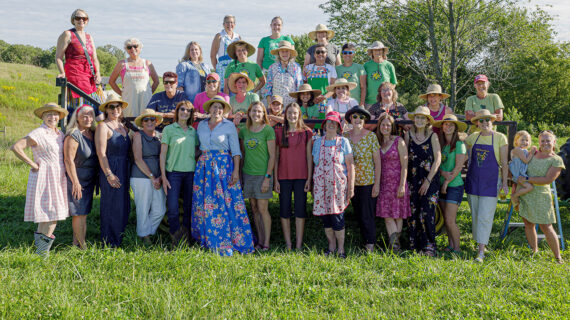
I've invited some friends over to help me with the cleanup and I'm gonna be making them a delicious lunch. For the ingredients, I went to Hillview Urban Agriculture Center, and then I went off ramping in the woods with my friend Bjorn. And finally, I stopped at Birdsong Ridge Farm. Gather with us, Around the Farm Table.
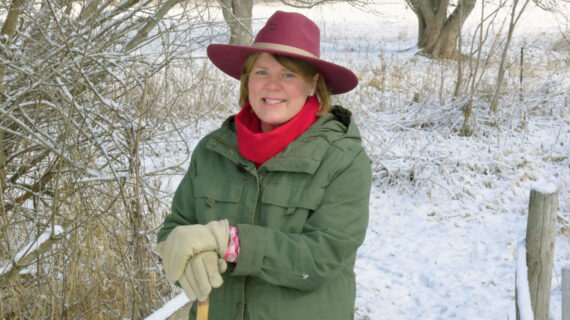
I'm your host Inga Witscher. Good morning girls. I'm Inga and I love everything about farming.
upbeat folksy music
Midwestern farms are a bounty of good food made by good people. I love being able to travel, to search out good ingredients. Cooking is all about what's seasonal, what's fresh. Every day can be filled with good food, good friends, and a beautiful herd of cows.
Welcome to the farm.
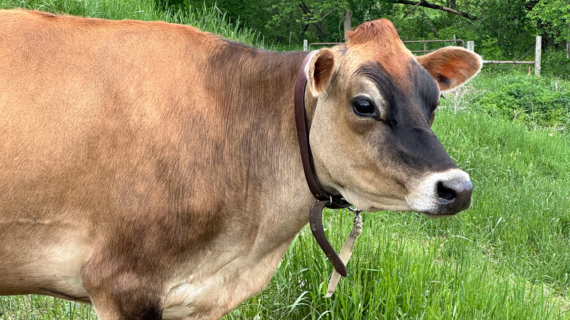
Inga to cow
Good girl.
Announcer
Around The Farm Ta ble is funded in part by
Wisconsin Farmers Union
United to Grow Family Agriculture, Heartland Credit Union, Focus Fund for Wisconsin Programming, and Friends of Wisconsin Public Television.
tractor engine roaring
upbeat folksy music
Wisconsin Farmers Union
Boy, we've had quite a few months here on the farm. In November, I woke up to the barn engulfed in flames. It was a few days before we were finishing our construction of our new creamery. So, it was a double blow.
Luckily, all the milk cows were outside in the pasture, so we didn't lose any of them. I'm grateful to the community that came out to support us after our barn fire, and I thought that our luck was turning, but after all the big snows we had here in January and February, our hay shed collapsed, and then a few weeks later, our winter housing collapsed. So, I guess things really do happen in threes. I hope that our luck is changing.
We've lost a lot over the last few months, but we didn't lose hope. We are so hopeful that, now that it's spring, we're gonna start rebuilding the farm, rebuilding our creamery, and everything is gonna be as good as new. I'm gonna help my guys finish cleaning up here, and then I'll head into the kitchen to make us some lunch. Why don't you check out the farms I visited yesterday to get our ingredients?
gentle folksy music
Wisconsin Farmers Union
I traveled to downtown La Crosse, where Natalie is working at Hillview Urban Agriculture Center, growing fresh foods in the middle of the city.
rocks hitting metal
Wisconsin Farmers Union
In addition to the greenhouse, Hillview is also making some special compost with the help of some wriggly little friends. Hi, Natalie. - Hi. Nice to see you.
- Nice to see you. Boy, spring has sprung in here. Ah, yes, we're very excited. Well, can I see a little bit around the greenhouse?
It's just-- - Yeah, I'll show you around. I'm so excited for spring and to be able to see living things. Yeah, if we go around here, I'll show you around. So, what kinds of things do you have going on in the greenhouse?
So, we have lots of things going on, but this is just one place where we do all of our services for the community. We also have cooking classes, but here at the greenhouse, we host lots of community members to come here and learn how to grow plants and the foods, so they can take it back home and then implement it in their gardens, or even just their one pot of basil that's not really doing so well. I got to learn from my grandparents and my parents. They drug us out to the garden all the time.
I imagine folks in the city sometimes, they didn't have that opportunity growing up. Do you find that's a problem? I find that's a big problem in the cities. A lot of people when they think of agriculture, they think of the farm fields, but they don't know that it can happen right in their cities and even right in their homes and their backyards, you know, when the people don't have bigger spaces to grow, they think it's just not possible.
But even teaching kids or the next generation or even yourself as an adult, how to care for that one basil plant or that herb, or just that one thing that you could probably even grow in your house. I think it's really important for people to still keep the growing culture alive. What does it mean to you to be able to be a part of such an amazing project? I absolutely love, you know, what I do at my job here, and the reason why I love it is 'cause I really believe in the mission of Hillview Urban Agriculture, is to give people access to a healthy, sustainable food system, which really isn't always possible in the city.
So, really to teach people and kids of all ages and gardening ability, whether they've been gardening for 50 years, or they kill everything they touch, I love to teach everyone how to grow the plants and how to somewhat be sustainable themselves. Well, one of the reasons I wanted to stop down here is I'm really interested in your compost that you make from worms. You want to see it? I would love to go see it.
All right, let's go check out the worms.
gentle folksy music
Wisconsin Farmers Union
So, this is actually where the worms are living? Mm-hmm. I don't see any. Are they kind of underneath the whole thing?
Yeah, so just like in nature, you never really see worms right on the top. So, they actually live right underneath the surface. So, if we take a look... Okay....we could see them under there.
Oh, wow. Yeah. And it's fun. So, you've got eggs in here, carrots, all kinds of different vegetables and fruits, where are you getting all this from?
So, we pick up from two local universities as well as a health care center in La Crosse, and that's gonna be about 400 pounds of food waste a week that we pick up and feed to our worms. That's a big deal. I mean, food waste is such an issue in the United States. We have so much food waste.
What a great way to utilize it. Yeah, it's really happy. You know, once you see all the numbers add up and when you carry those heavy buckets of food, you really understand, you know, once you get into this operation, you know, it's reused in such a great way instead of just sitting at the landfill. Sure, yeah.
So, for the people that don't know about compost, can you explain what it is and what's the benefits of compost? Yeah, so there's a few different kinds of composting and a lot of people are familiar with, you know, kind of your pile of your grass and your branches and maybe some food waste outside in a pile, but vermicomposting is really special 'cause it uses worms, and the worms that we have here are a kind of earthworm, they're red wigglers, and they're special 'cause they reproduce really fast and they eat a lot. So, they're actually taking these scraps and eating it and then, that's their-- it's coming out and it's soil, basically, or soil amendment. Yup, so yeah, so we get to harvest their waste, which acts just like any other manure, and this is actually really special because of the type of worms that we have.
They have a special bacteria in their stomach that their end product or their waste that we harvest is actually more nutritious than when they ate it. Wow, interesting. Is this something, you're doing it on quite a big scale. Can I do this at my house, if I wanted to?
Yeah, it's very possible to do this on a small scale with just your average tubs that you pick up at your hardware store. You could buy the worms online or even from us, and you use some basic bedding like newspaper, grass or... and you just start feeding the worms and they adapt very well, and they're here to eat and reproduce and that's what they do well. One of the things that I like about using compost is, I never have to worry about burning the plants.
I know it's an organic resource and I know you're just building that soil by adding compost. Is that what you're encouraging folks to do? Yeah, we definitely encourage, you know, people are always asking, you know, how do you, how do I use this fertilizer? You can use it in many different ways from top dressing throughout the season.
So, just putting a little teaspoon to a tablespoon on a plant and watering it in. You can mix it into your raised bed or your garden rows at the beginning of the season, and you can even make a worm tea. So, you just put, you know, put it in a sock and leave it in a bucket of water for 24 hours, and it seeps through and that's a liquid fertilizer-- - Sure. that your plants can use.
Sure. Well, I'm gonna let these guys keep the worms in their garage, and I'm going to grab some compost and then head out to our next location.
gentle folksy music
Wisconsin Farmers Union
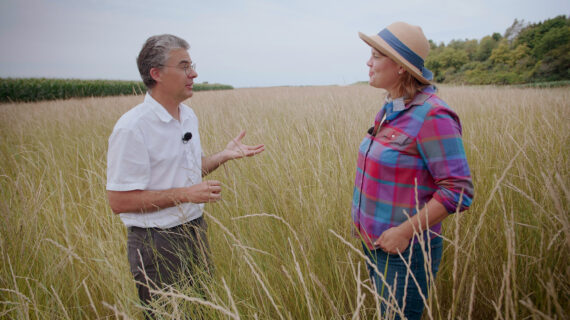
From the city to the hills of the Driftless Region, I took a hike into the forest, where I found Bjorn foraging for ramps, a wild food that appears for a short time only in the early spring. Hi Bjorn. Hey, Inga, how are you? Good, good to see you.
Good to see you. It's nice to be out here in the ramps with you. Yeah, totally. I always know when spring is here, is when I see you out ramping around.
Definitely, definitely, it's one of my favorite things to do in springtime. So, look at all these beautiful, this is the most I've seen, ramps and for folks that don't know, what is a ramp? They're actually a native plant in Wisconsin, and they're in the Allium family, which is what onions are in, garlic is in, leeks are in, so they're a relative of onions, garlics, and leeks, and they grow wild in Wisconsin, in usually north-facing maple forests, and they're a perennial, so they just come back year after year after year and they're super delicious. I love well, I love anything garlic, anything that has a strong flavor, I'm all about it, and that's one of my favorite things about this, is just, it's really pungent, you know what you're eating when you're eating it.
Definitely, definitely, definitely. Yeah, you know, you get a little bit of that garlic breath, but I think it's a great thing for spring. It's worth it.
laughing
Wisconsin Farmers Union
Yeah, totally, totally. Have you found that wild food, especially ramps, is becoming more and more popular? Yeah, I feel like it's getting more and more popular. I know for me, about the same time I started seeing them on menus, I was like, "What are ramps?" "I have no idea what these are," and a friend introduced me to them, who I was helping with their maple syrup operation, and I had never known what a ramp was, and I was walking through them all the time in the springtime.
Yeah, and like you, I love garlic and onions and leeks and essentially, it's just a combination of all those things that I love. Yeah, and I was reading about ramps a few years ago and I read in Appalachia, they're really popular, and people would go out and harvest these, just like I do with nettles because it was that first green and they were full of that, all that nutrition that we'd been missing for the whole winter. Yeah, it's kinda-- - And it's just a cleansing. Yeah, it's kind of like a spring cleansing tonic, at least for me, I just love, you know, you've gone through the winter eating lots of potatoes and carrots and stuff like that.
Don't show me another squash.
laughing
Wisconsin Farmers Union
It's all good, but getting that first local green thing of the year is just super rewarding and fresh and bright, and so, ramps are just some of the first things to come out of the ground here in spring. Here's what else I love about wild foods and things like this, is you don't really have to do anything to them, it's not like you're out there weeding away all these other things so they can grow or having to bring out compost for them. They just, they do their own thing. That's the kind of harvesting I like to do.
Yeah, yeah, that's the beauty of ramps and native perennials like this is, they just do their thing, they're there, they grow, and you just have to come out and harvest them. Speaking about harvesting, I know it's important not to overharvest. Yeah, I'm glad you brought that point up. That's super important to talk about.
Ramps are a really slow-growing species. They reproduce in two different ways. They'll produce seeds and then they'll also produce little rhizomes where they'll reproduce off to the side of the plant, and what's crazy to think about is, when they reproduce with seeds, it takes five to seven years for a plant to be able to produce seeds, and then once it produces seeds and it drops those on the forest floor, it can take anywhere from 6 to 18 months for those seeds to germinate. So, if we all got really excited and went out and collected all the ramps in this area, we could really be destroying that habitat or that whole plant system.
Yeah, totally, it's really important to be, have sustainability in mind. I know all the ramp patches I harvest from, I only take a tiny bit of the population that's there, 'cause I want to enjoy them into the future, and I want other people to enjoy them in the future. - Sure. So, yeah just, I think it's so important that if people are going and harvesting ramps, they just take a little bit here and there and they can come back every year and enjoy.
So, a lot of times I noticed you'll just harvest the leaves but, if we, could we harvest one of the bulbs just to kind of, see what they look like? Yeah, yeah, definitely. Yeah, and so typically, they grow in these clumps as you can see right here, there's kind of a clump of ramps between us, and what I think of is, there is one seed, way years ago, maybe 20, 30 years ago that germinated in this spot and it's kind of been shooting off rhizomes or seeds, and we can dig one up to kind of show you, and they're pretty hard to get out of the soil. You can't just pull them, like a carrot or anything.
There's quite a bit of roots. Mm-hmm. And then when you pull them up, they usually come up kind of in these clumps here. Okay.
As you can see. They're beautiful to look at. Yeah, yeah, definitely, and what I find interesting is there's this little, kind of sheath of skin and this is the ramp from last year when it was full sized. Oh!
And so, you kind of have to pick that off and I always try to get as much soil off of them as possible 'cause it takes a long time to clean these-- Yeah....when you actually dig the whole entire plant, but that's pretty much it and you can, I usually trim off the roots Uh-huh. And then you can eat from the bulb, the stem, all the way up to the leaf. What's your favorite way to eat them? I love ramp pesto actually.
Really early in the season, when they're smaller, they're very fiery, they have a really strong garlicy and oniony flavor, and I love making pesto that time of year and eating it throughout the season from my freezer. Ah, I know. I think I'm gonna do a pesto, but since I'm cooking for some folks that maybe aren't used to that fieriness Yes, definitely. and that intense garlic like we are, I'm gonna put a little bit of kale in to help mellow it out a little bit.
Yeah, yeah, that sounds like a great idea. I bet that'll be delicious. Well, I'm gonna harvest some more ramps with Bjorn and then, why don't you meet me at our next stop.
gentle folksy music
raindrops
Wisconsin Farmers Union
I'm here in Viroqua at Birdsong Ridge Farm. I'm ready to get out of these April showers and into the greenhouse to find out what Beth is doing here on the farm. Just outside of Viroqua, Birdsong Ridge is taking form. After working for years as a research biologist, Beth and Frank relocated to Wisconsin with their two children to become farmers and homesteaders.
Hi Beth, thank you so much for agreeing to meet with me today. Oh, hi, Inga. I love coming to Viroqua and I wanted to visit some people who are doing something different, and you guys are, you fit the bill. I love visiting new farms.
Tell me a little bit about what you're doing. Well, in the couple of years that we've been here, we've been growing greens here in our greenhouse year-round and then, in our 13 acres of fields, we're working on regenerating soil that was pretty compacted and nutrient deficient from years of monoculture from corn and soybeans. So, that's been quite an uphill battle, but we're getting closer to where we want to be with it. So, one thing I love, I found your blog a few months ago, and I am just so inspired by reading it and learning a little bit about what you guys are doing and your intentions for here.
Can you tell us what regenerative agriculture is? Yeah, well regenerative agriculture, it's a pretty broad term for just a style of farming that focuses on giving back to the land in a way that enhances biodiversity and soil health rather than just trying to take from the soil. Okay. So right now, we're starting a series of cover crops.
We've been doing a summer mixed cover crop and then a winter cover crop in rotation to try and just add organic matter back to the soil and then, we're also working on planting trees, and we're possibly gonna do a prairie restoration. Lots of different things. Just less areas of mowed grass is one of our biggest pushes because so much of this farm was actually just mowed lawn before, so that doesn't give very much habitat to very many things. Yeah.
I'm not a lover of mowing lawn at all. Yeah, why do it if you don't have to? I sort of put my cows in my front yard, and I know it irritates the neighbors, but I love it. Ah, that's a great idea.
Grazing is something that we thought of too, but with our two little kids on the farm, as well as trying to get all this new stuff started, we're like, maybe a few years down the line, we can start grazing animals. We're not quite ready. What's it like being in this new adventure? Also, you're raising kids, I see you've got the sandbox here, and toys and the kids are running around.
They must be in heaven. Yeah, well, especially in the wintertime, you know, they're so little that there's only so much time they can spend in the snow and so, we come in here and this is our oasis and we only heat it to about 34 degrees right above freezing but on a sunny day, it can easily be 70 in here in the winter, so, we're in here in T-shirts and running around and yeah, it's been great for them. All my favorite memories were growing up on the farm with my dad and my mom and my grandparents around and my uncles and it's just, I think it's the best way to grow up. Oh, yeah.
Well, that's one of the reasons that we decided to do this. My job as a biologist for the government before had me traveling several weeks out of every month and when I had my first baby, I thought, you know what, I need a shift, I need a lifestyle that allows me to be with my kids, but yet still, you know, doing something I really wanted to do. So, farming was a, kind of an obvious choice for us. Do you see yourself growing in the years to come?
Yeah, yeah, we actually have a business plan, and it entails every year trying to expand a little bit, a little bit what we're producing and right now, we're very small. We sell to a couple restaurants in town and you know, a few individuals, we drop off salad mix on porches, you know, around, so-- - I love that. What do you find most gratifying about being able to grow this delicious beautiful food? Well for me, it's having free fresh greens just picked moments ago, and you know, I was saying, my kids, for whatever reason, don't eat vegetables off their plate very easily unless they're dipped in ketchup, maybe but, My husband is the same way.
laughing
Wisconsin Farmers Union
still, they will come out here and they will just pick kale off the plant and they'll be, you know, their faces will just be green with vegetable matter and I think if we didn't have this, they wouldn't be eating their vegetables at all. So, we're so lucky in that way. What are some tips that you can give me for going into something like growing in a greenhouse? Well, you have to be a little more careful in a greenhouse setting than you do out in a field because you don't get that annual kind of flush of the spring rains and the winds blowing things around.
I mean, it's, everything is very cumulative and what you put in the soil kind of stays there, other than maybe some of the nutrients that the plants take up and you take away. So, salts can accumulate, you can end up with pest problems, and you know, there's not predators in here to come and eat insects. So, we actually brought chickens in last year for a while to deal with grasshoppers that were in here, and we bring ladybugs in to deal with the aphids. So, you kind of have to get a little more creative with you know, disease and pest issues than you would if you were just doing it outside.
We're not certified organic yet, but we are definitely wanting to be, as of next year, we hope. So, we're really committed to using organic methods and non-chemical ways of controlling those problems. Well, that's fantastic. I'm gonna gather some greens here and then, why don't you meet me back in the kitchen.
gentle folksy music
Wisconsin Farmers Union
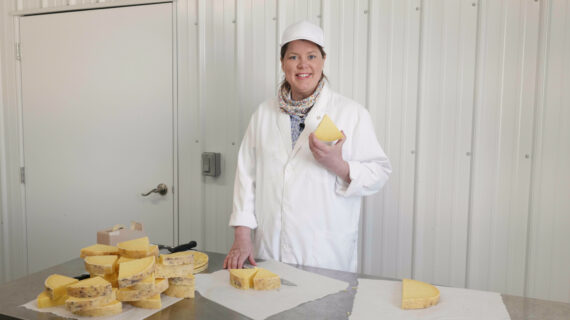
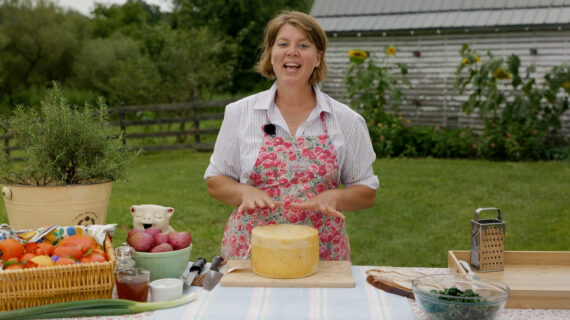
Even though I don't have a barn to milk cows in, I still have to milk the cows, and the good thing about that is, I've had plenty of milk left over to do things with. So, I've been making lots of things with dairy products. Cheeses, butters, everything you can think of, and one of my favorite things to make is ricotta cheese. It's really easy, and it's delicious in everything, especially these ricotta dumplings.
I'm telling you, they taste like you're biting into just little clouds of deliciousness, they're fantastic and the best part is, they're easy to make. What I did is, I started with about two cups of ricotta, and I strained this in a cheese cloth for 24 hours to get out any extra moisture. You want the ricotta to be firm, and now, I'm ending up with about a cup and a half. I'm gonna put that right in my mixer along with one egg and one egg yolk, some Parmesan cheese, and then just a little bit of flour.
That's gonna help thicken everything up. And we're just gonna give that a little bit of a zip just until it comes together.
mixer whirring
Wisconsin Farmers Union
And that is perfect. It only takes a minute. Now that the dough's come together, I'm gonna put it in my handy dandy pastry bag, and you can pick these up at the craft store or some grocery stores. I use them for a lot of different things.
I don't know why I talk to my food; it never listens to me. Get down, get down, come on. Once you have everything in the bag, you're gonna cut off the end of it and then we're gonna pipe this out on a floured cookie sheet. We're gonna go in long lines.
Look at how nice that is. It's so easy to work with these bags. Stop right there. We'll start again.
Once you have them all squeezed out, just cut them into about one-inch pieces and then, you can just toss them with a little bit of that flour and let them rest for a few hours. Okay, while these are resting, I'm gonna make my next recipe. We're gonna be using our ramps and the kale that we got. So for our pesto, like if you were doing a basil pesto or anything else, I'm gonna start with a little bit of Parmesan cheese.
I'm just gonna toss this right into my mixer here.
mixer whirring
Wisconsin Farmers Union
Alrighty, so into here, I'm gonna add a little bit of kale and I'm just gonna slice it up, so that it comes together a little bit easier. I'm gonna take the stems off. So, I've got a good handful of the kale and then, a little bit more of the ramps to get that nice ramp flavor. And then, I'm gonna put a little bit of lemon juice in there.
Give it a fresh squeeze, and then, now you're just gonna press go.
mixer whirring
Wisconsin Farmers Union
Once everything starts to come together, you're gonna add a little bit of olive oil, a little bit at a time until you get the consistency that you want.
mixer whirring
Wisconsin Farmers Union
And I think that looks perfect. Look at that beautiful green. I'm gonna go ahead and boil up some water and pop the dumplings in, and then we'll have lunch.
gentle folksy music
Wisconsin Farmers Union
Serve the ricotta dumplings with a wild ramp pesto. A light-bodied wine pairs nicely. Serve your guests Wisconsin cheese and charcuterie to round out the meal.
everyone chuckling
Wisconsin Farmers Union
I hope that this is a good reminder to never give up hope, and I hope you'll gather with us next time
Unison
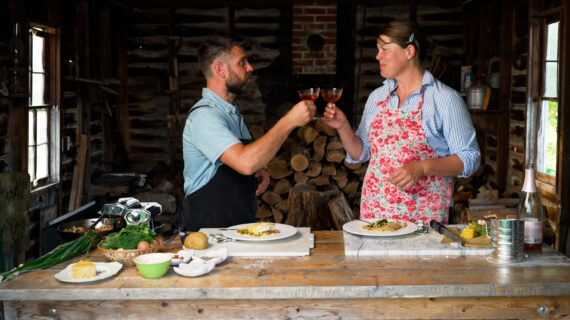
Around the Farm Table. I'm your host, Inga Witscher. Thanks guys, cheers. Only one week of clean up left and then we're done.
chuckling
gentle folksy music
Announcer
Around the Farm Ta ble is funded in part by
Wisconsin Farmers Union
united to grow family agriculture, Heartland Credit Union, Focus Fund for Wisconsin Programming, and Friends of Wisconsin Public Television.
Search Episodes
Related Stories from PBS Wisconsin's Blog




Donate to sign up. Activate and sign in to Passport. It's that easy to help PBS Wisconsin serve your community through media that educates, inspires, and entertains.
Make your membership gift today
Only for new users: Activate Passport using your code or email address
Already a member?
Look up my account
Need some help? Go to FAQ or visit PBS Passport Help
Need help accessing PBS Wisconsin anywhere?

Online Access | Platform & Device Access | Cable or Satellite Access | Over-The-Air Access
Visit Access Guide
Need help accessing PBS Wisconsin anywhere?
Visit Our
Live TV Access Guide
Online AccessPlatform & Device Access
Cable or Satellite Access
Over-The-Air Access
Visit Access Guide




Follow Us