

 Passport






Restorative Lunch
11/08/18 | 26m 47s | Rating: NR
Bailing hay can be hard work and the body needs time to rest, relax and restore. With that in mind, Inga will be cooking up a Korean chicken soup for her neighbors. The ingredients include homegrown rice from Mequon, pastured poultry and ginseng from Marathon County.


Copy and Paste the Following Code to Embed this Video:
Restorative Lunch
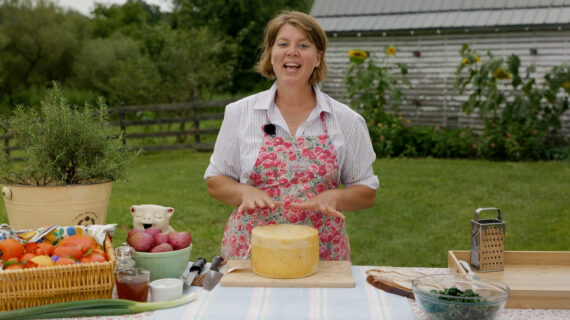
Welcome to the farm! I'm making my neighbors a restorative lunch today. I feel like, after a summer of baling hay, we all need it. I picked up some rice in Mequon and then I headed out to The G Farm for some chicken. And finally, I wound up in Marathon County for some ginseng. Gather with us, Around the Farm Table. I'm your host, Inga Witscher. Good morning, girls! I'm Inga and I love everything about farming. Midwestern farms are a bounty of good food made by good people. I love being able to travel to search out good ingredients. Cooking is all about what's seasonal, what's fresh. Every day can be filled with good food, good friends, and a beautiful herd of cows. Welcome to the farm!
affectionately to cow
Good girl! Around the Farm Table is funded in part by Wisconsin Farmers Union, United to grow family agriculture, Heartland Credit Union, and Friends of Wisconsin Public Television. What, you ready to go back in? - Bawk-boc-boc-boc. There you go. I try to clean out my nesting boxes at least once a week. That way I can just get rid of any manure and it's nice and clean and it's a good environment for the chickens. A healthy environment for the chickens is key and that's why I started adding herbs to my nesting box. So some of the herbs that I'm adding today is cilantro. And what cilantro does, it's an antioxidant and it's a fungicide and it's full of vitamin K. So I add that right to the nesting boxes and while the chickens are nesting they can also nibble on the cilantro and get some of those good vitamins in them. The other one is lavender. Everybody loves lavender, am I right? And it's just so soothing and just calms the chickens down and it smells delicious in the coops. So I'm just going to place that in. And also it looks really beautiful. I think taking extra special care of your chickens is a nice thing to do. After all, having fresh eggs is so worth any time invested in making sure your chickens are happy. You can also just hang the lavender from the coop and it just gives off that beautiful smell. I'm already relaxed just dealing with this. The next thing I'm going to add to my laying boxes is going to be some fresh parsley. And that's going to go right in. This parsley is going to stimulate them to lay more eggs. So as they're nibbling the parsley-- You could also just add this right to their food but I think it's pretty right in the nesting boxes where they're going to spend their time. So that's going to make them lay more eggs and it's also a great way to use up the extra parsley from your garden. Rosemary is for pain relief. I just add this in if any of the chickens are feeling like they need a little bit of aspirin they can just come right over here and nibble on the rosemary. It also smells so lovely. It's one of my favorite herbs. Finally, I'm going to put some mint in, and the mint deters insects and rodents. The smell, the essential oils that it gives off, none of those insects want to get close, so it's going to help me cut down on the fly population in my chicken coop. So whether you're looking for extra ways to use up those herbs from your garden or you just want to pamper your chickens, this is an excellent way to do it. I'm going to finish up with my chickens here. Why don't you take a look at what I did yesterday when I was picking up the ingredients?
twangy, folksy music
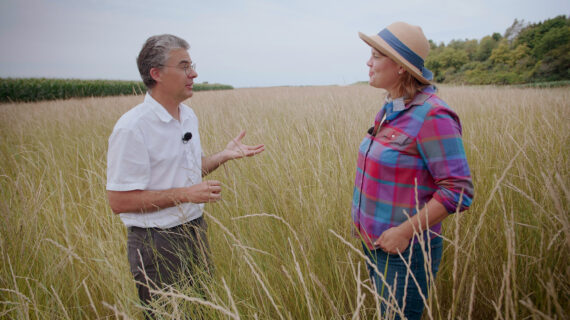
I'm here at the Mequon Nature Preserve, just outside of Milwaukee. I'm here to talk to Professor Michael about growing domesticated rice.
country music
Michael, thank you so much for taking some time today to show me where we're at. Explain to the viewers where we're at. So we're here at the Mequon Nature Preserve. But actually, this used to be the old Stotz Farm, a homestead farm founded I think in 1848 or so. And the last farmers stopped farming about three years ago. And now it's part of the Mequon Nature Preserve and I'm leasing it for my rice patties here. I've thought of agriculture in Wisconsin as a lot of things. I've never thought about growing rice in Wisconsin. How did you come up with that idea? Yeah, so my day job, I'm a Professor of Biology at Marquette University. And I'm studying stress tolerance in plants and my model system is rice. By doing this for a couple of years, I noticed, well, there are rice varieties that can be grown in Wisconsin. And then one thing led to the other. I got a grant from Marquette to buy equipment and make this a small business if you will, for all the grad students and undergrad students. And here we are so this first acre, last year we did the first ever acre. And this isn't wild rice. Because when I think of rice in Wisconsin I think wild rice growing in different areas. And what's the difference between the cultivated rice? Correct. So this is domesticated rice. It's Asian rice. The difference is they're cousins, they're both grasses. But wild rice is really a wild plant. And my understanding is that the tribes in Wisconsin, the Native American tribes, want to keep it a wild plant that is not being domesticated and grown in patties. So it's grown in lakes and managed by the tribes. Therefore, this is an alternative crop. It's related to wild rice, but really it's a domesticated plant, an agricultural plant, very different from the wild setting that the wild rice has to be in. And that's part of their culture. Just like you're working with some Hmong in the area here because rice is part of their culture too. That's correct, so for Hmong, domesticated rice is part of their culture for the last six, seven thousand years, right? And the Hmong community were refugees from the Vietnam War. They came here maybe 30 years ago as refugees and started farming vegetables but they really were experts in rice farming as well. So as of last year, for the first time, they were now involved back in a tradition that is very important to their culture. So last year they brought, this year too, they brought their children, grandchildren, nephews, nieces, to show them that's how we grow rice in our tradition. And also last year they came, and the women came in traditional garbs. Later on, I took pictures because it's an important part of the culture. Sure, yeah. Wow, that's-- What a great way to kind of show the next generations down what's going on. I think it's important to do that with anything really. And in fact, this row here was planted by Hmong farmers, again by hand. The rest was planted by machine. If you're going to plant it by hand, how long does that take? One acre takes about 300 man hours, woman hours. So with the machine, we can do it in maybe three, four hours if we are fast. Oh, wow. - Yeah. So it is kind of a labor-intensive crop. Oh, yeah, if you do it by hand it's labor intensive. Where do you see this fitting in in Wisconsin agriculture? I think in Wisconsin agriculture, it used to be wetlands here before Europeans came and drained it for agriculture for corn and soybean. But I have already farmers telling me that the wetlands are coming back so the edges of many farms are always flooded and wet and can't be, you know you can't grow corn or soybean there. For instance, I have one guy said that he has two acres that's constantly wet for the last three years. They have to take insurance for growing corn. So they're interested in maybe partnering with me and maybe start growing rice, as well. So Arkansas is a big grower of rice here in the United States, California, Do you see Wisconsin as being a contender in the rice industry? I'll see it in the future because I think, maybe I'm wrong, but I think maybe in the future there won't be enough water in California or enough water in Arkansas, but we have so much water and even before that happens we can develop rice as a new cash crop simply by having access to so much water that other places don't have. So if we are smart and develop this nicely, I think yeah, I think it can be a new cash crop. And it's a nice little specialty crop. Where are you selling your rice right now? I sold it last-- I mean this year, actually, at the Fondy Farmers Market, the winter market. In Milwaukee? In Milwaukee and I'm also selling it online or word of mouth. So that's the idea that I set up a website, sell it online. And maybe also like, a community, you know, agriculture system where people can say well I'm going to commit to this many pounds of rice each year and I just pick it up, these kind of things. Is it difficult to grow here in Wisconsin? Because of the harsh winters? Yes, so the challenge that's part of my research, the challenge is the cold spring and so this rice here I selected of many, many varieties to be able to survive occasional low temperatures, even short freezing spells, during the spring and because it has to compete, the rice has to compete with the wheat and it can't do that if it gets too much damage by cold. As we've been standing out here there's just been all these different dragonflies and things buzzing around us. This is its own little ecosystem. You're right. It is actually a little ecosystem. One of the missions of the Mequon Nature Preserve is to bring back or restore this land to what it used to be. And this area most likely was a wetland because the water doesn't, it just doesn't percolate down. It stays in here. It's a really nice little-- in a way artificial-- ecosystem but it's very close to what it used to be. Well, Michael, this has been so exciting. Thank you for sharing a little about rice with me. You're welcome. I'm going to let you go back to work. Thank you. And we need to get back on the road.
slower country music
I'm here in Larsen at The G Farm. Justin's a relatively new farmer and I'm here to pick up some chicken from him and also find out how farm life's treating him. Justin, thank you for inviting me out to your farm. How long have you been farming out here for? Inga, I've been out here for just over three years. So, you're new? - Yes, definitely new. Did you always know you were going to be a farmer? I did not and I had other plans previous to this. What kinds of things did you do before becoming a farmer? Well, I had a desk job but just before the desk job, I did do some military time. I was in the Army and packed parachutes. Oh, wow! And now you're on the farm. Absolutely! -
laughing
What are some of the things you're doing here? I see some turkeys over here, some chickens over here. You have a little bit of everything. Yep, I've got cows, pigs, turkeys, and chickens. And chickens was the start definitely. And you're really doing the pasture poultry here. How often do you move those birds? Those get moved every single morning. Each day I wake up that's the first thing I take care of, making sure that they're getting fed. And then I move them and give them their new grain for the day. Do you see right away how the chickens can fertilize that ground and they're being moved? Usually, it takes about half a season, because after that water gets soaked in, behind that chicken, then it really comes up lush. How did you figure out that this is the farming style that you wanted to do? I love seeing the animals outside with the fresh air and sunshine. Was that important to you? It was very important to have all the diversity because of the help that has for the rest of plant life and animal life alike. What do you see the farm growing into? I hope that at some point, as there's a highway here, someone's able to drive down and see cornfield, cornfield, some big monstrosity of a tree, and many other trees beside it. So I think that it'll be fun for someone to visit here in 20 years when it's filled up and looks like nature. Because you're more of the restoration agriculture. -
Justin
Yes. Can you explain what that is for folks? So the idea behind restoration agriculture is to take any land and not just sustain it but to bring it more back to what it would look like without us around. So what are some things that you've been doing? Plantings? Definitely a lot of tree planting, shrubs, just having bees helps everything get pollinated a little bit better. The diversity is helpful so those types of things. It's really exciting seeing all the different things you're doing. Isn't it kind of fun? Having a farm is like having a blank canvas in a way. You just get to experiment and see what's going to work and what's not going to work. - Definitely. I'm never bored and I'm always learning something new and so it is a new challenge every day. You're marketing your meat through meat CSA. Can you explain what a meat CSA is? Well, my community supported agriculture Meat CSA consists of beef, pork, chicken, and turkey and I hand select just based on what I have access of and bring that to the customers to their door each month. And so they have choices of 8- or 16-pound, with eggs if they'd like, and that's a great way to help any small farm to be able to continue to build. Yeah you have your customer base there and not only that, you're not having to say well I'm selling on my ribeyes, but, or, chicken, people want chicken breasts but nothing else and so it's a great way for us as farmers to be able to educate folks on the other cuts. Absolutely. - Where's your market? Is it mostly in the Oshkosh area? Mostly in Appleton, actually. Appleton/Neenah, that's where a vast amount of my customers come from. Has it been exciting meeting the customers and seeing their feedback? I like when they get to come here to the farm and visit me so that's really fun for them because they get the opportunity to see how everything's done and sometimes they even get to be a part of it. That is so lovely. Well, thank you so much for spending some time here with me today. I'm excited to taste some of the chicken. I love that pastured chicken flavor. What's the breed that you have? I have Freedom Rangers. They're a red bird versus the Cornish cross that's the white one that you generally see. All right, well, good. I'm going to grab some chicken here on the farm and then I'll meet you in Wausau, where we're going to pick up some ginseng.
twangy music
I'm here in Marathon County at the Kaldunski Ginseng Farm. Bob and Carol have been growing ginseng here for about 37 years and I'm excited to see just how they do it. Thanks for having me out on the farm. I'm excited to learn about ginseng. Why is Marathon County known for ginseng? Why is this a great place to grow it? Well for one the ginseng we have that the soils that ginseng requires. We have the rich minerals. We have the warm days, the cool nights, and we have the growing, the climate, the region that is perfect for it. It likes kind of a little bit--not a late spring but it likes the spring and a fall and it likes the rest or go dormancy for the winter. So we have the perfect climate for it and minerals. I always think of Wisconsin as being a difficult place to grow things because of our long cold winters. Ginseng doesn't mind that? Ginseng likes cold winters. Likes time off. Ginseng will come up in the spring in May when the frost leaves and will bear fruit or grow through the summer and then come fall being September, October, the plant naturally goes down in dormancy and we look forward and the plant does too to cool soil and freezing, but yes it thrives in that weather. And Wisconsin is the largest producer of ginseng in the United States, is that right? Yes, Wisconsin is about the only producer. Very little is grown in neighboring states and Wisconsin, because, again, of its climate and its infrastructure is the place that's noted for the Wisconsin ginseng. How many acres are being grown here? The industry has about 1,800 acres currently. Wow, that's not a lot compared to say soybeans or corn. No, it's not. It's actually pretty small. Matter of fact, I have a neighbor that grows just 1,800 acres of corn and that's probably small in some standards for others. But it's very labor intense so everything's by hand. So you're planting by hand and everything? We used to plant by hand but now it is modernized. We do have mechanical seeders and things like that. But bed preparation, rock picking, putting in of the posts, putting the structures up, it's all labor intense and time-consuming. How many years does it take before you can harvest the ginseng crop? It's a three-year crop. Three-year-old ginseng. And that would be the smaller root and there's marketplaces that are different sorts or types of market for the roots and most common is three-year-old but there's a four- and five-year-old market also. But from the time you plant it till you harvest it, it is four years because you do plant the previous year before it grows. So there's many different uses for the ginseng. Yes, three-year-old ginseng, that ginseng is more sold as a whole root, as a packaged root. Given in Asian cultures as a gift, things like that. The four-year-old roots are larger. Those roots a lot of times will be sliced and either green or fresh root or in dry root and used in soups or baking or things like that, salads. Along with the five-year root. So, you have little different uses or meanings for those roots. Where's your market for this? Because I know in my little community, we're all Norwegian basically. And we're not cooking with a lot of ginseng. So, where are you selling the ginseng to? 85 percent of Wisconsin ginseng ends up in Asia. And the reason for that is that the traditional Chinese medicine that goes back centuries, they've traced back to I believe four or five hundred A.D. And they feel it even goes before that. And they use it for well-being, energy, cooling, and many other things but those are some major things. But it is a big part of the Chinese medicine and they do recognize the value of the Wisconsin ginseng because of the qualities that the ginseng does have. Oh so it's different than ginseng grown in Asia? Yes, the ginseng, Wisconsin ginseng traditionally has a higher ginsenoside which gives it that bittersweet when you bite it or chew on it. They recognize that and that's the value because of the slow-growing climate we have here, where it grows slowly and that brings that level of ginsenoside up higher and that's what they value. So if I'm in Asia and I tell somebody, "Oh, I'm close to Marathon County." they're going to know. They'll know exactly where you are and they'll probably even ask you about Marathon City. That is so exciting! They know exactly where Marathon and Marathon City is in the United States. - Wow! Are you going to put in a different cover crop before you put in another ginseng crop into this garden right here or how does that work? Ginseng can only be grown one time on the parcel of ground that you have, but there is preparations... So once the ginseng's grown here you can never come back here? We can never come back. At this point, we know where there's enough good, virgin soil that we move to and that's something, again, that's become a little more scarce just because of the old-timers or people that had recognized or knew where the gardens were planted. Because ginseng in Marathon County goes back to about the early 1900s, 1905, 1910. So when we run out of acres in Marathon County, there's no more ginseng industry. Well, true but there is a lot of acres left yet. It's just that some of the people that knew where exactly things were, they're gone or they didn't record it. So that's one of the challenges we have. I love driving through this area because you can always tell where the ginseng's being grown because you see the shade. And tell me about the structure. Is that mimicking the forest where you find wild ginseng? Yes, that's exactly what we do. The structure is if it's wood or if it's a plastic structure they're all mimicking like about 80 percent shade. And that's very unique or very similar to what the forest gives it. And the ginseng is very, very sensitive to sunlight. Well, this has really been interesting. I'm excited to cook with ginseng and to introduce my Norwegian neighbors to a little something different. Well, we'd better get back to the kitchen so we can start cooking.
folksy music
Today, I'm going a little bit outside of my comfort zone in the kitchen; I'm going to be doing a Korean dish called Samgyetang. It's a soup made with chicken, rice, and ginseng and it's eaten in Korea on the three hottest days of the year. It's meant to help restore you on those long hot summer days and just give you a little bit of energy. I think it's going to be the perfect lunch for my neighbors. We've been doing hay nonstop this summer and I know that they'd like a little bit of restorative energy to get through the next few hot months. The first thing I'm going to do, it's a very simple recipe which I love simplicity. It makes life so much easier. So the first thing I'm going to do is just take my chicken and I picked out one of the smallest ones that Justin had just so it can fit in my pot. You could do this with Cornish hens too if you had them. And just coat the chicken with some salt, getting all over the legs and on the back, too. We think of chicken soup here in America as something that you want to eat when you have a cold. When you're sick it makes you feel better. You really want to make sure that you're getting good quality chicken when you're making your chicken soups because the minerals and all the things from the bones that are going to come out in that broth, that's what the healthy part is. And you want to make sure you have a healthy bird, preferably raised on pasture so they're getting a nice quality diet, and that's going to help you feel better. I've tried to make chicken noodle soup for myself when I'm feeling sick but nothing compares to my mom's chicken soup when I'm sick. I think it's just because moms just always make it so much better. All right, the salt is in and I just put it in the cavity, too. I'm going to season inside. I have four garlic cloves and I just want to smash them. Smashing is going to release some of that garlic flavor in the garlic oils. But it won't be too overpowering. I enjoy cooking for my neighbors. I often will go down to Tommy's for a coffee in the morning and all of the guys that go, their wives always make these delicious cookies and treats and Tommy's wife Bonnie makes the best bar cookies. I can never compete with their baking. So, I tend not to bring anything down. But I like to make savory things so I like having them back over for lunch. These are jujubes and they're a Chinese or an Asian date. I'm going to stuff about seven right into that cavity. And this is just going to add a nice little Asian flavor to it. And then about a quarter cup of rice. This is a sticky rice and I soaked this overnight to help it cook a little faster. I'm just going to put that right in the cavity here. It's like stuffing your Thanksgiving turkey. I also like to kind of make unusual things for the neighbors just to give them something to talk about the next day. And get that rice all the way in here and then finally I'm going to do the ginseng. I'm just going to cut this into a few different pieces. I hope that we start especially here in Wisconsin, start using ginseng more because we're growing it here. I think it's delicious and I'm excited to use it today, in my simple chicken soup recipe. So that's how easy it is to stuff the chicken. Then, I'm going to cross the legs. I think I have a little bit of cheesecloth here. I didn't have any kitchen twine and I didn't want to use any baling twine although baling twine works to fix everything, I think, but I'm going to use a little cheesecloth to tie my chicken's legs together to keep the stuffing in. And then place it right here in the pot. So, look at that, five minutes and you've got your soup ready to go. And then I'm just going to cover this with water and I'm going to pop it on the stove and let it, bring it to a boil and let it simmer for about an hour until the chicken's cooked through. Well, I'm going to put this on the stove and then get the table set for the guys.
upbeat country music
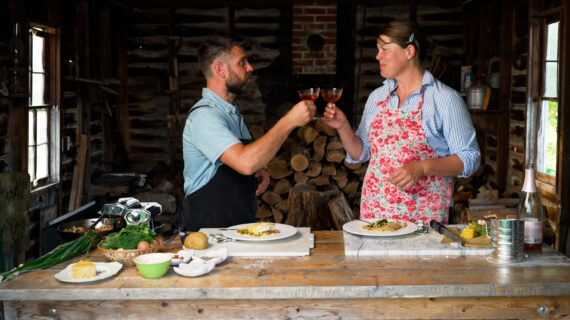
Serve the soup piping hot and garnish with sliced scallions. Make sure to have plenty of cold water on hand to cool the guys down. For dessert, serve buttery blueberry muffins. Well, I hope this has inspired you to get outside and make your neighbors some lunch. And I hope you'll gather with us next time Around the Farm Table. I'm your host, Inga Witscher. Around the Farm Table is funded in part by Wisconsin Farmers Union, united to grow family agriculture, Heartland Credit Union, and Friends of Wisconsin Public Television.
Search Episodes
Related Stories from PBS Wisconsin's Blog






Donate to sign up. Activate and sign in to Passport. It's that easy to help PBS Wisconsin serve your community through media that educates, inspires, and entertains.
Make your membership gift today
Only for new users: Activate Passport using your code or email address
Already a member?
Look up my account
Need some help? Go to FAQ or visit PBS Passport Help
Need help accessing PBS Wisconsin anywhere?

Online Access | Platform & Device Access | Cable or Satellite Access | Over-The-Air Access
Visit Access Guide
Need help accessing PBS Wisconsin anywhere?
Visit Our
Live TV Access Guide
Online AccessPlatform & Device Access
Cable or Satellite Access
Over-The-Air Access
Visit Access Guide




Follow Us