

 Passport





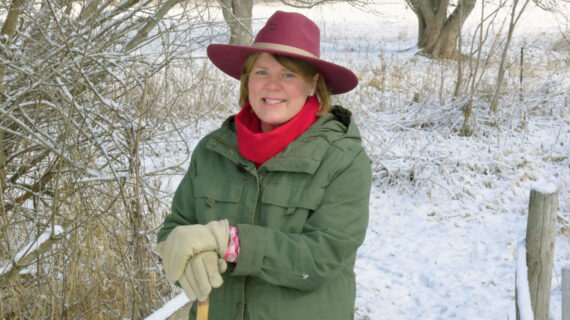
Oneida Agriculture
11/19/19 | 26m 47s | Rating: NR
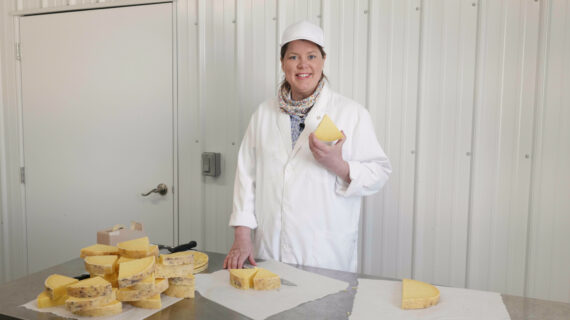
Inga visits the Oneida Nation of Wisconsin to tour various agricultural projects. She visits Tsyunhehkwa organic farm to learn about a proprietary strain of white corn, hemp, and grass-fed cattle. She then learns how the Oneida Nation brought a herd of bison to Wisconsin before visiting the Oneida Nation Orchard. Chef Arlie Doxtator visits to show her the traditional way of making white corn soup.


Copy and Paste the Following Code to Embed this Video:
Oneida Agriculture
Announcer
The following program is a PBS Wisconsin original production.
midtempo folksy music
Announcer
Welcome to Tsyunhehkwa, the organic farm of the Oneida Nation. I'm here today to spend some time with tribal members and discover all sorts of things that they have going on here. I'll be stopping by to see about some bison, grass-fed beef.
cow mooing
Announcer
We're gonna be visiting an apple orchard, learning about white corn, and then finally, we're gonna cook up a delicious lunch. Gather with us Around the Farm Table. I'm your host, Inga Witscher.
upbeat folksy music
Announcer
Good morning, girls! I'm Inga, and I love everything about farming.
upbeat folksy music
Announcer
Midwestern farms are a bounty of good food made by good people. I love being able to travel to search out good ingredients. Cooking is all about what's seasonal, what's fresh. Every day can be filled with good food, good friends, and a beautiful herd of cows.
Welcome to the farm.
Inga to cow
Good girl.
Announcer
Around the Farm Table is funded in part by
Wisconsin Farmers Union
United to Grow Family Agriculture, Heartland Credit Union, A gift in memory of Wendy Bladorn, Focus Fund for Wisconsin Programming, and Friends of Wisconsin Public Television.
gentle folksy music
Wisconsin Farmers Union
Three sisters is a method of growing plants in your garden, so what the three sisters are, it's corn, beans, and squash or pumpkins, and the reason that they grow together is 'cause they go together. It's another companion plant. So what happens is, you're gonna be planting all of these varieties together, so the corn stalks will grow up, and that will be your trellis for your beans to grow up. The beans are gonna fix nitrogen into that soil, and that's gonna be beneficial to all the other plants.
When the squash is growing around the corn and the beans, the leaves act like a canopy, so they're essentially mulching out any of the weeds. This is a technique that's been used for generations and generations, and it's one that my folks taught me as well. It's a great way to utilize space, and it's just kind of a fun way to garden.
upbeat folksy music
Wisconsin Farmers Union
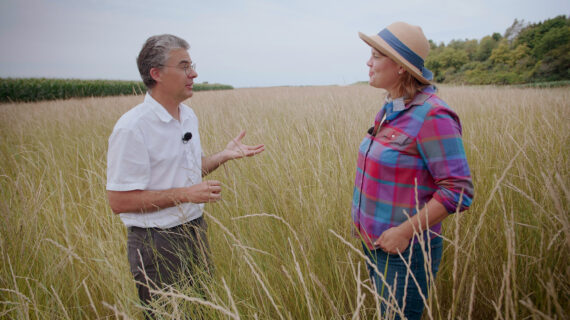
Hey, Kyle. Hey, Sheko'li Swakwe.ku'. Nice to see you. So, welcome.
Sheko'li is hello and Swakwe.ku' is greetings in Oneida. My name is Tekali'wakk in Oneida, it means Two Matters Connected. Oh! Y'all can call me Kyle Wisneski, I'm the supervisor here at Tsyunhehkwa.
Well, thank you for having me, I'm really excited to spend the day with you and just see what's going on here. Can you tell me a little bit about the Oneida Nation and why it's important that you're doing agriculture here? The importance of Tsyunhehkwa to the Oneida people is the reintroduction of our indigenously, organically grown foods. So we wanna produce safe foods for our people, and then being able to also can those foods and have those healthy foods year-round.
It's very important to us. Are you growing anything that's very unique for your culture? The main staple at Tsyunhehkwa is our O.na'ste corn. This white corn that we're standing by right here is only grown in a couple places in the world.
Really? So it's very indigenous to the Oneida people. It's something that is very unique to us and there's no other non-indigenous farmer that is able to grow this corn. So that is the reason why Tsyunhehkwa is here, is to reintroduce that white corn to the community.
And we invite anybody and everybody in the community to our site. Well, I would love to kind of take a look around. It's a beautiful fall day, I'd love to just kind of look at all the different things you've got going on. Yeah, absolutely, let's take a walk.
We're gonna be heading to the corn drying facility. We also say, where the corn sleeps for the winter. We also believe that all plant life, especially the corn, has a spirit. So traditionally, these corns and all these foods would come into your lodge, traditionally.
Okay. This is one of the most sacred places that we have on the farm, and this is where we say the corn sleeps for the winter. That is beautiful; I love it. This is the drying room, and I want to talk to you about the braiding process.
Yeah. So after we pick the corn out of the field, we husk it down to our three strongest husks, and we create this braid. There's 65 cobs on the braid, and they'll sit in here to dry for approximately a month and a half. Wow, this seems labor-intensive.
Very labor-intensive; it takes about 25 minutes to 30 minutes to do a braid. If you're a beginner, we're talking about 45 minutes to complete one braid. It would take me a lot longer than that. The reason we braid the corn this way is because of the high moisture content.
So it comes off the field at about 40 to 45% moisture, and we really have a concern about mold within the first 24 hours. Sure; and so a typical field corn, that's gonna come off a lot less moisture. A lot less, around 20%, so they don't have to worry about it at all. So this is important, to hang 'em all up, get 'em nice and dry, and then this is really the staple for a lot of the foods that, traditionally, was in your diet.
Is that correct? Yeah, so this is the main staple in our diet, along with our three sisters. So the corn, beans, and squash. And this corn is different because of the protein content, right?
Right, right. So we have in between 18 to 24% protein in the corn, along with many antioxidants and nutrients as well for your benefit. So what is, like field corn? Field corn is anywhere from 2 to 4%.
So this is a huge source of protein. Talking four to six times the amount of protein. So this is a great foundation for your diet? Absolutely, yep.
Well, this is really fantastic. Well, can I help you hang up some braids? Yeah, absolutely, let's try.
upbeat folksy music
Wisconsin Farmers Union
Welcome to our processing unit. I want you to meet Reuben, he's gonna talk about shelling, cleaning the corn, and processing. Okay, so I wanna see how they did it traditionally. Okay, we would twist it off of the husk, and we would just sit there with our hands like this, bare hands.
Generally, we would sit in a circle and do something like this. Many hands make light work. Oh yes, certainly. And now, with modern technology caught up with us, and as every aspect of society nowadays, and of processing.
We've got this machine. What I'm doing here first is getting off like some of the kernels that might be decayed or-- Marred. - Cracked. And then we have this machine here now.
A little noisy, but it works very good.
machine rumbling
gentle folksy music
Wisconsin Farmers Union
So now we're into the hemp that you're gonna use for fiber. Correct. - Interesting. So, the fiber can be used in a lot of different products.
Kyle
Yes, we're also growing fiber to create some process for ropes and different things like that. You know, this has been really interesting to be able to spend the morning with you, seeing all these different projects you're working on. And I just have to ask you, when you're growing these things that are native to your culture, how does that make you feel? That you get to connect with your ancestors?
Absolutely, it's getting your hands dirty into the ground, makes the connection, I believe. You know, and having that connection with that ground outcrops into the community, you know? Showing that my excitement really gets the community excited, and just having that opportunity to bring those traditional foods back to the people is an honor. And doing it in the same way that your ancestors did.
Doing it the same way, as well as thinking of other innovative ways as well. I think it's important to stay true to your culture, but the demand is so big in our community that we have to figure out ways to get that product out to them. Right, well thank you for spending the morning with me, I know that you've got things to do, and I'm looking forward to having lunch with you later on. But now it's time for us to head over and find out about Lynn is raising grass-fed beef.
upbeat folksy music
Kyle
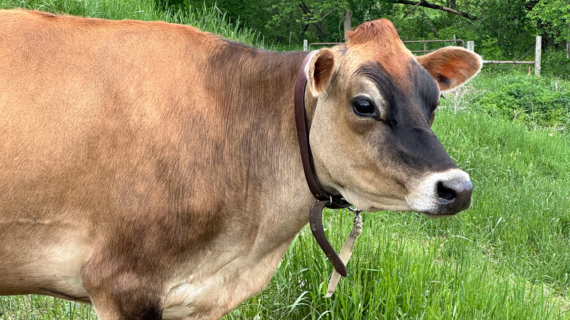
Can you tell me a little bit about what your role is with the Oneida tribe and the agriculture here? So I'm an agricultural worker with Tsyunhehkwa, which is the organic farm here at the Oneida Nation, and my main role is that I'm in charge of the cattle herd. And this is a registered Shorthorn herd, and it's the only registered Shorthorn herd of any tribal nation in the U.S. Interesting.
Why did you pick this breed? What are your reasons? We're 100% grass-fed, which means that we don't feed them corn or anything like that, so-- Even in the winter? Even in the winter.
So one of the big issues that we have is that we need something that's actually gonna finish and grow on grass alone. This is an old, old heritage breed, so because of that, they actually do very well on the grass by itself. They also are phenomenal mothers. We don't have to worry about 'em 24 hours a day.
They're designed to actually birth on their own, take care of their calf on their own, and really, that's one of the main reasons that we chose these animals, we don't have to be here babysitting them continuously. Like a lot of dairy cows. - Right. Like, dairy farms in different beef regions, it's the same thing.
With this breed, we don't have to worry about that. This is a completely natural environment for them. The Oneida Nation believes in following the natural cycles of life, and what we've decided with this herd is that that's how we're going to manage them. We're gonna try to replicate nature as close as we can.
With the rotational grazing, it's replicating the buffalo herds.
Inga
Right.
Lynn
So on a limited space. So each and every day we move our cattle herd, they go to a fresh chunk of pasture. We just moved 'em here today, this is new pasture. And those cows won't come back to this piece of ground for a minimum of 30 days.
We prefer to have 45 days or more, and that allows the grass to recover fully and also, it provides soil health.
upbeat folksy music
Inga
What do you enjoy most about working with cattle? Just being out with these animals, they make you feel good, you know? These are just a wonderful creature, they are so beautiful. And when you're outside, on pasture especially, it's one of the best things that you could ever do, and it makes a wonderful day for me, and I just love being out there.
Oh, I feel the same way. We're kindred spirits.
both laughing
Inga
And old farmers all were like that, and that's where we need to go. We need to get back to where all the farmers can go out and enjoy their day, and enjoy what they're doing. Well, I hope that you'll enjoy lunch with us in a little while, I'll let you get back to the farm. And then, why don't we head on out and learn about the bison?
midtempo folksy music
Inga
Well, this is a beautiful day to be out here.
TJ
Yeah, it's gorgeous. So tell me about where we're at. We are in Oneida, Wisconsin, on the Oneida Nation Indian Reservation, which the Oneida Nation Farm runs approximately 6,000 acres here, which includes our beautiful buffalo herd.
Inga
Do you call it bison or buffalo?
TJ
Buffalo.
Inga
Buffalo, okay. How many buffalo are you raising here?
TJ
Currently, we have about 200 head, approximately 60 cows, 20 bulls, and then the rest is our yearlings and two-year-old cattle.
Inga
Bison were endemic to this region of Wisconsin, correct?
TJ
Yeah, they were. And they probably don't mind the winter, they don't really mind a whole lot of it, do they? No, no, you can see we're out in the middle of nowhere, basically, out here, and they survive the winter, probably, season the best. I mean, you look at how thick their fur coat is, and when winter comes around, they love the cold weather.
They run out here and play in the snowbanks just like a little kid.
laughing
TJ
Well I'm glad they love it. Yeah, nice to know some like it. I'm loving the fall. Yeah, indeed.
Inga
How long have the buffalo been back on this tribal land? In 1996, Pat Cornelius, our previous farm manager, worked together with the ITBC, the InterTribal Bison Council, and they, together, brought 13 head of buffalo from Yellowstone National Park out here, and it was this small 40-acre pasture at the time. Now we have over 200 acres that we graze, and there was 1,300 head of buffalo introduced. And why did they wanna bring buffalo back?
Not only to protect the sovereignty of the Oneida people, but the buffalo. They tie them together in very closely. Pat said when those 13 buffalo got off the trailer here at Oneida on the reservation, it shook the ground.
rhythmic music
Inga
Well, it's neat seeing bison. I've seen a few herds around the state of Wisconsin, and they seem to do well here in Wisconsin, right? Yeah, they strive. I mean, if you go out in the Dakotas or Wyoming, where they're more so found, there's no protection, there's no barn, there's no shelter.
They strive in the winter months. Not only in the winter, but then spring, summer, fall with grazing, too. Well, your pastures are looking really great here. I love grazing, that's the whole reason I farm is I love grazing, and I think it's nice to have these animals come in here, and they're harvesting their feed, spreading their manure.
But bison, I think, are used a lot now as managing those native prairies in different parts of the United States. You bet. And that's just one of the benefits for having them. Correct?
- Yeah, correct. For us, I mean, Oneida took back a lot of this land. They had the reservation; they lost a lot of land. Now, as they became more financially wealthy and stable, they were able to buy this land back, and one of the uses with it was to put Oneida Nation's buffalo herd on their own land, and it really does mean a lot to all of us.
It must be so rewarding for the tribe to know that they're raising their own meat, it's staying in the community, and they're feeding people really, really healthy foods. Exactly. With the buffalo here, that's what we strive for. It's grown here, it's raised here.
It's not bought off the reservation, it's born on the reservation. From farm to food to table is 100% here, and we take great pride in that. You grew up on a beef farm, so you're used to eating a lot of beef. How does that compare to eating bison?
Bison is a much leaner meat, but it is a juicy meat, it still has enough fat in it for the marbling, and likewise, you fry it up on the grill, it is probably second to none, it is very good. Yeah, I've been eating a lot more in the last few years and I really enjoy it. Yup, the bison graze in the grass, they're a much leaner meat, like I said, and short term and long term, they're healthier, just less fat in them. How are you managing your pastures here?
Are you doing a mob grazing, or? We inter-rotationally graze, so basically we run about 8 paddocks, 20 to 40-acre size paddocks, and then we rotationally graze those paddocks to allow proper regrowth of our grass, and then yet still mow it down so it's short enough to kind of eliminate any weeds or any unwanted trees and weeds. That's what I love about farming, especially grazing, is that you're coexisting with all these different species that are out there, with all the different bugs, the bees, all these pollinators, and having those grasslands is a great area for those nesting birds, and those different species to come and have that little haven. So I love everyone that pastures, you know?
Oh yeah, it's nature at its finest. You're still managing the land, but you're allowing the animals to do it. There hasn't probably been a tractor out here in 15 years. The animals are managing the land, they're getting the feed, they're harvesting the feed, and they manage the land.
We just have to manage the animals. One thing people ask me, "Why should we eat local? "And why should we be supporting these farms?" And I say, "Because these farms are thinking so much about "our land, our water, how the environment is doing around us." As farmers, we think a lot more about what they're eating than they ever will, right? Oh yeah, that's one of Oneida's biggest philosophies, is to take care of the next seven generations ahead of us.
So that's not just me and you, that's the next seven generations, so that's a very long time, and that's what we take pride in, it's preserving the Oneida reservation, our farm fields, our pastures, for the future. Well, this has been really great and I'm gonna get on down the road, but thank you so much for taking time with me. Yeah, you bet, thank you. All right, it's time for us to go pick some apples.
gentle acoustic music
Inga
What a beautiful day to be out here walking through the apple orchard, thanks for having me.
Jeff
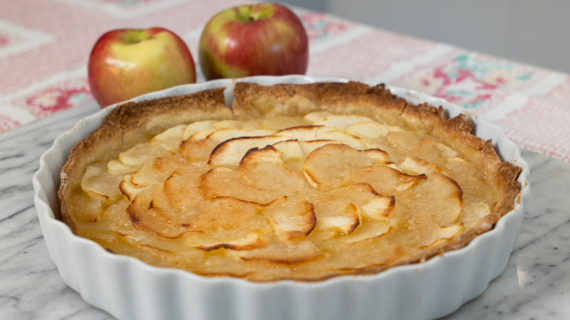
Yes, thank you for coming to the Oneida apple orchard. We have 31 acres here. 34 different varieties, including pears. Well that's a lot to manage.
You mind showing me around? Sure, let's take a walk.
gentle acoustic music
Jeff
So how did you fall in love with becoming an orchardist? Years ago, I was born and raised down in Cedarburg, and basically right across the street, there was an orchard. So at about 14 years old, I started working for them, picking apples, and pumpkins, and squash, and I liked it that much that I stayed in it. Good!
Why was it important to the tribe to have an orchard here? Well, the orchard already existed before the tribe bought it. It was planted in '86, '87, and the tribe bought it in '94. It goes back in our history, coming from New York to here, that we brought apple trees along, so it meant tradition to us to have it.
So what brought you from the southern part of the state up to here, where we're at, near Green Bay? Originally, that orchard kind of got shut down as Cedarburg expanded, so then I went to the southwest part of the state, that's basically apple country here, in Wisconsin. Right, down in the Driftless, yep. Yeah, around Gays Mills and down that strip there.
And then, when the tribe bought this, they knew that I was in the orchard business, and being a tribal member, they asked me to come up here and run this orchard.
upbeat folksy music
Jeff
Are these apples, are they going back to tribal members? Or are you selling to everyone? What's happening with the end product? This is a community orchard, yes.
But we do sell to our schools and our senior center, the community can come in and pick the apples. 'Cause everybody has a different taste in apples. Some people like 'em green, some people like 'em real sour. Not me.
both laughing
Jeff
But we have just about every different variety, different tastes that people can want. So Jeff, it sounds like you've been working with apples most of your life. What is it that keeps drawing you back to this occupation? The difference.
Every year there's a different thing, whether it's weather, whether it's insects, it's always different, it's always making you think. But the other thing is, also all the different varieties that are coming out, like Fujis and planted Galas. By having all those different varieties, does that take your season a little bit longer? Yes, for the most part we can start picking already in the middle of August.
This year, we're a week to two weeks late because of the cool spring, but then it usually lasts until the first part of November. And then you take the rest of the year off. -
laughing
Jeff
I wish, I wish! Take a long vacation.
both laughing
Jeff
What's that process after you all have picked the apples? They have to go through that whole cleaning process, and sizing and things? Is that right? Yes, yes, we put them through our apple grader, which washes them off, polishes them, and then sizes them up.
From the tree, they usually go right into our cooler and we can keep apples here, usually until Christmas time. Then we start pruning. And that's never ending. Yeah, yes.
Well, do you have any favorite varieties that I can taste-test today? Yes, one that we have available right now is the Zestars, and maybe we can run a few Honeycrisp.
upbeat folksy music
Jeff
So these are the, what's the variety? These are the Zestars. We just started planting them, probably about seven years ago, and they're becoming one of our most favorite apple that we have. They're delicious.
Yes. Well, before I eat too many of these apples, I think we need to get back and start cooking.
upbeat folksy music
Jeff
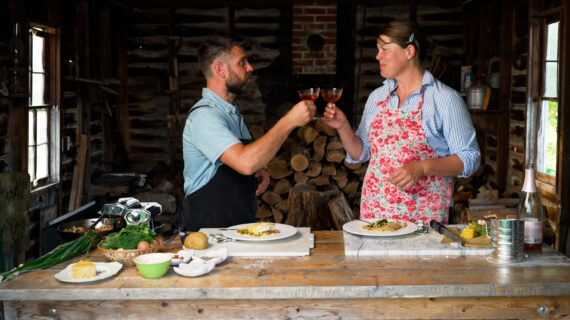
Arlie, thank you so much for cooking lunch for us today. Thank you for asking me. I'm excited to try this white corn soup because this is something that's-- It's part of our history, it's part of our culture is what it is. Okay, 'cause this white corn, this is the Oneida white corn?
Yes, this is the Oneida white corn, yes. This is part of us. This has been with us for thousands of years. Oh, I'm so excited.
The recipe, from what I know, has stayed the same, and that's the process of taking the corn, boiling it, adding wood ash to take the hulls off, adding beans and sometimes a protein.
Inga
So that's what you were doing outside on the fire.
Arlie
That's what we were doing on the fire, in the rain. I'm glad that you were out there instead of me. It got a little wet, but we're good. And you did this all in this beautiful pot.
In the clay pot. This is pre-contact, before we had the metal pots. For me, it's important to reconnect, have that reconnection to our foods. Brings a whole new flavor to the traditional corn soup that we would make on the stove in a pot.
I love what you're saying, because you're not only reconnecting with your ancestors through the ingredients, but also through the cooking process. These are all parts of what we are, and who we are, and they each serve a purpose, and they each have a responsibility and a duty. Even the shape of how the pot was cooked, if you remember over the fire, I was able to grab this even though it was on the fire. That's all part of using the clay pot, which I use.
Again now, there's a different flavor that comes in in this whole process as well. I've learned that, while cooking it in the metal pot, you can get some really good flavor, some real good corn soup, there's just an added flavor that happens with the clay pot. For sure. I suppose it's like cast iron or something, you know, how my grandmother passed on her cast iron pan for generations, and they said we should never clean it.
Yes. I'm not sure about that.
laughing
Arlie
To an extent, to an extent. The clay pots are the same way. This isn't something you're gonna put in a dish machine. Yeah.
You know, a good wiping out. But that's how we've had them. Imagine, if you will, being in the longhouse, and under that smoke hole where the fires were, were large pots of these, clay pots, maybe two or three of them, and grandma or aunties were always cooking in them. They stayed there, usually until the whole community was ready to move.
Okay. And at that time, then they would take them and move them. But these things were probably sitting in the fire for, one maybe it had corn soup in it, one may have had a fish soup in it, one may have had just vegetables or beans cooking in it. But at some point, in that longhouse, we had the clay pots just sitting there.
And now you've got the turkey, and that's been cooking in with all the other ingredients. Yes it has. So from the process that we had, after the corn was cooked, after it was hulled with the wood ash, after it was rinsed, then we add the beans. Cranberry beans is what I prefer, usually out of my garden.
Otherwise, from the store, you can get the kidney beans or small red beans. The meat that I've used is a smoked turkey meat. Smoked meat is one of our traditional ways of preserving, smoking and drying. That goes in, and I prefer the legs, sometimes I'll be able to get the thigh meat, just for the bone and for the flavor.
Inga
For the flavor. And once it's heated up and it's cooked further, you'll see that I was able to take it off the bone. We'll chop it and then we'll put it in, get it back on the fire, bring it back up to temperature, and by then we should just about be ready to go. What does it mean for you to be able to have the same ingredients as your ancestors, and also pass that down to the next generation?
It means everything. When we talk about some of our history, our current history, we kind of got away from this. We were using the pork. Pork was introduced to us from the Europeans, so we would use smoked pork hocks, they would use hams, they would use any kind of fresh pork for this soup.
As I was learning, and I was doing my research, and I found out the different meats that went in there, and the different proteins that we use, turkey seemed to be the example for, like a everyday soup. Different proteins were added for different reasons, but the turkey, and maybe a fish, I've even see recipes with a fish in it. Those were the meats that were used in our diet. Well, Arlie, the guys are coming in from outside and I know, I've been watching them work all day, luckily, I've just had to watch them, so I can imagine how hungry they are.
Should we go serve them lunch? We can serve them lunch. Great.
The Oneida Longhouse Singers performing moccasin dance song
Inga
Well, I hope this has inspired you to search out ingredients in your area, and I hope you'll gather with us next time
In unison
Around the Farm Table! I'm your host, Inga Witscher. Thank you, guys, so much.
upbeat folksy music
Announcer
Around the Farm Table is funded in part by
Wisconsin Farmers Union
United to Grow Family Agriculture, Heartland Credit Union, Focus Fund for Wisconsin Programming, and Friends of Wisconsin Public Television.
Search Episodes
Related Stories from PBS Wisconsin's Blog



Donate to sign up. Activate and sign in to Passport. It's that easy to help PBS Wisconsin serve your community through media that educates, inspires, and entertains.
Make your membership gift today
Only for new users: Activate Passport using your code or email address
Already a member?
Look up my account
Need some help? Go to FAQ or visit PBS Passport Help
Need help accessing PBS Wisconsin anywhere?

Online Access | Platform & Device Access | Cable or Satellite Access | Over-The-Air Access
Visit Access Guide
Need help accessing PBS Wisconsin anywhere?
Visit Our
Live TV Access Guide
Online AccessPlatform & Device Access
Cable or Satellite Access
Over-The-Air Access
Visit Access Guide




Follow Us